AI for Real Estate · Part 6
AI Pricing, Valuation, and Market Intelligence for Real Estate: When to Trust the Algorithm and When to Trust Your Expertise
Continue the AI for Real Estate series with Part 6 of 7.
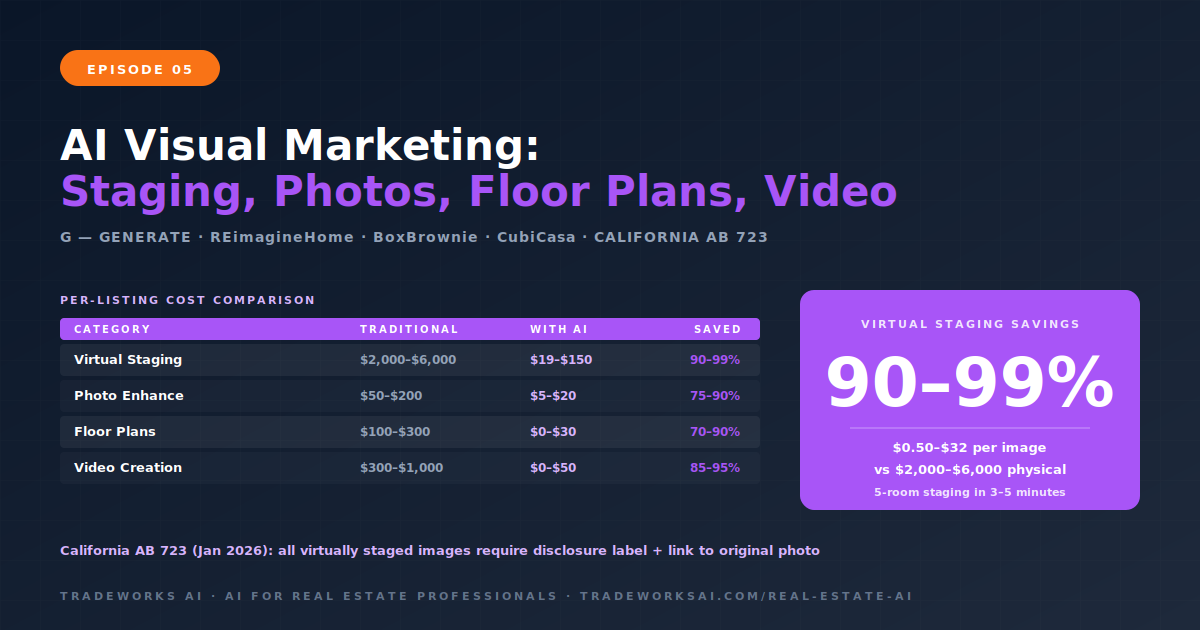
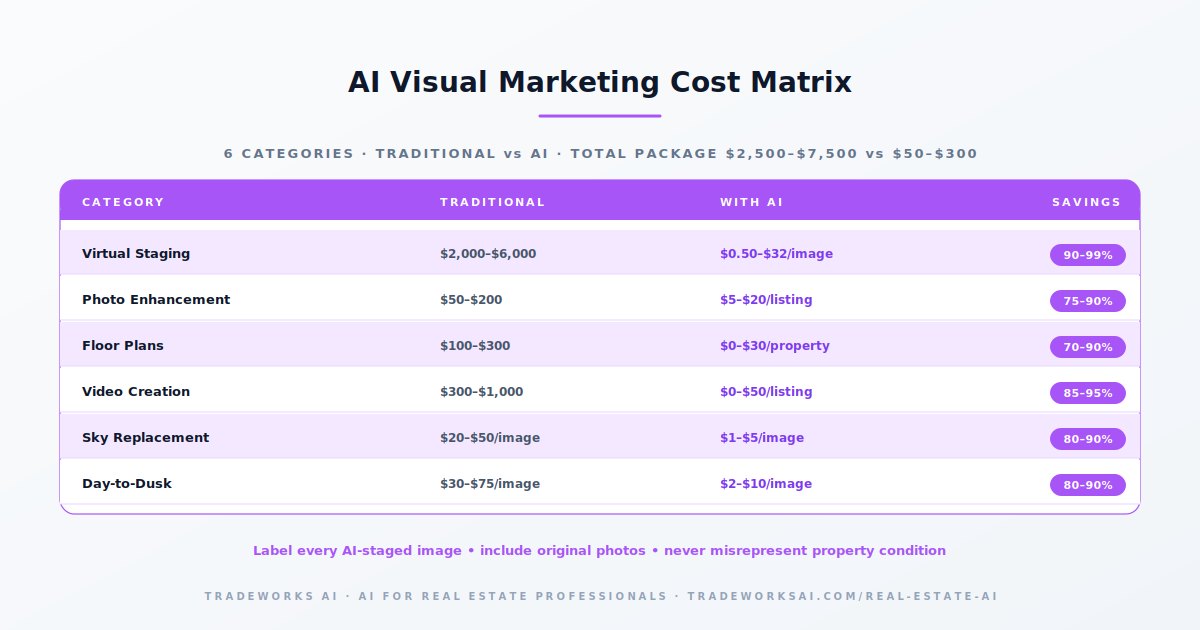
Traditional home staging costs $2,000 to $6,000 per property for initial setup and runs $500 to $1,500 per month for ongoing furniture rental. AI virtual staging costs $0.50 to $32 per image depending on the platform and delivers results in seconds to minutes rather than days. For a five-room staging at $19 to $30 per image, the total is $95 to $150 per listing versus thousands for physical furniture. The cost difference is 90 to 99 percent. AI photo enhancement auto-tags listing images, replaces overcast skies with blue, enhances lighting, and generates property descriptions from visual analysis. AI floor plan generation turns a smartphone scan into a professional floor plan without a laser measuring tool. AI video creation transforms static listing photos into walkthrough videos with cinematic effects in minutes. Together, these tools form the visual marketing component of the GENERATE layer in the AGENT Framework — making professional-grade listing presentation accessible to every agent at every price point.
The data from Series A Episode 6 bears repeating: listings with professional photography sell 32% faster. Video generates 403% more inquiries. Drone photography accelerates sales by 68%. Yet only 9% of agents create listing videos, and many agents at the entry and mid-tier levels skip professional staging entirely because of cost. AI visual marketing eliminates the cost barrier. A new agent with zero staging budget can now present virtually staged photos that, on a phone screen, are indistinguishable from physical staging. The playing field has been leveled — not by lowering the quality ceiling, but by raising the accessibility floor.
| Platform | Approach | Cost Per Image | Turnaround | Best For |
|---|---|---|---|---|
| REimagineHome | AI-first, staging + declutter + renovation preview + landscaping | ~$0.50–$2.00/image (subscription from $19/mo) | 3–5 minutes | Most agents — best value + feature combination |
| BoxBrownie | Human designers + 3D rendering | $24–$32/image | 24–48 hours | Luxury listings requiring highest quality |
| Collov AI | AI-first, selective furniture removal, freemium | ~$0.50–$1.50/image | Seconds to minutes | Teams needing volume at lowest cost |
| Virtual Staging AI | AI-first, fast outputs, subscription | ~$1–$3/image (subscription ~$79/mo unlimited) | 15 seconds to minutes | High-volume listing agents |
| Trolto | AI staging + cinematic video flythrough | Higher per-image | Minutes | Social media-focused agents (IG/TikTok) |
| Apply Design | Manual control, drag-and-drop precision | $7–$15/image | 10+ minutes | Design-savvy agents wanting exact placement |
REimagineHome, founded by virtual staging pioneer Styldod, has emerged as the most recommended AI staging platform for real estate agents in 2026. Starting at $19 per month, it covers virtual staging across multiple room and decor styles, furniture removal and decluttering, renovation preview (show sellers what updated cabinets or countertops could look like before spending a dollar), and landscaping enhancement for exterior photos. Results return in 3 to 5 minutes and are consistently clean enough for MLS use.
The renovation preview feature is particularly valuable for listing appointments with dated homes. Instead of describing what a kitchen remodel could look like, you can show the seller a realistic AI rendering of their specific kitchen with updated finishes. This visual tool strengthens pricing conversations and helps sellers understand the value of pre-listing improvements.
At subscription pricing, the per-image cost drops to approximately $0.50 to $2.00, making it viable to stage every listing regardless of price point. For agents doing 5 or more listings per month, the unlimited potential at $19 to $49 per month represents extraordinary value.
BoxBrownie is not AI — it uses professional human designers who manually stage each photo using 3D rendering software. The results are consistently the highest quality in the market, with photorealistic output that withstands scrutiny on large screens, print materials, and luxury marketing collateral. At $24 to $32 per image with a 24 to 48 hour turnaround, BoxBrownie is more expensive and slower than AI alternatives. The quality premium is worth it for luxury listings where every visual detail matters and where marketing materials may appear in print magazines, billboards, and high-end digital presentations. For standard MLS listings viewed on phone screens, the quality difference between BoxBrownie and top AI platforms like REimagineHome is minimal to most buyers.
Restb.ai applies computer vision to real estate photography in ways that go beyond staging. The platform automatically tags listing photos by room type (living room, kitchen, bathroom, exterior), identifies property features visible in images, scores photo quality, and generates structured data from visual content. For MLS compliance and listing accuracy, Restb.ai ensures that photos are properly categorized and that the property description matches what the images show. The auto-tagging feature saves agents the tedious work of manually labeling 25 to 40 photos per listing. The quality scoring helps agents identify which photos need retaking or enhancement before they go live.
CubiCasa turns a smartphone video scan of a property into a professional 2D or 3D floor plan. The agent walks through the property recording video with their phone, uploads it to CubiCasa, and receives a dimensionally accurate floor plan within minutes. Traditional floor plans from a photographer or measurement service cost $100 to $300 per property and require scheduling. CubiCasa delivers comparable results from a tool the agent already carries in their pocket. For buyer-facing marketing, floor plans help remote buyers understand property layout before visiting in person — particularly valuable for out-of-area relocations and investor clients.
AI video tools transform static listing photos into dynamic video content. Trolto creates cinematic fly-through videos from AI-staged images with effects like flickering fireplaces and dynamic lighting. Amplifiles converts listing photos into professional video walkthroughs in minutes. CapCut’s AI editing features (covered in Series A Episode 7) add transitions, music, and text overlays to raw footage. For agents who know they should create listing videos but lack the time, equipment, or editing skills, AI video creation makes it possible to produce social-media-ready video content for every listing without a camera crew or video editor.
| Scenario | Recommendation | Reasoning |
|---|---|---|
| Vacant property under $500K | AI staging (REimagineHome or Collov) | Buyers focus on value and potential. AI quality is sufficient on phone screens. |
| Vacant luxury $800K+ | Physical staging or BoxBrownie | Luxury buyers scrutinize details. Higher quality justifies cost at this price point. |
| Occupied, well-furnished | Neither — photograph as-is | Existing furniture tells the lifestyle story. Staging over real furniture adds complexity. |
| Occupied, cluttered/dated | AI declutter + selective enhancement | REimagineHome or Collov can remove clutter and modernize specific elements. |
| New construction/pre-construction | AI staging + 3D rendering | Show potential buyers the finished product before construction completes. |
| Investment property | AI staging (lowest cost option) | Investor buyers care about ROI, not staging quality. Collov free tier or Virtual Staging AI. |
The biggest unresolved technical challenge in AI virtual staging is multi-angle consistency. When you stage a living room from two different angles, the AI may place different furniture, different rugs, and different decor in each image. Buyers viewing the listing see two versions of the same room that do not match. This is not a deal-breaker for most standard listings where buyers understand virtual staging, but it undermines credibility on luxury properties and in competitive markets.
The workaround: stage from your best single angle per room and include that one staged image alongside the original unstaged photo. If you need multi-angle staged images for a property, use BoxBrownie’s human design service where a designer ensures consistency across all angles. AI will solve this problem eventually, but in 2026, human QA is still superior for multi-angle coherence.
On phone screens at standard listing photo resolution, most buyers cannot distinguish AI-staged images from physical staging for standard vacant rooms in neutral lighting. The quality gap becomes apparent on large screens, in print, and for geometrically complex spaces. For MLS-standard listings, AI staging is sufficient for the majority of properties. For luxury listings going to print or billboard, physical staging or human-designed virtual staging (BoxBrownie) remains superior.
Yes, with disclosure. Most MLS systems require that virtually staged photos be clearly labeled and that original unaltered photos be included. California AB 723, effective January 2026, specifically requires a “virtually staged” label adjacent to each altered image plus a link to the original photo. Always check your specific MLS rules and include disclosure language in your listing remarks.
Collov AI offers a free tier that handles basic staging with decent quality. HomeDesigns AI also offers a free tier. For paid options, REimagineHome at $19 per month provides the best value with staging, decluttering, renovation preview, and landscaping enhancement included. At subscription pricing, per-image costs drop below $1.
Yes for vacant or lightly furnished properties. AI staging helps buyers visualize the space and increases engagement with listing photos. The cost at $1 to $5 per image makes it economically viable for every listing. Always include original unstaged photos alongside staged versions and disclose that digital staging has been applied.
REimagineHome supports exterior enhancements including landscaping visualization and sky replacement. For dedicated exterior work like day-to-dusk conversion, lawn enhancement, and weather correction, BoxBrownie and specialized tools like PadStyler offer stronger options. Exterior AI enhancement is particularly valuable for listings photographed on overcast days or with sparse landscaping.
82% of agents use AI. Only 17% report significant impact. The difference is not the tools — it is the strategy. The AI Readiness Assessment grades your business across 6 dimensions and maps the AGENT categories to the right stack for your stage.
Continue the AI for Real Estate series with Part 6 of 7.

Continue the AI for Real Estate series with Part 7 of 7.