AI for Real Estate · Part 5
AI Visual Marketing for Real Estate: Virtual Staging, Photo Enhancement, and Video Creation at a Fraction of the Cost
Continue the AI for Real Estate series with Part 5 of 7.
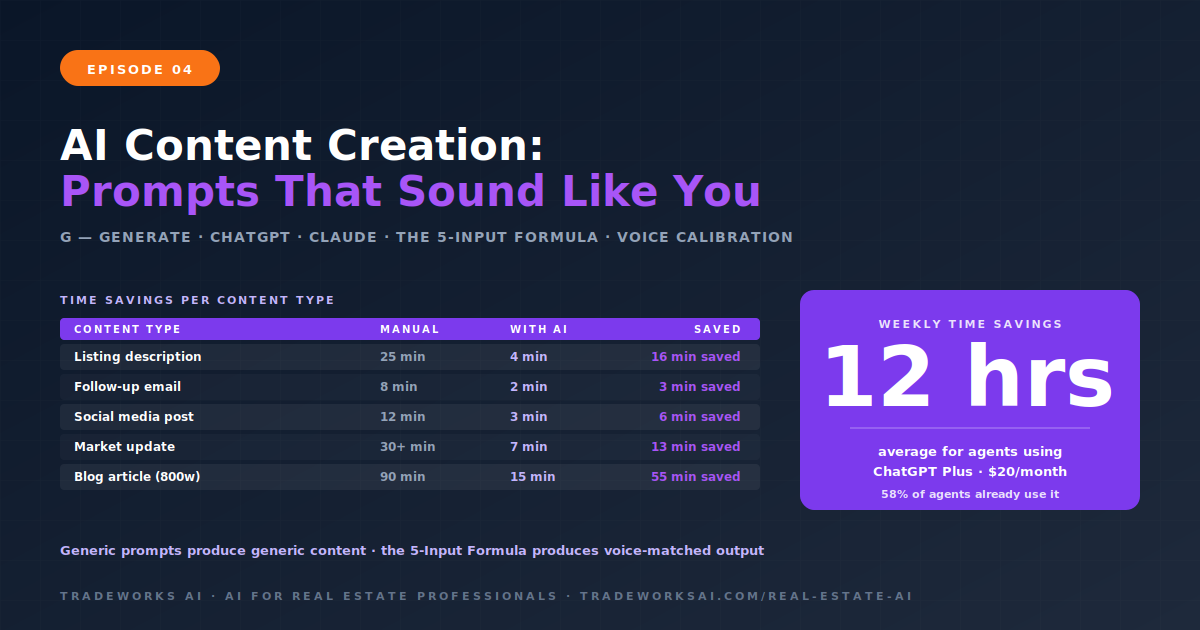
Forty-six percent of real estate agents use AI-generated content for listing descriptions and marketing. ChatGPT is used by 58% of agents, Claude by a growing share that values long-form precision, and Gemini by 20%. In rigorous testing, ChatGPT Plus saves agents an average of 12 hours per week on writing tasks: listing descriptions drop from 25 minutes to 4 minutes each, follow-up emails from 8 minutes to 2, and social media posts from 12 minutes to 3. At $20 per month for a paid tier, the ROI is measured in hundreds of dollars of time saved per week. Yet 46% of agents who use AI report no noticeable business impact. The gap is not the tool. It is the prompt. Agents who type “write a listing description” get generic, interchangeable output that sounds like every other AI-generated listing. Agents who provide property details, neighborhood context, buyer persona, tone direction, and a specific output format get content that sounds like them. This episode covers the GENERATE layer of the AGENT Framework — the AI tools and techniques that create content at scale without sacrificing your voice.
Real estate agents are expected to produce an extraordinary volume of written content: MLS listing descriptions for every property, social media posts across 3 to 5 platforms, email campaigns to multiple audience segments, blog articles for SEO, market updates for sphere of influence, text message sequences for leads, and neighborhood guides for community authority. The average listing alone requires an MLS description, 3 to 5 social media posts across platforms, an email announcement to the database, a property flyer, and potentially a blog post and video script. Without AI, this content production takes 4 to 8 hours per listing. With properly prompted AI, it takes 30 to 60 minutes.
The agents who are seeing no impact from AI are treating it like a vending machine: insert generic prompt, receive generic output, paste it unchanged. The agents seeing 12 or more hours of weekly savings are treating AI like a skilled junior copywriter who needs clear direction, specific context, and editorial oversight before anything goes live.
| Dimension | ChatGPT | Claude |
|---|---|---|
| Listing Descriptions | More creative, emotionally engaging | More structured, MLS-compliant, consistent formatting |
| Social Media | Trending tone, conversational, punchy | Measured, professional, detail-oriented |
| Email Campaigns | Warm, persuasive, varied | Precise, instruction-following, longer sequences |
| Market Reports | Good for summaries, quick analysis | Stronger for long-form, data-heavy reports (200K context) |
| Blog Articles | Creative angles, engaging hooks | Comprehensive structure, SEO-aware formatting |
| Custom Setup | Custom GPTs (store brand context) | Projects (store brand context + reference files) |
| Price | Free / $20 mo (Plus) | Free / $20 mo (Pro) |
| Best For | Creative marketing, conversational content | Professional documents, complex instructions, long-form |
The practical recommendation: use both. ChatGPT for listing descriptions, social media, and marketing copy where creative energy matters. Claude for market reports, CMA narratives, formal client communication, and any task where following complex, multi-step instructions is critical. Both offer free tiers powerful enough for daily use. Paid tiers at $20 per month each unlock longer conversations, faster responses, and advanced features. Most agents will find $20 per month for one tool provides exceptional ROI. Agents who create high volumes of content may benefit from having both at $40 per month total.
The most powerful AI content technique is teaching the AI your voice. Both ChatGPT and Claude offer features that store your context permanently. ChatGPT’s Custom GPTs and Claude’s Projects allow you to upload your brand guidelines, past successful listings, preferred tone descriptions, and a “no-no list” of words and phrases you never use. Once configured, every conversation within that custom setup automatically includes your background without restating it.
To train AI on your voice, provide 5 to 10 examples of your best writing — listing descriptions you are proud of, emails that got great responses, social posts that generated engagement. Tell the AI: “Study these examples. Match this tone, vocabulary level, and sentence structure in everything you write for me.” Then provide your no-no list: generic phrases like “seamless blend,” “boasting,” “nestled in,” or “a stone’s throw from.” The AI will avoid these patterns and produce content that sounds distinctly like you.
| Content Type | Time (Manual) | Time (AI + Review) | Savings | Prompt Tip |
|---|---|---|---|---|
| MLS Listing Description | 25 min | 4 min + 5 min review | 16 min | Use the 5-Input Formula with exact property data |
| Social Media Post | 12 min | 3 min + 3 min review | 6 min | Specify platform, character limit, and hook style |
| Follow-Up Email | 8 min | 2 min + 3 min review | 3 min | Include lead context from CRM for personalization |
| Market Update | 30+ min | 7 min + 10 min review | 13+ min | Supply your verified local data; AI structures the narrative |
| Blog Article (800 words) | 90 min | 15 min + 20 min review | 55 min | Provide keyword, target audience, and 3–5 key points to cover |
| Drip Campaign (5 emails) | 3+ hrs | 30 min + 30 min review | 2+ hrs | Define the sequence goal, audience, and CTA for each email |
| Video Script (60 sec) | 20 min | 5 min + 5 min review | 10 min | Specify hook, key message, CTA, and on-screen text callouts |
The most efficient AI content workflow is batching: generating an entire month of content in a single focused session. Set aside 2 hours. In the first 30 minutes, list all properties, market updates, and themes for the month. In the next 60 minutes, run each through your AI with the 5-Input Formula or custom setup, generating MLS descriptions, social posts, email copy, and blog outlines. In the final 30 minutes, review, edit, and schedule. The result: 30 days of content produced in 120 minutes. This mirrors the 4-Hour Content Batching System from Series A Episode 7, now accelerated by AI from 4 hours to 2.
One listing becomes seven pieces of content through AI repurposing. Start with the MLS description as your source material. Ask the AI to generate: a 200-word Facebook post with a different angle than the MLS description, an Instagram caption with a hook in the first 125 characters, a Twitter/X post under 280 characters, a LinkedIn post positioning the listing within market context, an email announcement for your database, a blog paragraph for a monthly market roundup, and a 60-second video script. Seven pieces of content from one property. Each takes 2 to 5 minutes with AI. Total time: 15 to 30 minutes. Without AI: 2 to 3 hours.
AI content must be reviewed for factual accuracy, tone, Fair Housing compliance, and brand voice before publication. One factual error about a property — wrong square footage, incorrect school zone, fabricated feature — damages credibility and can create legal liability. The AI is your first draft writer, not your publisher.
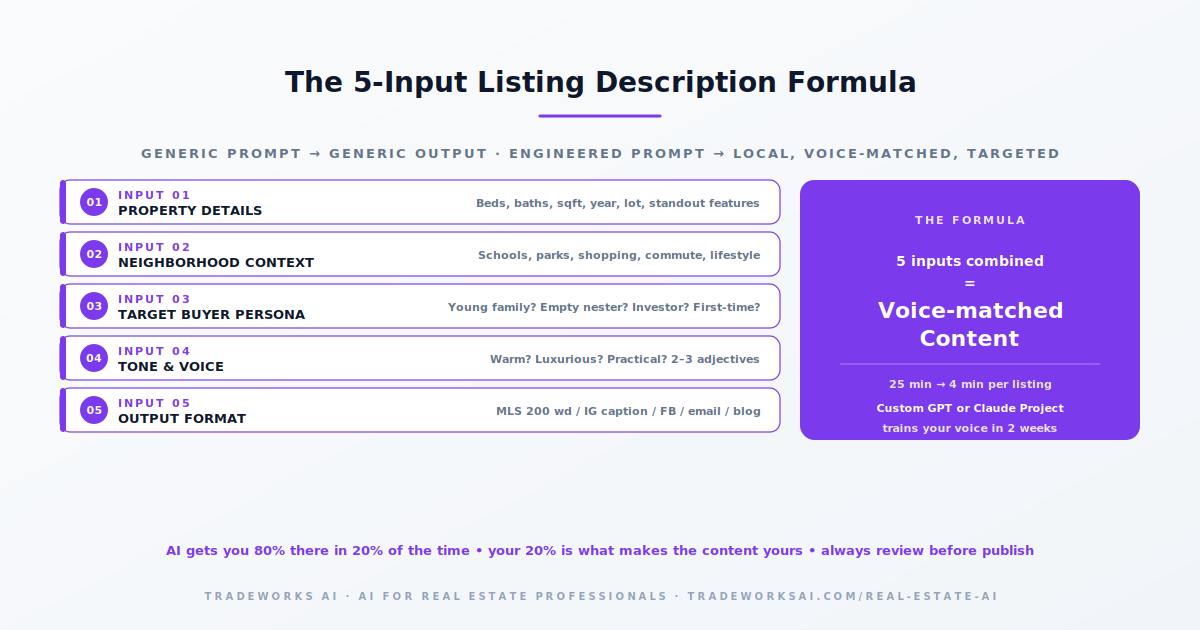
The prompt determines the output. “Write a listing description” produces generic content. The 5-Input Formula produces targeted, local, voice-matched content. The difference between agents who see AI impact and those who do not is almost entirely prompt quality.
Every agent’s AI content sounds the same because most agents use the same default prompts. The agents whose AI content is indistinguishable from their manually written content have invested 30 minutes in setting up a Custom GPT or Claude Project with their voice examples, brand guidelines, and no-no list. That 30-minute investment pays dividends on every piece of content for years.
Yes, with the requirement that the agent reviews and verifies all content before submission. The agent is responsible for accuracy regardless of how the content was created. AI-generated content is a first draft that must be fact-checked against actual property data before going live on any MLS system.
Current industry standards do not require disclosure that text content was AI-assisted. However, California requires labeling digitally altered listing photos starting January 2026, and NAR has flagged transparency as a key area for responsible AI use. The safest practice is to ensure all content is reviewed, verified, and approved by a licensed agent before publication.
Both are excellent. ChatGPT produces more creative, emotionally engaging listing descriptions and social content. Claude is stronger for long-form market reports, structured documents, and following complex multi-step instructions. Most agents should try both with the free tiers and use whichever fits their writing style. Power users benefit from having both at a combined $40 per month.
Three steps: provide specific inputs (the 5-Input Formula), train the AI on your voice (Custom GPT or Claude Project with your writing examples), and always edit the output with local knowledge and personal details the AI cannot know. The agents whose AI content sounds generic are giving the AI generic inputs.
Yes. Using the batch creation method and the 1-to-7 Repurposing System, agents can generate 30 days of social media content across multiple platforms in approximately 2 hours. The key is having your listing data, market themes, and content calendar prepared before the AI session, then running each piece through the 5-Input Formula and reviewing the output.
82% of agents use AI. Only 17% report significant impact. The difference is not the tools — it is the strategy. The AI Readiness Assessment grades your business across 6 dimensions and maps the AGENT categories to the right stack for your stage.
Continue the AI for Real Estate series with Part 5 of 7.
Continue the AI for Real Estate series with Part 6 of 7.