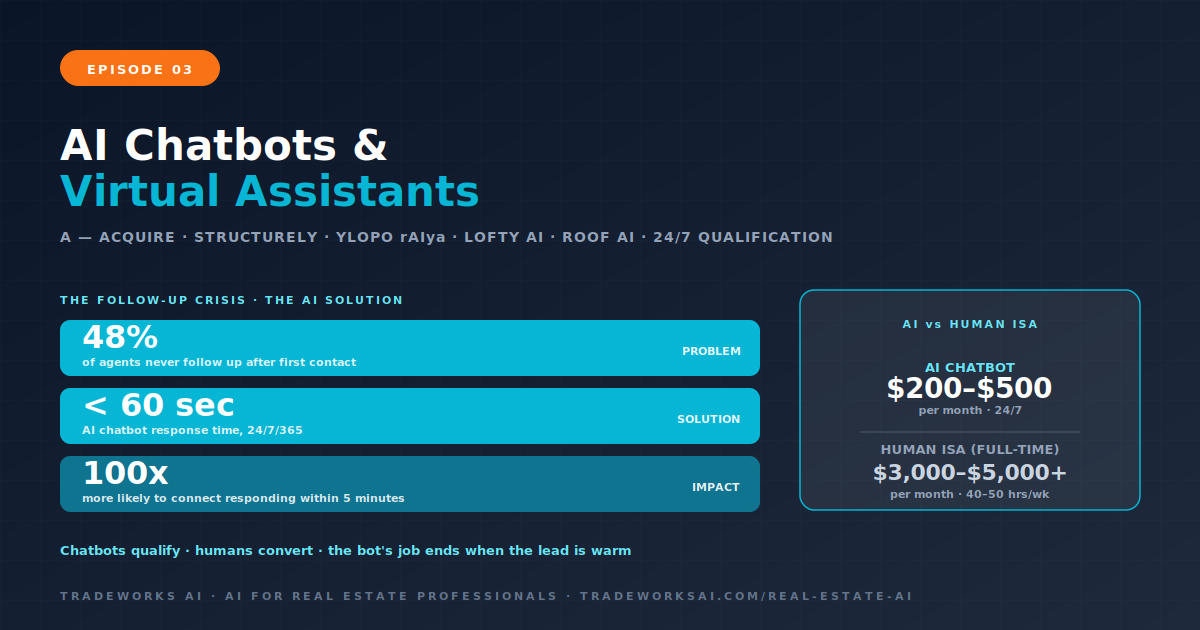
AI for Real Estate · Part 3
AI Chatbots and Virtual Assistants for Real Estate: The 24/7 Lead Qualification Layer
Continue the AI for Real Estate series with Part 3 of 7.
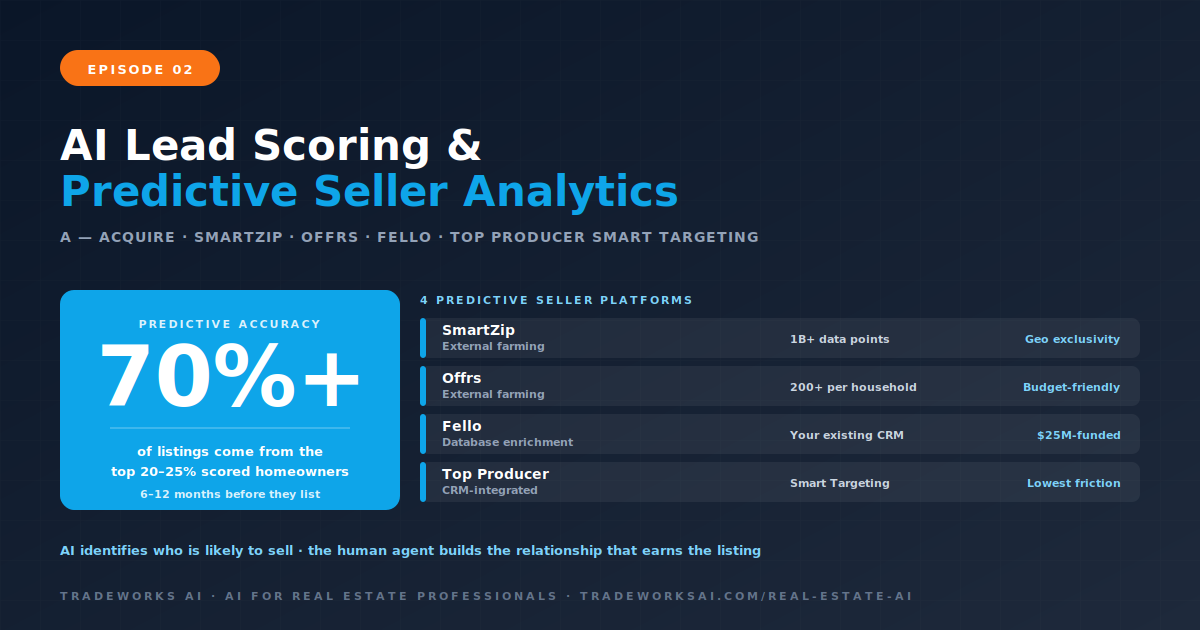
Predictive seller analytics use artificial intelligence to analyze hundreds of data points per household — mortgage age, equity position, life events, online behavior, property tax records, and neighborhood turnover patterns — and predict which homeowners are most likely to sell within the next 6 to 12 months. Leading platforms like SmartZip and Offrs claim over 70% accuracy in their predictions, meaning their algorithms can narrow a farm of 1,000 homeowners down to approximately 250 who contain the majority of upcoming listings. For listing-focused agents, this transforms geographic farming from a spray-and-pray mailer campaign into a data-driven targeting strategy that reaches the right homeowners at the right time. This episode covers the ACQUIRE layer of the AGENT Framework — the AI tools that find leads smarter, not just faster.
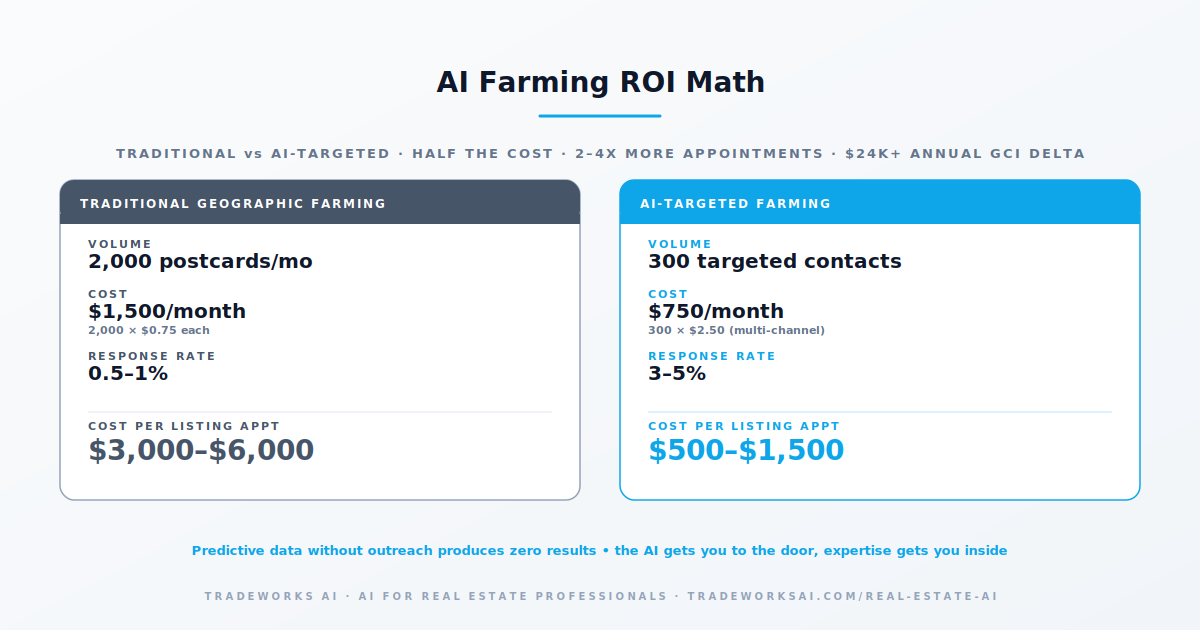
Traditional geographic farming treats every homeowner in a zip code equally. You send 2,000 postcards and hope that the 15 to 20 who are actually considering selling happen to remember your name. The cost is high and the targeting is zero.
Predictive analytics flip this model. The AI analyzes 200 to 1,000 or more data points per household across multiple categories. Property data includes mortgage origination date, current loan-to-value ratio, equity position, property tax assessment history, and time since last sale. Demographic data includes household composition changes, employment shifts, and credit activity. Behavioral data includes online search patterns, real estate website visits, home valuation inquiries, and social media signals. Market data includes neighborhood appreciation rates, comparable sales velocity, and inventory levels.
The algorithm weights these signals and generates a probability score for each homeowner. A household where the mortgage originated 7 years ago, equity exceeds 40%, the owners recently searched for homes in another city, and comparable homes in the neighborhood are selling above asking price scores significantly higher than a household that bought 18 months ago with 5% equity and no behavioral signals. The top 20 to 25% of scored homeowners contain approximately 70% of the listings that will occur in the next 12 months.
| Platform | Approach | Data Points | Best For | Pricing |
|---|---|---|---|---|
| SmartZip | External farming | 1B+ data points | Listing agents farming new territories | Custom (geographic exclusivity) |
| Offrs | External farming | 200+ per household | Budget-conscious listing agents | Custom (territorial) |
| Fello | Database enrichment | MLS + property + behavioral | Agents with large existing databases | $25M-funded, custom pricing |
| Top Producer Smart Targeting | CRM-integrated farming | MLS + demographic + AI scoring | Top Producer CRM users | Add-on to Top Producer subscription |
| Revaluate | Database scoring | Behavioral + social + property | Agents wanting database audits | Custom pricing |
SmartZip was one of the first platforms to bring predictive analytics to residential real estate. The platform analyzes over one billion data points gathered from behavioral, demographic, event, and property information to identify likely sellers 6 to 12 months before they list. Agents select their desired zip codes, and SmartZip populates a CRM with scored homeowners and their associated data. The platform includes automated marketing tools for direct mail, email campaigns, PPC advertising, home valuation landing pages, and a comparative market analysis tool.
The value proposition is clear: instead of mailing 2,000 postcards to an entire zip code, you focus your marketing budget on the 250 to 400 homeowners who are statistically most likely to sell. At a claimed accuracy rate above 70%, this dramatically improves the return on every marketing dollar. SmartZip operates on a geographic exclusivity model — only one agent per territory — which means your competition is not using the same data against you.
The honest assessment: SmartZip has undergone ownership changes, having been acquired by Constellation Software. Some agents have reported inconsistent delivery and support during transitions. The platform works best for agents willing to commit to a territory for 12 or more months and who have the discipline to work the leads through consistent multi-channel outreach. Predictive data without follow-up is an expensive subscription to a list you never call.
Offrs takes a similar approach to SmartZip — predictive analytics for geographic farming with territorial exclusivity — but has historically positioned as more accessible in pricing. The platform analyzes over 200 data points per homeowner using data from CoreLogic, ATTOM, Experian, and tax records to predict likely sellers. Offrs also integrates Facebook demographic targeting to supplement its predictive models, driving targeted ads to homeowners in the scored territory.
The leads feed into the Offrs CRM backend, and agents can export data to their preferred CRM or dialer via CSV. Like SmartZip, Offrs was also acquired by Constellation Software, and the platform has faced questions about accuracy and sustainability from some users. The claimed 70% or higher accuracy rate applies to the probability that the platform’s top-scored homeowners contain the majority of actual listings in that territory over 12 months.
For agents evaluating SmartZip versus Offrs, the decision often comes down to territory availability, pricing negotiation, and local market data quality. Both platforms serve the same fundamental function: narrowing a large farm into a targeted list of likely sellers.
Fello takes a fundamentally different approach than SmartZip and Offrs. Instead of farming external territories, Fello enriches your existing CRM database. You sync your contact list to Fello, and the platform fills in missing information — property addresses, ownership timelines, equity details, and behavioral data — then applies AI lead scoring to predict which of your existing contacts are most likely to sell.
This approach is powerful for agents with large databases of past clients, sphere contacts, and accumulated leads who have gone cold. Instead of paying for new external leads, you are mining the database you already own. Fello’s AI analyzes MLS history, property data, ownership duration, and engagement patterns to score each contact. High-scoring contacts receive automated, personalized outreach campaigns designed to reactivate the relationship and convert to a listing appointment.
Fello raised $25 million in venture funding and is operated by a Keller Williams mega team, which gives it credibility in the practitioner community. The platform is best suited for agents and teams with 500 or more contacts in their database who want to extract listings from their existing relationships rather than farming new territory.
Top Producer Smart Targeting brings predictive seller identification directly inside the Top Producer CRM. The AI identifies the top 20% of likely sellers in your farm area and provides automated marketing tools to reach them. Because it operates within the CRM you already use, there is no data export, no separate login, and no integration complexity.
For agents already on Top Producer, Smart Targeting is the lowest-friction path to predictive seller analytics. The scoring is integrated with the Follow-Up Coach, which means the CRM not only identifies likely sellers but tells you exactly who to contact each day and what to say. This combination of prediction plus daily action guidance is uniquely valuable for agents who need structure in their prospecting routine.
Beyond dedicated predictive platforms, most modern CRMs now include some form of AI lead scoring. Follow Up Boss tracks behavioral signals — website visits, email opens, listing views, search frequency — and ranks leads by engagement intensity. Lofty monitors multi-channel behavior and triggers alerts when a contact shows buying or selling signals. Top Producer combines MLS data with contact engagement to generate relationship health scores.
CRM-based lead scoring serves a different function than predictive seller platforms. Where SmartZip and Offrs analyze external data to find new potential sellers, CRM lead scoring analyzes the behavior of leads already in your database to prioritize follow-up. Both are valuable. The complete AI lead strategy uses external prediction to find new sellers AND internal scoring to prioritize existing contacts.
The predictive seller analytics space has experienced significant consolidation. First.io was acquired by RE/MAX and subsequently shut down. SmartZip and Offrs were both acquired by Constellation Software. Fello raised $25 million but operates as a venture-funded startup. Revaluate has survived as an independent player for 10 years.
For agents evaluating these platforms, the consolidation history matters. Before committing to a 12-month territory contract, ask about the company’s ownership stability, data portability if the platform changes, and cancellation terms. The worst outcome is paying for a territory, building a farming campaign, and having the platform pivot or shut down mid-contract.
Authenticity Check: AI identifies who is likely to sell. The human agent builds the relationship that earns the listing. Predictive data gives you a head start, but the homeowner still chooses the agent they trust. Never let AI-generated outreach feel automated to the recipient. Personalize the first touch. Reference something specific about their property or neighborhood. The data gets you to the door. Your expertise gets you inside.
Leading platforms claim over 70% accuracy, meaning their top-scored homeowners contain approximately 70% of the actual listings that will occur in a territory over 12 months. Accuracy varies by market, data quality, and the specific time horizon. No platform predicts with certainty — the value is in dramatically narrowing your target list from thousands of homeowners to hundreds of likely sellers.
Pricing is custom-quoted based on geographic territory and lead volume. SmartZip and Offrs typically require territorial commitments. Fello pricing varies by database size. Top Producer Smart Targeting is an add-on to the existing CRM subscription. Total investment including the platform plus marketing spend typically runs $500 to $1,500 per month for individual agents and more for teams covering multiple territories.
Yes. Fello is specifically designed as a CRM add-on that enriches your existing database. SmartZip and Offrs can export scored leads to your CRM via CSV or API. Top Producer Smart Targeting is built directly into the Top Producer CRM. The key is ensuring your scored leads flow into a system with automated follow-up — a scored list without a nurture sequence is an expensive contact list.
Minimum 6 months. The platforms predict sellers 6 to 12 months out, which means the homeowners identified today may not list for 3 to 9 months. Agents who evaluate predictive platforms after 60 to 90 days are measuring too early. Commit to at least 12 months of consistent multi-channel outreach before evaluating ROI.
Predictive seller analytics analyze external data to identify homeowners likely to sell in a geographic territory. Lead scoring analyzes the behavior of contacts already in your CRM to prioritize follow-up. Predictive analytics answer the question “who should I target?” Lead scoring answers the question “who should I call first?” The complete strategy uses both.
82% of agents use AI. Only 17% report significant impact. The difference is not the tools — it is the strategy. The AI Readiness Assessment grades your business across 6 dimensions and maps the AGENT categories to the right stack for your stage.
Continue the AI for Real Estate series with Part 3 of 7.
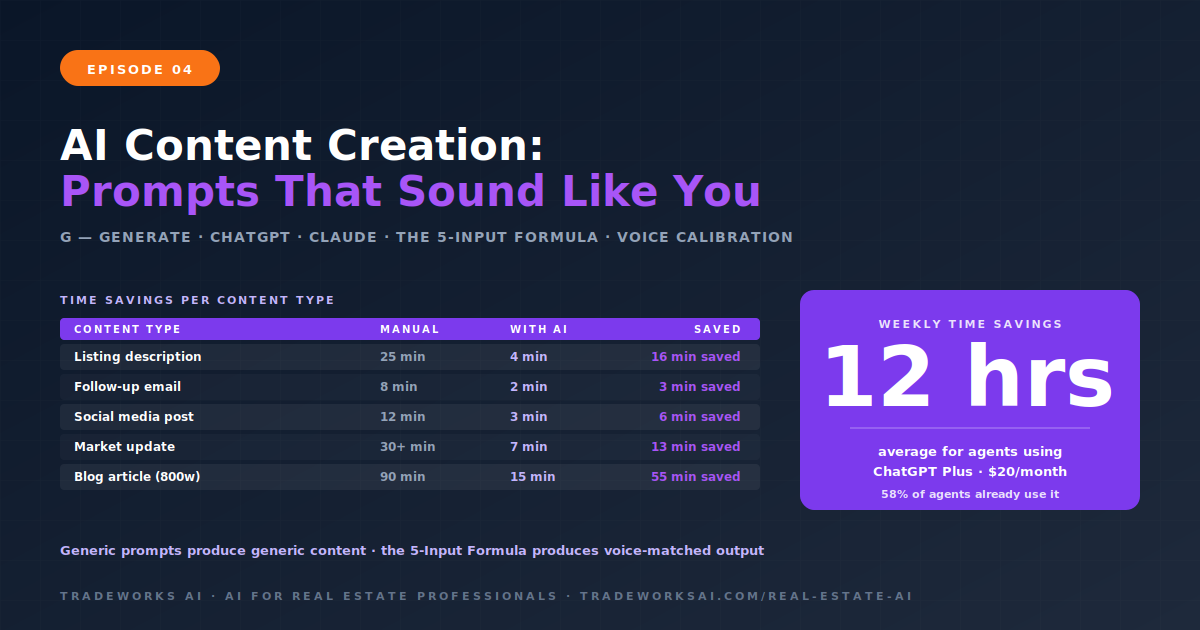
Continue the AI for Real Estate series with Part 4 of 7.