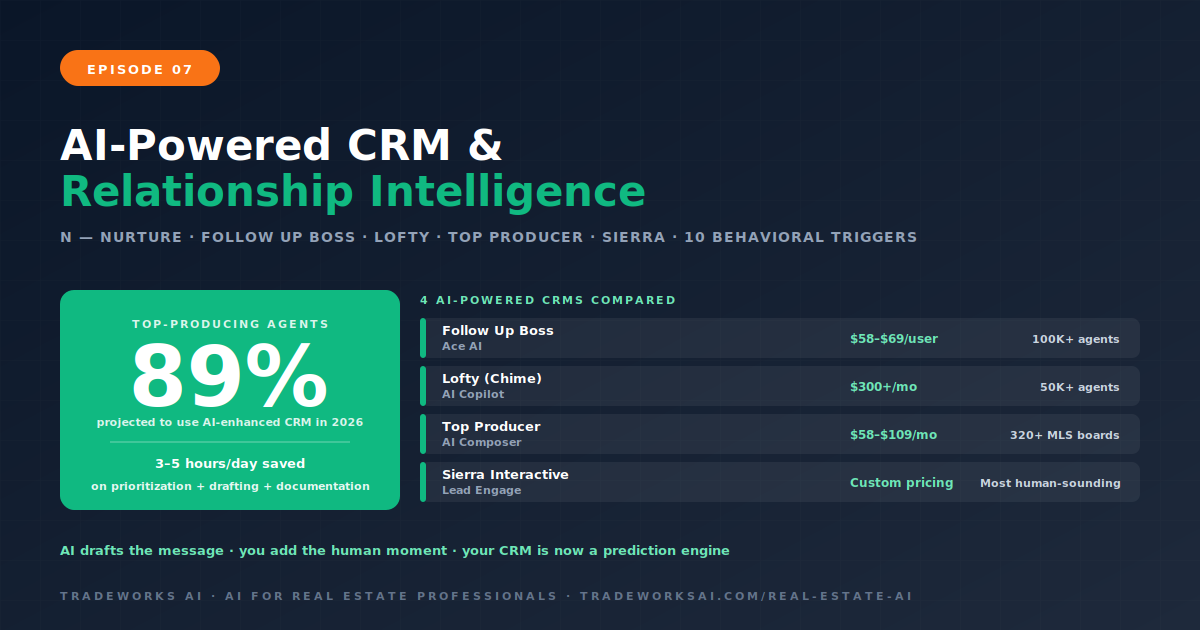
AI for Real Estate · Part 7
AI-Powered CRM and Relationship Intelligence for Real Estate: Your Database Is Now a Prediction Engine
Continue the AI for Real Estate series with Part 7 of 7.
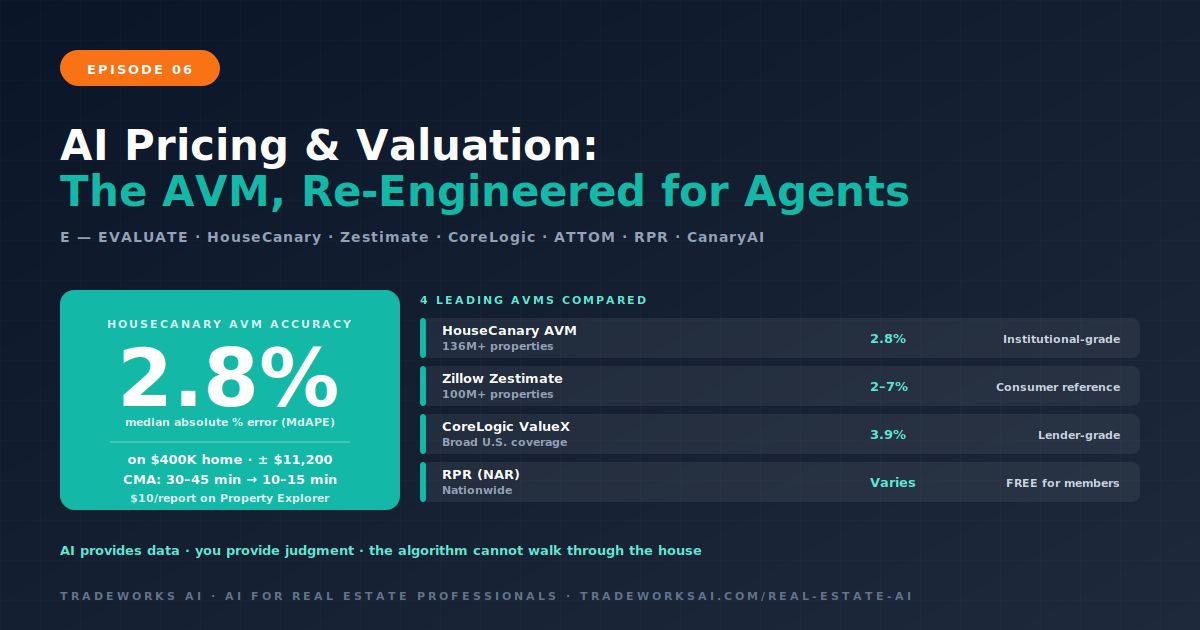
HouseCanary’s automated valuation model achieves a median absolute percentage error of 2.8% across more than 136 million U.S. residential properties — approaching the accuracy of full appraisals. CoreLogic’s Total Home ValueX claims 99% accuracy with 3.9% year-over-year tracking precision. ATTOM’s AVM places 70% of valuations within 10% of actual sale prices. These tools process hundreds of data points per property — comparable sales, tax records, market conditions, neighborhood trends, property characteristics — and generate valuations in seconds that would take an agent 30 to 45 minutes to compile manually. Yet every AVM carries a disclosure: “An AVM is an estimated sale price. It is not the same as the opinion of value in an appraisal developed by a licensed appraiser.” The algorithm cannot walk through the house. It cannot smell the mold behind the drywall. It cannot feel the energy of the neighborhood at 7 PM on a Tuesday. This episode covers the EVALUATE layer of the AGENT Framework — the AI tools that make you faster and more data-informed, and the human judgment that makes you right.
An AVM is a machine learning model trained on millions of property transactions, tax records, MLS data, and market indicators. When you request a valuation, the AVM identifies comparable properties based on location, size, age, features, and recent transaction history, weighs each comparable by similarity and recency, adjusts for market conditions, property differences, and neighborhood trends, and generates an estimated value with a confidence score.
The leading AVMs analyze far more data than a human CMA typically considers. HouseCanary provides over 75 data points at the property, block, ZIP code, MSA, and state levels, including current and forecasted values, land values, loan-to-value ratios, home price indices, and rental price indices. The system uses computer vision to assess property condition from photos, reducing the need for physical inspections for routine valuations. Monthly internal testing and quarterly third-party testing validate accuracy continuously.
| Platform | Median Error | Coverage | Best For | Cost |
|---|---|---|---|---|
| HouseCanary AVM | 2.8% MdAPE | 136M+ U.S. properties | Institutional investors, agents needing CMA-grade data | $10/report (Property Explorer CMA), enterprise API |
| Zillow Zestimate | 2–7% (varies by market) | 100M+ properties | Consumer reference point, not professional-grade | Free (consumer) |
| CoreLogic Total Home ValueX | 3.9% YoY tracking | Broad U.S. coverage | Lenders, appraisers, institutional users | Enterprise pricing |
| ATTOM AVM | 6% median (70% within 10%) | Nationwide | Investors, data analysts | Enterprise/API pricing |
| Clear Capital ClearAVM | Lending-grade (varies) | Nationwide | Mortgage lenders, portfolio managers | Enterprise pricing |
| RPR (Realtors Property Resource) | Varies | Nationwide | NAR members (free) | Free for NAR members |
For practicing real estate agents, two tools stand out as immediately accessible: HouseCanary’s Property Explorer CMA at $10 per report, which delivers an institutional-grade valuation with neighborhood analytics and heat maps, and RPR, which is free for NAR members and provides property data, valuations, and market reports. The Zillow Zestimate is what your clients will reference — you need to understand its limitations so you can explain why your CMA is more accurate.
HouseCanary’s CanaryAI adds a generative AI layer on top of the company’s valuation database. Instead of navigating dashboards and pulling reports, agents and investors can ask questions in plain English: “What is the estimated value of 123 Oak Street?” “How has this ZIP code’s median price changed in the last 12 months?” “What is the after-repair value if I renovate the kitchen and bathrooms?” CanaryAI responds with data-backed answers, visualizations, and confidence intervals. Image-based valuations use uploaded photos and computer vision to adjust for property condition, delivering sharper estimates without requiring the agent to input every detail manually. For agents who want AI-powered valuation without learning a new platform, CanaryAI’s conversational interface is the most accessible entry point.
| Scenario | Trust AI? | Why |
|---|---|---|
| Standard suburban home, recent comparable sales available, no unique features | High confidence | AVMs perform best with abundant comparable data in homogeneous markets |
| Initial pricing conversation with a seller | Use as starting point | AVM provides objective data to anchor the discussion before adding adjustments |
| Market trend analysis (ZIP code, neighborhood, MSA) | High confidence | AI excels at processing large datasets and identifying statistical trends |
| Portfolio valuation for investors | High confidence | Volume valuations where 2–3% accuracy across hundreds of properties is sufficient |
| Monitoring client home values (Homebot, ComeHome) | High confidence | Automated monthly tracking where directional accuracy matters more than precision |
| Scenario | Trust Human? | Why |
|---|---|---|
| Unique property (waterfront, historic, custom build) | Essential | Few comps. AVM lacks context for truly unique properties. Human judgment fills the gap. |
| Property condition issues not in public records | Essential | New roof, hidden damage, unpermitted additions — none visible to the algorithm. |
| Hyperlocal micro-market knowledge | Essential | The difference between the quiet side of the street and the noisy side. Block-level nuance. |
| Seller emotional attachment to price | Essential | Data does not negotiate. You do. The pricing conversation requires empathy and persuasion. |
| Rapidly shifting market conditions | Important | AVMs use historical data. In a market turning quickly, your real-time observation leads the algorithm. |
| Luxury and ultra-luxury properties | Important | Thin comparable data. Lifestyle factors that algorithms cannot quantify. Buyer psychology matters. |
The most common pricing conflict: the seller’s emotional valuation versus the market’s data-driven valuation. AI tools strengthen the agent’s position in this conversation because the data is objective, verifiable, and presented by a machine rather than a person. Sellers who push back on an agent’s opinion may be more receptive to data from HouseCanary or RPR that shows the same conclusion. The AI-Enhanced CMA presentation follows a specific sequence: lead with the AVM data (objective, institutional-grade), present the adjusted comparables (your professional analysis), explain the market forecast (where prices are heading), and conclude with your recommended price and strategy. The data builds the case. Your expertise interprets it. The seller makes an informed decision rather than an emotional one.
| Tool | Function | Best For | Cost |
|---|---|---|---|
| HouseCanary HPI + Forecasts | Market trend analysis, price forecasting, neighborhood heat maps | Agents + investors wanting forward-looking data | Included in Property Explorer ($10/report) |
| RPR Market Reports | Local market statistics, trends, property data | NAR members needing free market intelligence | Free for NAR members |
| Cloud CMA (Lone Wolf) | Professional CMA presentation creation from MLS data | Agents wanting polished listing presentation materials | ~$45/month |
| Remine (Lone Wolf) | MLS-integrated property intelligence, ownership data | Agents needing deep property research | Included in many MLS subscriptions |
| ChatGPT / Claude | Market analysis narratives from your data | Agents who supply their own verified stats for AI to structure | $0–20/month |
Cloud CMA at approximately $45 per month deserves special mention: it pulls MLS data and creates professional, branded CMA presentations that agents can customize and present to sellers. Combined with an AVM baseline from HouseCanary or RPR, Cloud CMA transforms the AI-enhanced data into a polished deliverable that elevates the listing appointment. From Episode 4, ChatGPT and Claude can also draft market analysis narratives from your verified data, turning raw statistics into client-friendly market updates and reports.
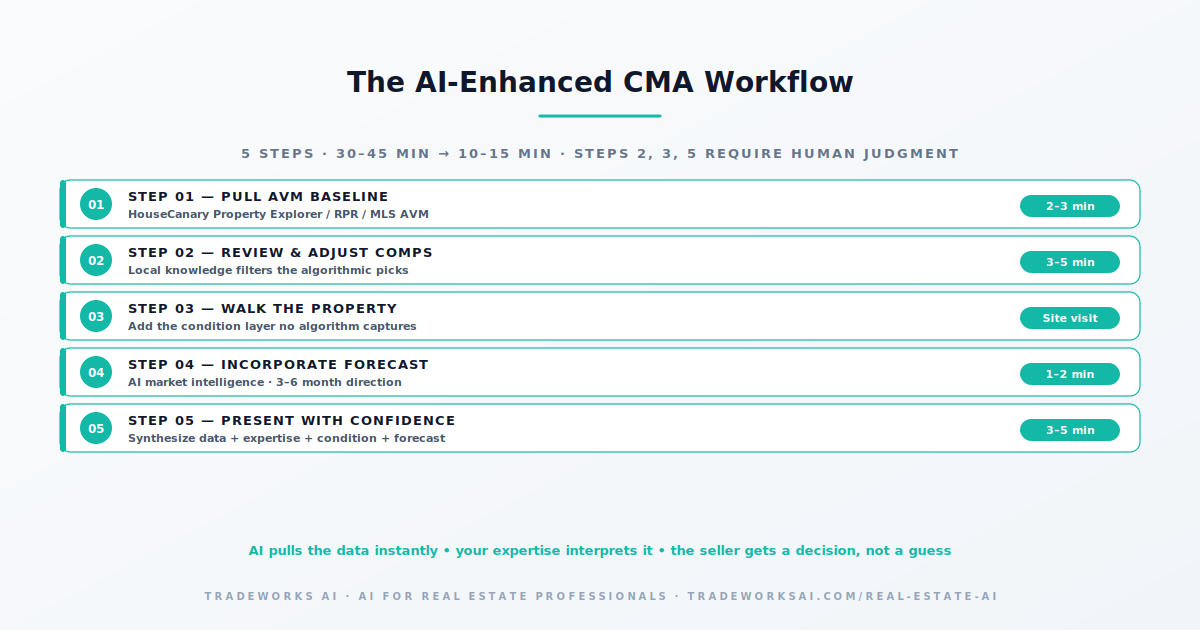
AVMs provide an excellent starting point but do not replace a complete CMA. HouseCanary’s 2.8% median error means on a $400,000 home, the estimate could be $11,200 above or below actual value. For initial pricing conversations and market analysis, this accuracy is valuable. For final pricing recommendations, the agent must adjust for property condition, unique features, and hyperlocal market factors that the AVM cannot capture. The AI-Enhanced CMA Workflow uses the AVM as Step 1, not as the final answer.
The Zestimate is the most recognized consumer AVM and serves as a useful directional reference. Its accuracy varies significantly by market, ranging from approximately 2% in data-rich markets to 7% or more in areas with fewer transactions. The Zestimate is what your seller will Google before your listing appointment. Understand its methodology and limitations so you can explain why your CMA, enhanced with institutional-grade data and local expertise, is more accurate.
HouseCanary’s Property Explorer CMA product is available at $10 per report for individual comparative market analyses. CanaryAI provides conversational access to the valuation database. Enterprise API access for teams and brokerages requires custom pricing. For most individual agents, the $10 per-report model provides institutional-grade data on an as-needed basis without a monthly subscription commitment.
AI market forecasting tools like HouseCanary’s Home Price Index analyze historical trends, current indicators, and economic signals to project price direction at the ZIP code, MSA, and national levels. These forecasts are directionally valuable for pricing strategy and investment decisions. They are not crystal balls. No AI can predict black swan events, policy changes, or sudden market shifts with certainty. Use AI forecasts as one input in your market analysis, not as the definitive prediction.
RPR (Realtors Property Resource) is free for all NAR members and provides property valuations, market data, and customizable reports. It is the best zero-cost AI valuation tool for practicing agents. For agents willing to invest $10 per report, HouseCanary’s Property Explorer delivers institutional-grade accuracy (2.8% median error) that significantly exceeds free alternatives.
82% of agents use AI. Only 17% report significant impact. The difference is not the tools — it is the strategy. The AI Readiness Assessment grades your business across 6 dimensions and maps the AGENT categories to the right stack for your stage.
Continue the AI for Real Estate series with Part 7 of 7.
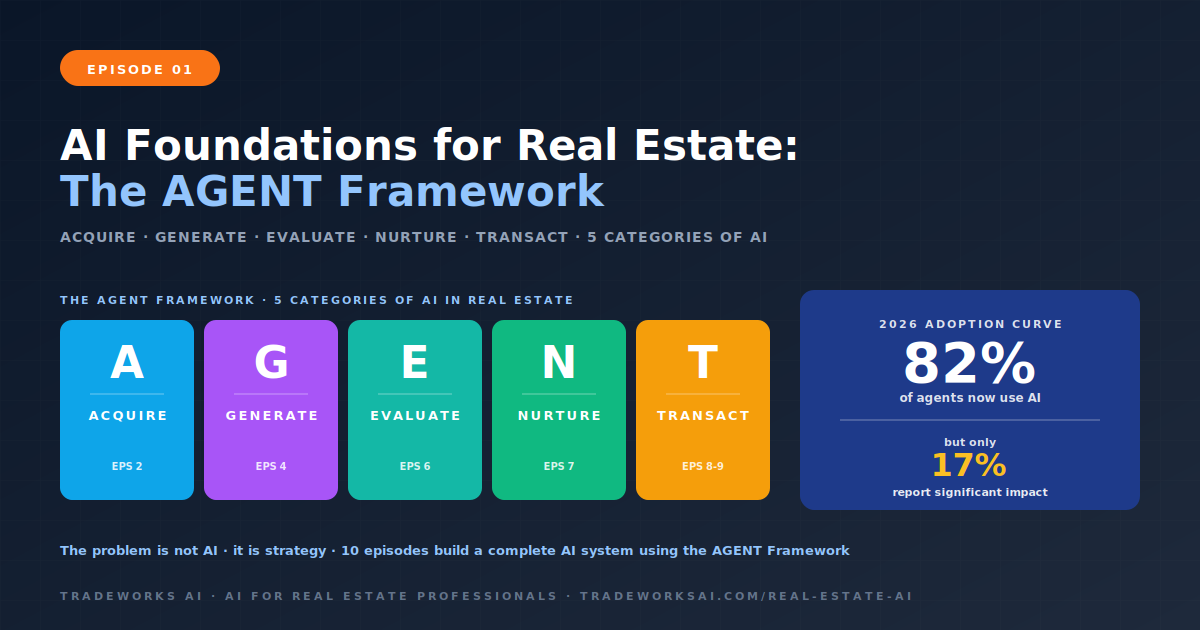
Continue the AI for Real Estate series with Part 1 of 7.