AI for Real Estate · Part 2
AI Lead Scoring and Predictive Seller Analytics for Real Estate: Finding Tomorrow’s Listings Today
Continue the AI for Real Estate series with Part 2 of 7.
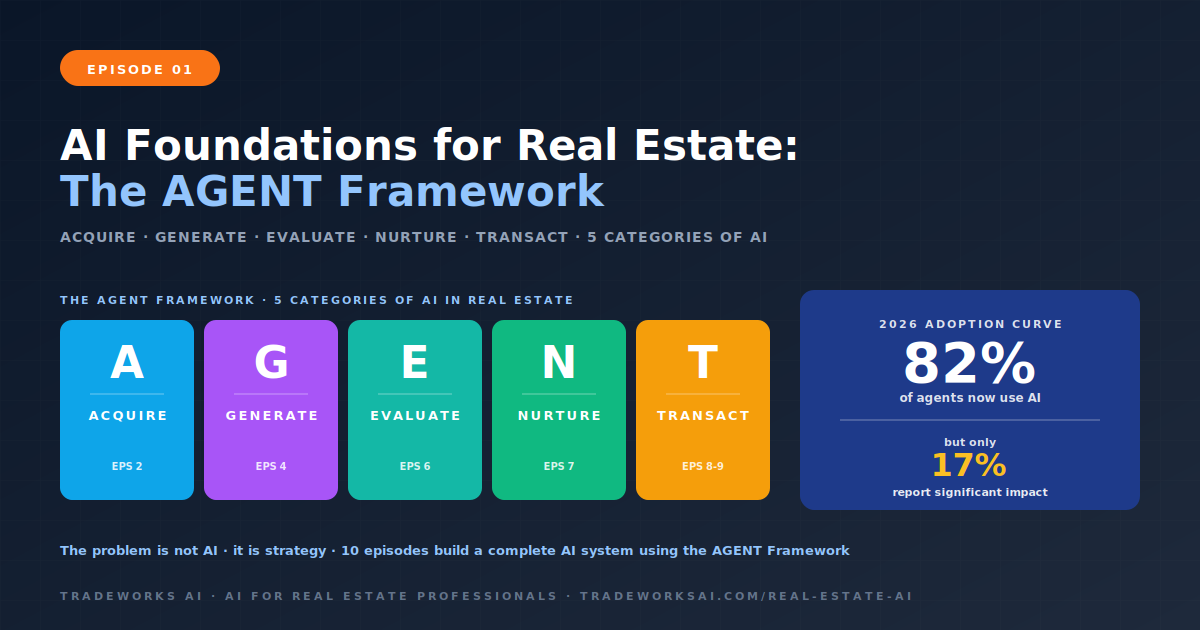
Eighty-two percent of real estate agents now use AI in some form, according to the RPR February 2026 survey — up from 68% in the NAR 2025 Technology Survey and approximately 15% in 2023. Ninety-seven percent of brokerage leaders report their agents are using AI. The adoption curve has moved from early adopters to mainstream in under three years. But here is the number that should concern every agent: only 17% report that AI has had a significant positive impact on their business. Forty-six percent — nearly half — say they noticed no difference at all. The problem is not AI. The problem is how agents are using it. Most type “write a listing description” into ChatGPT, receive a generic paragraph that sounds like every other AI-generated listing, and conclude that AI is overhyped. This series changes that. Over 10 episodes, we build a complete AI system for real estate professionals using the AGENT Framework: five functional categories that map every AI application to a specific business outcome.
AI in real estate is not one technology. It is a collection of capabilities that serve different functions. Understanding the four core types helps you evaluate which tools are worth paying for and which are marketing hype.
Natural Language Processing (NLP): The technology behind ChatGPT, Claude, and Gemini. NLP reads, writes, and understands human language. In real estate, this powers listing description generation, email drafting, chatbot conversations, document analysis, and market report summarization. ChatGPT is used by 58% of agents, Gemini by 20%, and Microsoft Copilot by 15%.
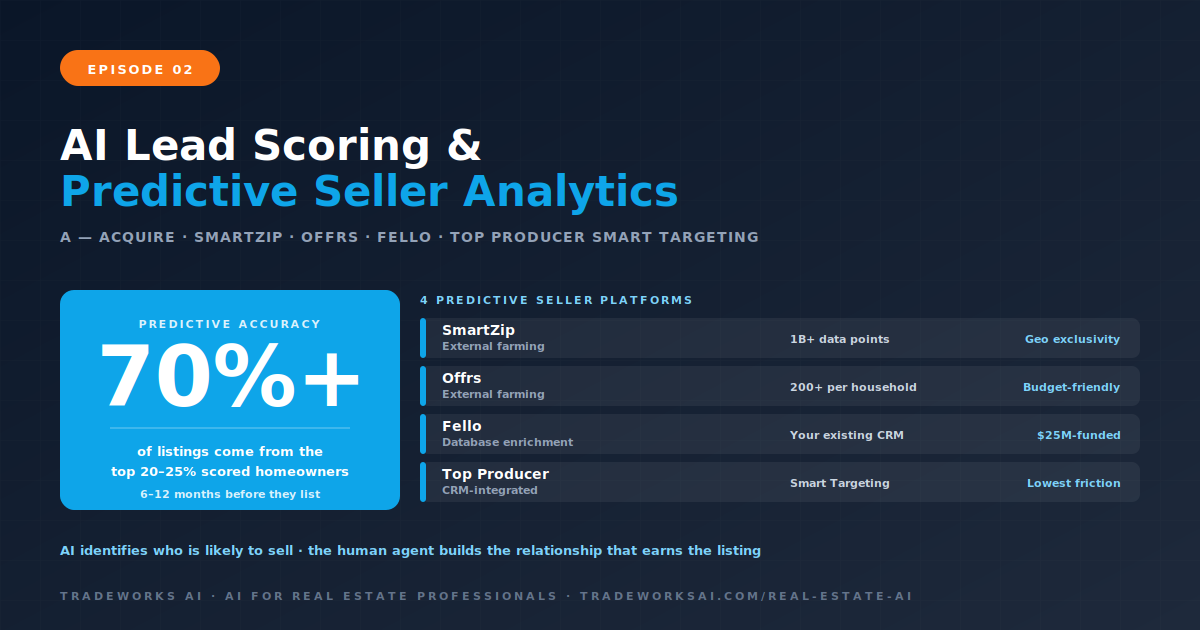
Machine Learning / Predictive Analytics: The technology behind lead scoring, predictive seller identification, and market forecasting. ML analyzes historical patterns to predict future outcomes. SmartZip predicts likely sellers with 72% accuracy by analyzing hundreds of data points per household. Your CRM’s lead scoring uses ML to rank contacts by conversion probability.
Computer Vision: The technology behind AI virtual staging, photo enhancement, property recognition, and floor plan generation. Computer vision understands images the way NLP understands text. Restb.ai auto-tags listing photos by room type. Virtual Staging AI transforms empty rooms into furnished spaces for $15–50 per image.
Automation / Agentic AI: The emerging capability where AI takes multi-step actions autonomously. A lead arrives, the AI texts them, qualifies their timeline, checks your calendar, and books a showing — without human intervention. Best-in-class brokerages using agentic AI report 74% reduction in time-to-first-contact and 18% reduction in cost-per-closed-side.
Every AI tool you encounter in real estate fits into one of these five categories. When a vendor claims their AI “does everything,” you can evaluate it against the AGENT Framework and identify exactly which categories it serves and which it does not. The agents who succeed with AI are not the ones who use the most tools. They are the ones who strategically cover each AGENT category with the right tool for their business stage.
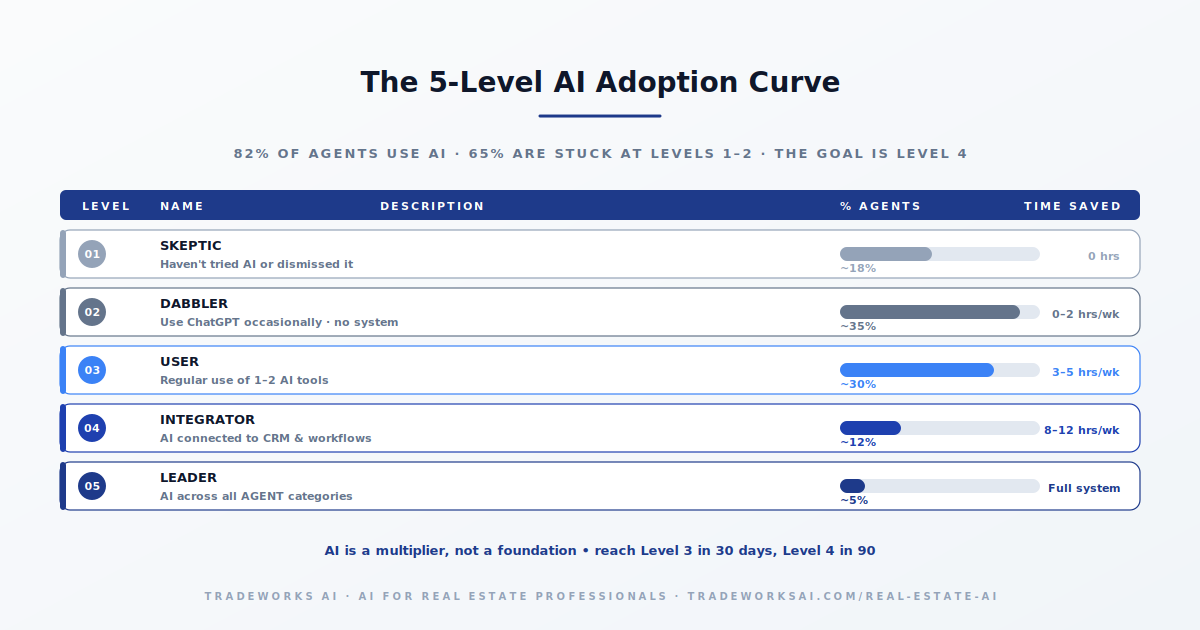
| Level | Name | Description | % of Agents (est.) |
|---|---|---|---|
| 1 | Skeptic | Haven’t tried AI or tried once and dismissed it. | ~18% |
| 2 | Dabbler | Use ChatGPT occasionally for listing descriptions or emails. No system. | ~35% |
| 3 | User | Regularly use 1–2 AI tools (ChatGPT + one other). Save 3–5 hrs/week. | ~30% |
| 4 | Integrator | AI tools connected to CRM and workflows. Automated lead scoring, content, follow-up. Save 8–12 hrs/week. | ~12% |
| 5 | Leader | AI across all AGENT categories. Predictive analytics, agentic automation, AI-powered CRM. Structural competitive advantage. | ~5% |
The data tells the story: 82% of agents have tried AI, but most are at Level 2 — Dabbler. They use ChatGPT for one task, see modest results, and plateau. The agents reporting significant positive impact (17%) are at Level 4 and above — they have integrated AI into their workflows, not just their task list. This series is designed to move you from wherever you are to at least Level 3, and ideally Level 4, by Episode 10.
| Category | What AI Does | Example Tools | AGENT Layer |
|---|---|---|---|
| Lead Gen & Scoring | Predicts likely sellers, scores leads by conversion probability, qualifies via chat | SmartZip, Offrs, Structurely, Ylopo AI | A — Acquire |
| Content Creation | Writes listing descriptions, emails, social posts, market reports | ChatGPT, Claude, Jasper, platform-integrated generators | G — Generate |
| Visual Marketing | Virtual staging, photo enhancement, video creation, floor plans | Virtual Staging AI, BoxBrownie, Restb.ai, CubiCasa | G — Generate |
| Pricing & Valuation | Automated valuations, AI-enhanced CMAs, market forecasting | HouseCanary, Zillow Zestimate, Remine | E — Evaluate |
| CRM & Communication | Smart follow-up, behavioral triggers, AI email drafting, predictive timing | FUB AI, Top Producer AI, Lofty AI | N — Nurture |
| Transaction & Compliance | Document analysis, deadline tracking, fraud detection, e-closing | Blend, Qualia, document AI tools | T — Transact |
Before investing in any AI tool, assess your current readiness. Score yourself 1–5 on each dimension:
| Dimension | Score 1 (Low) | Score 5 (High) |
|---|---|---|
| CRM Foundation | No CRM or rarely used | CRM used daily, contacts tagged, pipeline tracked |
| Content Consistency | Post sporadically, no system | Weekly content calendar, batch production |
| Data Quality | Contacts scattered, no tags | Clean database, segmented, updated regularly |
| Tech Comfort | Struggle with new software | Adopt new tools quickly, self-taught |
| Time Available | No time for new systems | Can dedicate 30–60 min/day to learning |
| Budget | $0 available for AI | $50–$200/mo for AI tools |
Score 18–30: Ready to implement AI systematically. Start with Episode 2. Score 12–17: Build your CRM foundation first (Series A), then return. Score 6–11: Focus on the basics — CRM, consistent posting, database hygiene — before adding AI.
Authenticity Check: AI is a multiplier, not a foundation. If your CRM is empty, your database is messy, and your content is nonexistent, AI will multiply zero. Build the foundation first. AI amplifies what already works.
Most real estate AI tools cost $25 to $200 per month. A complete AI stack covering all five AGENT categories can be assembled for $100 to $500 per month depending on your business stage. The free tier of ChatGPT alone covers Level 1–2 content creation. Paid tools like SmartZip ($300–$500/mo for predictive leads) and Structurely ($179/mo for AI ISA) represent the upper end for individual agents. Episode 10 provides the complete cost breakdown by business stage.
| Ep | Title | AGENT Category | Key Tools |
|---|---|---|---|
| 1 | AI Foundations (this episode) | All | Framework + Assessment |
| 2 | AI Lead Scoring & Predictive Analytics | A — Acquire | SmartZip, Offrs, Fello, Top Producer |
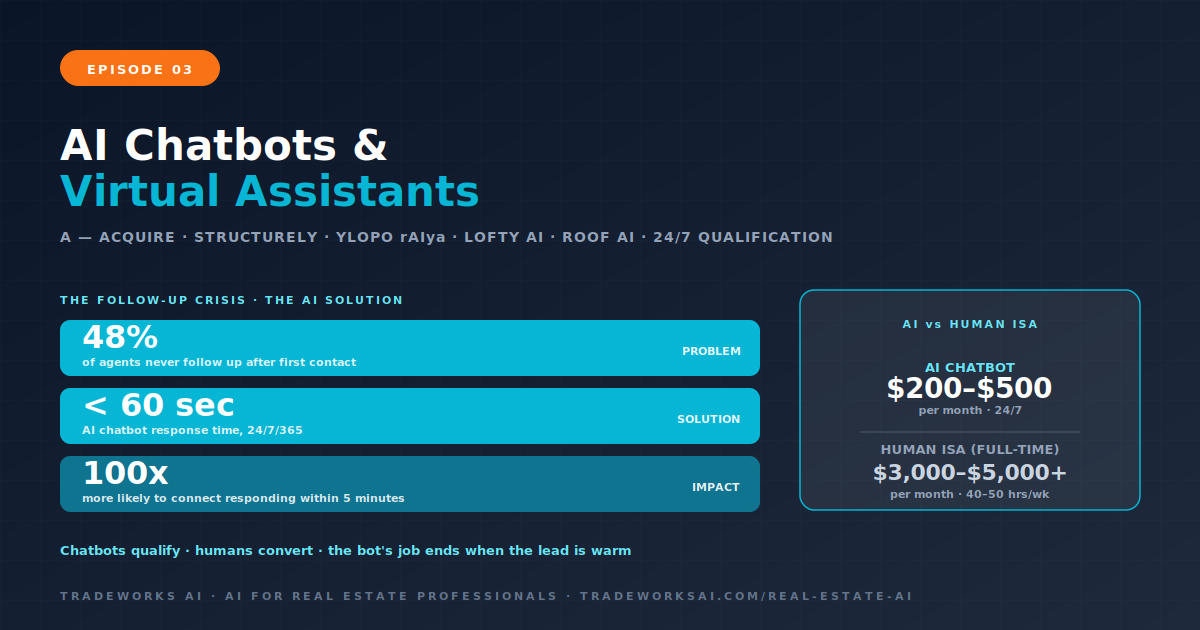
| 3 | AI Chatbots & Virtual Assistants | A — Acquire | Structurely, Lofty AI, Ylopo AI |
| 4 | AI Content Creation | G — Generate | ChatGPT, Claude, Jasper |
| 5 | AI Visual Marketing | G — Generate | Virtual Staging AI, BoxBrownie, Restb.ai |
| 6 | AI Pricing & Market Intelligence | E — Evaluate | HouseCanary, Skyline AI |
| 7 | AI-Powered CRM & Relationship Intel | N — Nurture | FUB AI, Top Producer AI, Lofty |
| 8 | AI for Property Management | T — Transact | Yardi Virtuoso, AppFolio AI |
| 9 | AI in Mortgage, Title & Transactions | T — Transact | Blend, Document AI, RON |
| 10 | The AI-Powered RE Business (Finale) | All | Full AGENT assembly + 90-day roadmap |
No. AI will divide agents into two groups: those who use it to amplify their expertise and those who do not. The transaction process, client relationships, negotiations, and local market knowledge all require human judgment. AI handles data and logistics. The agents who use AI effectively will have more time for the work that actually requires a human — the conversations, the negotiations, the moments that build trust.
There is no single best tool. ChatGPT is the most widely used for content creation (58% of agents). For lead scoring, SmartZip leads with 72% predictive accuracy. For chatbots, Structurely is the most established. For CRM intelligence, Follow Up Boss and Lofty have the most advanced AI features. The right tool depends on which AGENT category you need to address first.
Free to $500 per month depending on business stage. ChatGPT and Claude both offer free tiers powerful enough for content creation and email drafting. A starter AI stack (ChatGPT free + Homebot at $25/mo) costs $25 per month. A comprehensive stack covering all five AGENT categories runs $200 to $500 per month. Episode 10 provides the complete cost breakdown.
Yes. Start with ChatGPT or Claude — both are free and conversational. Give the AI a real task from your business: describe a property you are listing and ask it to write the description. Edit the output. Do this daily for two weeks. You will develop an instinct for what AI does well and where it needs your guidance. No coding, no technical setup required.
The AGENT Framework is a 5-category system developed by TradeWorks AI that maps every AI application in real estate to a specific business function: Acquire (find leads), Generate (create content), Evaluate (analyze markets), Nurture (maintain relationships), and Transact (manage deals). Each episode in this series covers one or more AGENT categories in depth.
82% of agents use AI. Only 17% report significant impact. The difference is not the tools — it is the strategy. The AI Readiness Assessment grades your business across 6 dimensions and maps the AGENT categories to the right stack for your stage.
Continue the AI for Real Estate series with Part 2 of 7.
Continue the AI for Real Estate series with Part 3 of 7.