Reviews & Reputation · Part 2
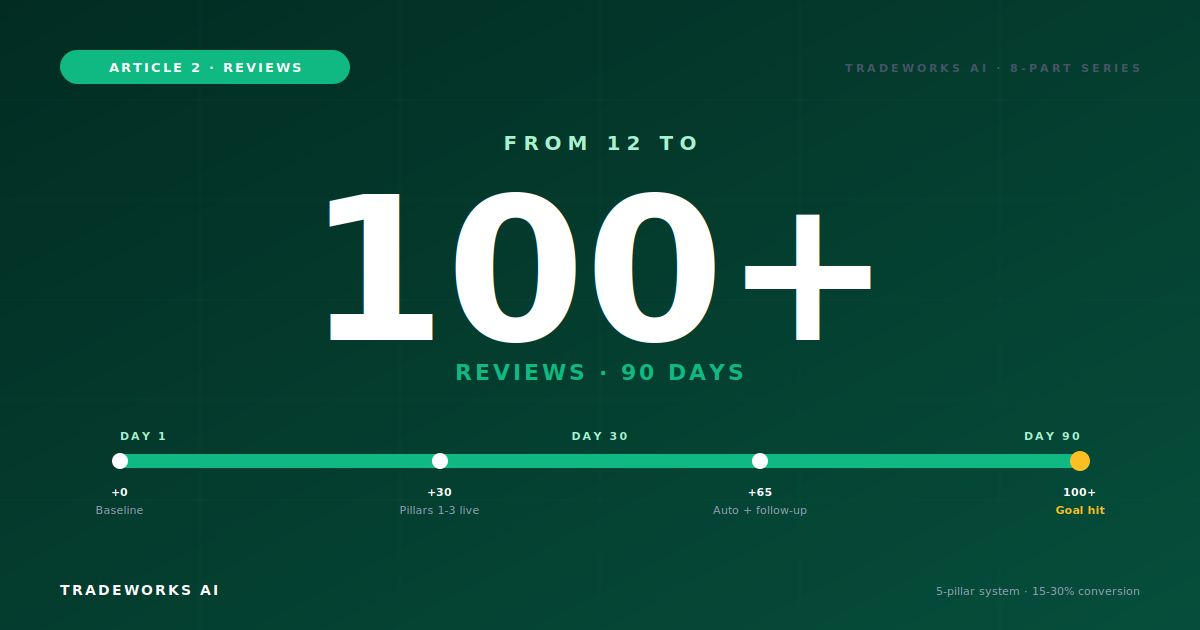
The Review Acquisition System: 100+ Reviews in 90 Days
Continue the Reviews & Reputation series with Part 2 of 8.
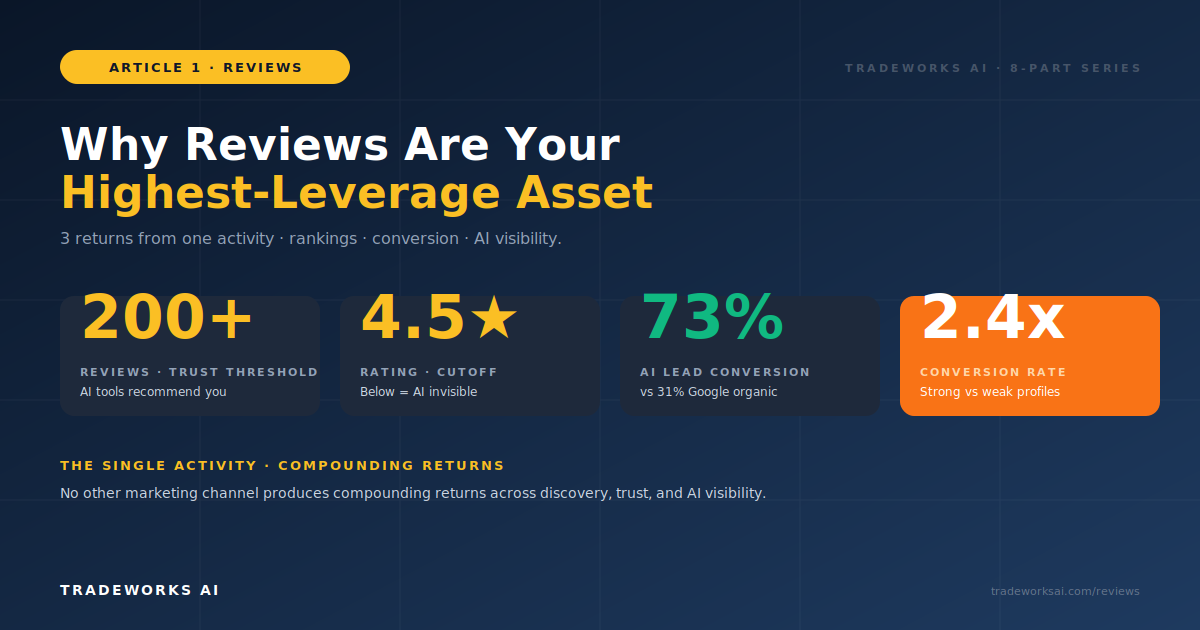
Online reviews are the highest-leverage marketing asset for home service contractors in 2026 because they simultaneously drive three of the most valuable outcomes in your business: local search rankings, customer conversion rates, and AI recommendation visibility. A contractor with 200-plus reviews averaging 4.5 stars or higher captures roughly 3 times more local search citations than a competitor with under 50 reviews, converts inbound leads at 2.4 times the rate of contractors with weak review profiles, and gets recommended by ChatGPT, Gemini, and Perplexity in the small fraction of cases where AI tools surface contractor names at all. No other marketing channel produces compounding returns across discovery, trust, and AI visibility from a single underlying activity. This guide breaks down the math, the thresholds, and the specific reasons reviews now outperform every other line item in your marketing budget.
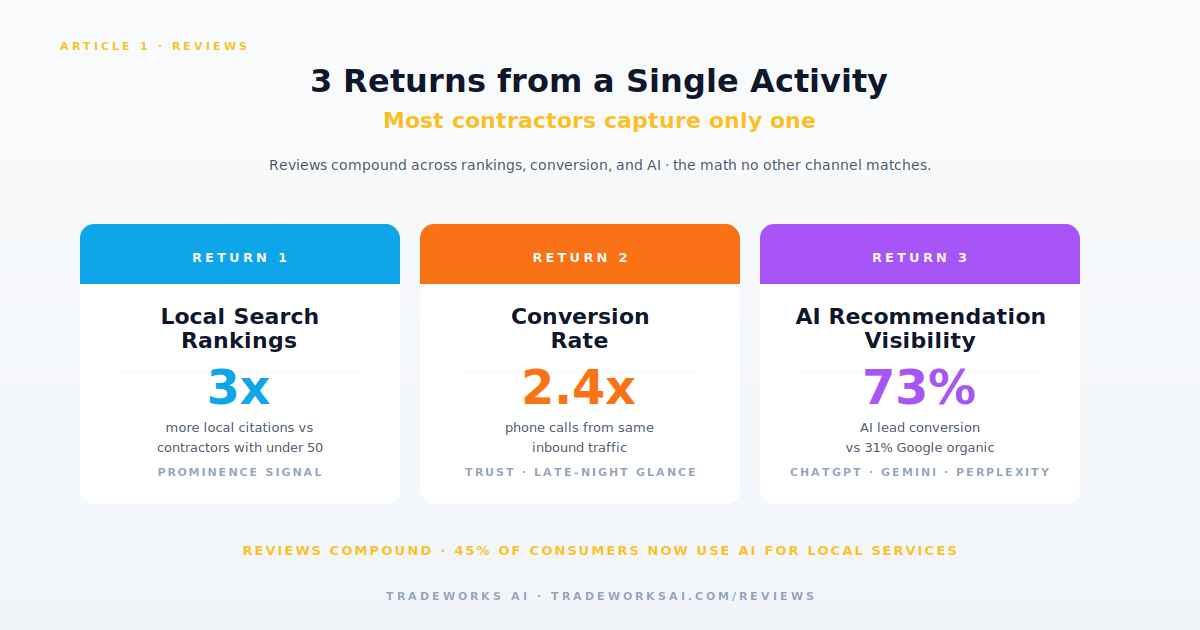
Most contractors think about reviews as a single thing. A number on Google that customers see before deciding whether to call. The math is more interesting than that. A review investment produces three distinct returns simultaneously, and most contractors capture only one of them.
Google ranks local businesses on three primary factors: relevance, distance, and prominence. Reviews are the dominant signal in the prominence calculation. Review count, review velocity (how recently you have been getting reviews), star rating, and keyword content within reviews all feed the local pack ranking algorithm.
A contractor with 340 reviews at 4.8 stars consistently outranks a competitor with 25 reviews at 4.9 stars. Even though the lower-volume contractor has a higher rating. Volume signals established trust to the algorithm. Recent volume signals current relevance. The combination produces map pack visibility that paid ads cannot replicate.
Reviews convert traffic into phone calls. The data is consistent across every research study published since 2020. Contractors with strong review profiles (200-plus reviews, 4.5-plus stars, recent activity) convert their inbound web and Google Business Profile traffic at roughly 2.4 times the rate of contractors with weak profiles.
The mechanism is trust. A homeowner with a flooded basement at 9 PM is not in the mood to research three contractors carefully. They glance at the review section, count the stars, scan two or three recent comments, and call. If your profile reads as established and recent, you get the call. If it reads as thin or stale, they scroll to the next name.
This is the return most contractors do not yet recognize. AI search tools - ChatGPT, Gemini, Perplexity, Google AI Overviews - now answer contractor recommendation questions for roughly 45 percent of consumers, up from 6 percent in 2025. When a homeowner asks ChatGPT who is the best plumber in Tampa, the AI does not return ten blue links. It returns two or three names with reasons attached.
Reviews are the dominant input to that recommendation. AI systems heavily weight review volume (200-plus is the established-trust threshold), recency (within the last 6 months), and rating (4.5 plus). A contractor without active review momentum is invisible to AI recommendations. AI-referred leads convert at 73 percent compared to 31 percent for Google organic leads, because the homeowner already trusts the AI-vetted recommendation.
The contractors building review velocity now will own AI recommendation slots through 2028. AI systems get progressively more confident in their existing recommendations and progressively less likely to swap them out. Citation history compounds.
Lets put concrete numbers against the three returns. Imagine a contractor doing 1.5 million in annual revenue, currently at 60 reviews and a 4.4-star average. They commit to a review acquisition system that adds 100 new 5-star reviews over the next 12 months while maintaining their current 4.4-star floor. What happens?
Local search impact: review volume passes the 150-mark threshold where AI and Google search both treat the business as established. Map pack visibility increases by an estimated 35 to 50 percent based on aggregated SEO data. If the contractor was previously generating 80 organic local leads per month, they would now generate 108 to 120.
Conversion impact: review profile crosses the trust threshold for higher-intent traffic. Inbound conversion rate moves from roughly 18 percent to 23 percent. Same lead volume, more booked jobs.
AI visibility impact: contractor enters the top 1 to 2 percent of locally recommended businesses across ChatGPT, Gemini, and Perplexity. This produces an estimated 15 to 30 additional AI-referred leads per month at a 73 percent conversion rate.
Combined revenue impact at an average job value of 800 dollars: somewhere between 280,000 and 480,000 dollars in additional annual revenue from a review investment that costs less than 200 dollars per month in software and 5 hours per week of office time.
There is a tipping point in the data that most contractors miss. Below a 4.5-star average, conversion rates and AI recommendations both drop dramatically. Above 4.5 stars, the difference between 4.6 and 4.9 is small. The threshold is harder than the gradient.
Why? Because both human consumers and AI systems treat 4.5 as the cutoff between trusted and questionable. A 4.4-star business looks like it has unresolved issues. A 4.5-star business looks like a normal business with normal customer experiences. The half-star difference produces an outsized perception swing.
For contractors below 4.5: your top priority is not getting more reviews. It is identifying and resolving the reasons your existing customers leave 1, 2, and 3-star reviews. Review acquisition without quality improvement just lowers your rating faster.
For contractors above 4.5: your top priority is volume and recency. Each new 5-star review reinforces the rating and adds to total volume. Each month that goes by without new reviews quietly de-weights your standing in both Google and AI systems.
A common contractor question: would I rather have 50 reviews at 4.9 stars or 300 reviews at 4.6 stars? In 2026, the answer is almost always 300 at 4.6. Assuming both are above the 4.5 threshold.
Volume is the dominant signal because it represents established trust, sample size validity, and ongoing business activity. A 4.9-star average from 50 reviews could plausibly be a small operation with selective review requests. A 4.6-star average from 300 reviews could only come from a high-activity business with broad customer exposure.
AI systems weight volume even more heavily than human consumers do. The 200-review threshold appears repeatedly in research as the point where AI systems treat a business as established enough to recommend. Below 200, the recommendation calculation defaults to higher-volume competitors regardless of rating.
The implication: stop optimizing for the perfect 5.0 average. Optimize for sustained volume above 4.5.
Review recency matters more in 2026 than it did even two years ago. Both Google and AI systems have shifted toward weighting reviews from the last 6 months heavily, with reviews older than 12 months contributing minimally to current rankings.
A contractor with 500 reviews from 2019 to 2023 and zero reviews in the last 12 months is almost as invisible as a contractor with 30 reviews from the last 6 months. The 30-recent contractor will often outrank the 500-stale contractor for high-intent local queries.
The reason is simple. Both Google and AI systems are trying to answer the question is this business currently active and operating well. Old reviews answer a different question. Was this business active years ago? Algorithms that need to recommend a contractor right now down-weight stale data.
Practical rule: aim for at least 5 to 10 new reviews per month minimum to maintain recency signals. More if you are in a high-volume trade or competitive market.
Reviews compound. So does the absence of them.
Every month a contractor goes without active review acquisition, three things happen quietly. First, their existing review base ages, and the recency signal weakens. Second, competitors who are running review systems pull further ahead in volume, and the gap becomes harder to close. Third, AI systems become progressively more confident in their existing recommendations. The contractor without recent reviews falls further out of consideration.
Twelve months of inactivity produces a measurable decline in local pack visibility, conversion rates, and AI recommendation frequency. The contractor is not standing still. They are slipping backwards while competitors compound forward.
This is why reviews are the highest-leverage marketing asset. The compounding works in both directions. Active review systems produce exponential returns over 12-24 months. Inactive review profiles produce exponential decline.
If you take one thing from this article, take this: reviews are not a marketing tactic. They are the foundation that every other marketing channel depends on.
Your Google Ads convert better when your review profile is strong. Your local SEO compounds faster when reviews are flowing. Your AI search visibility depends on review volume and recency. Your sales conversations close faster because the homeowner already trusts you before the call.
Every other category in your marketing mix produces returns that are partially capped by your review profile. Strengthen the foundation and every other line item performs better. Neglect the foundation and every other line item underperforms regardless of budget.
The next 7 articles in this series cover exactly how to build a review system that produces these returns. Part 2 walks through the acquisition system that generates 100-plus reviews in 90 days. Part 3 covers response strategy with templates. Part 4 handles negative review crisis management. Parts 5 through 8 cover multi-platform strategy, automation, AI-era considerations, and team training.
Read Part 2 next: The Contractors Review Acquisition System: How to Get 100-Plus Reviews in 90 Days.
200-plus reviews with at least one new review per week is the benchmark for established trust as of 2026. AI systems weight 200 as a minimum threshold for recommendation eligibility. Below 50 reviews, contractors are functionally invisible in competitive markets. Between 50 and 200, contractors compete but with significant disadvantage against established competitors.
Google reviews are the highest-priority platform for local SEO and Google AI Overview recommendations, but ChatGPT and Gemini pull from multiple platforms. ChatGPT leans heavily on Angi, Yelp, and BBB. Gemini pulls from Facebook and Nextdoor. A multi-platform review presence is the only way to be visible across the full AI search landscape. Google first, then expand.
Local search ranking improvements typically appear within 60 to 90 days of consistent review acquisition. Conversion rate improvements appear immediately as the review profile strengthens. AI search visibility shifts take 90 to 180 days because AI systems update their training and retrieval data more slowly than Google does.
No. Paying for reviews violates the terms of service of every major review platform and risks account suspension, legal exposure under FTC endorsement guidelines, and complete loss of review history if detected. Legitimate review acquisition systems generate reviews from real customers through systematic request workflows. The next article in this series covers exactly how.
Reviews are publicly visible on third-party platforms like Google, Yelp, Facebook, BBB, and Angi. Testimonials are statements customers provide for use on your own website or marketing materials. Reviews drive local search and AI recommendation visibility because they are publicly verifiable on independent platforms. Testimonials drive on-site conversion. Both matter and serve different functions.
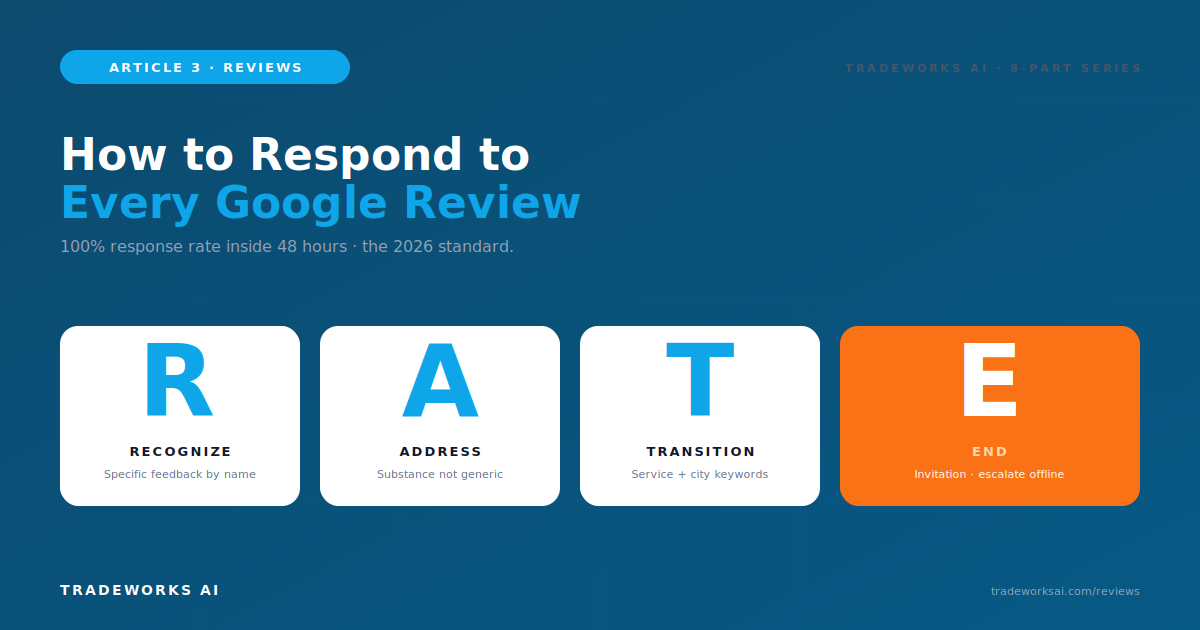
Critical. Google directly factors response rate into local ranking. AI systems use response behavior as a signal of business activity. Homeowners read responses to evaluate how a business handles both positive and negative feedback. The standard is 100 percent response rate within 48 hours for both 5-star and lower-star reviews. Part 3 in this series covers response templates and SEO-optimized response patterns.
Most contractors think their review profile is "fine." Then we benchmark it against the local competitors who are taking the AI recommendation slots. Our free audit checks volume, recency, rating, response rate, and platform coverage — and shows you the highest-leverage moves to get to 4.7+ stars and 200+ reviews this year.
Continue the Reviews & Reputation series with Part 2 of 8.
Continue the Reviews & Reputation series with Part 3 of 8.