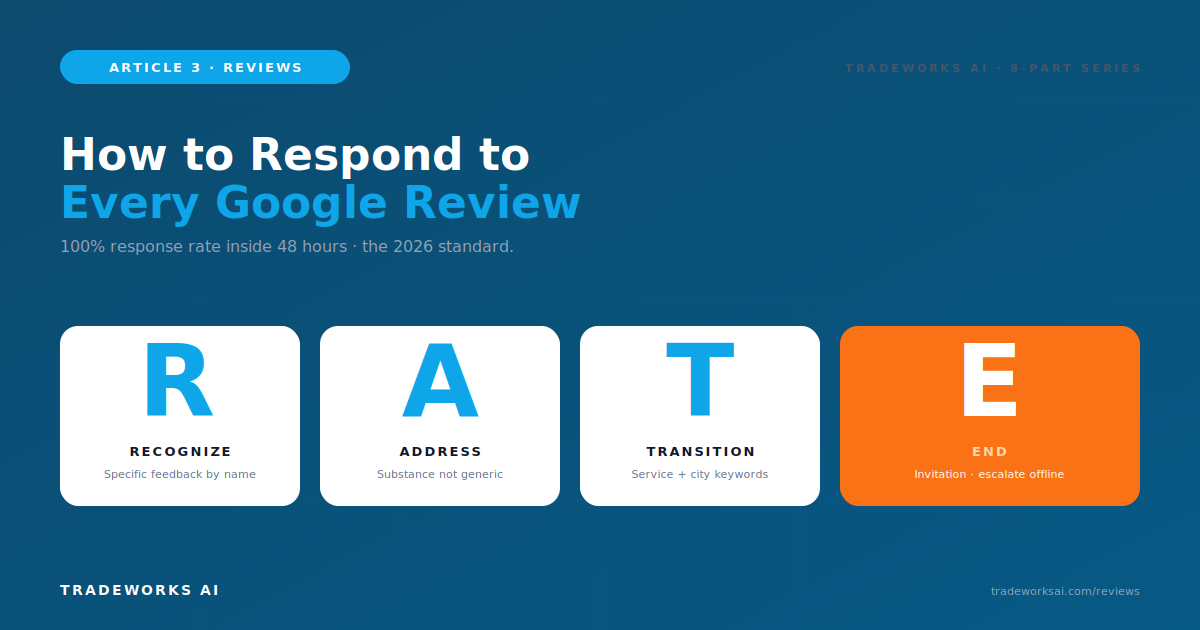
Reviews & Reputation · Part 3
How to Respond to Every Google Review
Continue the Reviews & Reputation series with Part 3 of 8.
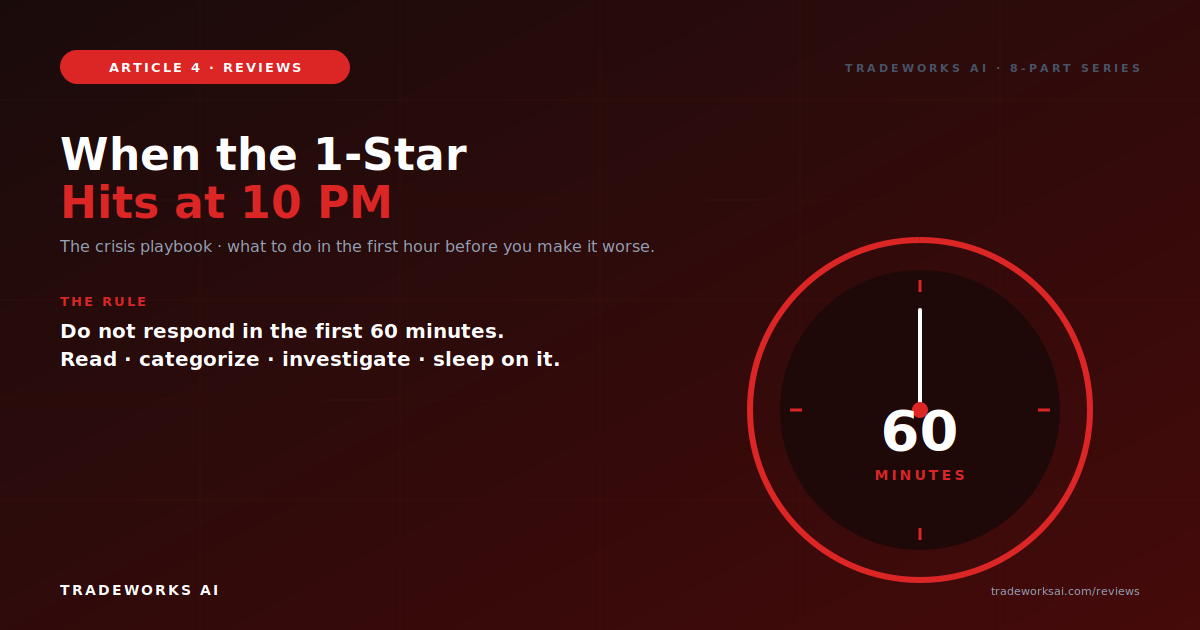
When a serious negative review posts, the contractor has roughly 60 minutes between the notification and the first action that can damage the situation permanently. The wrong responses include: replying when emotional, calling the customer immediately, sharing private details publicly, or arguing the facts in the review thread. The right framework is a 60-minute decision sequence: read carefully without responding for the first 15 minutes, categorize the review against five crisis types in the next 15, pull the work order and gather facts in the next 15, and draft a response in the final 15 - then sleep on it before posting. This article covers the 5-type crisis matrix (legitimate complaint, misunderstanding, false review, coordinated attack, viral escalation), the response strategy and removal options for each type, the three things you never do regardless of category, the legal boundaries that protect both your business and the customer, and the recovery strategy that follows any serious negative review event.
Part 3 in this series covered routine 1-2 star reviews where the customer is dissatisfied but the situation is recoverable. This article covers what comes after that. The reviews that make your stomach drop. The ones that contain accusations, false claims, employee names, neighborhood specifics, or threats of legal action. The ones that come in at 10 PM when you are tired and emotional and your first instinct is exactly the wrong one.
Most contractors lose the battle in the first hour. They respond emotionally. They call the customer in anger. They write something publicly that becomes evidence in a worse outcome. The crisis playbook exists to prevent the first hour from becoming the worst hour.
The single most important rule in this entire article: do not respond in the first 60 minutes. Read. Categorize. Investigate. Draft. Then sleep on it. Post in the morning.
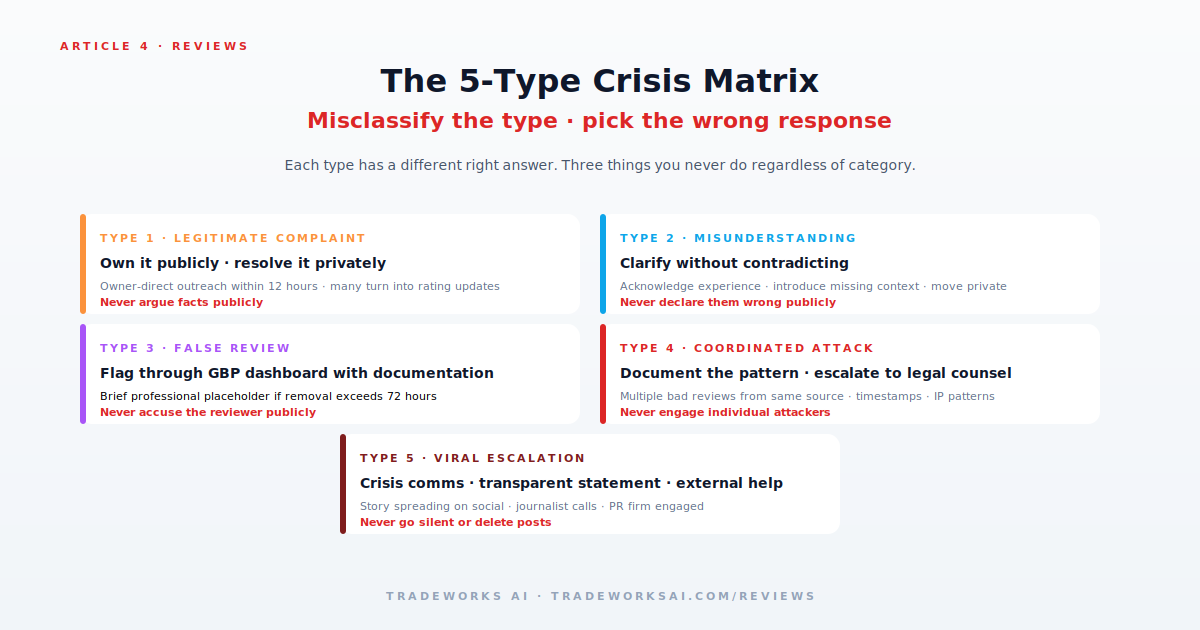
Not every negative review is the same crisis. The response strategy differs by type. Misclassifying the type produces the wrong response and often makes things worse.
The customer had a real problem. The work was incomplete, the technician was rude, the appointment was missed, the price was higher than quoted. The customer is angry but their facts are largely correct.
Response strategy: own it publicly. Resolve it privately. Owner-direct outreach within 12 hours. Many legitimate complaints can be turned into rating updates or removed reviews after offline resolution.
What you do NOT do: argue the facts publicly. Even if their version is slightly exaggerated, contesting the details makes the contractor look defensive and the customer look credible.
The customer got something wrong. They blamed your team for a problem caused by another contractor, attributed words to a tech that were not said, or misremembered the agreed scope. Their grievance is real to them but the underlying facts can be clarified.
Response strategy: clarify without contradicting. Acknowledge their experience, gently introduce the missing context, and move toward private resolution.
What you do NOT do: declare them wrong publicly. Even with documentation on your side, the public correction reads as combative.
The reviewer was never your customer. The review describes services or interactions that never happened. The reviewer is identified as someone with a personal grudge, a former employee, or a competitors associate. Or the review violates Google policy for other reasons (profanity, off-topic content, conflict of interest).
Response strategy: flag through Google Business Profile dashboard with documentation. Post a brief professional placeholder response only if removal takes longer than 72 hours. Do not engage substantively until removal decision comes back.
What you do NOT do: accuse the reviewer publicly of being fake. That escalates and creates evidence in the wrong direction. Document privately, flag through Google, and let the platform process work.
Multiple negative reviews appear in a short window from accounts with similar patterns. A competitor mentions your business in their marketing in a damaging way. A disgruntled former employee organizes a campaign. A local social media group is targeting your business.
Response strategy: document everything. Mass-flag the reviews through Google. Escalate through Google business support if the platform-level flagging does not produce removals. Consult an attorney if the pattern suggests deliberate sabotage. Do not respond publicly until the strategy is confirmed.
What you do NOT do: name the competitor or accuse anyone publicly. Coordinated attacks frequently include attempts to bait the contractor into legally damaging public statements. The first move is documentation, not response.
A single negative review or incident gains social media traction. The story moves from Google to Facebook groups to Nextdoor to local news. Your business name is suddenly trending in your service area for the wrong reasons.
Response strategy: bring in professional PR or crisis communications support immediately if the audience reaches beyond the original platform. The response is no longer just about the review - it is about a media event. Strategy involves a coordinated public statement, legal review, and managed engagement across multiple channels.
What you do NOT do: try to manage a viral situation yourself. Contractor business owners are not trained crisis communicators. Bringing in support that has handled this before costs less than the damage from a botched response.
Every serious negative review goes through the same 60-minute decision sequence. The framework forces structure into a moment that wants to be reactive.
Read the review carefully. Read it three times. Note specific claims, specific names, specific dates, specific service references. Notice whether the language matches a customer who actually used your service. Notice whether the facts described match anything you can verify in your work order system.
Do not call the customer. Do not respond on the platform. Do not text the technician. Do not draft a response yet. Just read.
Why this matters: emotional state at minute 5 is the worst possible state to make any decision in. The review is fresh, your defenses are up, and your judgment is impaired. The next 60 minutes need to happen with cooler thinking.
Use the 5-Type Crisis Matrix. Which type is this?
Type 1 - Legitimate? The complaint maps to a real interaction with verifiable facts on both sides.
Type 2 - Misunderstanding? The complaint references your business but contains factual errors that documentation can clarify.
Type 3 - False? The reviewer was never your customer. The interaction described did not happen. The review violates platform policy.
Type 4 - Coordinated? This review fits a pattern of recent negative activity. Other suspicious accounts, similar language, timing clustering.
Type 5 - Viral? The review has already moved beyond Google. Social media engagement has begun. Local media or community groups are picking it up.
Categorization determines everything that follows. Misclassifying produces the wrong response.
Pull the work order if there is one. Pull the technicians report. Pull any text or call records with the customer. Pull payment records. If the review references specific facts, verify or contradict each one against your records.
Photograph or screenshot the review immediately. Document the time stamp. Note any subsequent edits to the review.
If the review is Type 3 (false), document the evidence supporting that classification. Account history, language patterns, lack of customer record, similarity to other reviews.
If the review is Type 4 (coordinated), pull the other recent negative reviews and look for patterns. Account creation dates, review history, account locations, language similarities.
Documentation is what protects you in every subsequent step. Without it, you have your memory against the customers public claim.
Draft the response based on the type. Templates below. Save the draft. Do not post.
First: an hour later, the response will read differently. You will catch tone issues, factual overreaches, and emotional content you did not see at minute 50.
Second: more facts often surface in the next 12 hours. The technician remembers the job. The dispatch records show something. The customer texts after thinking about it.
Third: the platform may already be processing your removal flag. Posting publicly while a flag is pending complicates the platforms review.
Sleep on it. Post in the morning. The single discipline of waiting overnight prevents the largest category of crisis-response damage.
[Customer first name] - I read your review carefully. You are right to be frustrated about [paraphrase the core issue without arguing details]. I want to make this right. I am [owner first name], the owner. Please call me directly at [phone] - any time, including evenings. I want to understand what happened on our end and resolve it.
Notes: own it without conceding facts that may not be accurate. Owner-direct contact path. No defensiveness. Public visibility of the response is what protects you with future readers.
[Customer first name] - thanks for sharing this. I want to understand the full situation - I am pulling the work order from [date] and looking at our records. The experience you described does not fully match what our records show, and I would like to walk through it with you directly. Please call me at [phone] - I am [owner first name], the owner.
Notes: opens the door to clarification without publicly contradicting. Future readers see professionalism, not combat.
First step: flag through Google Business Profile. Do not respond publicly while the flag is pending unless 72 hours pass without resolution.
We have flagged this review for verification through Google. We do not have any record of this person as a customer or this service interaction occurring. We have requested platform review and will update if the review is verified.
Notes: factual statement only. No accusations. No emotional language. The reader can draw their own conclusion from the absence of customer record.
Do not respond publicly until the strategy is confirmed with documentation and, where appropriate, legal counsel. Mass-flag the reviews. Escalate through Google business support. If the pattern suggests competitor sabotage, document for potential legal action.
A single placeholder response on the most prominent of the coordinated reviews is acceptable if removals do not happen quickly:
We are aware of recent activity on our profile and have flagged multiple reviews for platform review. We do not have customer records matching the accounts that posted these reviews and are working with Google to resolve the situation.
Bring in professional crisis communications support before crafting any public statement. The response framework here is fundamentally different from the four prior types and warrants engagement that goes beyond a single review platform. Coordinated public statement, legal review, managed engagement across channels.
Do not respond when emotional. The 60-minute framework is the minimum buffer between trigger and response. Sleep on it.
Do not share customer details publicly. Names you may know, addresses, payment specifics, conversations from texts or calls - all of these are private and sharing them publicly creates legal exposure and reputational damage. The exception is information the customer voluntarily shared in their own review.
Do not engage in public back-and-forth. After your initial response, do not respond again to follow-up comments from the same reviewer. The conversation moves offline or it ends. Public threads escalate; they do not resolve.
Reviews can be removed through Google Business Profile in specific circumstances. Each type has a different removal probability.
Type 1 (Legitimate): low removal probability. Google does not remove honest negative reviews from real customers. The path is offline resolution and a request to the customer to update their review. Never ask for removal - ask for update if the resolution earned it.
Type 2 (Misunderstanding): low to medium removal probability if the customer voluntarily updates after offline clarification. Same path as Type 1 - resolution then update request.
Type 3 (False): medium to high removal probability if you can document that the reviewer was never a customer and the interaction never occurred. Google removes reviews that violate their policies including content from non-customers, conflict-of-interest reviews, and clearly false claims.
Type 4 (Coordinated): high removal probability when documented through Google business support escalation. Google has dedicated processes for coordinated review attacks. Documentation of patterns increases removal speed.
Type 5 (Viral): platform-specific. The review removal is secondary to the broader crisis communications response.
Some negative reviews cross into legal territory. Knowing where the line sits matters before you act.
Defamation has a specific legal definition: false statements of fact that damage your business reputation. Opinion is not defamation. Hyperbole is not defamation. Reviews that say "this contractor is the worst in town" are protected opinion. Reviews that say "this contractor stole my money" or "this contractor is unlicensed" are factual claims that, if false, can constitute defamation.
Reviews containing specific false factual claims about your business operations, licensing, or legal status.
Reviews containing threats, harassment, or content directed at specific employees by name.
Situations where the review references contracts, payments, or services that involve potential legal exposure.
What an attorney can do: send cease-and-desist letters, file defamation actions where warranted, subpoena platform records to identify anonymous reviewers, advise on safe public statements during ongoing legal action.
Important: pursuing legal action is rarely the right answer for a single negative review. The publicity of legal action often amplifies the original review beyond what ignoring it would have done. Consult an attorney to understand options - then weigh costs versus likely outcomes carefully before pursuing.
This article does not constitute legal advice. Consult a licensed attorney in your jurisdiction for specific situations.
Sometimes the technician was rude. Sometimes the work was incomplete. Sometimes the price quote was wrong. Sometimes the appointment was missed and not rescheduled. Sometimes the customer is right and the contractor is wrong.
In these situations, the best response is the simplest one. Acknowledge the failure publicly. Resolve it privately. Implement the process change that prevents recurrence. Move on.
Counter-intuitively, customers and prospects respect contractors who own their mistakes more than contractors with perfect records. A 4.7-star average with a few legitimately negative reviews and excellent owner responses outperforms a 4.9-star average with no negative reviews because the lower-rated profile reads as authentic and accountable.
When the review is right, the customer is doing you a favor. They are showing you the gap in your operation. Use it.
Most crises do not come out of nowhere. They come from patterns you ignored.
Multiple 3-star reviews mentioning the same issue. Systemic problem. Fix the underlying issue before the 1-star arrives.
Reviews mentioning specific employees by name in negative context. HR issue. Address the employee dynamic before the next review.
Reviews mentioning safety concerns, code violations, or licensing questions. Operational risk. Internal audit immediately.
Reviews from customers whose work order had issues that did not resolve cleanly. Predictable retaliation. Proactive outreach before the review window closes.
Reviews from neighborhoods or routes with high technician churn. Service quality variance. Process review.
First: accelerate the acquisition system from Part 2. The fastest way to dilute one negative review is volume of recent positive reviews. Twenty 5-star reviews in 30 days following a 1-star event reduces the damage materially.
Second: review the response profile across platforms. Make sure recent positive reviews have responses that pull the negative review out of the average viewer experience.
Third: internal review. What process triggered the issue? What change prevents recurrence? Document and implement.
Fourth: monitor for 60 days. Watch for follow-up activity from the same reviewer or coordinated patterns suggesting the situation is not done.
Negative reviews are part of operating a real business. Avoiding them entirely is not realistic. Managing them well is what separates contractors who weather crises from those who do not.
The 60-minute decision framework, the 5-type matrix, and the discipline to wait overnight before posting anything are the difference between a recoverable situation and a permanent reputation hit.
Read Part 5 next: Beyond Google - Yelp, Facebook, Angi, BBB, Nextdoor. Multi-platform review strategy and why each platform requires different tactics.
Almost never. Pursuing legal action on a single negative review usually amplifies the situation more than ignoring it would. Legal action makes sense when the review contains specific false factual claims that damage your business, or when a coordinated pattern suggests sabotage. Consult an attorney before deciding. Most contractor cases that proceed to legal action end up costing more than the original damage.
Yes, in specific circumstances. Reviews from non-customers, reviews violating content policies, reviews with conflicts of interest, and clearly false reviews can be removed when documented through Google Business Profile flagging. Honest negative reviews from real customers are almost never removed regardless of how unfair they feel.
Stop public communication immediately and consult an attorney. Continued public engagement during a threatened legal action can be used as evidence in any subsequent proceeding. The attorney advises on safe communication paths, including whether any public statement should be made at all during the legal review period.
Refunds offered as resolution for legitimate complaints are appropriate. Refunds offered explicitly in exchange for review removal violate Google policy and can result in account suspension. The distinction matters: resolve the issue, then ask the customer if they would update their review based on the resolution. Never tie the refund to the review action explicitly.
Reviews from former employees often violate Googles conflict-of-interest policy. Flag through Google Business Profile with documentation that the reviewer was an employee. Do not respond publicly with employment details - that creates additional legal exposure. The platform process is the path, not the public response.
Some platforms (Yelp historically, certain industry-specific platforms) have removal policies that rarely produce results. The strategy on these platforms is response and dilution. Professional response, accelerated acquisition of positive reviews, and acceptance that the platform will not act. Part 5 in this series covers platform-specific review strategy in depth.
Most contractors think their review profile is "fine." Then we benchmark it against the local competitors who are taking the AI recommendation slots. Our free audit checks volume, recency, rating, response rate, and platform coverage — and shows you the highest-leverage moves to get to 4.7+ stars and 200+ reviews this year.
Continue the Reviews & Reputation series with Part 3 of 8.

Continue the Reviews & Reputation series with Part 5 of 8.