Reviews & Reputation · Part 2
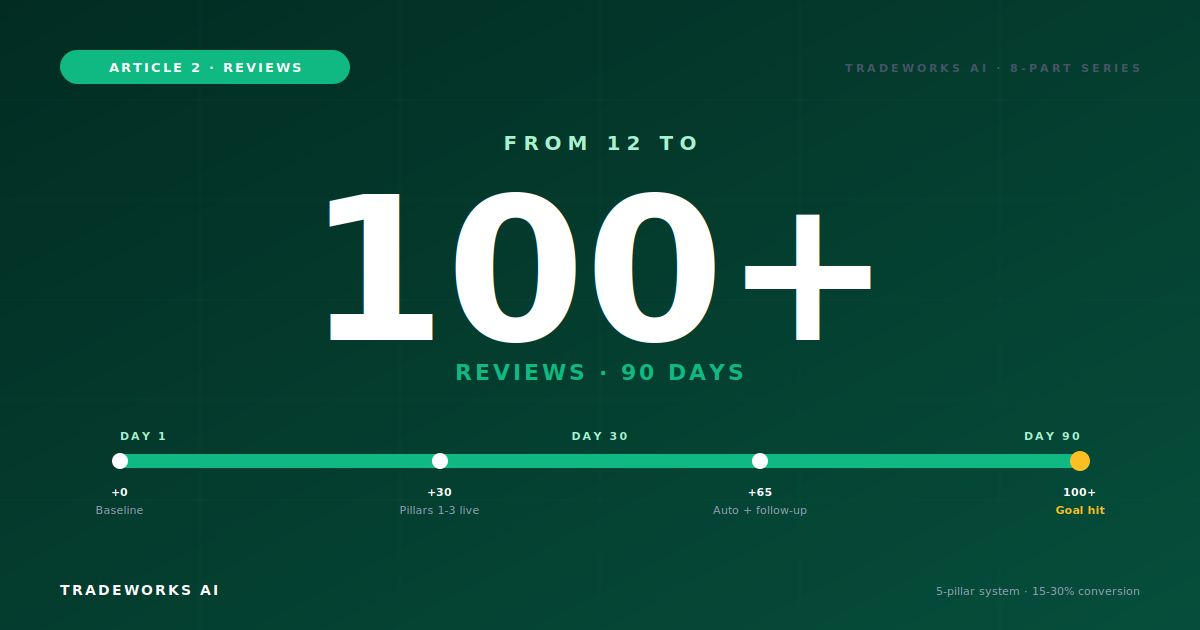
The Review Acquisition System: 100+ Reviews in 90 Days
Continue the Reviews & Reputation series with Part 2 of 8.
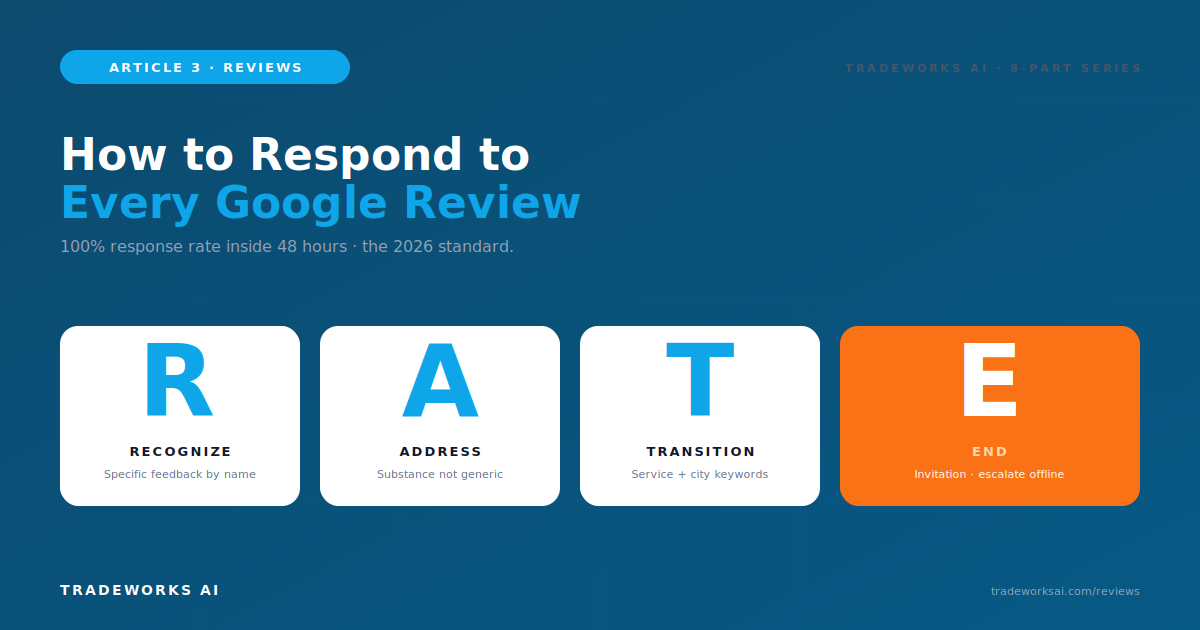
The standard for contractors in 2026 is a 100 percent review response rate within 48 hours, with every response following a four-part structure: Recognize the customers specific feedback, Address the substance of what they said, Transition to a value mention that includes service keywords and location, and End with an invitation to return or escalate offline. Google directly factors response rate into local search ranking. AI systems use response patterns as a business-activity signal. Homeowners read responses to evaluate how you handle both praise and complaints. Generic copy-paste responses produce none of these benefits and signal a checked-out operation. This article covers the R-A-T-E framework, response strategy by review category (5-star, 4-star, 3-star, 1-2 star routine), copy-paste templates with personalization variables, common response mistakes that damage rankings, and the role of AI in drafting responses at scale while keeping a human in the final approval loop.
Most contractors treat review responses as a courtesy. Google treats them as a ranking signal.
First: Google directly weights response rate. Businesses that respond to reviews rank higher in the local pack than otherwise-equivalent businesses that do not. The exact weighting is not published, but Googles own documentation explicitly states that responding to reviews helps your local SEO. Local SEO research consistently confirms a measurable ranking lift for businesses with 100 percent response rates.
Second: AI systems use responses as activity signals. ChatGPT, Gemini, and Perplexity all factor business activity into recommendation calculations. A profile with 200 reviews and zero responses reads as semi-abandoned. A profile with 200 reviews and 200 thoughtful responses reads as actively operated. The active operation gets recommended.
Third: responses appear in search results. Your responses are crawled, indexed, and surface in local search snippets. A response that includes your primary service keyword and city naturally extends the indexable surface area of your Google Business Profile. A response that is just "thanks for the kind words" extends nothing.
Combined: response rate is one of the highest-leverage activities you can run on existing reviews. The acquisition system from Part 2 brings reviews in. The response system from this article makes them work harder.
Acknowledge what the customer specifically said. Reference their actual experience, not a generic version of it. If they mentioned the technician by name, name the technician back. If they mentioned the service area, name the area. If they mentioned a specific outcome, reference the outcome.
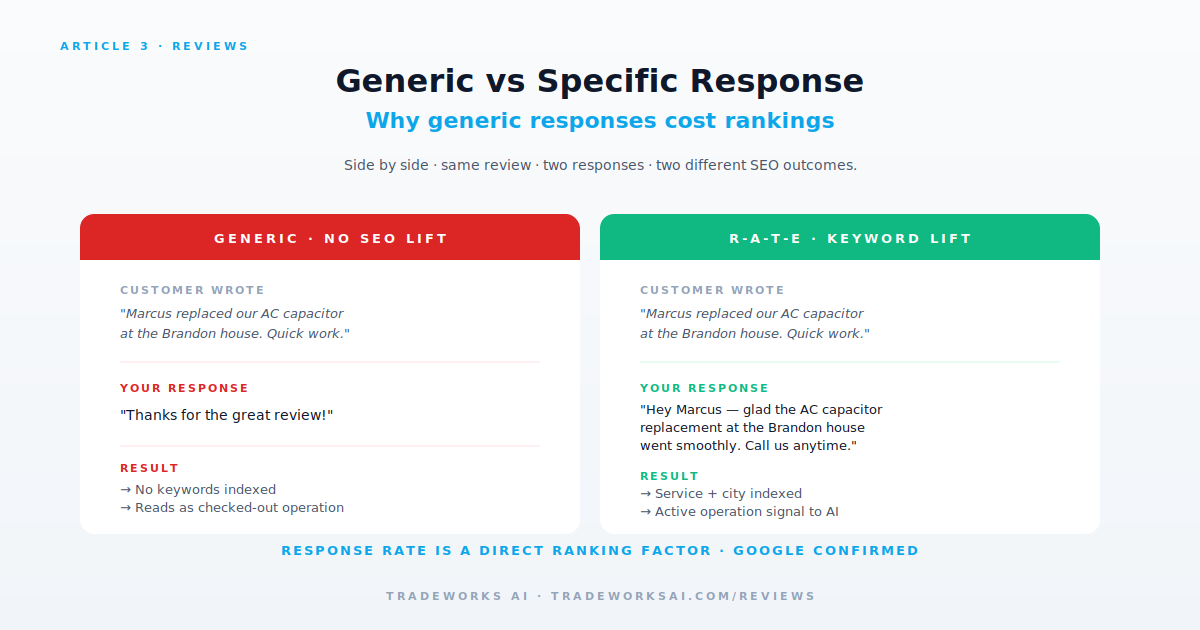
Specific recognition: "Hey Marcus - thanks for taking the time to write this. Glad the AC capacitor replacement went smoothly at the Brandon house."
The specific version does three things at once: it personalizes, it includes the service keyword (AC capacitor replacement), and it includes the geographic keyword (Brandon house). All three feed back into search.
For positive reviews, this means appreciating the specific element they highlighted. For neutral or negative reviews, this means addressing the substance of what they said - either resolution-focused or invitation to discuss offline.
On a 5-star review where the customer praised the technician, the address is acknowledging the technician by name and the work specifically. On a 3-star review where the customer noted scheduling delays, the address is acknowledging the delay reality and what is being done about it.
Avoid generic apology language on negative reviews: "We are sorry you had a bad experience." That phrase signals a templated response that did not actually engage with what the customer said.
Move the response toward a value mention that includes service or location keywords naturally. This is where the SEO weight gets added.
Service keywords to weave in naturally: the trade (HVAC, plumbing, electrical, roofing), the specific service (capacitor replacement, water heater installation, panel upgrade), the service area (city or neighborhood).
Done well: "Glad the water heater installation in Wesley Chapel worked out - if anything else comes up on the property, we are always nearby."
Done badly: "Thanks for choosing us, we appreciate your business." Generic, no keyword integration, indexable value zero.
Close with an invitation to return or escalate. For positive reviews, invite continued engagement. For negative reviews, escalate offline with a direct contact path.
Negative review close: "I am Trevor, the owner - please call me directly at 813-XXX-XXXX so I can make this right."
The owner-direct path on negative reviews accomplishes two things: it shows public accountability, and it pulls the conversation off the public review thread where escalation can become viral.
Each rating category requires a different tone and emphasis. The R-A-T-E structure stays constant; the content shifts.
Most contractors mishandle 5-star responses by being too short. "Thanks!" is not a response. It signals you did not bother.
A strong 5-star response runs 30-60 words and includes: customer name, specific service or technician reference, service keyword, location keyword, and an invitation to return. Three to five sentences typically.
Hey [Customer first name] - thanks for taking the time to write this. Glad the [service type] job at the [neighborhood/city] property went smoothly. [Technician name] is one of our best - I will pass this along to him. If anything else comes up at the [neighborhood/city] place, you have our number. Appreciate the trust.
Thanks [Customer first name]. Means a lot. [Technician name] said the [service type] in [city] went well - he enjoys these. Reach out anytime.
4-star reviews are the most underutilized response opportunity in contractor marketing. The customer is positive but withheld the fifth star for a specific reason - and they often did not say why explicitly. Your response is your chance to surface that reason and address it.
Thanks for the feedback [Customer first name]. We always want a 5-star experience - if there is something we missed on the [service type] job at the [city] property, I would love to hear it. Reach me directly at [phone] or [email] and we will make sure it is handled next time. Appreciate the honest review.
Two notes on this template. One: it does not assume what was wrong - it invites the customer to share. Two: it leaves the public review intact and respectful while opening a private channel for any feedback.
3-star reviews are the trickiest response category. The customer is communicating that something specific was unsatisfactory but they were not angry enough to leave 1 or 2 stars. Future readers will see your response as more important than the original review - it tells them how you handle imperfect situations.
Hi [Customer first name] - thanks for sharing this. I hear you on [paraphrase the concern in their own language]. I am pulling the work order from [date] for the [service type] at the [city] property to understand what happened on our end. I would like to make this right - can you reach me directly at [phone]? I am [owner first name], the owner.
Three notes. One: paraphrase their concern back so they see you read it. Two: reference specifics (date, service type, location) to show this is not templated. Three: name yourself as the owner. This signals public accountability and shifts the relationship dynamic.
This template covers routine 1-2 star reviews where the customer is upset but the situation is recoverable. Part 4 in this series covers crisis-level negative reviews, viral incidents, and situations where the public response strategy is fundamentally different.
[Customer first name], I am sorry your experience with the [service type] at the [city] property did not meet expectations. I want to understand what happened and make it right. Please call me directly at [phone] - I am [owner first name], the owner. Looking forward to hearing from you.
What is intentionally absent: defensiveness, justification, factual rebuttal. None of those work in a public response. They make the contractor look unprofessional regardless of who was actually right. Save the facts for the offline conversation.
What is present: ownership of the experience, owner accountability, direct contact path. This response signals to future readers that you handle problems professionally - which is often more persuasive than the original review is damaging.
Generic copy-paste responses. "Thank you for your business." repeated across 200 reviews signals a checked-out operation. Google can detect templated responses. So can humans.
No keyword integration. Responses that do not mention services or locations forfeit the SEO/AEO benefit. Every response should include at least one service keyword and one location reference.
Defensive responses to negative reviews. Public arguments lose 100 percent of the time, even when the contractor is factually right. The tone signals more than the facts ever can.
Apologetic-only responses to negative reviews. Pure apology with no resolution path looks weak and changes nothing.
Responding too late. The first 48 hours after a review posts is when the most prospects read it. Late responses still help SEO but lose conversion impact.
Not responding at all. The single most damaging mistake. A profile with 60 percent response rate looks worse than a profile with 100 percent response rate plus a few imperfect responses.
AI tools have legitimately useful applications in review response - and one critical limitation.
Useful applications. ChatGPT or Claude can draft initial responses across all four star categories using your brand voice document. The draft saves 60-80 percent of the writing time. The human reviewer adjusts, personalizes specifics, and approves before posting. This pattern works well at scale - a contractor handling 30-plus reviews per month can run the entire response workflow in under 30 minutes per week.
Critical limitation. AI should not respond to negative reviews unsupervised. The tone calibration on a 1-2 star response is too consequential to leave to a model that has no context for the actual job, the customer relationship, or the local dynamics. Negative review responses get drafted by humans, with optional AI assistance for refining language - never the reverse.
FSM-native AI tools (ServiceTitan, Jobber, BirdEye, Podium) increasingly include review response automation. Use them for 4 and 5-star drafts. Manual or owner-drafted only for 3 stars and below.
The single non-negotiable: every response - human or AI-drafted - gets reviewed by a person before posting. The brand voice document from Article 2s acquisition system carries forward to ensure tone consistency.
Google: highest ranking impact, full R-A-T-E framework, public-facing reviews and responses indexed by search. 100 percent response rate within 48 hours.
Yelp: different culture. Yelp users skew skeptical. Defensive responses backfire faster on Yelp than anywhere else. Lean shorter, more measured. Yelp does penalize businesses for review solicitation - keep that in mind when drafting acquisition workflows.
Facebook: visibility-driven. Responses appear to the customers network. Tone slightly warmer than Google. Same R-A-T-E framework.
Angi/HomeAdvisor: formal tone. Customer service language conventions apply. The platform itself sometimes mediates disputes.
BBB: most formal. Responses become part of the BBB record. Treat as you would written customer service correspondence.
Daily review check (Monday-Friday). Office staff or owner pulls all new reviews from the prior 24 hours.
1-2 star reviews: owner-drafted, posted within 24 hours, with same-day offline outreach attempt.
Weekly audit: confirm every review from the prior week has a response. Patch any missed responses.
Monthly review: response rate audit, sample 10 responses for quality check, refine templates if needed.
Part 2 covered how to bring 100-plus reviews in over 90 days. Part 3 covers how to make every one of those reviews work harder for your search visibility, AI recommendations, and conversion rates.
Together: a complete review system. Acquisition pulls reviews in at 15-30 percent conversion. Response strategy multiplies the value of every review by adding indexable, keyword-rich responses that signal active operation to Google, AI systems, and prospects reading them.
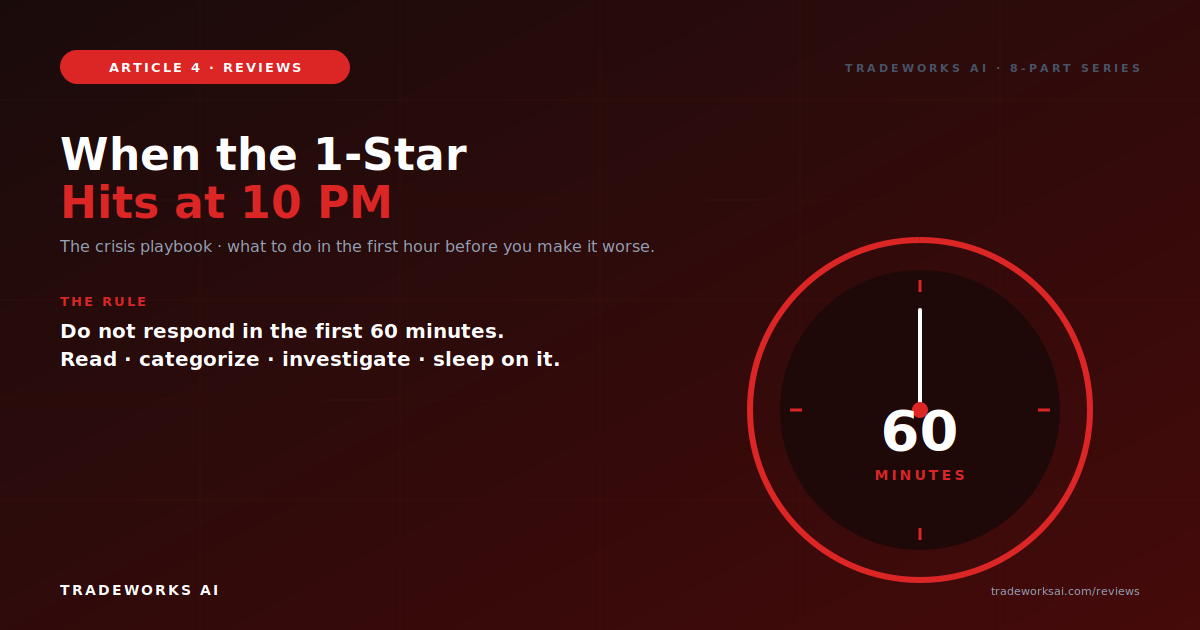
Read Part 4 next: The Negative Review Crisis Playbook - What to Do When a 1-Star Hits at 10 PM. The viral negative review and how to handle situations that escalate beyond the routine response framework.
Within 48 hours for 5-star and 4-star reviews. Within 24 hours for 3-star and below. The first 48 hours after a review posts is when the most prospects read it - response timing materially affects conversion impact.
Yes for 5-star and 4-star reviews where the tone is straightforward. Use ChatGPT, Claude, or your FSMs built-in AI to generate drafts using your brand voice document. Human review and approval before posting is non-negotiable. For 3-star and below, draft manually - the tone calibration is too consequential for unsupervised AI.
Yes. The R-A-T-E framework applies across platforms but tone calibrates differently. Yelp users skew skeptical and defensive responses backfire faster. Facebook tone runs slightly warmer because responses appear in social feeds. BBB is the most formal. Adjust tone, keep the structure.
Flag it for removal through Google Business Profile. Do not respond publicly to fake reviews if you intend to flag them - public responses can complicate Googles review of the flag. If Google declines to remove, respond professionally to mitigate damage. Part 4 covers this scenario in depth.
Yes. Google allows you to edit responses at any time. If you realize a response was suboptimal, edit it. Do not delete and re-post - this creates a notification to the customer and looks defensive.
Yes if the review is less than 6 months old. Late responses still help SEO and signal active operation. Older than 6 months: lower priority but acceptable for sustained activity signal. Focus first on new reviews then backfill chronologically.
Most contractors think their review profile is "fine." Then we benchmark it against the local competitors who are taking the AI recommendation slots. Our free audit checks volume, recency, rating, response rate, and platform coverage — and shows you the highest-leverage moves to get to 4.7+ stars and 200+ reviews this year.
Continue the Reviews & Reputation series with Part 2 of 8.
Continue the Reviews & Reputation series with Part 4 of 8.