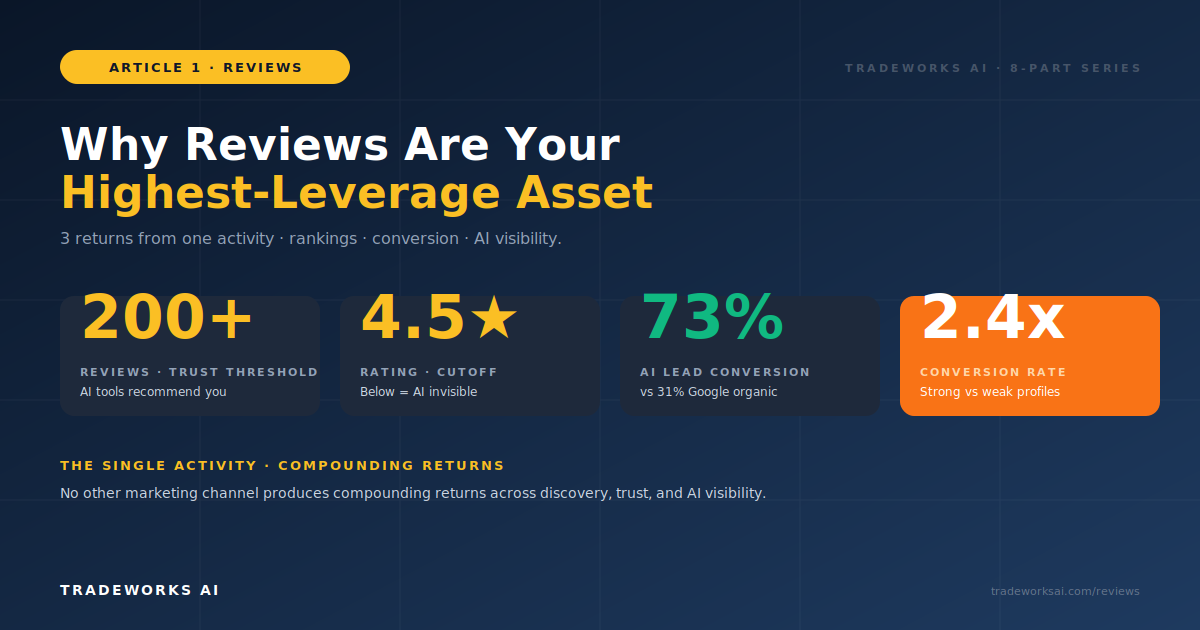
Reviews & Reputation · Part 1
Why Reviews Are the Highest-Leverage Marketing Asset
Continue the Reviews & Reputation series with Part 1 of 8.
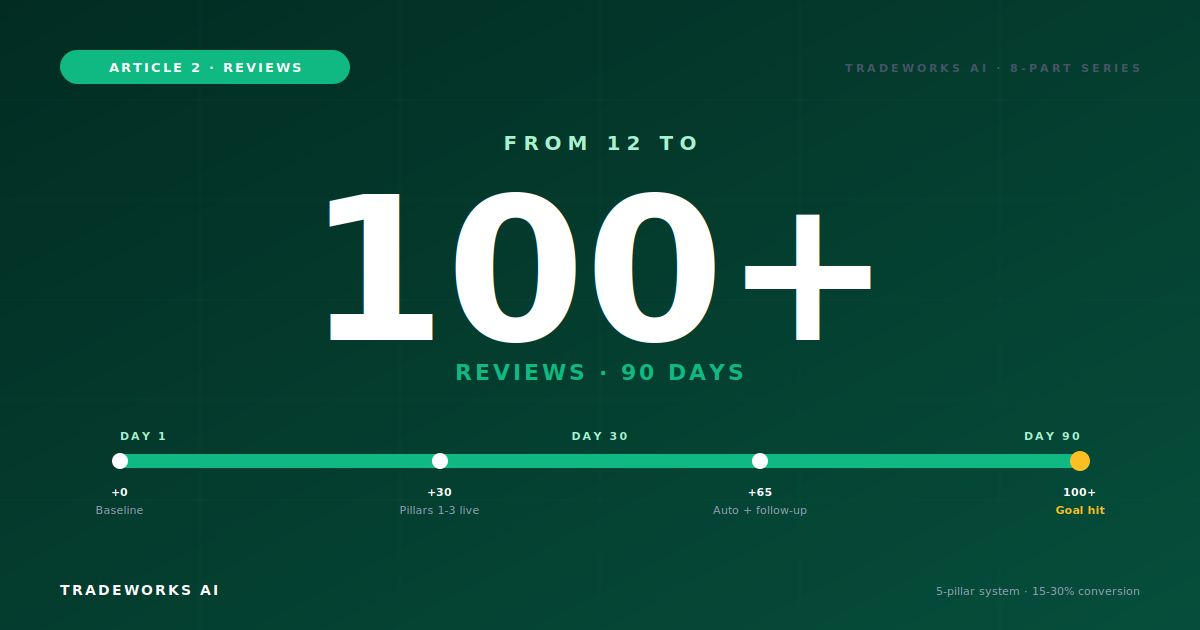
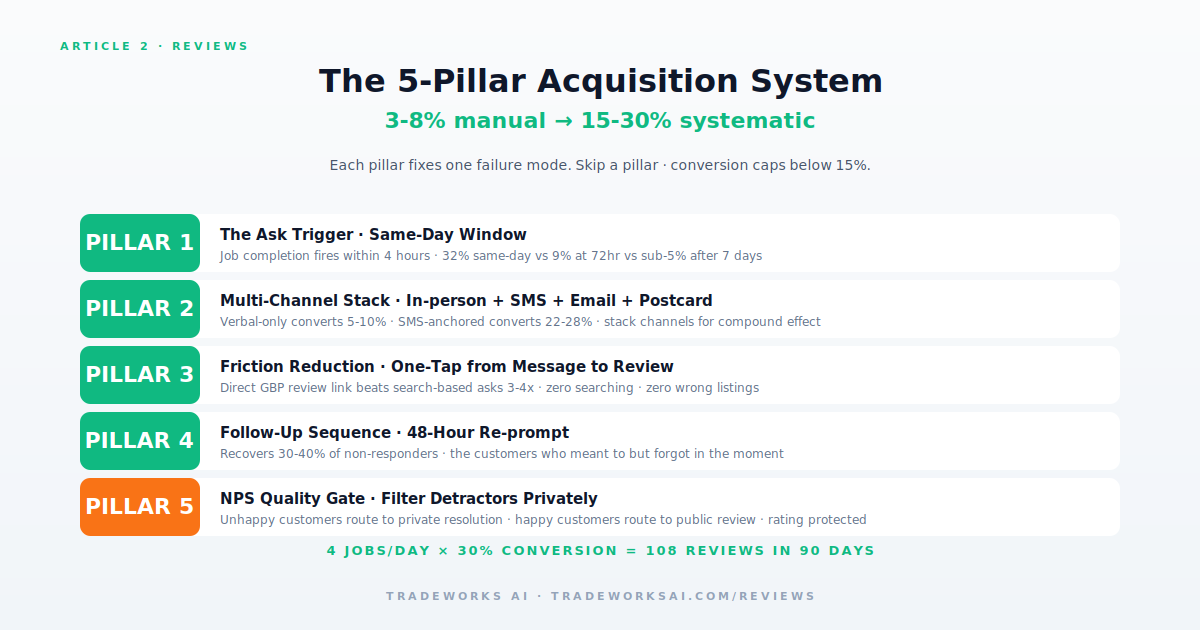
Contractors without a systematic review acquisition process convert 3 to 8 percent of completed jobs into online reviews. Contractors running a structured 5-pillar system convert 15 to 30 percent. That conversion gap is the difference between adding 12 reviews per quarter and adding 100-plus. The system has five components: a precisely-timed ask trigger anchored to the job completion moment, a multi-channel ask stack across in-person, SMS, email, and postcard, friction reduction down to a single tap from message to Google review, a follow-up sequence that catches non-responders without harassment, and a quality gate that filters unhappy customers out of the public review request flow before they damage your rating. This article covers each pillar in detail, the 90-day implementation timeline, the common pitfalls that derail conversion rates, and the tools and software options for any contractor stage from solo operator to multi-location enterprise.
Lets put real numbers against the goal. 100 reviews in 90 days works out to roughly 1.1 reviews per day. The math gets easier when you back into your specific job volume.
A contractor doing 4 jobs per day at a 30 percent conversion rate generates 1.2 reviews per day. 108 in 90 days. Mission accomplished.
A contractor doing 8 jobs per day at a 15 percent conversion rate generates 1.2 reviews per day. Same outcome, lower conversion needed because volume is higher.
A contractor doing 15 jobs per day at a 10 percent conversion rate generates 1.5 reviews per day. 135 in 90 days. The system overdelivers.
The math works for any contractor doing 4 or more jobs per day. Below that volume, you can still hit 100 reviews in 90 days but the conversion rate has to be higher: a 2-job-per-day contractor needs 55 percent conversion. Achievable but tight - and most operations at that scale should set a 60 or 90-review goal instead.
Most contractors plateau between 3 and 8 percent. The 5-pillar system is what closes the gap.
First: inconsistent asking. The technician remembers to ask on the jobs where the customer is visibly happy and forgets on the routine ones. The result: only 30-40 percent of completed jobs get any review request at all.
Second: asking too late. The peak satisfaction window is the 24 hours immediately after job completion. Same-day asks convert at roughly 32 percent. 24-hour asks at 24 percent. 72-hour asks at 9 percent. After 72 hours, conversion drops below 5 percent. Most contractors who do ask are asking 3-7 days later.
Third: single-channel asking. The technician says "hey, leave us a review" verbally at the front door. The customer says yes. The customer drives off and never thinks about it again. Verbal-only asks convert at 5-10 percent because there is no follow-up artifact. SMS-anchored asks convert at 22-28 percent because the link is in the customers pocket.
Fourth: friction-heavy asks. The customer is told to search for the business on Google and leave a review. Half of customers drop off at the search step. The other half find the wrong listing. Direct-link asks convert at 3 to 4 times the rate of search-based asks.
Fifth: no follow-up. One verbal ask, no second touch. The 60-70 percent of customers who intended to leave a review but forgot in the moment never get prompted again. A simple 48-hour email follow-up recovers 30-40 percent of those non-responders.
Each of these issues alone drops conversion by 30-50 percent. Combined, they keep most contractors stuck below 8 percent forever.
Each pillar addresses one of the failures above. All five run together. Skip a pillar and the conversion rate caps below 15 percent.
The trigger is the moment the system fires. Three rules.
Rule 1: Trigger at job completion, not at payment. Pre-payment asks outperform post-payment asks by roughly 2x. The customer is happy the work is done. The financial transaction has not yet become the dominant memory.
Rule 2: Trigger automatically. Manual asks suffer from inconsistency. The system should fire on every job completion regardless of who remembers. FSM platforms (ServiceTitan, Jobber, Housecall Pro) all support automatic trigger workflows. Standalone tools (NiceJob, Podium, BirdEye) integrate with most FSMs to handle the trigger.
Rule 3: Time the trigger to the same-day window. The first message goes out within 4 hours of job completion. Conversion rates drop sharply once the customer leaves the satisfaction peak.
Single-channel asking caps conversion below 12 percent. Multi-channel asking pushes it past 25 percent. Five channels in order of conversion impact.
Channel 1: SMS at job completion. Highest converting digital channel. 22-28 percent conversion when paired with a direct review link. Sent same-day, ideally within 4 hours.
Channel 2: In-person verbal at job completion. Anchors the request and signals to the customer that the SMS is coming. Should not be the only ask but improves the SMS conversion when used together.
Channel 3: Email at 48 hours for SMS non-responders. 8-12 percent additional conversion. Different format and channel catches customers who ignore SMS.
Channel 4: Postcard at 7 days for non-digital customers. 4-6 percent conversion but addresses customers who do not engage with SMS or email. Useful in older or rural demographics.
Channel 5: Phone call at 14 days for high-value jobs only. 15-25 percent conversion when triggered for invoices over a threshold. Resource-intensive but high return on premium customers.
Every additional click between the customer and the Google review form drops conversion by 15-25 percent. Three friction-reduction tactics.
Tactic 1: Direct review link. Generated from your Google Business Profile dashboard. Format is typically a short g.page/r/ URL or a search.google.com link with your place ID embedded. One tap from the SMS opens the review form pre-loaded with your business.
Tactic 2: QR codes everywhere. On invoices. On business cards. On truck wraps. On door hangers left after the job. Customers who wanted to review but forgot rediscover the prompt at the next physical touchpoint.
Tactic 3: Pre-typed message starter. Not a script - that violates TOS and produces inauthentic-looking reviews. Just a friendly opening that gives the customer something to start from. "Hi - thanks for handling our AC repair so quickly. The technician was..." Then the customer fills in the rest.
No-response after the first ask is the norm, not the exception. The follow-up sequence catches the 60-70 percent of customers who would have left a review but forgot.
Day 2: Email follow-up if no review yet. Different copy, same direct link.
Day 7: Second SMS or postcard with a different angle - typically referencing what the customer said they were happy about.
Day 14: Phone call for high-value jobs only. Stop here. Further outreach crosses into harassment territory and damages relationships.
Total touchpoints: 4 over 14 days. After Day 14, the workflow ends. The customer either reviewed or they moved on.
This is the pillar most contractors skip and the one that protects your rating most. Before the first review request goes out, send a short Net Promoter Score question to filter the response.
Question: "On a scale of 0 to 10, how likely are you to recommend us to a friend or family member?"
Customers responding 9 or 10 (Promoters) get the review request. These are the customers most likely to leave 5-star reviews and most likely to mention specific positive details.
Customers responding 7 or 8 (Passives) get a follow-up question first: "What could we have done to make it a 10?" If their response is positive ("nothing, it was great"), proceed with the review request. If they identify a real issue, address the issue before sending any review request.
Customers responding 0 to 6 (Detractors) do NOT get a public review request. They get a private message: "We would love to make this right - can we discuss?" Resolve the issue offline. If you cannot resolve it, accept the loss but do not invite them to publish a 1-star review.
The Quality Gate does two things: it protects your rating from systemic 1-star damage, and it surfaces resolvable issues before they become public. A contractor running this filter for 12 months ends with a higher star average AND a better customer experience because issues get caught and fixed.
Important note: the Quality Gate is not review filtering for the purpose of suppression. It is feedback filtering for the purpose of issue resolution. The detractor still gets to leave a review if they want - you just do not invite them. This distinction matters legally under FTC endorsement guidelines and ethically.
A working system in 90 days. Four phases.
Week 1: Count current reviews. Total. Last 30 days. Last 90 days. Calculate your current job-to-review conversion rate. Identify FSM-native review tools or evaluate standalone options.
Week 2: Generate your direct Google review link. Print QR codes for trucks, invoices, and business cards. Configure the review request workflow in your FSM or standalone tool. Build the NPS gate logic.
Train technicians on the in-person ask script. Keep it short - the SMS does the heavy lifting.
Run the workflow on 5-10 jobs as a test. Monitor each request manually.
Run the system on every job. Manual quality check on each request the first week.
Track conversion rate weekly. Aim for 15 percent by end of Week 6.
A/B test SMS opening lines, follow-up timing, and review channels (Google primary, then layer Yelp/Facebook).
Weekly conversion review. Iterate the lowest-performing channel.
Add multi-platform requests (Google primary, then Yelp or Facebook for customers who already left Google reviews).
Generic asks. "Leave us a review" without specifying Google vs Yelp vs Facebook causes confusion and drop-off. Always specify the platform.
No NPS gate. Sending review requests to detractors is the fastest way to drop your rating. The Quality Gate is non-negotiable.
Search-based asks. Telling customers to search for you on Google instead of providing a direct link cuts conversion in half.
Single-channel reliance. Verbal-only or SMS-only asks both cap below the multi-channel rate. Stack the channels.
No follow-up. The first ask catches 30-40 percent of intended reviewers. The follow-up sequence catches the rest.
If you are on a major FSM, the review automation is likely already available. ServiceTitan Marketing Pro includes review request automation. Jobber Plus and AI tier include review request workflows. Housecall Pro Pro plan includes integrated review tools. Cost: usually included in your existing FSM subscription. ROI window: immediate.
If your FSM does not include review automation or you want more sophisticated tooling, standalone platforms integrate with most FSMs. NiceJob (~75 dollars/month) is the most cost-effective for solo and small operations. Podium (~300 dollars/month) handles SMS-heavy review workflows well. BirdEye (~400 dollars/month and up) is the enterprise-tier option with multi-platform syndication and AI response capabilities.
If budget is tight, a basic DIY stack works for stages 1-2. Twilio for SMS (pay-per-message, ~10-30 dollars/month for typical contractor volume). Mailchimp or similar for email follow-ups (free at low volume). Manual NPS gate via Google Form or Typeform. Total cost: 30-50 dollars/month. Trade-off: more office labor required.
Starting baseline of 60 reviews. End of 90 days: 160 reviews. The contractor crosses the 150-review AI recommendation threshold. They establish a sustainable 30-plus reviews per month maintenance pace. Part 1 in this series covered the revenue math at this scale: 280K to 480K in additional annual revenue from the visibility and conversion improvements.
The system compounds beyond Day 90. Months 4 through 12 typically add another 250-400 reviews on the same automated workflow. By month 12, the contractor is at 400-plus reviews and well into the AI recommendation tier across ChatGPT, Gemini, and Perplexity.
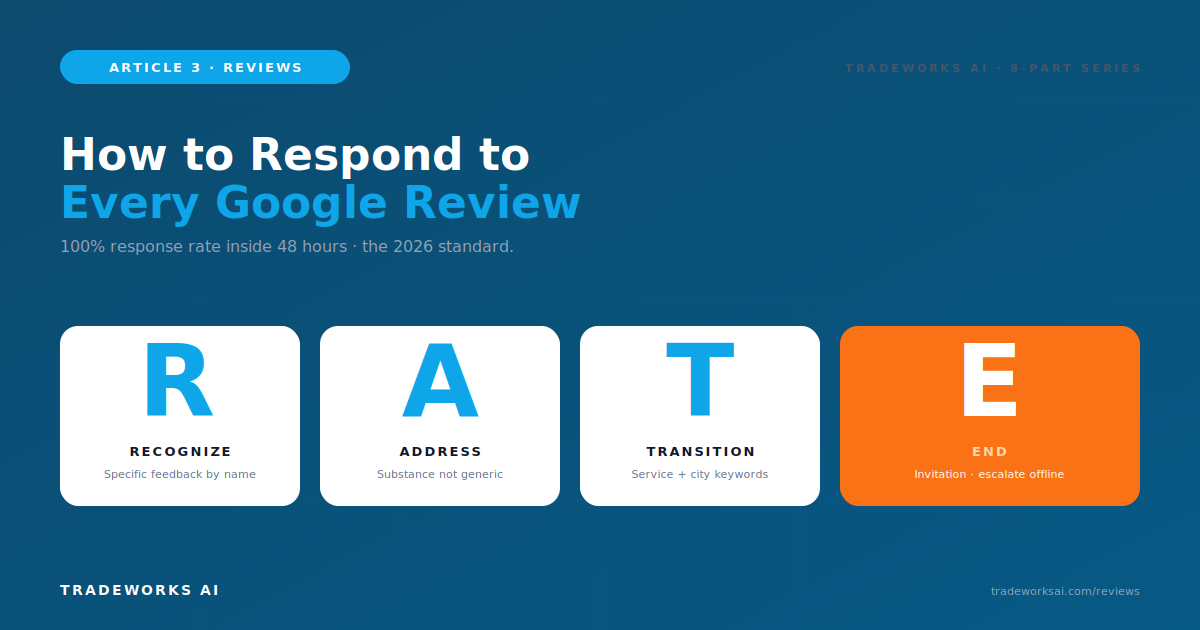
Read Part 3 next: How to Respond to Every Google Review (Templates for Positive, Neutral, and Negative). Response strategy is the second half of the review system - what you say back matters as much as what comes in.
Conversion rate improvements appear immediately as the review profile strengthens. Local search ranking improvements typically appear within 60 to 90 days of consistent review acquisition. AI search visibility shifts take 90 to 180 days because AI systems update their training and retrieval data more slowly than Google does.
No. Offering discounts, gift cards, or any compensation for reviews violates the terms of service of every major platform and the FTCs endorsement guidelines. Penalties range from review removal to permanent business profile suspension. Legitimate review acquisition relies on systematic asking and friction reduction, not incentives.
The postcard channel handles this. A physical mailer 7 days post-job with a QR code linking to your direct review link converts at 4-6 percent and addresses customers who are not digital-first. For older demographics or rural service areas, postcards can outperform email follow-ups.
Most major FSMs include some level of review automation. ServiceTitan Marketing Pro, Jobber AI, and Housecall Pro all support automatic review request triggers. Configuration depth varies. For sophisticated multi-channel workflows or NPS gating, standalone tools (NiceJob, Podium, BirdEye) often outperform the FSM-native options.
Google occasionally filters reviews it considers suspicious. Common triggers: review velocity that exceeds your business size, reviews from accounts with patterns Google flags, or reviews containing language that triggers spam detection. Real reviews from real customers using direct review links rarely get filtered. If you experience high filter rates, audit your acquisition workflow for issues. Part 4 in this series covers crisis response including filtered reviews.
Yes. The DIY tier (Twilio + Mailchimp + manual NPS) works for any operation. The trade-off is more office labor and more potential for inconsistent execution. If you are doing 4-plus jobs per day without an FSM, an FSM with built-in review automation is usually a better investment than the standalone DIY stack.
Most contractors think their review profile is "fine." Then we benchmark it against the local competitors who are taking the AI recommendation slots. Our free audit checks volume, recency, rating, response rate, and platform coverage — and shows you the highest-leverage moves to get to 4.7+ stars and 200+ reviews this year.
Continue the Reviews & Reputation series with Part 1 of 8.
Continue the Reviews & Reputation series with Part 3 of 8.