Real Estate Tech · Part 14
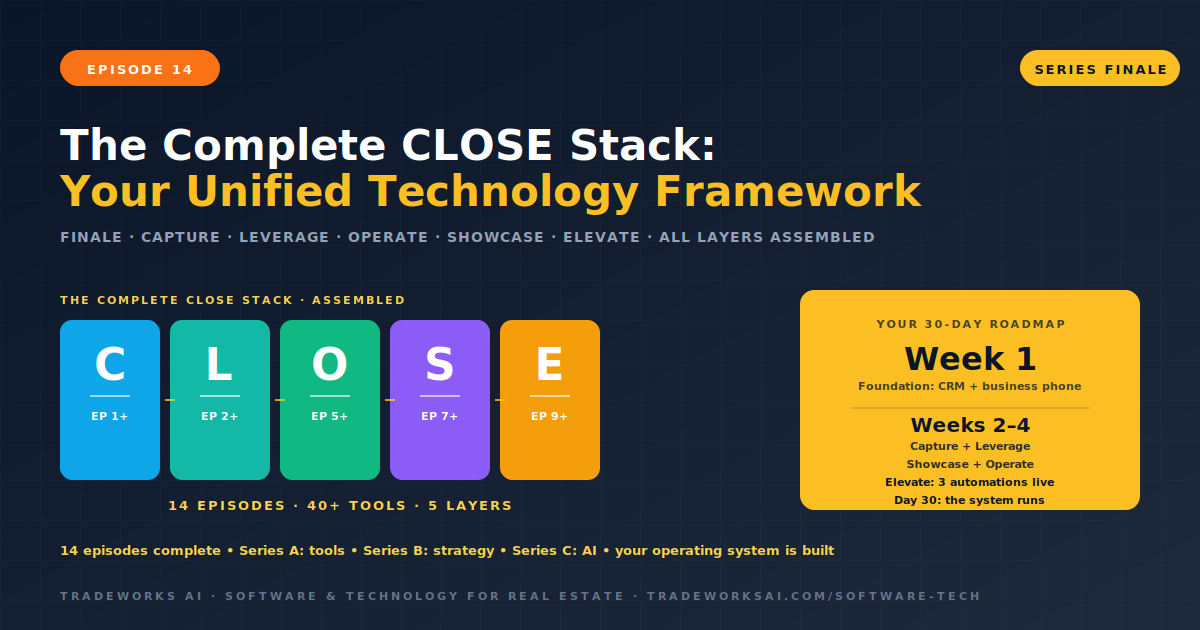
The Complete CLOSE Stack for Real Estate Professionals: Your Unified Technology Framework for 2026 and Beyond (Series Finale)
Continue the Real Estate Tech Stack series with Part 14 of 14.
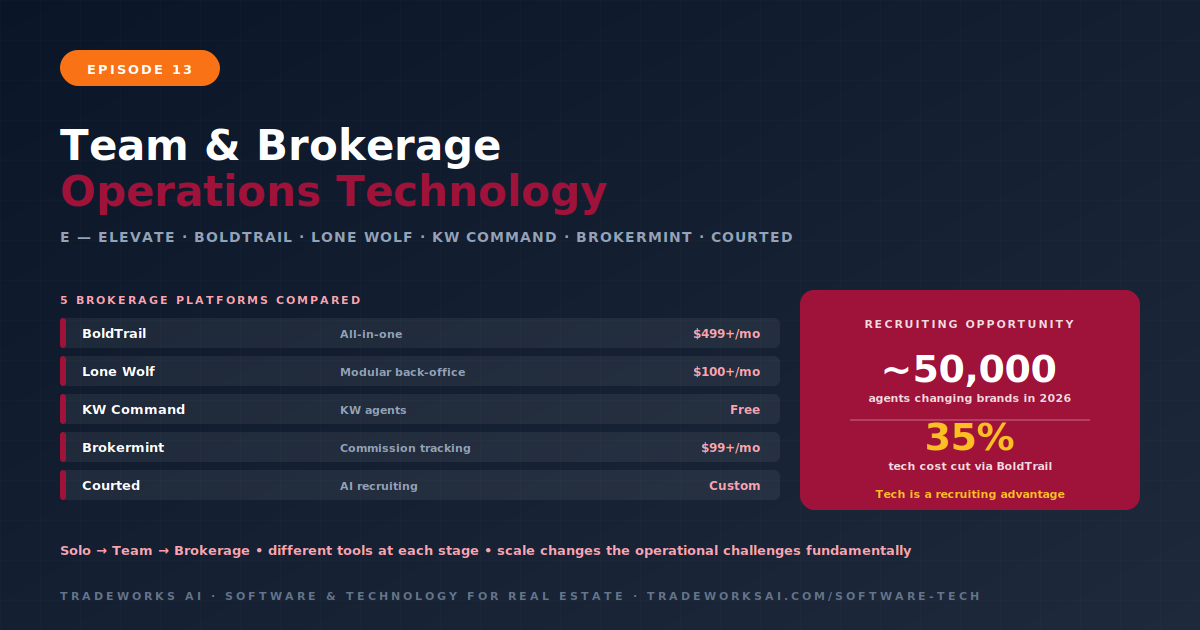
The technology that serves a solo agent does not serve a team leader. The technology that serves a team leader does not serve a brokerage owner. Scaling a real estate business requires different tools at each stage because the operational challenges change fundamentally: a solo agent manages their own leads and transactions; a team leader manages people, lead distribution, accountability, and shared systems; a brokerage owner manages financial operations, compliance, recruiting, and an ecosystem of agents with diverse needs. Approximately 50,000 agents are projected to change brands in 2026, with mid-tier producers 35% more likely to switch brokerages than they were just three months prior. The technology a brokerage offers is increasingly a recruiting advantage — or a recruiting liability. This episode maps the technology requirements at each growth stage and compares the platforms that power team and brokerage operations.
| Stage | Key Needs | Primary Technology |
|---|---|---|
| Solo Agent (1 person) | Personal CRM, lead gen, marketing, transaction mgmt | Follow Up Boss, Real Geeks, dotloop, Canva, Buffer |
| Team Leader (2–15 agents) | Lead routing, accountability, shared CRM, team communication | FUB with team features, BoldTrail, Slack, ShowingTime |
| Brokerage Owner (15+ agents) | Commission mgmt, compliance, recruiting, back-office, agent ecosystem | Lone Wolf, BoldTrail, Brokermint, Courted, KW Command |
The transition from solo agent to team leader is the most challenging technology shift in a real estate career. As a solo agent, your tools are personal: your CRM holds your contacts, your email sends your campaigns, your transaction management tracks your deals. When you add team members, every tool must suddenly accommodate multiple users, shared access, role-based permissions, and accountability tracking.
The minimum technology requirements for a functional team include a CRM with lead routing that distributes incoming leads to team members based on rules you define (round-robin, geographic, price range, or lead source), accountability dashboards showing each agent’s response times, conversion rates, and pipeline status, shared transaction management where the team leader has visibility into every active deal, and a team communication channel separate from client communication.
Follow Up Boss remains the strongest CRM for teams in the 2 to 15 agent range because of its lead routing flexibility, speed-to-lead tracking, and integration with virtually every lead source. At $58 to $69 per user per month, it scales without requiring a platform migration. The critical upgrade from solo to team is adding lead routing rules and accountability dashboards — features that exist in FUB but that solo agents rarely configure.
When a team grows beyond 15 agents or when an agent opens their own brokerage, the technology needs shift from CRM-centric to operations-centric. The brokerage owner now manages commission structures (splits, caps, royalties, franchise fees), compliance (document retention, audit readiness, licensing), recruiting (identifying, attracting, and onboarding new agents), and financial reporting (profit and loss, trust accounts, 1099 preparation). These functions require specialized back-office software that CRMs do not provide.
| Platform | Best For | Key Capabilities | Pricing |
|---|---|---|---|
| BoldTrail (Inside RE) | All-in-one brokerages | Front-office CRM + IDX + lead gen + back-office (commissions, billing, onboarding) + recruiting | ~$499/mo solo, scales for teams/brokerages |
| Lone Wolf Technologies | Back-office specialists | Back Office ($100/mo), BrokerMetrics (recruiting), Cloud CMA ($45/mo), Transact, Authentisign (35M+ signings) | Modular — assemble what you need |
| KW Command | Keller Williams agents | CRM + 75+ integrations (Lone Wolf, Canva, Google Gemini, RemyAI). Open ecosystem. Free for KW agents. | Free (KW agents only) |
| Brokermint (BoldTrail BackOffice) | Commission tracking | Splits, caps, royalties, franchise fees, agent billing, 1099s, QuickBooks integration | ~$99+/mo |
| Courted | AI agent recruiting | Predictive analytics to identify agents likely to move. ComposeAI for outreach. Recruitment CRM. | Call for pricing |
BoldTrail, the evolution of kvCORE by Inside Real Estate, is the most comprehensive all-in-one platform for real estate brokerages in 2026. The platform combines front-office tools (AI-powered CRM, customizable IDX websites with 600 or more MLS integrations, lead generation, marketing automation, and transaction management) with back-office operations (commission management, agent onboarding, billing, reporting, and QuickBooks integration) and a dedicated recruiting module. Brokerages switching to BoldTrail report cutting technology costs by approximately 35% by consolidating multiple separate tools into one ecosystem.
For brokerage owners who want a single platform that handles both the agent-facing experience and the financial back-end, BoldTrail is the most complete option available. The tradeoff is cost — solo agent plans start around $499 per month, and brokerage plans scale significantly higher — and complexity. The platform has a learning curve, and the depth of features means teams need dedicated onboarding time. For brokerages managing 20 or more agents, the consolidation value typically justifies the investment.
Lone Wolf takes a different approach than BoldTrail’s all-in-one model: modular products that brokerages can assemble based on their specific needs. The Back Office product at approximately $100 per month unifies team management, accounting, transaction tracking, and commission processing. BrokerMetrics enables recruiters to identify rising producers based on sales volume, transaction count, and market share. Cloud CMA at $45 per month creates professional listing presentations with MLS data integration. Transact handles transaction management. Authentisign provides digital signatures with over 35 million signings processed annually.
Lone Wolf’s strength is flexibility: brokerages that already have a CRM they love (like Follow Up Boss) can add Lone Wolf’s back-office and recruiting tools without replacing their entire tech stack. The Foundation platform, launched in 2024, modernizes the user experience and provides faster access to integrated tools. Lone Wolf serves over 10,000 offices, making it one of the most widely adopted brokerage operations platforms in North America.
Commission management is the most operationally critical back-office function for brokerages. Every deal requires accurate calculation of agent splits, brokerage fees, franchise royalties, transaction fees, referral fees, and tax withholding. Errors in commission calculations create agent disputes, financial liability, and regulatory risk.
Brokermint, now BoldTrail BackOffice, is the most widely used standalone commission management platform. It handles split calculations based on any structure (percentage splits, graduated splits, caps, team splits), tracks agent billing and cap status, generates 1099 forms, integrates with QuickBooks for accounting, and provides financial reporting for brokerage management. At approximately $99 or more per month, it serves brokerages that need dedicated commission tracking without a full platform migration.
For brokerages already on BoldTrail or Lone Wolf, commission management is included in the platform. For brokerages using a separate CRM and transaction management system, Brokermint bridges the gap between the deal closing and the money flowing correctly.
With approximately 50,000 agents projected to change brands in 2026, recruiting is the growth engine for brokerages. Traditional recruiting relies on personal relationships, market center events, and cold outreach. Technology-enhanced recruiting adds data-driven identification of agents likely to move, predictive analytics based on production trends and market activity, and AI-generated personalized outreach.
Lone Wolf’s BrokerMetrics provides data on agent production, transaction volume, market share, and performance trends — enabling recruiters to identify rising producers before competing brokerages notice them. Courted applies predictive analytics similar to tools like SmartZip and Offrs (which predict likely sellers) but for agent movement: identifying producing agents who are poised to change brands based on behavioral signals, production trajectory, and market conditions. ComposeAI generates personalized recruitment messages based on the agent’s production data and career stage.
For brokerage owners, the recruiting technology stack is increasingly the competitive differentiator. The brokerage that identifies a strong agent before the competition and delivers personalized, data-informed outreach has a measurable advantage over the brokerage that relies on pizza lunches and generic pitch decks.
As teams grow, communication infrastructure becomes critical. The tools that work for a solo agent — text messages and phone calls — create chaos at the team level when 10 agents are texting the team leader about different issues in the same thread. Structured team communication requires a dedicated internal channel (Slack or Microsoft Teams), clear separation between client communication and team communication, and organized channels for different functions (listings, transactions, marketing, general).
Slack is the most adopted team communication platform in real estate, with channels that can be organized by function: a listings channel for new listing activity, a transactions channel for deal updates, a leads channel for incoming lead notifications, and a general channel for team announcements. Integration with CRMs, transaction management platforms, and automation tools (via Zapier or Make) means lead notifications, deal status updates, and showing feedback can flow into Slack automatically. Google Workspace provides the productivity backbone: shared calendars, documents, spreadsheets, and video conferencing.
In 2026, the technology a brokerage provides is a recruiting tool. Agents evaluating brokerages ask: what CRM do you provide? What lead sources are included? What marketing tools are available? What is the transaction management platform? Is there a commission dashboard where I can see my pipeline and earnings in real time? A brokerage that answers “we provide BoldTrail with integrated CRM, IDX website, lead generation, marketing automation, and commission tracking” is more compelling than one that answers “we have a shared printer and you can use whatever CRM you want.” The technology investment is not just operational efficiency. It is agent attraction and retention.
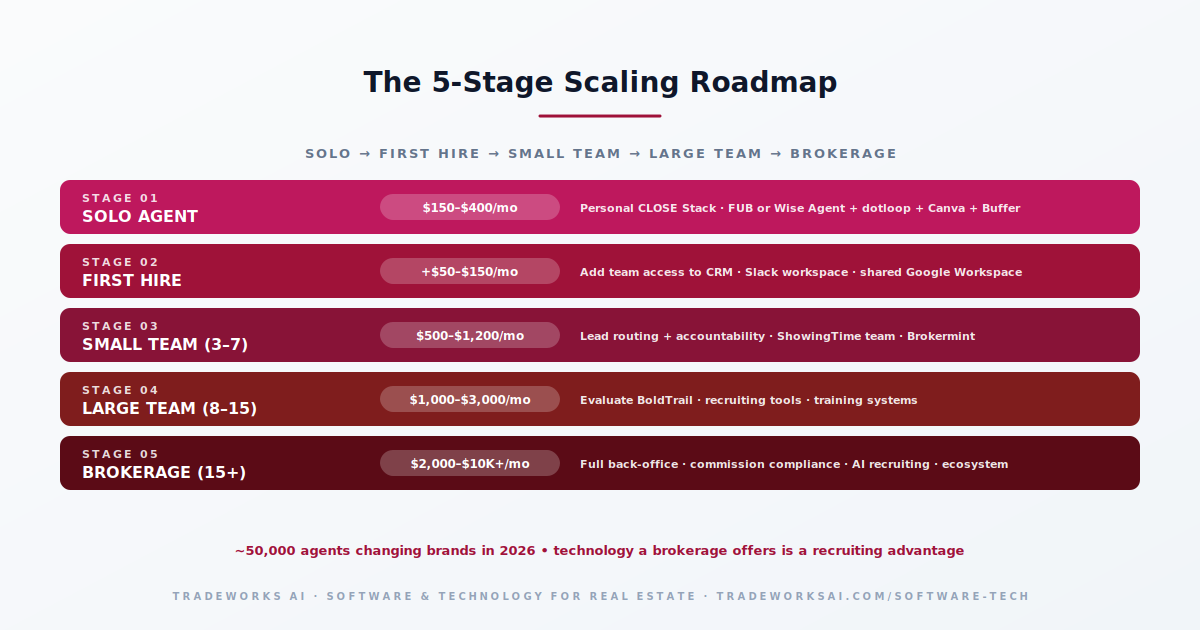
When you hire your first team member who needs access to your CRM, leads, or transactions. The transition should happen before the hire, not after. Set up team features in your CRM, establish lead routing rules, create a Slack workspace, and document your processes before bringing someone on. The worst time to configure team technology is while simultaneously training a new agent.
Commission management. Every other function has workarounds — agents can use their own CRMs, their own marketing tools, their own transaction platforms. But commission calculation, compliance, and financial reporting are brokerage-level responsibilities that require dedicated software. Brokermint at approximately $99 per month is the minimum viable back-office for a new brokerage.
For most solo agents, no. BoldTrail’s value scales with team and brokerage size. A solo agent gets more value from Follow Up Boss at $58 to $69 per month plus individual tools for each function. BoldTrail becomes cost-effective when the consolidation of 3 to 5 separate tools into one platform saves time, reduces integration friction, and the team features (lead routing, accountability, back-office) are actively used.
Three approaches: use BrokerMetrics or comparable analytics to identify rising producers in your market based on transaction volume and production trends. Use Courted’s predictive analytics to identify agents likely to change brands. Lead with your technology offering in recruitment conversations — demonstrate the CRM, show the lead sources, walk through the commission dashboard. Agents who are serious about growth evaluate the tools as much as the split.
No. They serve similar functions through different approaches. BoldTrail is all-in-one: front-office and back-office in one platform. Lone Wolf is modular: add back-office, recruiting, and presentations to your existing CRM. Choose one approach. If you want consolidation, BoldTrail. If you want to keep your current CRM and add back-office, Lone Wolf.
Most agents buy tools in reaction to problems. The result: disconnected subscriptions that duplicate data and create more friction than they solve. The CLOSE Stack Self-Assessment grades your stack across all 5 layers and identifies the highest-leverage gap to close first.
Continue the Real Estate Tech Stack series with Part 14 of 14.
Continue the Real Estate Tech Stack series with Part 1 of 14.