Real Estate Tech · Part 2
The Best Real Estate CRM in 2026: A Head-to-Head Comparison for Agents and Teams
Continue the Real Estate Tech Stack series with Part 2 of 14.
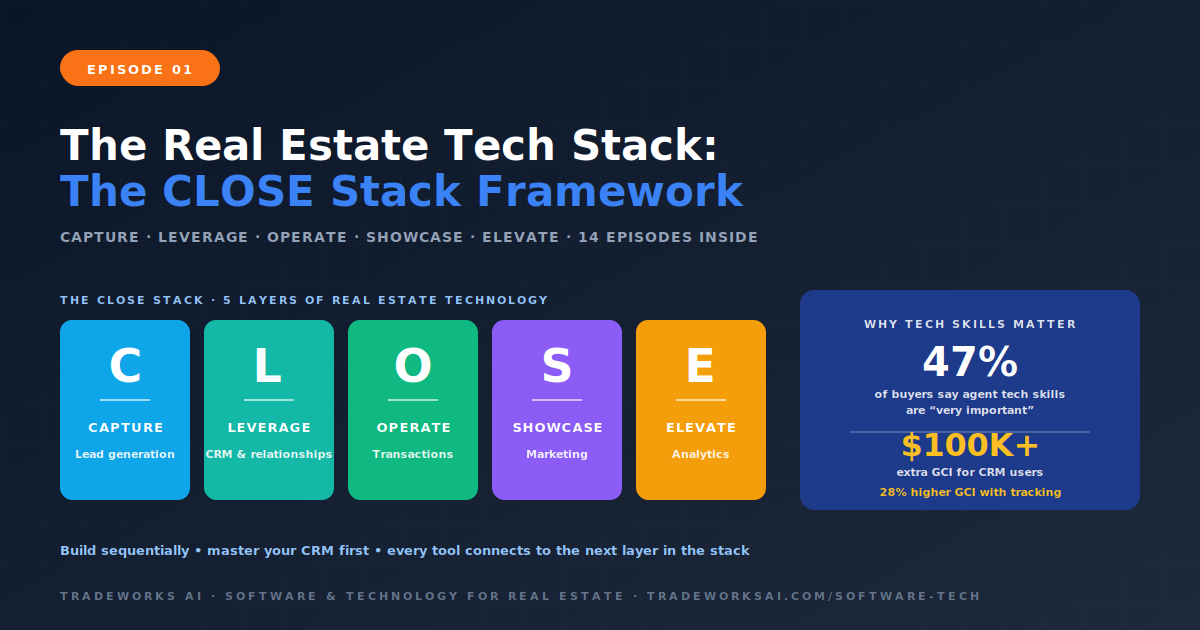
The real estate tech stack is the collection of software tools an agent uses to generate leads, manage relationships, execute transactions, market listings, and analyze business performance. In 2026, the right technology stack separates agents who close 20+ deals a year from agents who struggle to hit 6. According to the National Association of Realtors’ 2025 Technology Survey, 47% of buyers say an agent’s technology skills are “very important” in choosing who to work with, and agents who use CRM technology earn $100,000 or more in gross commission income compared to agents who don’t. This article introduces the CLOSE Stack — a 5-layer framework that organizes every tool category into a system that works together, not in isolation.
Most agents buy tools in reaction to problems. A lead slips through the cracks, so they buy a CRM. A listing sits too long, so they invest in professional photography. An open house flops, so they try Facebook ads. The result is a collection of disconnected subscriptions that don’t talk to each other, duplicate data, and create more friction than they solve.
The NAR Technology Survey confirms this pattern. One-third of agents spend $50 to $250 per month on technology. Twenty percent spend $251 to $500. Twenty-four percent spend over $500 per month. But spending more does not automatically produce better results. Agents who track their lead-source performance generate 28% higher annual gross commission income than those who rely on intuition alone. The differentiator is not budget — it is integration. Tools that feed data into each other create a system. Tools that operate in silos create overhead.
The CLOSE Stack framework solves this by organizing every real estate technology tool into five functional layers. Each layer serves a specific business purpose, and each layer connects to the others in a defined sequence. You build from left to right: Capture leads before you can Leverage relationships, Leverage relationships before you can Operate transactions, Operate transactions before you can Showcase results, and Showcase results before you can Elevate your business intelligence.
The CLOSE Stack is a framework, not a product recommendation. It maps every tool you might use into one of five functional categories. Once you understand which layer a tool serves, you can evaluate whether it fills a gap or duplicates a capability you already have.
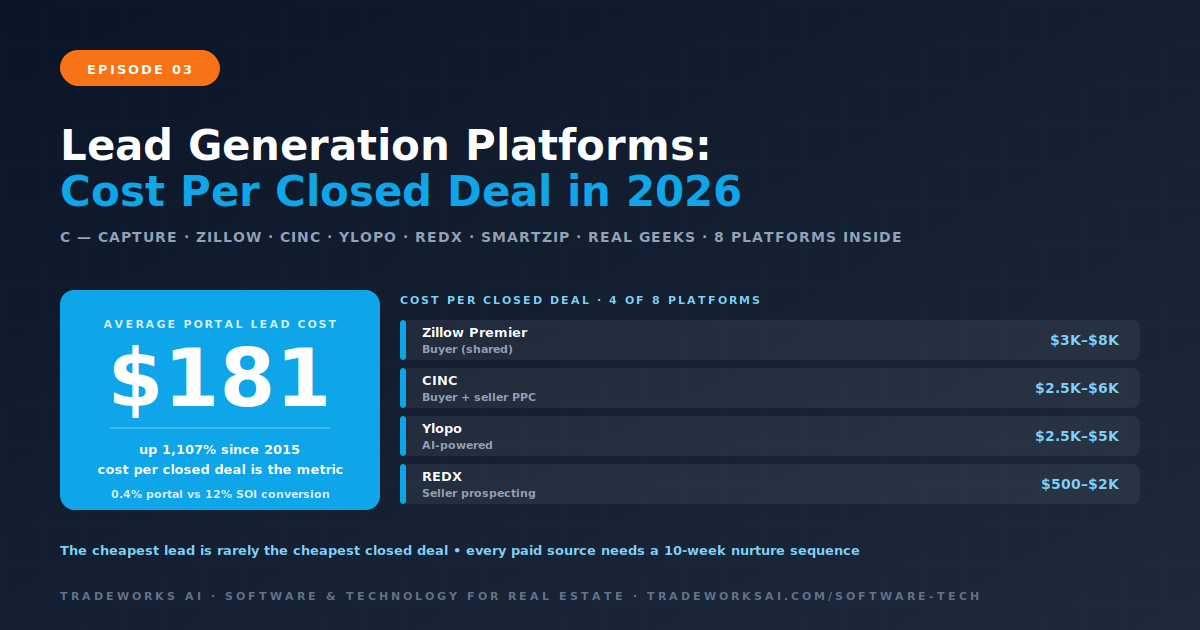
Capture tools put potential clients in front of you. They include your IDX website, landing pages, lead generation platforms like Zillow Premier Agent and Realtor.com, open house sign-in apps, social media ad platforms, and any tool designed to collect contact information from potential buyers and sellers. The key metric for Capture tools is cost per lead by source. In 2026, the average real estate lead costs $30 to $200 depending on the source, and conversion rates range from 0.4% for portal leads to 12% for sphere-of-influence referrals. Agents who track cost per lead by source — not just total leads — allocate budget to channels that actually produce closings.
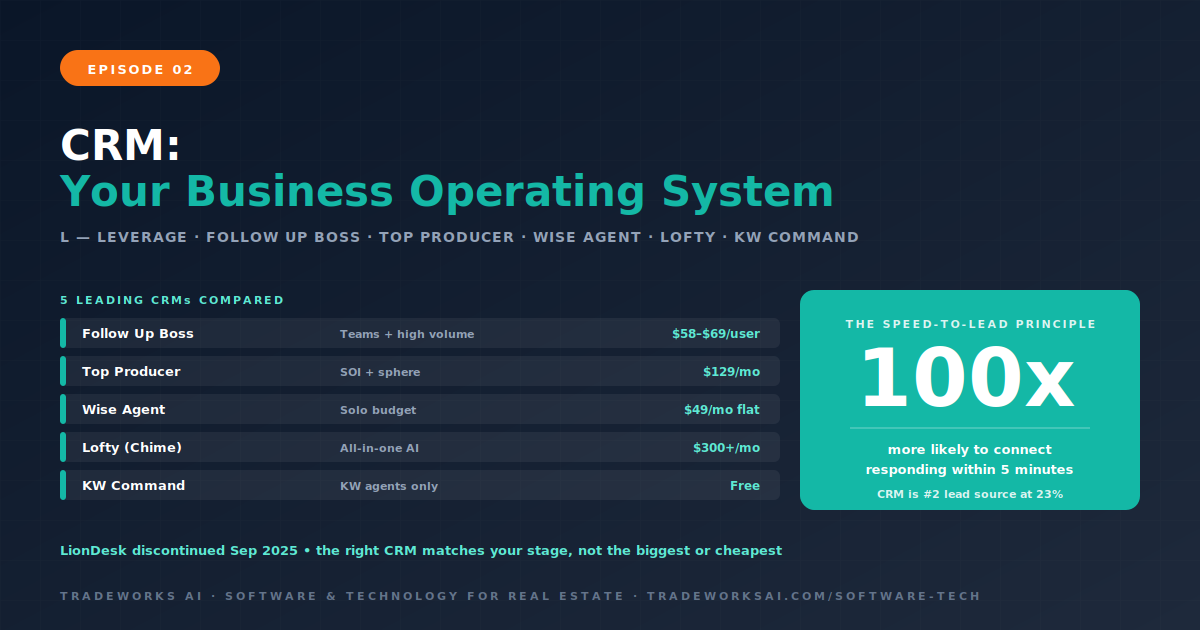
Leverage tools convert captured leads into clients and maintain relationships that generate repeat business and referrals. Your CRM is the operating system of your real estate business. It stores contacts, scores leads, automates follow-up sequences, tracks pipeline stages, and provides the data foundation for everything else in the stack. The NAR Technology Survey identifies CRM as the second-highest source of quality leads at 23%, behind only social media at 39%. The Speed-to-Lead principle applies here: agents who respond to new leads within 5 minutes are 100 times more likely to make contact than agents who wait 30 minutes. Your CRM’s lead routing and notification system determines whether you hit that 5-minute window or miss it entirely.
Operate tools manage the process from signed contract to closed transaction. E-signature platforms, document management, transaction checklists, compliance tracking, and team coordination software all live here. The average real estate transaction involves over 180 pages of documents and 15 to 20 coordinated tasks across 30 to 45 days. Digital transaction management saves 5 to 8 hours per transaction through automated workflows, deadline tracking, and multi-party signing. For teams and brokerages, Operate tools also include commission management, agent performance tracking, and compliance audit trails.
Showcase tools present your listings and your brand to the market. Professional photography platforms, video creation tools, virtual tour software, virtual staging, drone services, social media scheduling, and content creation tools all serve this layer. The data is unambiguous: listings with professional photography sell 32% faster. Listings with video generate 403% more inquiries. Homes with drone photography sell 68% faster. Sixty-one percent of agents now use drones, and 52% use AI-generated content. Showcase tools do not just market listings — they market you. A strong visual portfolio and consistent social media presence build the authority that makes homeowners choose you over competitors.
Elevate tools turn raw activity into strategic insight. Reporting dashboards, lead attribution analytics, market data platforms, and AI-powered predictive tools all live in this layer. Only 9% of agents report that listing portals provide their highest quality leads — but many agents continue to pour money into portals because they have not set up attribution tracking to know where their actual closings originate. Elevate tools answer the question that matters most: for every dollar I spend and every hour I invest, which channels produce revenue? Agents who review production metrics weekly generate 28% higher GCI than those who review quarterly or not at all.
Your technology stack should match your business stage. An agent closing 4 deals a year does not need the same infrastructure as a team leader closing 40. Over-investing too early wastes money. Under-investing too late loses deals.
A new agent needs the essentials: a CRM (many brokerages provide one), a personal website (even a simple one-page site), an e-signature tool (DocuSign or equivalent), a social media scheduling tool (free tier), and a smartphone with a good camera. The total investment at this stage should not exceed $500 per month. Focus on mastering your CRM first. Every contact, every interaction, every follow-up goes into the system. The habits you build now determine whether your database becomes an asset or a graveyard of forgotten contacts.
Once you are closing 8 or more transactions per year, your stack expands. Add a professional IDX website with lead capture, at least one paid lead source, professional photography for every listing, video tools (even smartphone video with good lighting and a microphone), and email drip campaigns in your CRM. At this stage, your biggest upgrade is automation. Your CRM should automatically assign leads, trigger follow-up sequences, and notify you when prospects show buying or selling signals. The time you save on manual follow-up is time you reinvest in appointments and showings.
Team leaders need tools that scale beyond individual production. Add lead routing that distributes leads to agents based on rules (availability, geography, expertise), transaction management with team-wide checklists, commission tracking and reporting, and advanced analytics that show per-agent performance and lead-source ROI. The technology at this stage does not just help you produce — it enforces the standards and accountability that make a team productive without requiring you to personally oversee every lead and transaction.
Broker-owners need enterprise-level infrastructure. Add recruiting and onboarding technology, compliance and audit tools, brokerage-wide CRM with individual agent workspaces, marketing automation that serves the entire office, and financial reporting that tracks profitability by agent, team, and office. At this level, your technology stack is not a business expense — it is a recruiting advantage. The brokerages that attract top talent are the ones that provide agents with technology systems that make them more productive from day one.
If your lead generation platform sends leads to one inbox, your CRM lives in a different login, and your transaction manager exists in a third system, you are manually transferring data between tools. Every manual transfer is a point of failure where leads fall through cracks and tasks get missed. Before buying any tool, ask: does it integrate with what I already use? The best tool in the world is the wrong tool if it does not connect to your system.
Some agents operate on spreadsheets and sticky notes until they physically cannot manage the volume. By then, they have already lost hundreds of leads who never received follow-up, dozens of past clients who were never nurtured, and an unknown number of referrals that never materialized because they were invisible. Technology is not a reward for success. It is the infrastructure that creates success. The investment happens before the results, not after.
The opposite mistake is equally damaging. An agent attends a conference, sees 15 shiny demos, and signs up for all of them in the same week. Six months later they are paying $800 per month for tools they have barely configured. Build sequentially. Master your CRM first. Add one tool at a time. Evaluate each for 60 to 90 days before adding the next. Your stack should grow with your business, not ahead of it.
The most important concept in building a real estate tech stack is integration. Every tool in your CLOSE Stack should feed data into the next layer. A lead captured on your website flows automatically into your CRM. Your CRM triggers a drip campaign. When the lead converts to a client, the CRM hands off to your transaction management system. When the transaction closes, the data feeds your analytics dashboard and triggers a review request and past-client nurture sequence. This flow is not aspirational. It is achievable with tools available today at every budget level. The agents and teams who set up these integrations once operate at a fundamentally different level of efficiency than those who manage each tool in isolation.
This is Episode 1 of 14 in the Software and Technology for Real Estate Professionals series. Each subsequent episode takes a deep dive into one layer or category of the CLOSE Stack, with specific tool comparisons, pricing, and recommendations by career stage. Episode 2 covers CRM platforms. Episode 3 covers lead generation. Episode 4 covers IDX websites. The series builds through transaction management, listing marketing, social media tools, email platforms, automation, property management, mortgage and title technology, client communication, team operations, and culminates in Episode 14 with the complete CLOSE Stack assembly for your specific business stage.
Download the CLOSE Stack Self-Assessment to score your current technology infrastructure and identify which layer needs attention first.
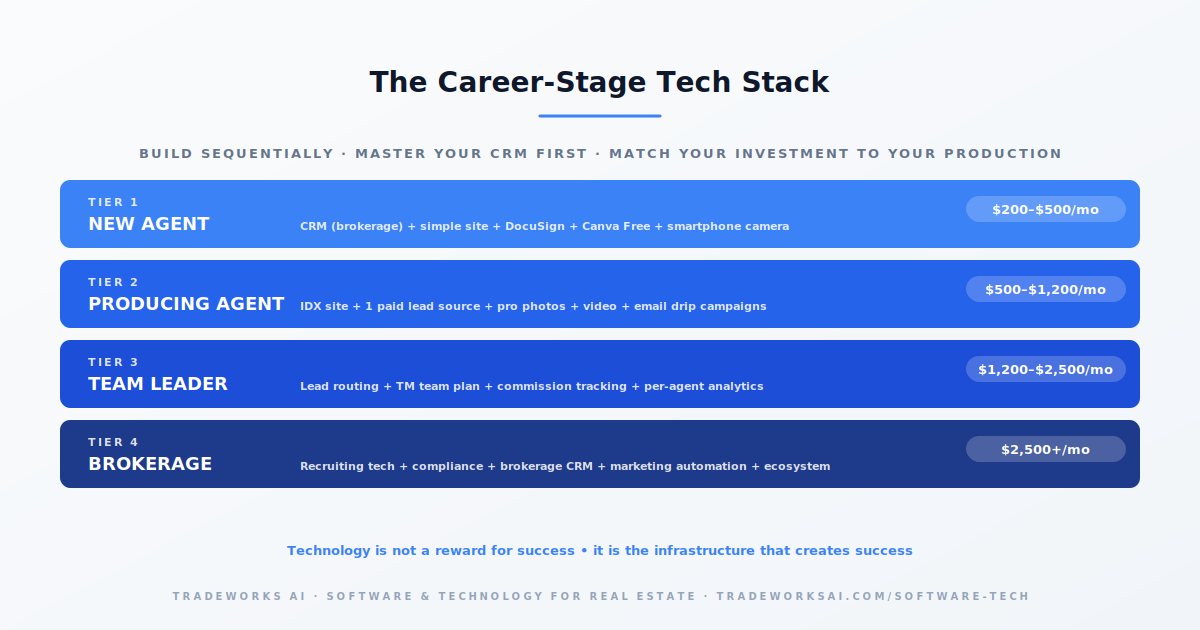
According to the NAR 2025 Technology Survey, 34% of agents spend $50 to $250 per month, 20% spend $251 to $500, and 24% spend over $500 per month. The right budget depends on your career stage. New agents can build an effective stack for $200 to $500 per month. Producing agents typically invest $500 to $1,200. Team leaders and broker-owners may spend $1,200 to $2,500 or more.
A CRM. It is the operating system of your business. Every other tool feeds into or out of your CRM. Agents who use CRM technology earn $100,000 or more in gross commission income compared to those who do not, according to industry data. If you invest in nothing else, invest in a CRM and use it consistently.
Your brokerage website is your brokerage’s marketing. Your personal IDX website is your marketing. Having your own site with your own domain, your own lead capture, and your own SEO presence gives you control over your brand and your leads regardless of which brokerage you are affiliated with.
Track three numbers: leads generated by source, cost per lead by source, and cost per closed deal by source. If you cannot answer these questions for every technology tool you pay for, you are investing blind. The Elevate layer of the CLOSE Stack is specifically designed to provide this visibility.
The CLOSE Stack is a 5-layer technology framework for real estate professionals developed by TradeWorks AI. The five layers are Capture (lead generation), Leverage (CRM and relationships), Operate (transactions and operations), Showcase (marketing and listing presentation), and Elevate (analytics and business intelligence). Each layer connects to the others in sequence, creating an integrated system rather than a collection of disconnected tools.
Most agents buy tools in reaction to problems. The result: disconnected subscriptions that duplicate data and create more friction than they solve. The CLOSE Stack Self-Assessment grades your stack across all 5 layers and identifies the highest-leverage gap to close first.
Continue the Real Estate Tech Stack series with Part 2 of 14.
Continue the Real Estate Tech Stack series with Part 3 of 14.