Real Estate Tech · Part 5
Real Estate Transaction Management Software in 2026: From Contract to Close Without the Chaos
Continue the Real Estate Tech Stack series with Part 5 of 14.
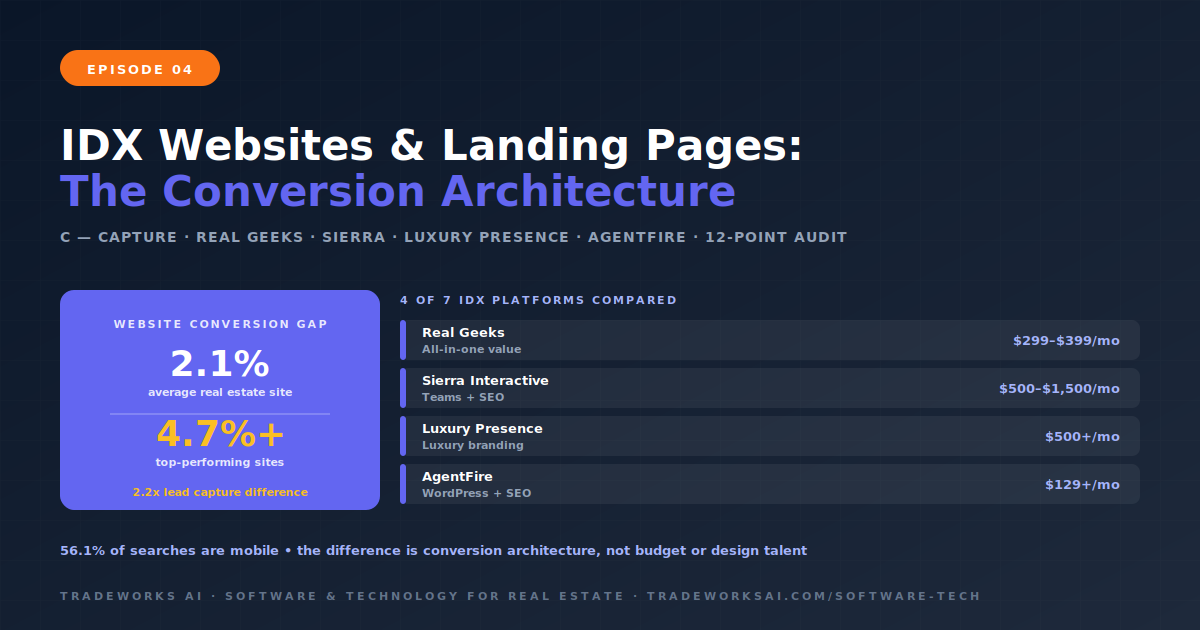
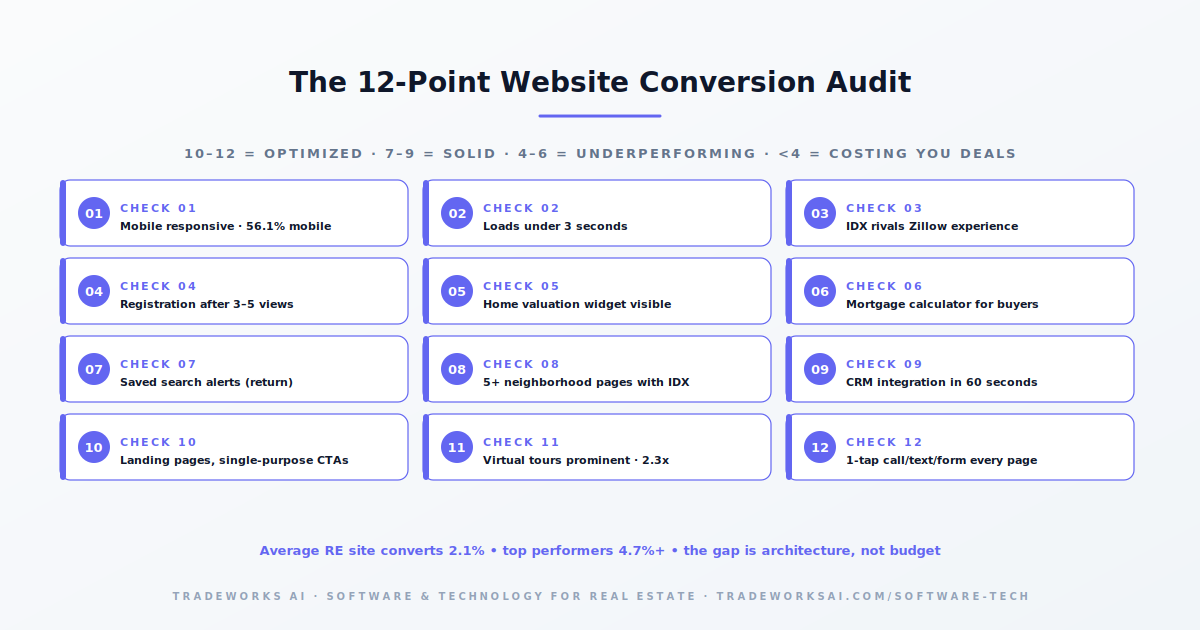
The average real estate website converts 2.1% of visitors into leads. Top-performing sites convert 4.7% or higher. That gap is not design talent or budget. It is conversion architecture: the strategic placement of lead capture elements, the timing of registration prompts, the quality of IDX search, and the presence of landing pages optimized for specific traffic sources. In 2026, 56.1% of home searches happen on mobile devices, 78% of local searches lead to action within 24 hours, and landing pages with virtual tours convert 2.3 times better than those with photos alone. Your website is either generating leads while you sleep or it is an expensive digital business card. This article compares seven IDX website platforms, reveals the 12-point conversion audit, and shows you how to match your website investment to your career stage.
In the CLOSE Stack framework, your website spans two layers. It is a Capture tool — the destination where leads from ads, search engines, social media, and referral links arrive. And it feeds directly into the Leverage layer — every lead captured on your site should flow automatically into your CRM with zero manual entry. The integration between your website and your CRM is the most important technical decision in your entire stack.
Your brokerage likely provides a website. That site serves your brokerage’s marketing objectives. Your personal IDX website serves yours. Having your own site with your own domain, your own lead capture, and your own SEO presence gives you control over your brand and your lead pipeline regardless of which brokerage you are affiliated with. This is the portability principle from Episode 2 applied to your web presence.
IDX — Internet Data Exchange — is the technology that displays MLS listing data on your website. In 2026, every major platform refreshes MLS data at least every 60 minutes, some in real time. The differentiator is not freshness but experience: custom polygon map searches, granular filters (school district, waterfront, year built, HOA fees), saved search alerts that bring visitors back to your site daily, and mobile-responsive design that works as well on a phone as a desktop. The best IDX implementations feel like Zillow or Redfin — familiar, fast, and comprehensive. The worst feel like a 2015 database query with a grid of thumbnails. Agents whose IDX search rivals the portals keep visitors on their site. Agents whose search feels inferior lose visitors back to Zillow within seconds.
The most debated topic in real estate website design is registration timing: when do you require visitors to create an account to continue browsing? Too early and you lose casual visitors. Too late and you miss the capture window. Industry best practice in 2026 is progressive registration: allow 3 to 5 free property views, then prompt for email to continue. For PPC landing pages where visitors arrive from paid ads, immediate registration with a clear value exchange (instant property alerts, market reports, home valuation) converts higher because the traffic already has intent. Home valuation widgets — where homeowners enter their address to get an estimated value — are the single highest-converting lead capture tool for seller leads. Mortgage calculators serve the same function for buyer leads.
Your IDX website is your organic hub. Landing pages are your paid traffic destinations. The two should not be the same page. A visitor arriving from a Google ad searching “homes for sale in Westchase under 400K” should land on a page showing exactly those results with a registration gate — not your homepage. A visitor arriving from a Facebook ad offering a free home valuation should land on a single-purpose page with a valuation form and no navigation distractions. Top-performing agents run 5 to 15 landing pages targeting specific neighborhoods, price ranges, property types, and seller motivations. Each page has one CTA, one lead capture form, and zero links that lead visitors away from the conversion path.
Neighborhood pages are the highest-ROI SEO content a real estate agent can produce. A page dedicated to “Homes for Sale in Westchase, Tampa” with market data, school information, lifestyle content, and embedded IDX results for that neighborhood ranks for hyper-local search queries that portals cannot match at the individual agent level. Sierra Interactive and AgentFire have built their SEO advantage around community pages. Agents who publish two neighborhood pages per month for 12 months build an organic traffic asset that compounds over time and reduces dependence on paid lead sources.
| Platform | Starting Price | Best For | IDX Quality | CRM Included | SEO Strength |
|---|---|---|---|---|---|
| Real Geeks | ~$299–$399/mo | All-in-one value | Strong | Yes (built-in) | Good |
| Sierra Interactive | $500–$1,500/mo | Teams + SEO | Excellent (proprietary) | Yes (built-in) | Excellent |
| Luxury Presence | $500+/mo | Luxury branding | Strong | Presence CRM | Good (managed) |
| AgentFire | $129–$149/mo + IDX | SEO + brand (WordPress) | Via IDX Broker | No (integrates) | Excellent |
| Placester | $79–$319/mo | Budget IDX | Adequate | Basic | Basic |
| kvCORE/BoldTrail | $499–$1,800/mo | Brokerages | Strong (portal-like) | Yes (AI-powered) | Good |
| CINC | $899+/mo | PPC-heavy teams | Strong | Yes (AI chatbot) | Moderate (PPC focus) |
Real Geeks is the most recommended IDX website platform for solo agents and small teams who want a complete system — website, CRM, and lead generation tools — at a competitive price. Trusted by over 7,000 agents, the platform includes IDX search with saved search alerts, a built-in CRM with lead routing and drip campaigns, home valuation landing pages for seller leads, a Facebook ad creation tool, and an AI-powered SEO blog creator.
The design templates are functional but not as visually polished as AgentFire or Luxury Presence. For agents who prioritize lead generation over premium aesthetics, Real Geeks delivers the strongest feature-to-cost ratio on this list. At approximately $299 to $399 per month with a $250 setup fee, it is the most accessible all-in-one platform for agents closing 8 or more transactions per year.
Best For: Solo agents and small teams wanting IDX + CRM + lead gen in one platform at mid-range pricing.
Sierra Interactive has built its reputation on two pillars: organic search performance and team accountability. Its proprietary IDX code is designed for SEO — indexable property pages, fast load times, and a content management system built specifically for neighborhood and community pages. Teams using Sierra often report that organic leads from their website reduce dependency on paid lead sources over 12 to 24 months.
In April 2026, Sierra launched its Luxury Site product, addressing the long-standing gap between performance and aesthetics. The new offering pairs design quality comparable to Luxury Presence with Sierra’s SEO infrastructure — a combination that did not previously exist in the market.
For teams, Sierra provides lead routing rules, accountability dashboards, speed-to-lead tracking, and multi-site management for agents running niche or community-focused sites. Pricing ranges from $500 to $1,500 per month depending on team size, which positions it in the premium tier.
Best For: Teams of 3+ agents who want organic SEO lead generation and structured agent accountability.
Luxury Presence creates the most visually stunning real estate websites in the industry. Used by over 8,000 agents and brokerages including RealTrends-ranked producers, Sotheby’s, Compass, and Christie’s affiliates, the platform delivers custom design that positions agents as luxury-market authorities. Cinematic video integration, high-resolution galleries, and bespoke layouts create a brand impression that matches high-end property portfolios.
The platform now includes Presence CRM, an AI-powered relationship management system that tracks the entire client journey. Managed marketing services covering SEO, social media, content, and PPC advertising are available as add-ons, making Luxury Presence an increasingly complete ecosystem.
The limitation is cost. Starting at $500 or more per month with premium design packages significantly higher, Luxury Presence makes economic sense for agents whose average transaction value exceeds $1 million. For agents in median-priced markets, the ROI math is harder to justify.
Best For: Luxury agents and top producers whose brand requires a premium web presence matching their market position.
AgentFire builds SEO-focused real estate websites on WordPress, giving agents ownership of their site, flexibility to customize, and the strongest SEO foundation of any platform at its price point. The Spark Site starts at $129 per month with no setup fee, and IDX integration through IDX Broker adds approximately $30 per month.
The platform’s strength is its add-on ecosystem: clickable neighborhood maps, market report widgets, community pages, and lead capture tools that can be layered onto the base site. For agents who are comfortable with WordPress and willing to invest in ongoing content creation, AgentFire delivers organic ranking power comparable to Sierra Interactive at a fraction of the cost. The tradeoff: you do not get a built-in CRM, so you need a separate platform like Follow Up Boss or Wise Agent.
Best For: SEO-focused agents who want WordPress flexibility, strong branding, and are comfortable managing their own CRM integration.
New agent ($80–$150/mo): Placester or Wix + iHomefinder. Get an IDX site live quickly and invest the savings in marketing and prospecting. Upgrade once you are closing consistently.
Producing agent ($200–$400/mo): Real Geeks or AgentFire. All-in-one (Real Geeks) or SEO-first (AgentFire) depending on whether you want built-in CRM or prefer to use your own.
Team leader ($500–$1,500/mo): Sierra Interactive. Organic SEO lead generation, team routing and accountability, multi-site management.
Luxury/top producer ($500+/mo): Luxury Presence. Brand positioning that matches your market segment.
Brokerage ($500–$1,800/mo): kvCORE/BoldTrail. Enterprise-level with individual agent workspaces, brokerage-wide branding, and AI behavioral automation.
Yes. Your brokerage website markets your brokerage. Your personal website markets you. A personal IDX site with your own domain, lead capture, and SEO presence gives you control over your brand and leads regardless of which brokerage you join. This is especially important for portability: when you change brokerages, your brokerage site stays behind. Your personal site travels with you.
The average real estate website converts 2.1% of visitors into leads. Top-performing sites convert at 4.7% or higher. The difference is conversion architecture: IDX quality, registration timing, lead capture tools, landing pages, and CRM integration speed.
Budget tier platforms start at $79 to $150 per month. Mid-tier all-in-one platforms run $200 to $400 per month. Premium platforms for teams and luxury agents range from $500 to $1,500 or more. Match your investment to your current production level and career stage. A new agent does not need a $500 per month website. A team leader cannot afford to run a $79 per month site.
Home valuation widgets for seller leads and saved search alerts for buyer leads. These two features generate more leads per dollar invested than any other website element because they offer ongoing value that brings visitors back repeatedly.
WordPress (via AgentFire or similar) gives you maximum flexibility, site ownership, and SEO control but requires more technical management. SaaS platforms (Real Geeks, Sierra, Placester) are faster to launch, easier to maintain, and include integrated tools but limit customization. If you have a developer or are tech-comfortable, WordPress is the stronger long-term play. If you want simplicity, choose SaaS.
Most agents buy tools in reaction to problems. The result: disconnected subscriptions that duplicate data and create more friction than they solve. The CLOSE Stack Self-Assessment grades your stack across all 5 layers and identifies the highest-leverage gap to close first.
Continue the Real Estate Tech Stack series with Part 5 of 14.
Continue the Real Estate Tech Stack series with Part 7 of 14.