Real Estate Tech · Part 4
Real Estate IDX Websites in 2026: The Conversion Architecture That Turns Visitors Into Leads
Continue the Real Estate Tech Stack series with Part 4 of 14.
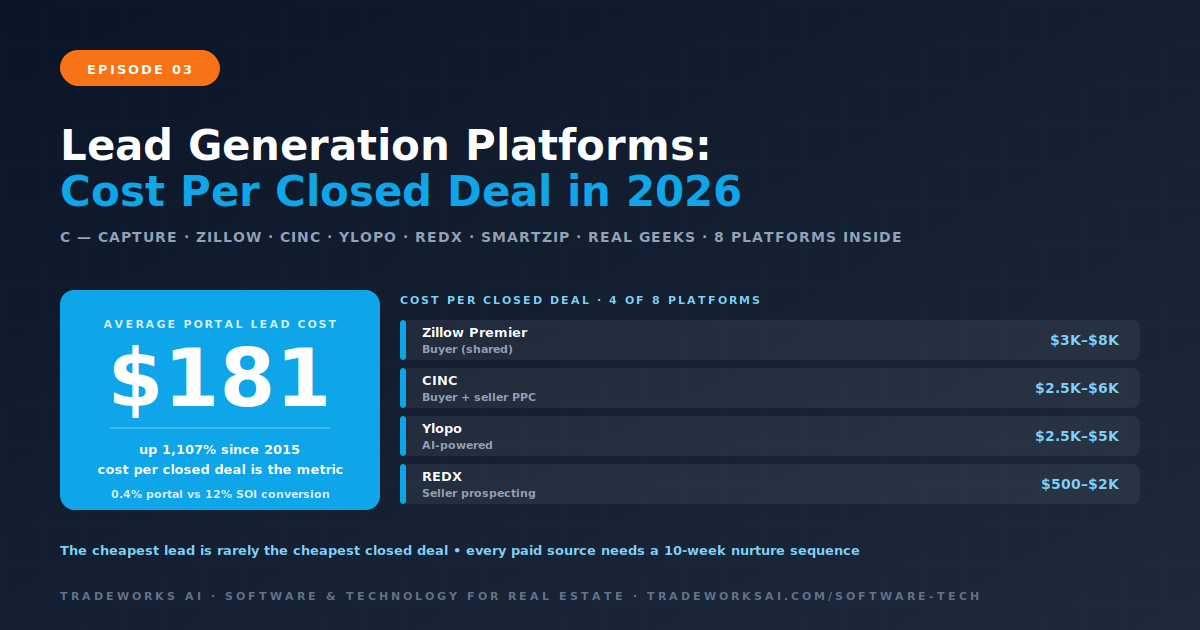
The best real estate lead generation platform depends on whether you are targeting buyers or sellers, your monthly budget, and your ability to convert leads through consistent follow-up. In 2026, the average portal lead costs $181 — up over 1,100% since 2015 — and conversion rates range from 0.4% for unworked portal leads to 12% for sphere-of-influence referrals. The platforms that deliver the strongest return are not necessarily the ones with the lowest cost per lead. They are the ones with the lowest cost per closed deal when measured across a full 12-month horizon. This article compares eight major lead generation platforms by cost per lead, conversion rate, cost per closed deal, lead type, and best-fit career stage.
Most agents evaluate lead generation platforms by cost per lead. A platform advertising leads at $20 each sounds cheaper than one at $50. But cost per lead without conversion context is meaningless. A $20 lead with a 0.5% close rate produces one deal per 200 leads — a cost per closed deal of $4,000. A $50 lead with a 3% close rate produces one deal per 33 leads — a cost per closed deal of $1,650. The more expensive lead is more than twice as profitable.
The metric that matters is cost per closed deal: total spend on a lead source divided by the number of transactions that source produced over 12 months. This includes the monthly subscription, ad spend, and the time investment of working those leads. Agents who track this metric earn 28% more in annual GCI than those who rely on intuition alone.
Every platform comparison in this article uses cost per closed deal as the primary evaluation metric. Cost per lead is provided for context, but it is never the deciding factor.
Real estate lead generation platforms fall into five categories, each with different economics, conversion profiles, and time requirements.
Zillow Premier Agent and Realtor.com are the dominant portals. Zillow drives over 230 million page views per month — nearly double Realtor.com. Portal leads are bottom-of-funnel buyers who are actively searching for properties. The intent is high, but so is the competition: leads are shared among multiple agents, and the agent who responds fastest typically wins. Portal lead costs range from $20 to $150 or more depending on zip code and competition. Conversion rates run 1 to 4% for agents with strong follow-up systems, and as low as 0.4% for agents who respond slowly or inconsistently.
Platforms like CINC, Ylopo, and Real Geeks generate leads by running Facebook and Google ad campaigns on behalf of agents, driving traffic to IDX websites with lead capture. These leads cost $8 to $40 each and convert at 1 to 3% over 6 to 12 months. The advantage is exclusivity — you are typically the only agent receiving each lead. The disadvantage is timeline: PPC leads are often earlier in their buying journey, requiring longer nurture sequences to convert.
REDX and Vulcan7 provide contact data for FSBOs, expired listings, pre-foreclosures, and geographic farming targets. The monthly cost is low — $39 to $99 per lead type — but conversion depends entirely on call volume, script quality, and persistence. These platforms do not generate leads for you; they give you the data to go find them. For agents who are comfortable with outbound prospecting, this is the lowest cost-per-closed-deal source available. For agents who dislike cold calling, it is a non-starter.
SmartZip and Offrs use AI to analyze hundreds of data points per household and predict which homeowners are likely to sell within the next 6 to 12 months. SmartZip maintains 72% accuracy on its predictions. The leads are exclusive to one agent per zip code, and the platform automates multi-channel outreach. The cost is the highest on this list — predictive seller platforms can run $5,000 to $12,000 per closed deal — but for listing-focused agents, a single listing generates 4.5 times more value than a buyer side.
Zillow Flex, Realtor.com ReadyConnect (OpCity), Sold.com, and HomeLight operate on a referral fee model: you pay nothing upfront and share 25 to 40% of your commission at closing. The advantage is zero financial risk. The disadvantage is significant: a $10,000 commission becomes $6,000 to $7,500 after the referral fee. For agents who lack the capital for paid lead generation or who want to supplement their pipeline with no additional monthly expense, these networks provide deal flow. For agents doing volume, the referral fees erode margins quickly.
| Platform | Lead Type | Cost Per Lead | Conv. Rate | Cost/Closed Deal | Best For |
|---|---|---|---|---|---|
| Zillow Premier Agent | Buyer (shared) | $20–$150+ | 1–4% | $3,000–$8,000 | High-volume buyer agents |
| Realtor.com/OpCity | Buyer (screened) | Referral fee | Varies | 25–40% of GCI | Zero upfront risk |
| CINC | Buyer + seller (PPC) | $8–$40 | 1–3% | $2,500–$6,000 | Teams with ad budget |
| Ylopo | Buyer + seller (AI) | $6–$30 | 1–3% | $2,500–$5,000 | Tech-savvy agents/teams |
| Real Geeks | Buyer (PPC + IDX) | $8–$30 | 1–3% | $2,500–$5,000 | Budget-conscious solo agents |
| Market Leader | Buyer (exclusive) | Included | 2–4% | Varies by market | Agents wanting guaranteed volume |
| REDX | Seller (data) | $39–$99/mo | 5–12% | $500–$2,000 | Agents who cold call |
| SmartZip | Seller (predictive) | Included | 1–3% | $5,000–$12,000 | Listing agents willing to farm |
Note: Conversion rates and costs per closed deal represent industry ranges from multiple data sources and vary significantly by market, agent skill, and follow-up consistency. Your results will depend on your speed-to-lead, nurture systems, and local competition.
Zillow dominates online real estate search with over 230 million monthly page views. Premier Agent gives you placement in front of active buyers in your zip code. Leads arrive with high purchase intent — these are people who have saved searches, favorited properties, and requested information on specific listings.
The challenge is competition. Premier Agent leads are shared among multiple agents, which means speed-to-lead is the single most important factor in conversion. The agent who responds first typically wins. In competitive markets, cost per lead can spike well above $100, and in luxury zip codes, the math often does not work.
Zillow also offers Flex, a pay-at-closing model where you skip the upfront cost and pay a referral fee (typically 25 to 40% of commission) only when a deal closes. Flex lowers risk but significantly reduces your net commission. For agents testing Zillow for the first time, Flex is a lower-risk entry point. For agents doing volume, the traditional Premier Agent model with strong follow-up systems produces better economics.
Best For: Agents who can respond to leads within 5 minutes, have a CRM with automated follow-up, and work in markets where cost per lead stays below $60.
CINC is one of the most comprehensive lead generation platforms available. It combines paid advertising management (Facebook and Google), an IDX website, a CRM with AI chatbot, and automated nurturing into a single integrated system. CINC’s advertising team specializes in micro-niche targeting — specific neighborhoods, property types, or price ranges — which produces more qualified leads than broad targeting.
Starting at $899 per month for solo agents and $1,500 per month for teams (including buyer leads), CINC is a significant investment. But for teams running multiple agents and processing high lead volume, the all-in-one approach eliminates the integration complexity of assembling separate tools. The AI chatbot qualifies leads automatically, and the CRM routes them to agents based on customizable rules.
Best For: Teams of 3 or more agents with $1,500 or more per month to invest in a complete lead-to-close system.
Ylopo is widely regarded as the most technologically advanced lead generation platform in real estate. It runs dynamic home search ads, home valuation campaigns, and AI-powered video ads across Facebook and Google, driving traffic to a branded IDX website. Its proprietary AI text and voice assistants — trained on over 50 million conversations — engage, qualify, and nurture leads 24 hours a day with response rates that rival human agents.
Starting at $395 per month plus ad spend (total investment typically $1,500 to $2,000 per month), Ylopo delivers the most sophisticated AI nurturing in the industry. Case studies consistently show 4:1 to 6:1 ROI over 12 months. The platform is ideal for agents and teams who want to leverage AI not just for lead generation but for the entire conversion pipeline.
Best For: Tech-savvy agents and teams willing to invest $1,500 or more per month and who want AI handling lead engagement and nurturing at scale.
REDX takes a fundamentally different approach: instead of generating inbound leads through ads, it provides outbound prospecting data. FSBO listings, expired listings, pre-foreclosures, and geographic farming contact data are available as individual subscriptions starting at $39 to $99 per month per lead type. The optional Power Dialer ($59 per month) enables rapid outbound calling.
For agents who are willing to pick up the phone, REDX produces the lowest cost per closed deal on this list. The leads are essentially free after the monthly data subscription — the investment is time, not money. Experienced prospecting agents who work FSBO and expired leads consistently report conversion rates of 5 to 12% and cost per closed deal under $2,000.
The limitation is clear: if you are not comfortable with cold calling, REDX will not work. The data is only as valuable as the agent’s willingness and skill in using it.
Best For: Listing agents who are comfortable with outbound prospecting and want the lowest cost per acquisition. Pair with Vulcan7 for more advanced dialer and scripting tools.
The median home buyer searches for 10 weeks before purchasing. This means that most leads — regardless of source — are not ready to transact when they first make contact. Agents who give up after 3 follow-up attempts are quitting right before the decision happens.
Every lead generation platform on this list requires a minimum 10-week nurture sequence to realize its full ROI. The platforms that include built-in nurturing (CINC, Ylopo, Market Leader) handle this automatically. The platforms that do not (Zillow, REDX, Realtor.com) require you to build the nurture sequence in your CRM. If your CRM does not have automated drip campaigns running for at least 10 weeks, you are paying for leads and then abandoning them before they convert.
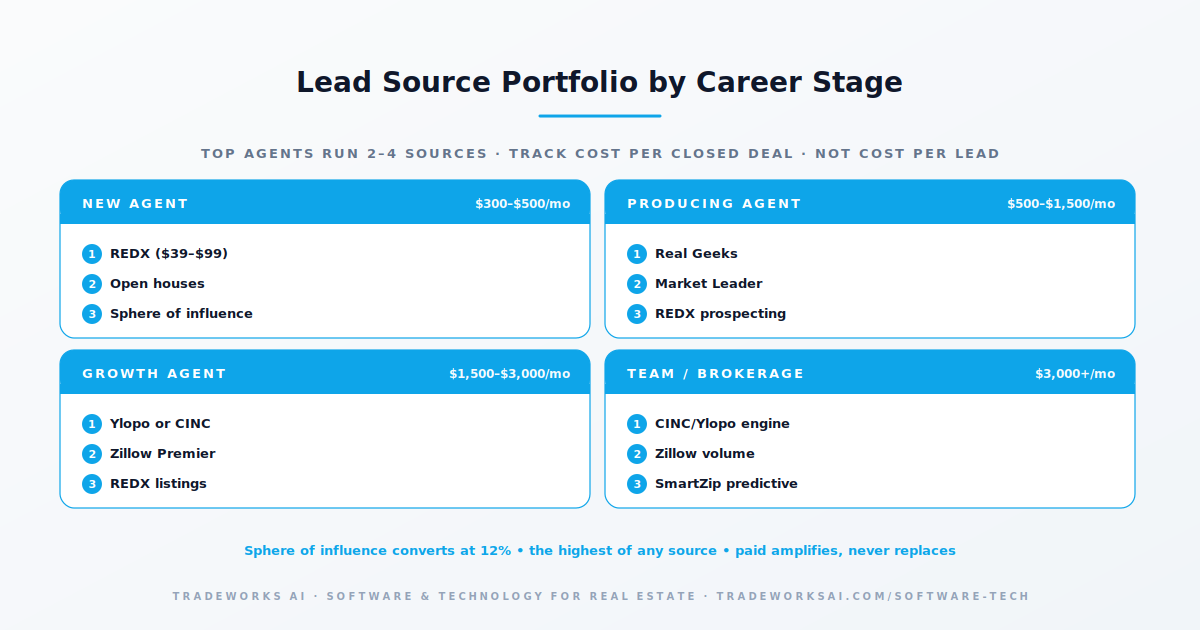
Top-performing agents do not rely on a single lead source. They run a portfolio of 2 to 4 sources, each serving a different function, and track cost per closed deal for each independently.
Before investing in any paid platform, audit the free lead sources most agents underutilize. Sphere of influence produces the highest conversion rate at 12% — higher than any paid source. Open houses generate face-to-face buyer leads at zero cost beyond your time. Geographic farming with door knocking and direct mail costs pennies per contact when done consistently. Past client reactivation through your CRM database produces referrals that close faster and at higher rates than cold leads. Social media content that positions you as a local expert generates inbound inquiries that convert at 3 to 5 times the rate of portal leads. These organic sources should form the foundation of your pipeline. Paid platforms amplify what is already working — they do not replace the fundamentals.
The average portal lead costs approximately $181 in 2026, which represents a 1,107% increase since 2015 according to REDX data. However, PPC-generated leads through platforms like CINC and Ylopo cost $8 to $40 each, and prospecting data through REDX costs $39 to $99 per month for entire lead lists. The cost varies dramatically by source, market, and competition.
Sphere of influence referrals convert at approximately 12%, the highest of any source. Among paid platforms, REDX prospecting data (FSBO and expired leads) converts at 5 to 12% for agents who actively work the phone. Portal leads from Zillow and Realtor.com convert at 1 to 4% with strong follow-up. PPC leads from CINC and Ylopo convert at 1 to 3% over a 6 to 12 month nurture period.
Zillow Premier Agent can be effective if you meet three conditions: you can respond to leads within 5 minutes, you have a CRM with automated follow-up sequences, and your market’s cost per lead stays below $60. In competitive or luxury markets where cost per lead exceeds $100, the economics often do not work. Consider Zillow Flex as a lower-risk alternative where you pay only at closing.
Most platforms require 3 to 6 months to produce measurable ROI, and 12 months to fully evaluate cost per closed deal. The median buyer searches for 10 weeks, so leads generated today may not close for 3 to 6 months. Agents who evaluate a platform after 30 to 60 days are measuring too early and may abandon a source before it produces results.
The lowest cost-per-closed-deal sources are sphere of influence (zero cost beyond relationship maintenance), open houses (zero cost beyond time), and REDX prospecting ($39 to $99 per month for data, with conversion driven by phone effort). For paid platforms with minimal financial risk, Zillow Flex and Realtor.com ReadyConnect charge referral fees only at closing, requiring zero upfront investment.
Most agents buy tools in reaction to problems. The result: disconnected subscriptions that duplicate data and create more friction than they solve. The CLOSE Stack Self-Assessment grades your stack across all 5 layers and identifies the highest-leverage gap to close first.
Continue the Real Estate Tech Stack series with Part 4 of 14.
Continue the Real Estate Tech Stack series with Part 5 of 14.