Google Ads · Part 3
Google Ads Campaign Structure for Contractors: The Architecture Blueprint That Cuts CPL by 15–25%
Continue the Google Ads Playbook with Part 3 of 10.
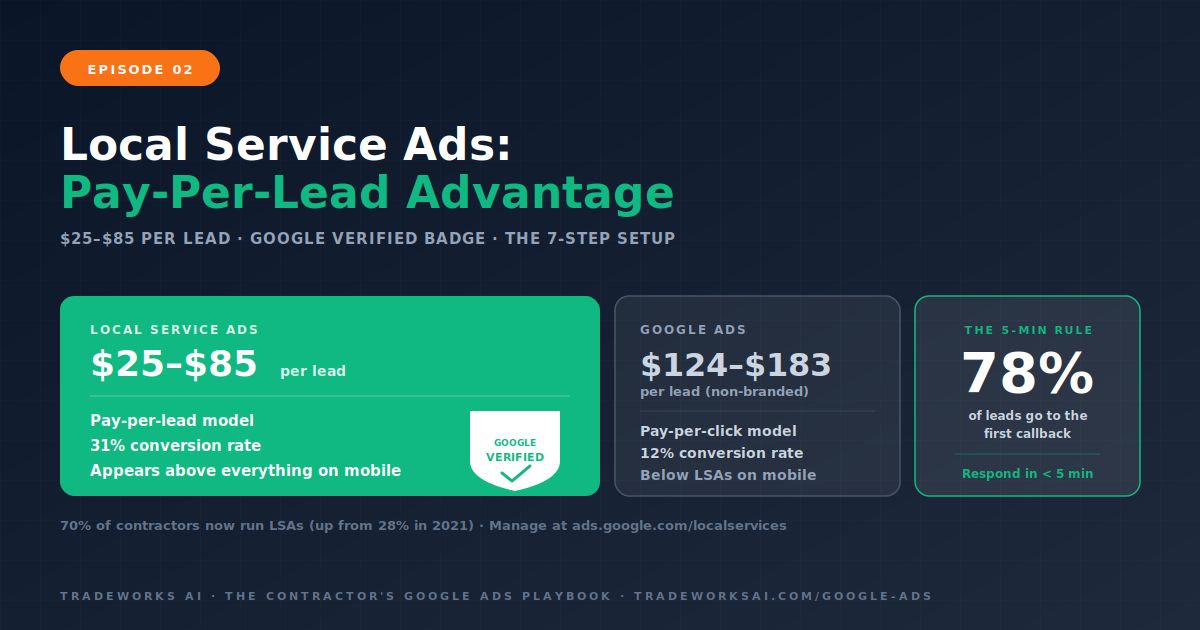
Google Local Service Ads (LSAs) for contractors cost $25 to $120 per lead depending on trade and market, convert at 31% compared to 12% for traditional Google Ads, and appear above every other result on mobile search. LSAs use a pay-per-lead model: you only pay when a homeowner calls or messages, not when they click. The Google Verified badge (formerly Google Guaranteed) signals that your business has passed background checks, licensing verification, and insurance confirmation. Setup takes 1 to 4 weeks and requires a verified Google Business Profile, active licenses, proof of insurance, and background checks for the business owner and field workers. LSA ranking factors in 2026: review count and recency (most important), responsiveness to leads, proximity to the searcher, business hours availability, and budget level. Weekly budgets typically range from $300 to $1,200.
If you are a contractor considering paid advertising for the first time, Local Service Ads should be activated before traditional Google Ads. Three reasons. First, LSAs convert at 31% versus approximately 12% for standard Google Ads. The pay-per-lead model means you are paying for homeowners who actually contact you, not for clicks that may bounce off your website. Second, LSAs appear at the absolute top of mobile search results—above traditional Google Ads, above the Map Pack, above organic results. 76% of near-me contractor searches happen on mobile. Being in positions 1 through 3 of LSA results means you are the first thing a homeowner sees. Third, the Google Verified badge functions as an instant trust signal. Homeowners choosing between a badged contractor and one without are heavily influenced by the badge: studies show it increases click-through rates significantly.
These are per-lead costs. Actual costs vary significantly by metro area—competitive markets like Houston, Phoenix, Dallas, Tampa, and Atlanta run at the high end. Smaller markets often fall below the midpoint. Compare these to Episode 1’s non-branded Google Ads CPLs: HVAC $149, Plumbing $183, Roofing $124, Electrical $128. For most trades, LSA delivers leads at 30 to 60% lower cost per lead than traditional Google Ads search campaigns.
LSAs operate differently from traditional Google Ads. You do not bid on keywords. You do not write ad copy. You do not choose landing pages. Google handles all of that. You set a weekly budget (not daily). Google shows your listing to homeowners searching for your services in your service area. You are charged only when a homeowner calls (over 30 seconds), messages, or books through your LSA profile. Google manages your ad delivery within your weekly budget, pausing your listing when the budget is reached and resuming the following week. The LSA standalone mobile app was discontinued in January 2025—all management now happens through the Google Ads platform at ads.google.com/localservices.
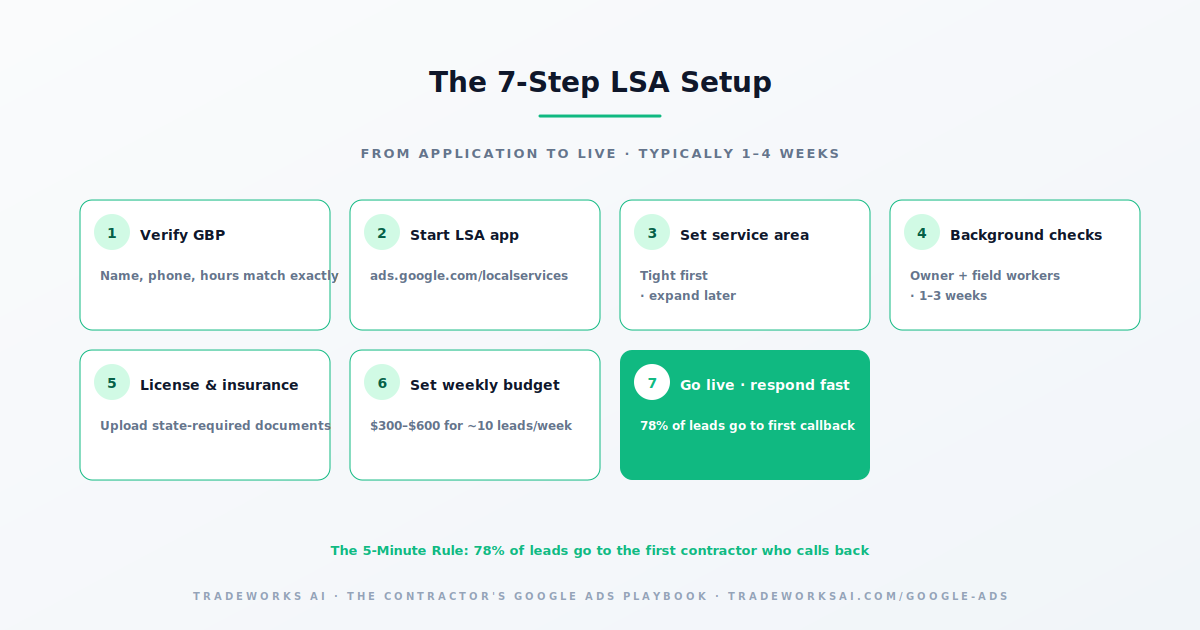
Your GBP must be claimed, verified, and complete. Business name, address, phone number, hours, categories, and service area must match exactly what you will enter in your LSA profile. Inconsistencies between your GBP and LSA create problems with both verification and ranking.
Navigate to ads.google.com/localservices. Select your business type and trade categories. Select every service you are licensed to provide—underselecting categories means you miss leads you are qualified for.
Set your service area carefully. LSAs charge per lead—if your service area is too broad, you pay for leads you cannot profitably serve. Start tight (your core service cities) and expand as you confirm which zip codes produce the best job values.
Google requires background checks for the business, the business owner, and all field workers who enter customers’ homes. This includes civil litigation history, business registration verification, insurance confirmation, and criminal history screening. The process does not include a credit check. Allow 1 to 3 weeks for completion.
Upload your active contractor license and proof of insurance. Requirements vary by state and trade. Google verifies these documents against state licensing databases.
Google recommends a budget that supports approximately 10 leads per week. For most contractors, the practical starting budget is $300 to $600 per week. Start conservative, let the algorithm collect 30 days of data, then adjust based on lead quality and volume.
Once verified, your listing goes live. The single most important optimization: respond to every lead within 5 minutes. The first contractor to call back wins the job 78% of the time. LSA ranking factors reward responsiveness—slower response rates directly reduce your lead volume.
Google does not publish the exact LSA algorithm, but the ranking factors are well-documented through industry analysis. Reviews are the number-one factor: businesses with 50 or more reviews and a 4.5 or higher average rating consistently rank above competitors with fewer or lower-rated reviews. Review recency matters—a steady flow of new reviews outperforms a large old collection (the same review velocity principle from our Reputation & Reviews series). Responsiveness is the second most important factor: how quickly you respond to leads, your answer rate, and whether you call back missed leads. Proximity to the searcher is the third factor—similar to the Map Pack, closer businesses get priority. Business hours affect when your listing appears. Budget level affects lead volume but does not significantly affect ranking position—a well-reviewed independent contractor who answers every call can outrank a franchise with larger ad spend but slower response times.
Not every lead Google charges you for is legitimate. You can dispute leads that are spam, wrong service type, outside your service area, or from someone who was not actually seeking your services. In 2026, Google’s automated dispute system handles approximately 90% of valid disputes automatically. Track every lead in a spreadsheet: call duration, what the customer needed, outcome. If your dispute rate stays under 15%, disputes are typically approved quickly. Note that Google discontinued credits for some categories of invalid leads in 2025—this makes precise service area and category configuration during setup critical.
LSA cost per lead ranges from $15 to $120 depending on trade and market. HVAC averages $25–$85, Plumbing $25–$65, Electrical $20–$70, Roofing $30–$95. You only pay when a homeowner actually contacts you—not for clicks or impressions.
Google Guaranteed (now transitioning to Google Verified) is a badge earned by passing Google’s verification process: background checks, license verification, and insurance confirmation. It appears on your LSA listing and signals trust to homeowners. Under the original program, Google offered customers up to $2,000 in satisfaction reimbursement.
Typically 1 to 4 weeks. The background check and license verification process takes the longest. Some contractors are approved within a week; others take 3 to 4 weeks depending on state licensing database response times.
Yes, and most successful contractors do. LSAs capture immediate-need, call-first searches. Google Ads capture planned-purchase searches where landing page control and messaging matter. They serve different moments in the buying cycle and complement each other.
The difference between a $400 cost-per-customer (profit) and a $700 cost-per-customer (loss) is rarely the bid — it is campaign architecture, landing pages, and tracking. The Google Ads Audit grades your account against the 10-part playbook, identifies the highest-leverage gaps, and shows the one optimization that compounds.
Continue the Google Ads Playbook with Part 3 of 10.
Continue the Google Ads Playbook with Part 4 of 10.