Google Ads · Part 2
Google Local Service Ads for Contractors: Setup, Cost, and the Pay-Per-Lead Advantage in 2026
Continue the Google Ads Playbook with Part 2 of 10.
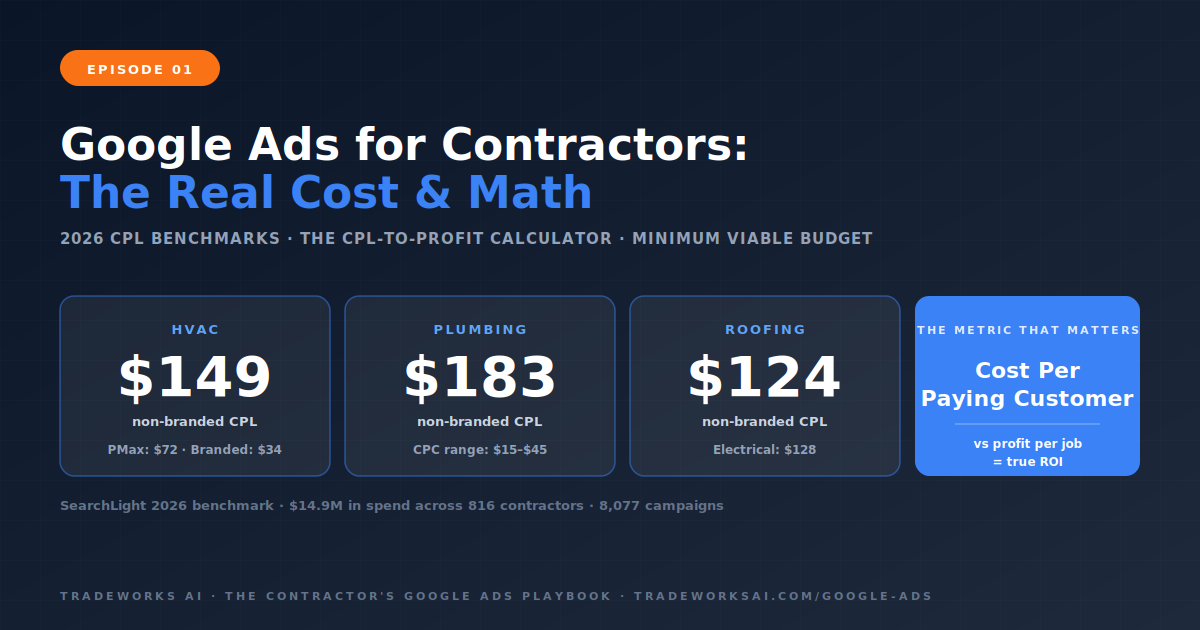
Google Ads for contractors costs $8 to $45 per click and $104 to $183 per lead depending on trade and market in 2026. Non-branded cost per lead benchmarks from SearchLight’s analysis of $14.9M in spend across 816 contractors: HVAC $149, Plumbing $183, Roofing $124, Electrical $128. Branded campaigns average $34 per lead. Performance Max campaigns average $72. The minimum viable monthly budget is $1,500 to $2,500. The metric that determines profitability is not cost per click or cost per lead—it is cost per paying customer relative to profit per job. The CPL-to-Profit Calculator: CPC multiplied by the inverse of your landing page conversion rate produces your CPL. CPL multiplied by the inverse of your booking rate produces your cost per customer. Compare cost per customer to profit per job to determine if the campaign generates or loses money.
Google processes more than 180,000 monthly searches for plumber near me in the United States alone. Searches for AC repair near me, electrician near me, and roof leak repair each generate tens of thousands more. Behind every one of those searches is a homeowner with a problem they need solved—often today. Google Ads places your business at the top of those results at the exact moment a homeowner is looking for someone to hire. It is the most direct paid lead generation channel available to contractors.
The question is not whether Google Ads works for contractors. SearchLight tracked $14.9 million in Google Ads spend across 816 contractors and 8,077 campaigns in January 2026. The average contractor in that dataset spent $14,206 per month. These contractors spend that money because when campaigns are structured correctly, Google Ads produces a measurable return. The real question is whether your specific campaign is producing a return—and most contractors cannot answer that question because they are tracking the wrong metric.
Most contractors evaluate Google Ads by one of two metrics: cost per click or total monthly spend. Both are misleading. A $15 CPC means nothing if the clicks never turn into calls. A $3,000 monthly spend means nothing if you cannot connect that spend to booked jobs and collected revenue. The metric that actually determines whether Google Ads is profitable is cost per paying customer. Not cost per click. Not cost per lead. Cost per paying customer—the total ad spend required to acquire one customer who books a job, shows up, and pays the invoice.
This distinction matters because two contractors in the same trade with the same cost per lead can have wildly different profitability. Contractor A pays $150 per lead with a 40% book rate and a $3,000 average ticket at 25% margin. Cost per paying customer: $375. Profit per job: $750. Net profit after acquisition: $375. Contractor B pays $100 per lead with a 15% book rate and a $800 average ticket at 20% margin. Cost per paying customer: $667. Profit per job: $160. Net loss per acquisition: $507. Contractor B has a lower CPL but is losing money on every customer acquired through Google Ads. Contractor A has a higher CPL and is profitable. The CPL number is irrelevant without the math behind it.
SearchLight’s January 2026 benchmark provides the most granular Google Ads cost data available for home service contractors. Here are the numbers by trade and campaign type.
Non-branded means the searcher typed a service keyword—AC repair near me, emergency plumber, roof leak repair—without mentioning any specific company. This is genuine customer acquisition and represents roughly 80% of total contractor Google Ads spend. Branded means the searcher typed your company name. These leads cost dramatically less ($34–$44) because the customer already knows you—they are confirming your phone number or looking for reviews. Performance Max is Google’s AI-driven campaign type that serves ads across Search, Maps, YouTube, Display, Gmail, and Discover simultaneously. PMax delivers HVAC leads at $72—roughly half the cost of non-branded search. Adoption among contractors doubled between December 2025 and January 2026.
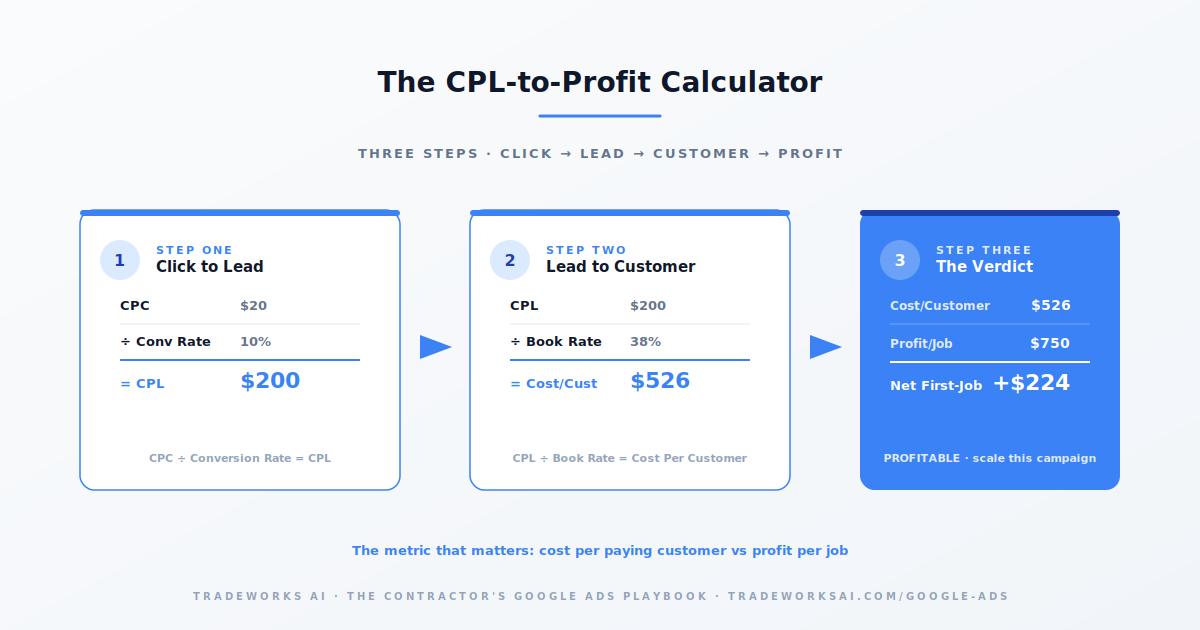
This is the framework you will use for every Google Ads decision from this point forward. Three steps.
Your cost per click divided by the percentage of clicks that become leads. If your CPC is $20 and 10% of visitors fill out a form or call, your CPL is $200. If that same $20 click goes to an optimized landing page that converts at 20%, your CPL drops to $100. Same ad budget. Same clicks. Half the cost per lead. This is why Episode 5 in this series—landing pages—exists. The landing page is the single highest-leverage optimization in the entire Google Ads system.
Your cost per lead divided by the percentage of leads your team actually books into paid appointments. If your CPL is $150 and your team books 38% of leads into appointments, your cost per paying customer is approximately $395. If your booking rate is only 20%, the same $150 CPL produces a $750 cost per customer. The phone answering and booking process is just as important as the ad itself—we covered this in the AI & Technology series (Article 2: AI Answering Services) and it connects directly to the Contractor Stack (Episode 9: CallRail).
The final comparison. If your average HVAC repair generates $2,500 in revenue at 25% margin, profit per job is $625. A $395 cost per customer produces $230 in first-job profit. That campaign is profitable on a single-transaction basis. If your cost per customer is $500 and your profit per job is $300, you lose $200 on the first job. That does not automatically mean the campaign is unprofitable—if that customer enters a maintenance plan, calls for future repairs, or refers neighbors, the lifetime value may justify the acquisition cost. But you need to know the math. Most contractors do not.
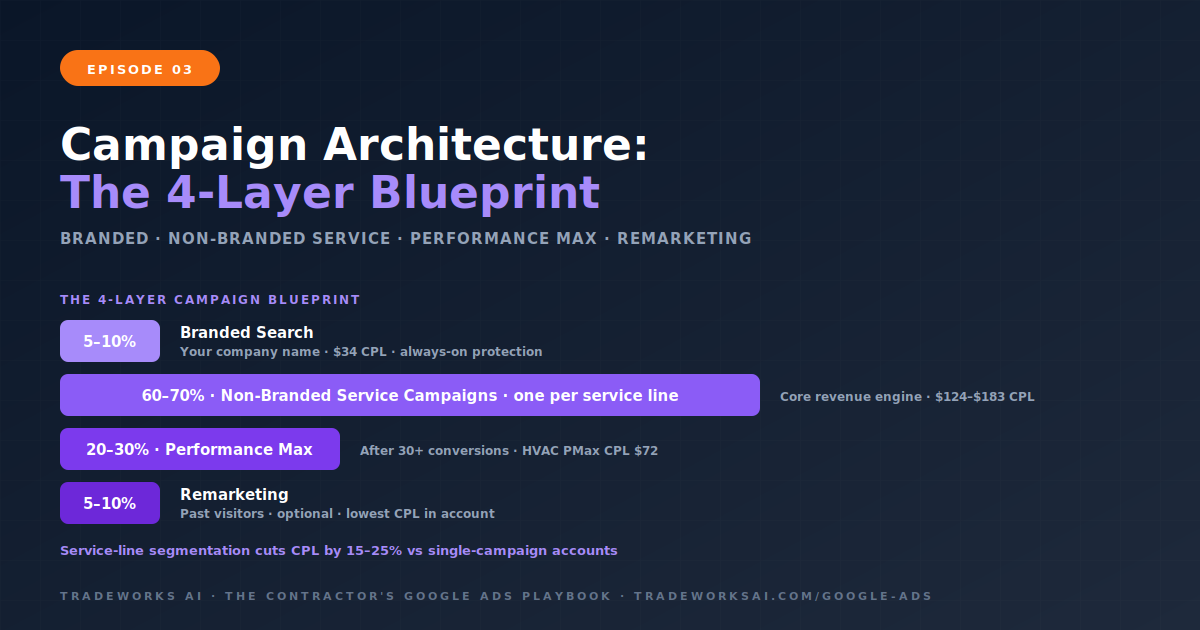
Your core customer acquisition engine. Keywords targeting homeowners with a need who have not chosen a contractor: AC repair near me, emergency plumber Tampa, roof leak repair today. Highest CPL ($124–$183) but highest volume of genuinely new customers. Start with 15 to 25 high-intent, exact-match and phrase-match keywords. Avoid broad match until you have 30 or more conversions and are using Smart Bidding.
Your company name as a keyword. Most contractors skip this because they assume organic results will handle it. That is a mistake. Competitors bid on your brand name and their ad appears above your organic listing. Branded campaigns cost $34 per lead and protect your name from competitor poaching. Run this from day one. Always.
Google’s AI-driven campaign type that runs across every Google surface: Search, Maps, YouTube, Display, Gmail, Discover. HVAC CPL: $72—roughly half of non-branded search. PMax adoption among contractors doubled in a single month (December 2025 to January 2026). The catch: PMax works best after you have 30 or more conversions in your search campaigns and solid conversion tracking infrastructure. Episode 9 in this series covers PMax setup and guardrails in full.
Contractors need $1,500 to $2,500 per month minimum to generate enough data for optimization. Below $1,000, you do not collect enough clicks and conversions to make informed decisions about which keywords, ads, and landing pages are working. HVAC and plumbing contractors in competitive metros—Houston, Phoenix, Tampa, Atlanta, Dallas—often need $3,000 to $6,000 per month. The 30-Day Rule: run your initial campaign for a full 30 days before making major structural changes. During those 30 days, check your Search Terms report weekly and add negative keywords (Episode 4), verify your conversion tracking is recording calls and form fills accurately (Episode 7), and evaluate your CPL against the trade benchmarks in this article. After 30 days, you have enough data for the first real decision: scale what is working, fix what is underperforming, or cut what is losing money.
Audit your current campaign against these five diagnostic signals. If three or more apply, stop increasing spend and fix the foundation before investing another dollar.
Your Search Terms report shows irrelevant queries. If plumber salary, HVAC training, DIY drain cleaning, or how to fix appear in your search terms, your keyword targeting is too broad or your negative keyword list is missing.
All ad traffic goes to your homepage. Sending an AC repair click to a generic homepage instead of a dedicated AC repair landing page reduces conversion rates by 40 to 60%. Every service keyword needs its own landing page.
Quality Score is below 5 on your primary keywords. Google’s Quality Score (1–10) measures how relevant your ads and landing pages are. Below 5, you are overpaying between 25% and 400% per click compared to a competitor with the same bid and a higher Quality Score.
No conversion tracking is configured. If you cannot see how many phone calls, form fills, and bookings came from your Google Ads spend, you are flying blind. Every optimization decision requires conversion data.
You have not reviewed the account in more than two weeks. Google Ads is not a set-it-and-forget-it channel. Search terms drift, competitors change bids, and seasonal demand shifts. Weekly review is the minimum cadence.
The remaining nine episodes of this series address every one of these issues: LSAs (Ep 2), campaign architecture (Ep 3), keywords and negative keywords (Ep 4), landing pages (Ep 5), Quality Score (Ep 6), tracking (Ep 7), budget optimization (Ep 8), Performance Max (Ep 9), and full funnel integration (Ep 10).
The minimum viable budget is $1,500 to $2,500 per month. Competitive metros require $3,000 to $6,000. The average contractor in SearchLight’s 2026 dataset spends $14,206 per month across all campaign types. Start at $1,500, evaluate after 30 days, and scale based on cost per paying customer relative to profit per job.
Non-branded 2026 benchmarks: HVAC $149, Plumbing $183, Roofing $124, Electrical $128. However, CPL alone does not determine profitability. A $200 CPL can be highly profitable for a contractor with a high average ticket and strong book rate. A $80 CPL can lose money for a contractor with a low ticket and weak booking process.
Yes, if the CPL-to-Profit math works. A contractor with a $2,500 average job and 25% margin generates $625 in profit per job. If their cost per paying customer through Google Ads is $400, they profit $225 on each new customer acquired—plus future lifetime value from maintenance plans, repeat work, and referrals.
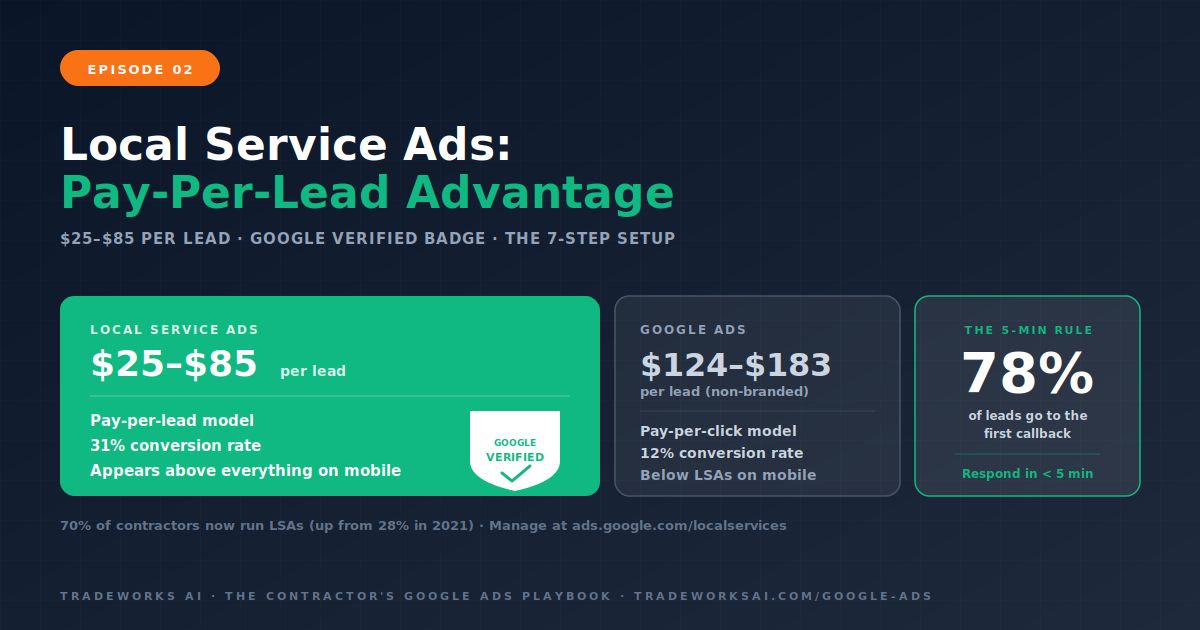
For most contractors, Local Service Ads should be activated first. LSAs convert at approximately 31% compared to 12% for traditional Google Ads, cost $20–$85 per lead (versus $124–$183 for non-branded search ads), and appear above everything on mobile results. Episode 2 of this series covers LSA setup in full.
Branded campaigns target your own company name as a keyword ($34–$44 CPL). Non-branded campaigns target service keywords like AC repair near me ($124–$183 CPL). Always run branded campaigns to prevent competitors from appearing above you when homeowners search your name.
The difference between a $400 cost-per-customer (profit) and a $700 cost-per-customer (loss) is rarely the bid — it is campaign architecture, landing pages, and tracking. The Google Ads Audit grades your account against the 10-part playbook, identifies the highest-leverage gaps, and shows the one optimization that compounds.
Continue the Google Ads Playbook with Part 2 of 10.
Continue the Google Ads Playbook with Part 3 of 10.