Google Ads · Part 7
Google Ads Tracking for Contractors: How to Prove ROI by Connecting Ad Spend to Booked Jobs
Continue the Google Ads Playbook with Part 7 of 10.
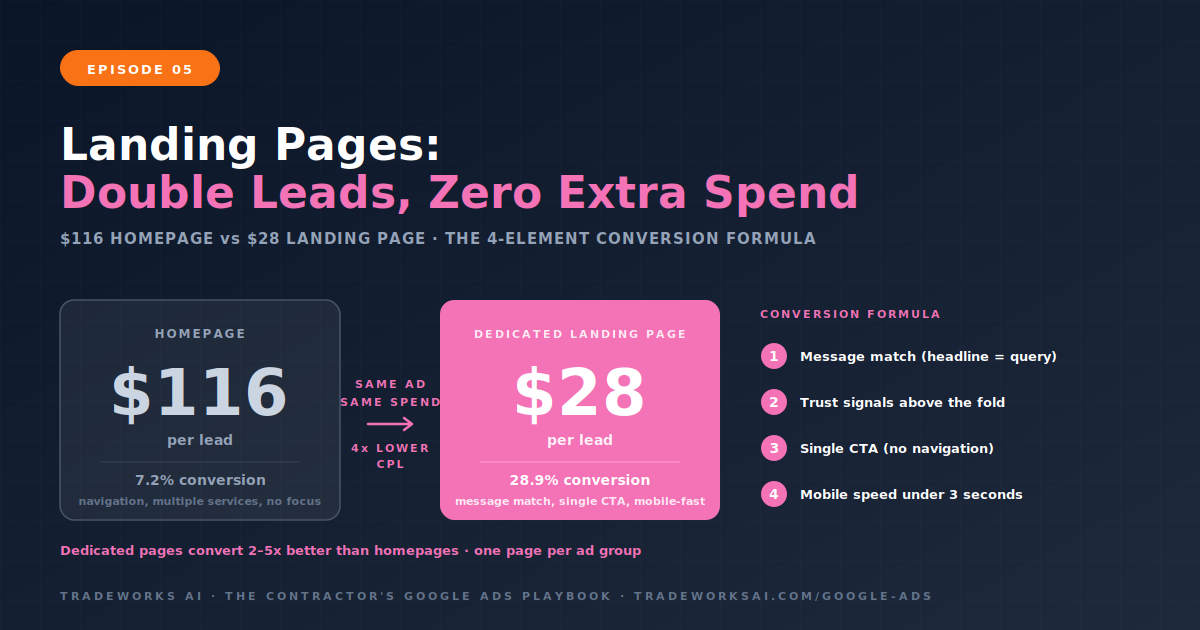
Dedicated Google Ads landing pages for contractors convert 2 to 5 times better than homepages. The median home services landing page conversion rate is 8.5% in 2026, while homepages typically convert paid traffic at 2 to 3%. In a real campaign comparison, a dedicated landing page converted at 28.9% versus 7.2% for a homepage—a 4x difference in cost per lead ($28 versus $116 per lead) with identical ad spend and keywords. The Landing Page Conversion Formula has four components: message match (your headline mirrors the search query and ad copy), trust signals above the fold (review count, years in business, licensing badges), a single primary CTA (click-to-call button on mobile, no competing navigation), and mobile speed (page load under 3 seconds, 76% of contractor searches happen on mobile). Every ad group from Episode 3 needs its own landing page matching the specific service.
In Episode 1, the CPL-to-Profit Calculator showed that conversion rate is the most powerful variable in the entire Google Ads equation. A $20 CPC with a 10% conversion rate produces a $200 CPL. The same $20 CPC with a 20% conversion rate produces a $100 CPL. Same ad. Same keywords. Same budget. Half the cost per lead. The landing page is where conversion rate lives. It is the single highest-leverage optimization in the entire Google Ads system because it affects every dollar you spend without requiring you to spend more. Every improvement to your landing page retroactively improves every click you have already paid for and will pay for in the future.
Most contractors send all Google Ads traffic to their homepage. This is the most expensive mistake in contractor PPC. A homepage is designed for brand exploration—it serves visitors arriving from organic search, direct traffic, social media, and referrals. It includes navigation menus, information about the company, links to multiple services, and content for visitors at every stage of the buyer journey. A homeowner who clicked an ad for emergency AC repair near me does not want to explore your brand. They want to confirm you fix AC units, see that you are trustworthy, and call you. Every navigation link, every secondary service listed, every About Us section is a distraction competing with the one action you need them to take: pick up the phone.
The data confirms the cost. Dedicated landing pages convert paid traffic at 2 to 5 times the rate of homepages. In a tracked campaign comparison, a dedicated landing page converted at 28.9% while the homepage converted at 7.2%—identical ad spend, identical keywords, identical market. The cost per lead difference: $28 per lead on the landing page versus $116 on the homepage. That is a 4x improvement from changing only the destination URL. Home services lead generation landing pages average an 8.5% conversion rate in 2026 industry benchmarks. Homepages average 2 to 3% for the same paid traffic.
Every high-converting contractor landing page shares four structural elements. When all four are present and optimized, conversion rates consistently reach 10 to 30% for home service paid traffic.
The headline on your landing page must mirror the search query and the ad copy. When someone searches emergency AC repair Tampa, clicks an ad that says Emergency AC Repair in Tampa — Same Day Service, and lands on a page with the headline Emergency AC Repair in Tampa, the experience is seamless. The visitor immediately knows they are in the right place. When that same click lands on a page titled Welcome to Tampa Bay HVAC Services, the visitor has to hunt for confirmation that you actually do emergency AC repair. That cognitive friction kills conversions. Message match means: the keyword, the ad headline, and the landing page headline all say the same thing. This is why Episode 3 recommended one landing page per ad group—each ad group targets a specific service intent, and the landing page must match that intent exactly.
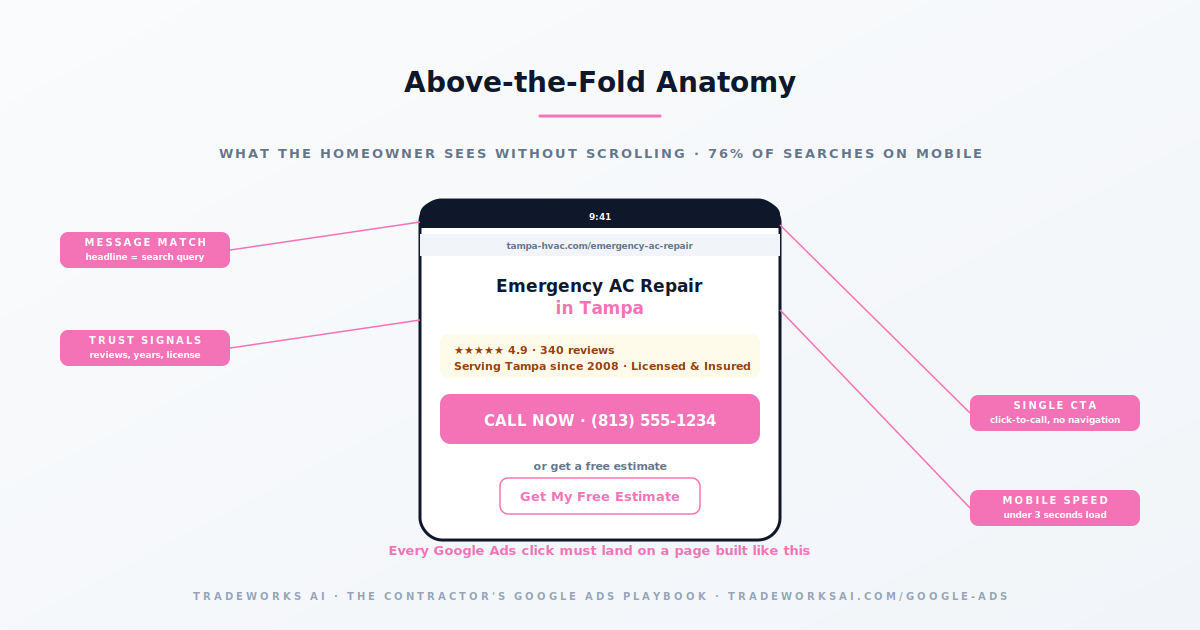
The area visible without scrolling—above the fold—must accomplish three things: confirm the visitor is in the right place (message match), state the value proposition, and establish trust. For contractors, the three most powerful trust signals are: your Google review count and star rating (4.8 stars, 340 reviews), your years in business or founding year (Serving Tampa Since 2008), and your licensing and insurance badges (Licensed, Bonded, and Insured — FL License #CAC123456). These three signals answer the homeowner’s unspoken questions: is this company real, are they experienced, and are they legitimate? Every additional second the homeowner spends looking for answers to those questions is a second closer to hitting the back button.
The landing page has one job: get the visitor to call or submit a form. Everything on the page serves that goal. Remove the main navigation menu—removing navigation has been shown to double conversion rates in controlled tests. Use a single, prominent CTA repeated at multiple points on the page: a click-to-call button at the top (essential for the 76% of contractor searches on mobile), a phone number in large text, and a short form for visitors who prefer to submit online. The CTA copy should be specific: Call Now for Same-Day AC Repair, not generic Contact Us or Learn More. First-person CTAs like Get My Free Estimate have been shown to outperform second-person alternatives by up to 90%.
76% of near-me contractor searches happen on mobile devices. If your landing page does not load in under 3 seconds on a mobile connection, you are losing the majority of your paid traffic before they see a single word. Page speed is also a direct component of Google’s Quality Score—a slow landing page increases your cost per click on top of killing conversions. Test your landing page speed with Google’s PageSpeed Insights tool. Target a score of 80 or higher on mobile. Common speed fixes for contractor landing pages: compress images (job-site photos are often massive uncompressed files), minimize code and scripts, use a fast hosting provider, and implement lazy loading for images below the fold.
Episode 3 established that each ad group in your campaign architecture targets a specific service and intent. Each ad group needs a landing page matching that specific service. For an HVAC contractor: the Emergency AC Repair ad group points to an emergency AC repair landing page. The AC Installation ad group points to an AC installation landing page. The Heating Repair ad group points to a heating repair landing page. This does not mean building 15 completely unique websites. It means creating a landing page template with the four Conversion Formula elements and customizing the headline, service description, trust signals, and images for each service. The template stays the same; the content changes to match the ad group intent. Accounts that moved from one generic landing page to service-specific pages saw 60 to 80% conversion rate improvements with no other campaign changes.
Above the fold handles confirmation and trust. Below the fold handles objections and reinforcement. Include: a brief service description with specific benefits (not features), 2 to 3 customer testimonials (real names and neighborhoods when possible), a simple explanation of your process (We arrive within 60 minutes, diagnose the issue, and provide a flat-rate quote before starting work), and your service area listed by city or neighborhood. Keep the total page length under 1,500 words. Longer pages do not convert better for emergency-intent home service traffic. The homeowner has a problem right now—they need confirmation and a phone number, not a comprehensive education.
Not every keyword, but every ad group. Each ad group targets a specific service intent. One landing page per ad group ensures message match between the keyword, ad, and landing page. For most contractors, this means 3 to 7 landing pages per service campaign.
Dedicated landing pages convert 2 to 5 times better than homepages for paid traffic. In tracked campaign comparisons, the improvement translates to 50 to 75% lower cost per lead with the same ad spend and keywords.
Message match—the alignment between the search query, ad headline, and landing page headline. When all three say the same thing, the visitor immediately confirms they are in the right place. Without message match, the other elements cannot overcome the initial disconnect.
Yes. Removing navigation eliminates distractions and keeps the visitor focused on the single CTA. Tests have shown this change alone can double conversion rates. The only link needed is the CTA (call button, form, or booking link).
The difference between a $400 cost-per-customer (profit) and a $700 cost-per-customer (loss) is rarely the bid — it is campaign architecture, landing pages, and tracking. The Google Ads Audit grades your account against the 10-part playbook, identifies the highest-leverage gaps, and shows the one optimization that compounds.
Continue the Google Ads Playbook with Part 7 of 10.
Continue the Google Ads Playbook with Part 8 of 10.