Reviews & Reputation · Part 4
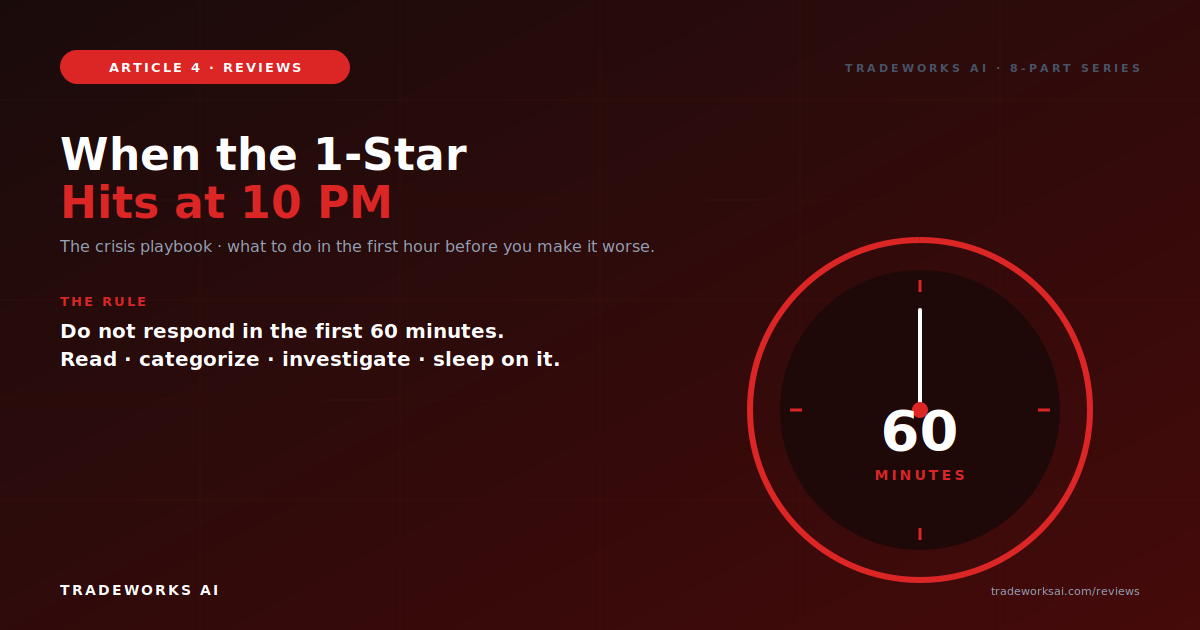
The Negative Review Crisis Playbook
Continue the Reviews & Reputation series with Part 4 of 8.
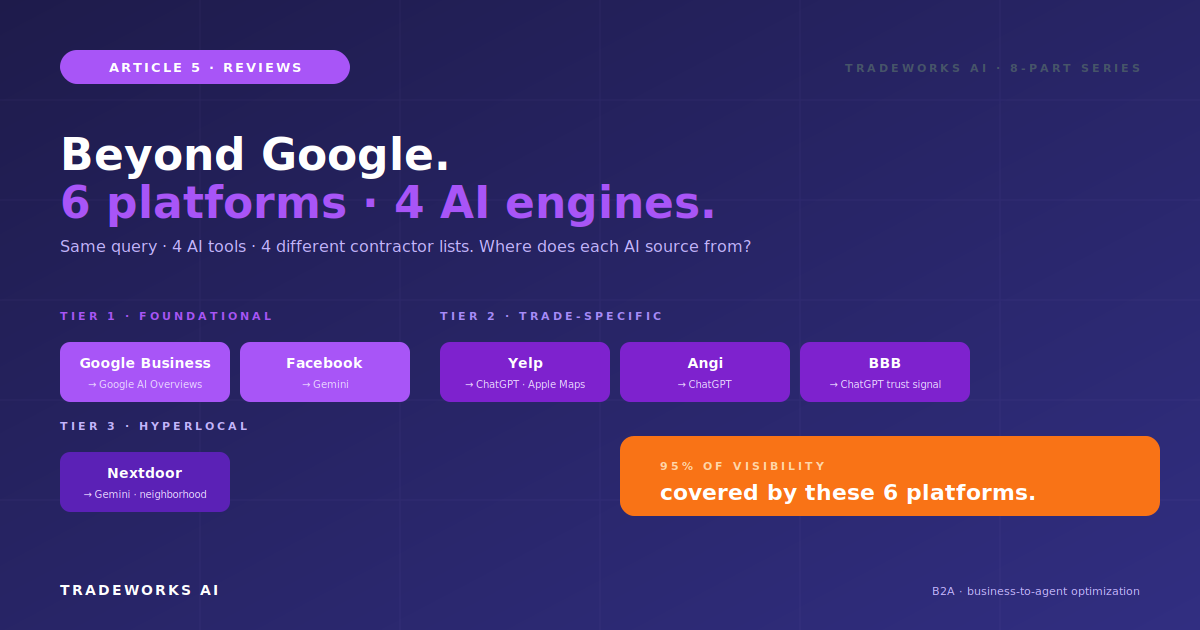
Google reviews drive the largest single share of contractor visibility, but in 2026 they no longer cover the full landscape. Different AI search tools source recommendations from different review platforms: ChatGPT leans heavily on Angi, Yelp, and BBB; Gemini pulls from Facebook and Nextdoor; Google AI Overviews use Google Business Profile primarily; Perplexity rewards specific website content with less platform dependency. The same query in four AI tools produces four different contractor lists with minimal overlap. Multi-platform review presence is no longer optional for contractors who want consistent visibility across the AI search landscape - it is the foundation of B2A (business-to-agent) optimization. This article covers the multi-platform tier system that organizes which platforms matter for which contractors, the platform-by-platform breakdown of audience, AI source mapping, acquisition rules, and response calibration, the resource allocation framework for limited time and budget, and the trade-specific priority maps that determine where each contractor type should focus.
Until 2024, contractor review strategy was almost entirely Google-centric. The math was simple: Google was where local search lived, the Map Pack drove local lead generation, and other platforms were nice-to-have at best.
Three shifts changed the landscape. First: 45 percent of consumers now use AI tools (ChatGPT, Gemini, Perplexity) to find local services, up from 6 percent in 2025. Second: each AI platform reads different signals from different sources - same query, different platforms, different recommended contractors. Third: AI Overviews now appear in 68 percent of local searches, fundamentally changing how Google itself displays results.
The implication for contractors: a strong Google review profile is necessary but no longer sufficient. ChatGPT may recommend a competitor with a strong Angi presence even when Google ranks you higher. Gemini may surface a competitor with active Facebook and Nextdoor reviews even when your Google profile is more developed. The contractor with the best Google reviews can still be invisible in 60 percent of AI-driven contractor recommendations because they have no presence on the platforms those AI tools source from.
Multi-platform review strategy is the response to this reality. Not platform-of-the-month chasing - structured presence across the platforms that actually feed your visibility into the AI tools your customers use.
Six platforms cover roughly 95 percent of contractor review visibility in 2026. Organized into three tiers based on universal applicability and resource allocation priority.
Google Business Profile - the foundation, primary visibility driver, source for Google AI Overviews.
Facebook - community signal, source for Gemini, native to most contractor customer demographics.
Angi - lead generation platform plus review platform, ChatGPT source, formal home-services positioning.
BBB - formal trust signal, older demographics, ChatGPT source, particularly weighted in B2B and high-trust services.
Nextdoor - hyperlocal trust, Gemini source, residential service contractors with neighborhood density.
Each platform requires different acquisition rules, different response tone, and different success metrics. Treating them identically wastes effort.
Audience: broadest possible. Anyone searching for a contractor in your service area.
AI source for: Google AI Overviews (primary), ChatGPT (secondary signal), all AI tools as a verification layer.
Acquisition rules: most permissive of all platforms. Direct review links, QR codes, automated workflows from FSMs all permitted. The 5-pillar acquisition system from Part 2 is built primarily for Google.
Response calibration: full R-A-T-E framework from Part 3. SEO/AEO keyword integration. Indexed in search.
Best use case: foundation for everything. Every contractor starts here.
Audience: residential customers, community-engaged demographics, older homeowners particularly active. Family decision-makers spend significant time here.
Acquisition rules: similar permissiveness to Google. Review request links work well. Page recommendation engagement also drives social proof.
Response calibration: slightly warmer tone than Google. Responses appear in social feeds - the audience is broader than just review readers.
Target volume: 50-plus reviews, 4.5-plus stars. Less critical to push into the hundreds because Facebook weights are different than Google.
Best use case: residential service contractors with community-engaged customer bases. HVAC, plumbing, cleaning, pest control.
Audience: urban and suburban consumers, particularly in markets like New York, Los Angeles, San Francisco, Chicago, Boston. Skews younger and more skeptical than Google. Apple Maps integration extends reach to iOS users.
AI source for: ChatGPT (primary), Apple Siri/World Knowledge Answers (expected primary at launch).
Acquisition rules: most restrictive of all platforms. Yelp explicitly penalizes review solicitation. Direct review request workflows that work on Google and Facebook can result in review filtering on Yelp. Yelp prefers organic, unsolicited reviews.
Response calibration: shorter, more measured tone. Yelp users skew skeptical and defensive responses backfire faster on Yelp than anywhere else. Lean factual and brief.
Target volume: 25-plus reviews if you operate in a Yelp-strong market. Below that threshold the platform investment may not be worth the constraint on acquisition tactics.
Best use case: urban/suburban contractors in Yelp-active metros. Less critical for rural markets where Yelp adoption is lower.
Audience: home service shoppers actively comparing contractors. Higher purchase intent than browsing audiences. Lead-generation oriented.
Acquisition rules: Angi has its own request workflow. Reviews from confirmed Angi-sourced jobs are most heavily weighted. Outside customer reviews are accepted but with less algorithmic weight.
Response calibration: formal but warm. Angi has customer service mediation built into the platform.
Target volume: 25-plus reviews on Angi if you participate in their lead-gen. Less critical if you do not pay for Angi leads.
Best use case: contractors who use Angi as a lead source benefit doubly - lead pipeline plus AI visibility. Contractors not on Angi for leads can still benefit from claiming and managing the listing for AI source coverage.
Special note: Angi is a hybrid platform - lead generation marketplace plus review aggregator. Decisions about Angi investment are not just about reviews - they involve broader pricing and lead-source strategy that varies dramatically by market.
Audience: older demographics, formal-trust consumers, B2B buyers. Particularly weighted for high-cost services and home improvement projects.
AI source for: ChatGPT (secondary signal). Less weight than Yelp or Angi but contributes to verification layer.
Acquisition rules: BBB has its own customer review process. Accreditation status matters more than review count for BBB visibility.
Response calibration: most formal of any platform. Responses become part of the BBB record. Treat as written customer service correspondence. Disputes can escalate to BBB mediation.
Target volume: A-plus rating maintenance is the goal. Review count secondary. 10-20 reviews suffice if rating is strong.
Best use case: contractors targeting older demographics, large-ticket projects (roofing, remodeling, HVAC replacement), B2B/commercial work.
Audience: hyperlocal - neighborhood-specific. Residential homeowners, family decision-makers, recommendation-driven discovery. Roughly 30 million US users with high engagement in service-recommendation conversations.
AI source for: Gemini (primary - Gemini specifically pulls from Nextdoor for local context).
Acquisition rules: Nextdoor has a Business Page system but reviews and recommendations behave differently than other platforms. Customer-initiated recommendations carry the most weight. The owner posts under personal account, not business page, for community engagement.
Response calibration: conversational neighbor tone. Never corporate. Nextdoor users specifically value the small-business community feel. Owner posts under personal account, not business.
Target volume: less about review count, more about active neighborhood presence. Recommendations and answer responses to neighborhood-asking-for-recommendations posts.
Best use case: residential service contractors in neighborhoods with high Nextdoor adoption. Particularly powerful for HVAC, plumbing, cleaning, pest control. Less relevant for commercial-only operations.
Most contractors do not have unlimited time and budget for review acquisition across six platforms. The allocation framework prioritizes effort.
100 percent of review acquisition effort on Google Business Profile. Implement the 5-pillar acquisition system from Part 2. Hit 200-plus reviews if achievable, or as close as your job volume permits. Crossing the AI recommendation threshold on Google is the highest-leverage first move.
Continue Google momentum (60-70 percent effort). Add Facebook as secondary platform (30-40 percent effort). Cross-platform review request workflow - customers who already left Google reviews get invited to Facebook second. Target 50-plus Facebook reviews by end of Phase 2.
Add the Tier 2 platforms most relevant to your trade. Continue Google (50 percent), Facebook (20 percent), Tier 2 platforms (30 percent split across most-relevant). Trade-specific guidance below.
Add Nextdoor if you operate in residential markets with neighborhood density. Evaluate niche platforms based on trade. Maintenance pace on Tier 1 and Tier 2 established by this point.
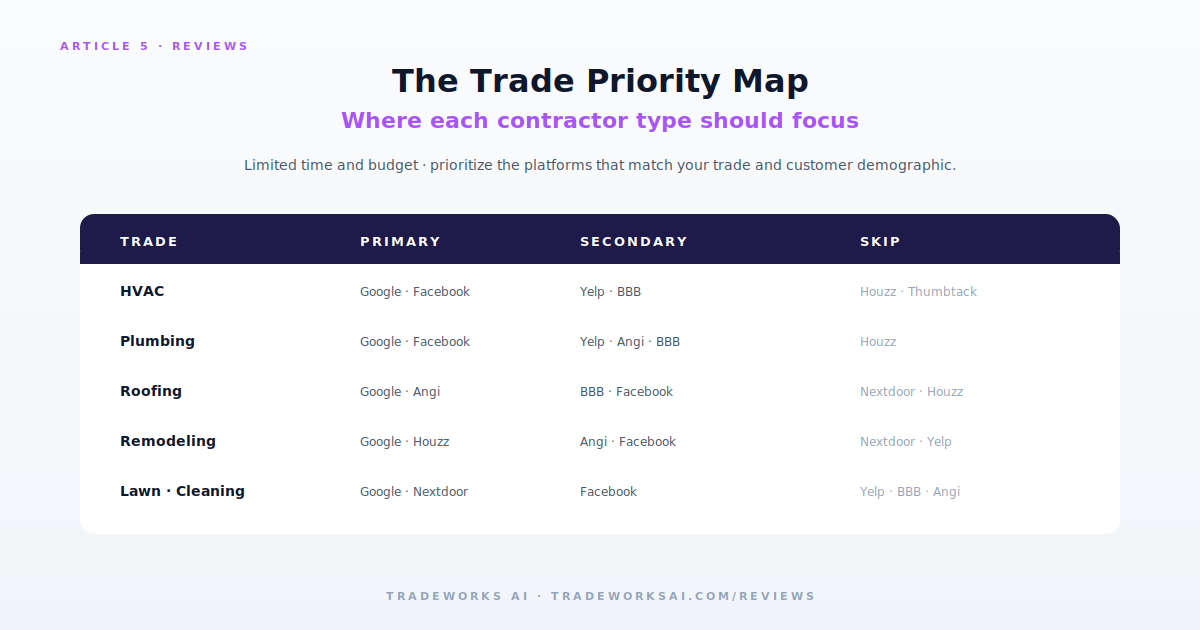
Priority order: Google -> Facebook -> Nextdoor -> BBB. Yelp matters in urban markets. Angi if you participate in their lead-gen.
Why: emergency-service nature of these trades benefits from neighborhood trust signals. Nextdoor recommendations drive same-day calls. BBB matters for higher-ticket replacements (water heaters, AC systems, panel upgrades).
Priority order: Google -> Facebook -> BBB -> Angi. Yelp lower priority unless urban.
Why: roofing is high-ticket and trust-sensitive. BBB accreditation matters substantially for storm-damage and insurance-related work. Angi participation common in roofing for lead generation.
Why: hyperlocal trust drives recurring-service decisions. Nextdoor recommendation networks particularly powerful. Visual social proof on Facebook (before/after photos) drives engagement.
Why: visual portfolio matters more than any other trade. Houzz functions as both review platform and portfolio platform. BBB and Angi credibility for high-ticket project investment.
Priority order: Google -> BBB -> LinkedIn (company page reviews) -> Angi/industry-specific directories.
Why: B2B buying decisions weight formal trust signals. BBB accreditation often required for procurement processes. Industry-specific directories carry weight in commercial bidding.
Why: real estate has its own platform ecosystem. Zillow reviews function as the industrys equivalent of Google for many search behaviors.
Treating all platforms identically. Each platform has different acquisition rules, response tone, and audience. Copying the Google approach to Yelp gets reviews filtered.
Over-investing in low-impact platforms. Building 100 reviews on a platform your customers do not use is wasted effort. Focus on platforms where your audience actually decides.
Underestimating Yelp impact in urban markets. Contractors in Yelp-active metros (NYC, LA, SF, Boston, Chicago) cannot ignore the platform regardless of acquisition restrictions.
Ignoring Nextdoor for residential service. The 30-million-user platform with high recommendation density is invisible to contractors who do not engage. Gemini AI source bonus.
Not adjusting response tone per platform. Yelp tone backfires on Facebook and vice versa. Each platform calibrates differently.
Letting platforms go stale. A profile with 100 reviews from 2 years ago and zero activity since signals abandonment to both algorithms and prospects. Maintenance pace matters as much as initial acquisition.
Google: 5-10 new reviews per month minimum to maintain recency signals. 100 percent response rate within 48 hours.
Facebook: 2-3 new reviews per month. Response rate maintained.
Nextdoor: weekly engagement on neighborhood recommendation posts. Quarterly check-in on business page if maintained.
Total monthly time: 5-10 hours office staff for an established contractor running the full multi-platform stack.
The contractor with 300 Google reviews and nothing else may be invisible to 60 percent of AI-driven contractor recommendations. The contractor with 200 Google reviews plus 50 Facebook reviews plus active Nextdoor presence plus BBB accreditation captures the full AI search landscape.
Multi-platform is not about diluting effort across too many platforms. It is about strategic presence across the specific platforms that feed visibility into the AI tools your customers use. The tier system organizes the strategy. The trade-specific priority maps adapt it to your operation. The phased rollout makes it executable without overwhelming your existing review acquisition workflow.
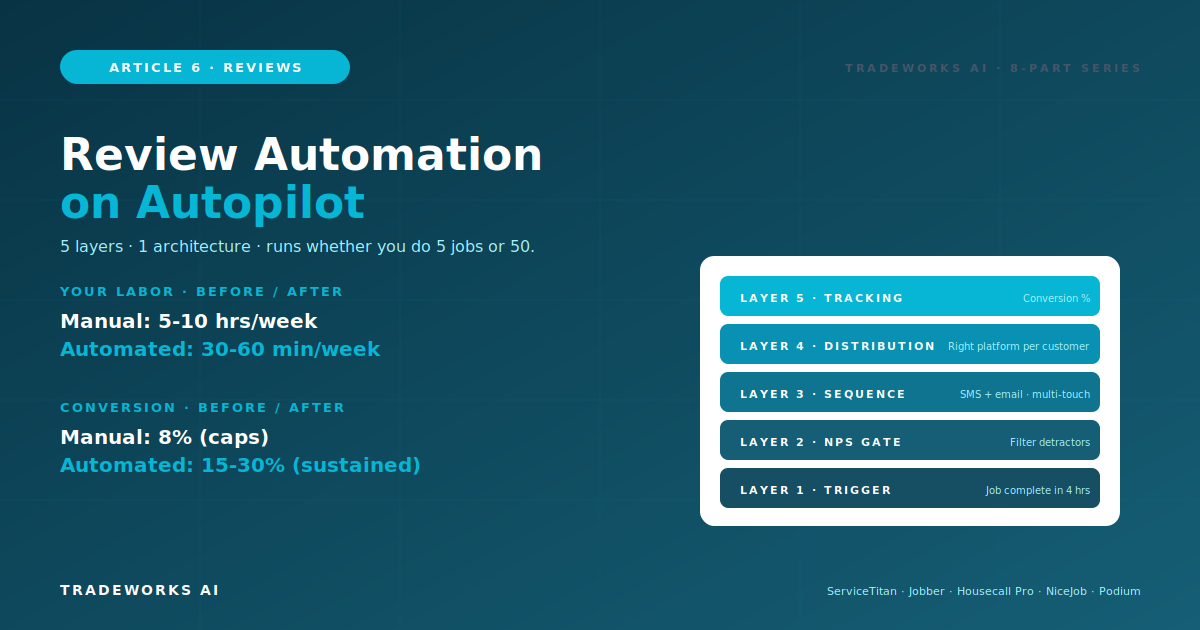
Read Part 6 next: Review Automation - The FSM Workflows That Generate Reviews on Autopilot. The technical implementation that makes multi-platform review acquisition manageable at any contractor stage.
Depth on Google first - 200-plus reviews on your foundation platform. Then expand to multi-platform breadth. The order matters: a strong foundation on Google plus thinner profiles on 3-4 other platforms outperforms thin profiles on all platforms simultaneously.
Yelp explicitly penalizes review solicitation, so the 5-pillar acquisition system from Part 2 cannot be applied directly. The path on Yelp is to make leaving a review easy and visible (link from your website, mention in invoice signatures, business card with QR) without explicitly asking customers to review you. Organic flow is what Yelp rewards.
Depends on neighborhood density. In dense suburban markets where Nextdoor adoption is high, the platform drives substantial residential service business. In rural markets or areas with low adoption, the effort is harder to justify. Check Nextdoor adoption in your specific zip codes before committing.
Houzz is essential for design-focused trades (kitchen, bath, remodeling, custom builds). Thumbtack is more of a lead-gen platform than review platform - investment decisions are about lead pricing more than review visibility. Industry directories (NARI, ACCA, NECA) matter for industry credibility but generate fewer direct customer reviews.
FSM-native tools (ServiceTitan Marketing Pro, Jobber AI, BirdEye, Podium) can aggregate review data across platforms. Standalone reputation management tools provide multi-platform dashboards. At minimum: monthly check on review count, rating, recency, and response rate per platform.
No. Most contractors operate well with Tier 1 (Google + Facebook) plus 1-2 Tier 2 platforms relevant to their trade. The full six-platform stack is optimal for established contractors at Stage 3-plus from the AI Stack Blueprint. Solo and small operations focus on Tier 1 first.
Most contractors think their review profile is "fine." Then we benchmark it against the local competitors who are taking the AI recommendation slots. Our free audit checks volume, recency, rating, response rate, and platform coverage — and shows you the highest-leverage moves to get to 4.7+ stars and 200+ reviews this year.
Continue the Reviews & Reputation series with Part 4 of 8.
Continue the Reviews & Reputation series with Part 6 of 8.