Local Search · Part 2
Google Business Profile Setup for Contractors: The Complete 2026 Guide
The 12-point completeness checklist, the categories that drive ranking, and every GBP field that matters in 2026.
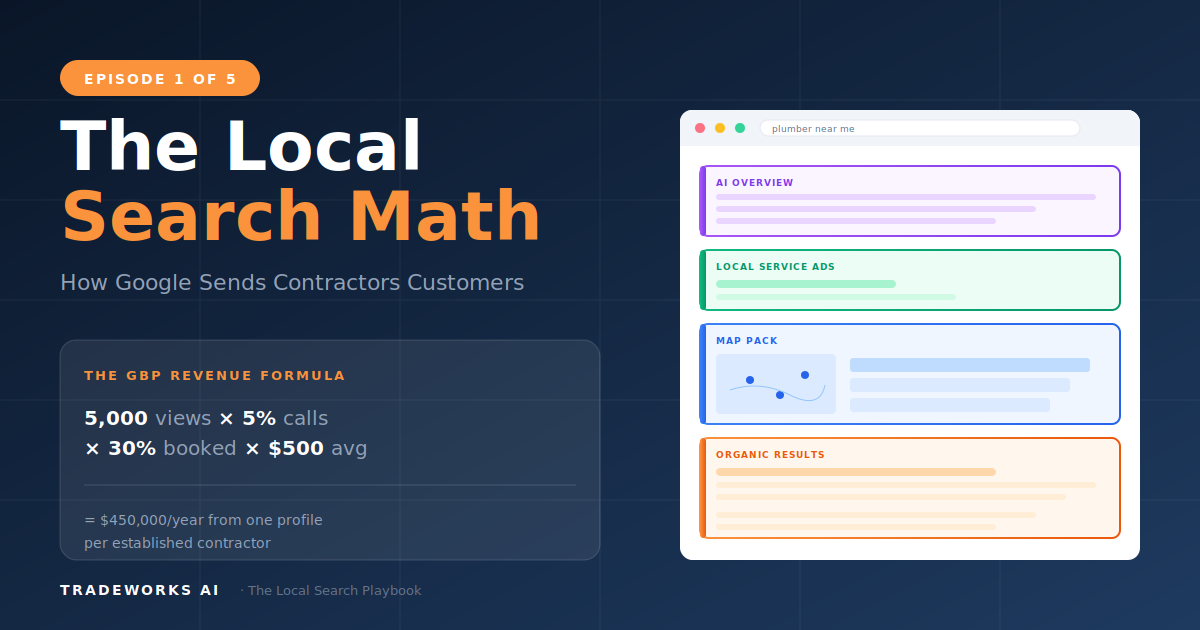
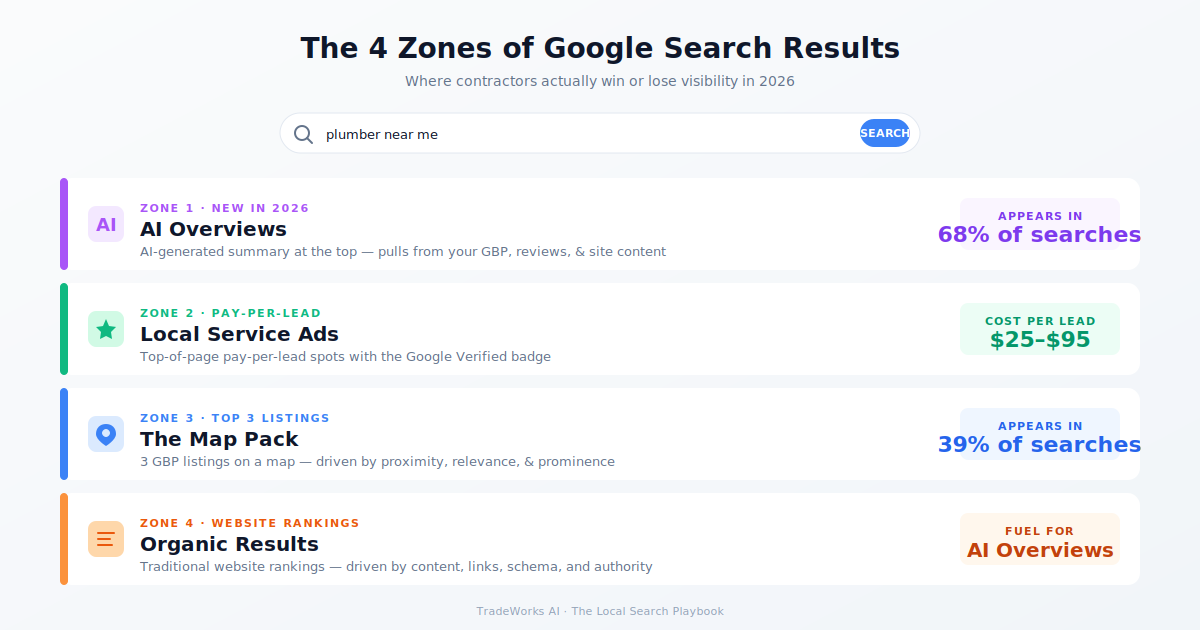
Google sends contractors customers through three distinct zones on the search results page: Local Service Ads at the top (pay-per-lead, Google Verified badge), the Map Pack in the middle (3 Google Business Profile listings driven by proximity, relevance, and prominence), and organic results below (website rankings driven by content authority and links). In 2026, a fourth layer has emerged: AI Overviews that now appear in 68% of local searches, summarizing contractor options before the viewer scrolls to the traditional results.
A single optimized Google Business Profile generates 50–150 calls per month for an established contractor, converting at 25–40% to booked jobs with an average ticket of $300–800 for service calls and $3,000–15,000 for installations. The math: one GBP profile, properly optimized, produces $150,000–500,000 in annual revenue for a typical home service contractor.
This article introduces the Local Search Stack — a 5-layer framework covering GBP Foundation, Map Pack Ranking, Local Service Ads, Reviews and Reputation, and AI Search Visibility — and the revenue math that shows why local search is the highest-ROI channel in contractor marketing.
When a homeowner searches "best AC repair near me" or "plumber in Tampa," Google shows them a page with four distinct zones. Each zone has different economics, different ranking factors, and different optimization strategies. Most contractors only think about one of them.
The very top of the page. Pay-per-lead model — you only pay when a customer contacts you. Google Verified badge (replaced Google Guaranteed in October 2025). Cost per lead ranges from $25 for simple services to $95 for high-ticket trades like HVAC and roofing. 70% of contractors now use LSAs, up from 35% in 2023.
LSAs are the first thing the homeowner sees. The contractor with a strong LSA presence captures the highest-intent traffic before the customer ever scrolls down to the Map Pack.
Three Google Business Profile listings displayed with a map. This was the dominant local search surface for the past decade. Rankings driven by three factors: proximity to the searcher, relevance to the query, and prominence (reviews, citations, authority).
Critical 2026 data: the Map Pack now appears in only 39% of local searches, down from 78% in 2023. AI Overviews have displaced it in many queries. When the Map Pack does appear, it remains the highest-converting organic local surface.
Traditional website rankings below the Map Pack. Driven by content authority, links, technical SEO, and schema markup. For contractors, organic results matter most for informational queries — "how much does AC replacement cost," "signs your water heater is failing" — that feed the top of the customer journey.
The newest zone. An AI-generated summary that appears above or alongside the traditional results in 68% of local searches. Sources from GBP data, website content, review platforms, and structured data. The contractor cited in the AI Overview captures attention before the customer sees any other result.
51% of local searches now result in zero clicks to any website — the customer gets their answer (phone number, hours, rating) directly from the search results page. For contractors, this means your Google Business Profile is your website for half of all potential customers. (See our deeper take on how AI search is rewriting visibility.)
Most contractors have no idea how much revenue their Google Business Profile generates. The math is straightforward.
Monthly GBP views × click-to-call rate × booking rate × average ticket = monthly GBP revenue.
A typical established contractor in a mid-size metro:
Running the math on conservative numbers: 5,000 views × 5% call rate = 250 calls per month. 250 calls × 30% booking rate = 75 booked jobs. 75 jobs × $500 average ticket = $37,500/month = $450,000/year from one GBP profile.
The aggressive-but-realistic scenario: 8,000 views × 7% call rate = 560 calls. 560 × 35% = 196 jobs. 196 × $600 average = $117,600/month = $1.4M per year.
Your GBP is not a listing. It is a revenue engine. The question is whether you are optimizing it or leaving six figures on the table.
The Local Search Stack is a 5-layer framework that covers every component of how contractors win local search visibility in 2026. Each layer builds on the one below it. Skipping layers creates gaps that limit the entire system.
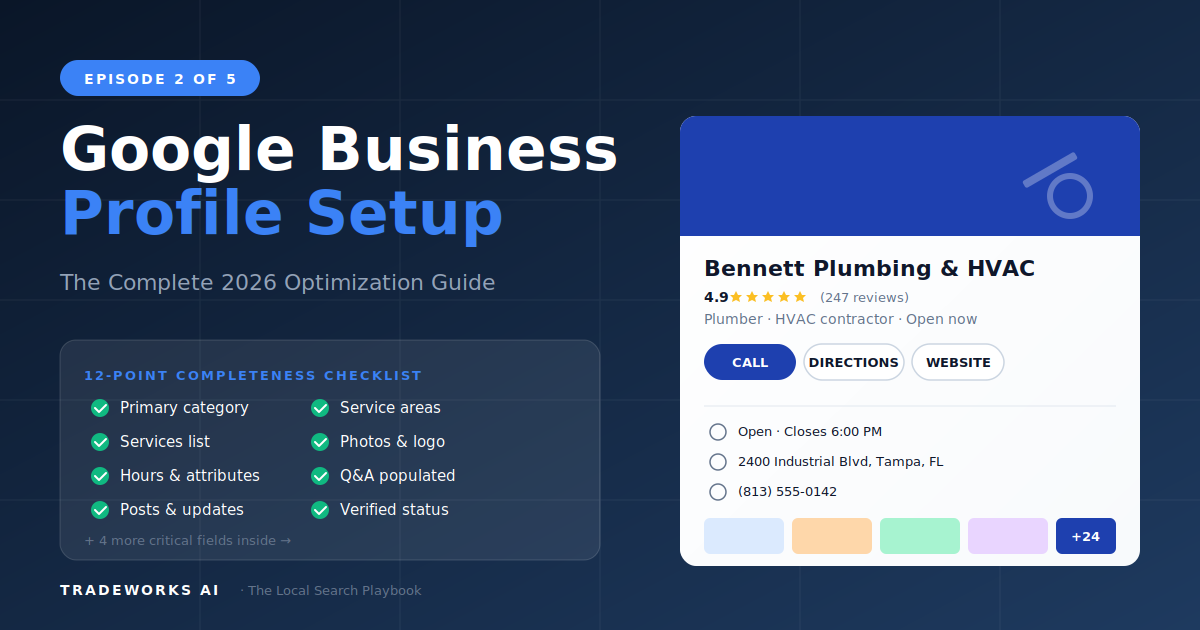
Your Google Business Profile is the data source that feeds everything else. Categories, services, attributes, photos, posts, Q&A, hours, service area — every field matters. An incomplete GBP is a broken pipeline feeding bad data to every surface including AI Overviews and AI tools. Part 2 covers GBP optimization in full depth.
Proximity, relevance, and prominence determine your position in the Map Pack. You cannot change proximity (it is the searcher's location). You control relevance through GBP category selection and website content. You control prominence through reviews, citations, and link authority. Part 5 covers Map Pack ranking factors in depth.
The pay-per-lead layer. Google Verified badge. AI-automated lead credits replaced manual disputes in 2025. LSA leads now cost $65–95 each, up 40% since 2023. The easy-money era is over — contractors who do not optimize are bleeding budget. (See our companion LSA setup guide.)
The amplifier layer. Reviews drive Map Pack ranking, AI recommendation eligibility, customer conversion, and trust signals across every other surface. The 200-review threshold, the 4.5-star cutoff, and the recency factor all compound across layers. (See how to get more Google reviews.)
The 2026 layer. ChatGPT, Gemini, Perplexity, Apple Siri, and Google AI Overviews all source from different signals to recommend contractors. 45% of consumers now use AI tools for local services. AI-referred leads convert at 73% vs 31% for Google organic.
Three shifts happened simultaneously that make 2026 the most consequential year for contractor local search since Google launched the Map Pack.
Google re-weighted local search results, favoring specific, verifiable, location-authentic content over templated city pages. Contractors who relied on thin, duplicated city pages lost visibility overnight. The update rewarded contractors with deep service pages, genuine local content, and verified business information.
Your Google Business Profile is no longer just a listing — it is the data feed for every AI system recommending local services. ChatGPT, Gemini, and Perplexity all pull from GBP data for local queries. A bad GBP in 2026 is not just a weak ranking factor; it is a broken pipeline feeding bad data to every AI system.
Google Verified badge replaced Google Guaranteed. AI-automated lead credits replaced manual disputes. Mandatory GBP linking. LSA leads now cost $65–95 each, up 40% since 2023. 70% of contractors now use LSAs. The contractors who do not optimize their LSA presence are subsidizing their competitors.
Local search is the highest-ROI channel in contractor marketing. A single optimized GBP profile generates $150,000–500,000 in annual revenue. The Local Search Stack gives you the framework to capture visibility across all four zones of the search results page — LSAs, Map Pack, organic, and AI Overviews.
The contractor who implements this system does not just rank — they dominate the entire first page of Google for their trade and service area. And in 2026, they also appear in the AI tools that a growing share of customers use before they ever open Google.
Three paths with different costs. Google Business Profile optimization is free (just labor). Local Service Ads cost $25–95 per lead depending on trade. Google Ads PPC costs $15–75 per click for contractor keywords. Most contractors start with GBP optimization (free) and add LSAs as the second investment.
New GBP profiles typically take 3–6 months to establish Map Pack visibility in competitive markets. Existing profiles with optimization improvements can see movement in 4–8 weeks. The primary ranking factors (proximity, relevance, prominence) respond at different speeds — prominence (reviews, citations) takes longest to build.
Yes — when the Map Pack appears, it remains the highest-converting organic local surface. The strategy shift is that Map Pack optimization alone is no longer sufficient. You also need AI Overview visibility, LSA presence, and organic ranking to capture the queries where the Map Pack does not appear.
Complete and optimize your Google Business Profile. It feeds every other layer of the Local Search Stack including AI Overviews and AI tool recommendations. An incomplete GBP limits visibility across all surfaces simultaneously. Part 2 covers the complete optimization playbook.
Both. LSAs capture the highest-intent traffic at the top of the page. Organic (Map Pack + website rankings) captures the research-phase traffic. The contractors who run both capture more of the customer journey than competitors who choose one or the other.
45% of consumers now use AI tools to find local services. AI tools source from your GBP data, reviews, and website content. The same optimization that wins on Google also feeds AI recommendations — but AI tools also source from platforms Google does not prioritize (Angi, Yelp, Facebook, Nextdoor). Multi-platform presence matters.
Most contractors have no idea how many calls, jobs, or dollars their Google Business Profile is producing — or where the leaks are. Our free audit maps your visibility across the Map Pack, LSAs, AI Overviews, and AI tools, then quantifies the revenue you are leaving on the table.
The 12-point completeness checklist, the categories that drive ranking, and every GBP field that matters in 2026.
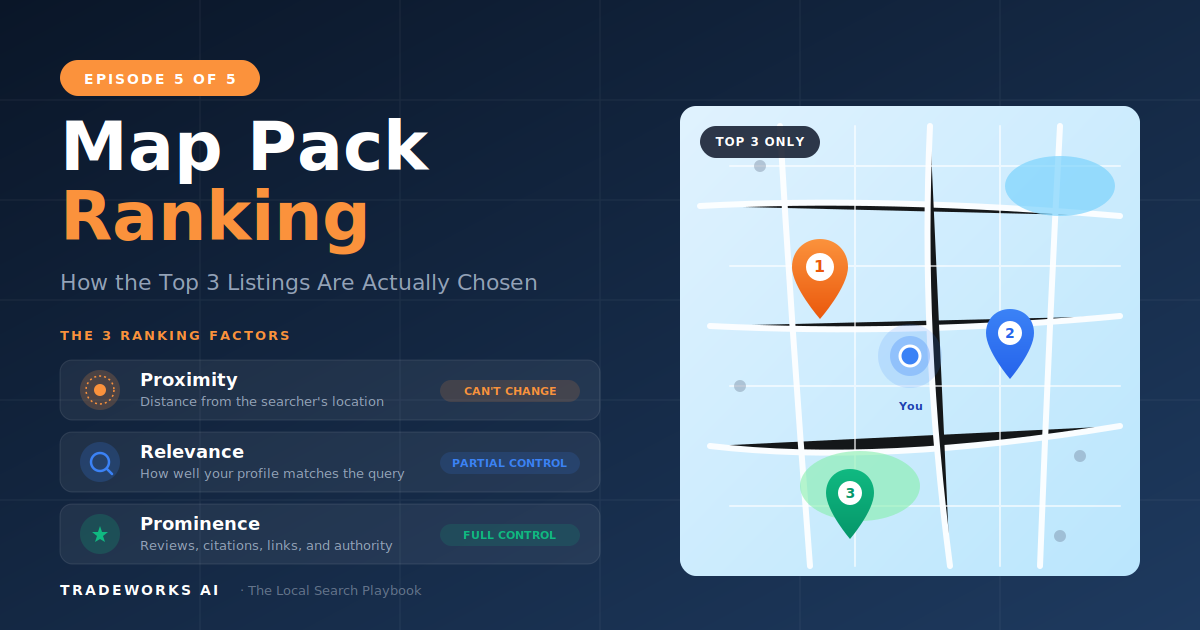
The three ranking factors, the weight breakdown, and the 8 tactical levers contractors actually control.