Local Search · Part 7
Google Local Service Ads — The 2026 Setup & Optimization Guide
Continue the Local Search Playbook with Part 7 of 10.
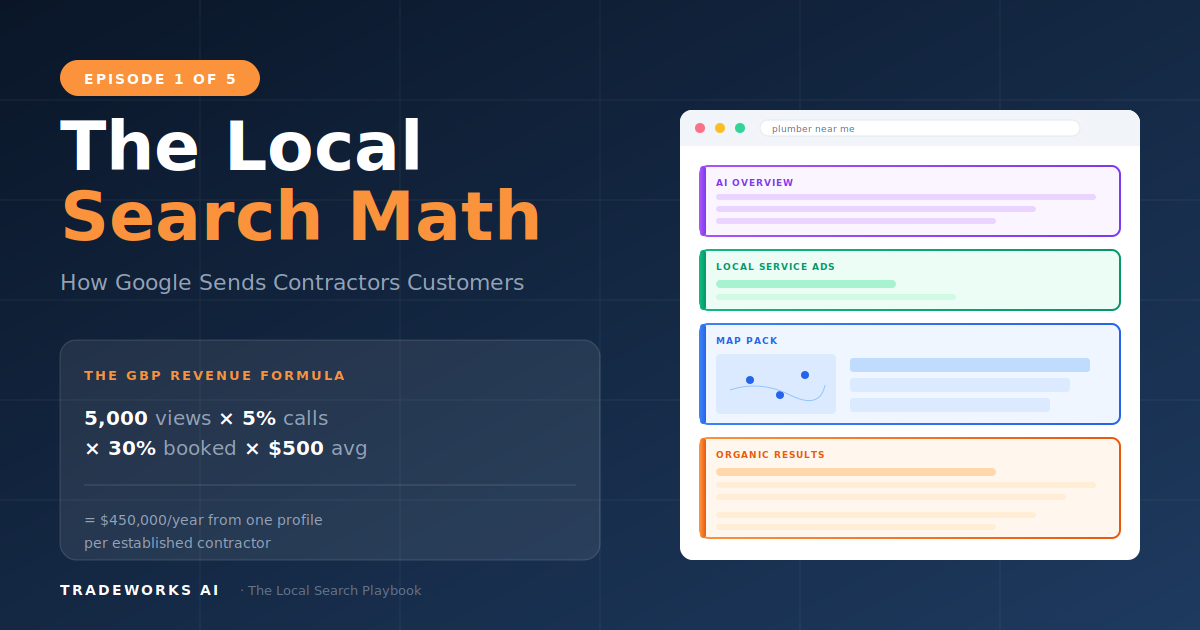
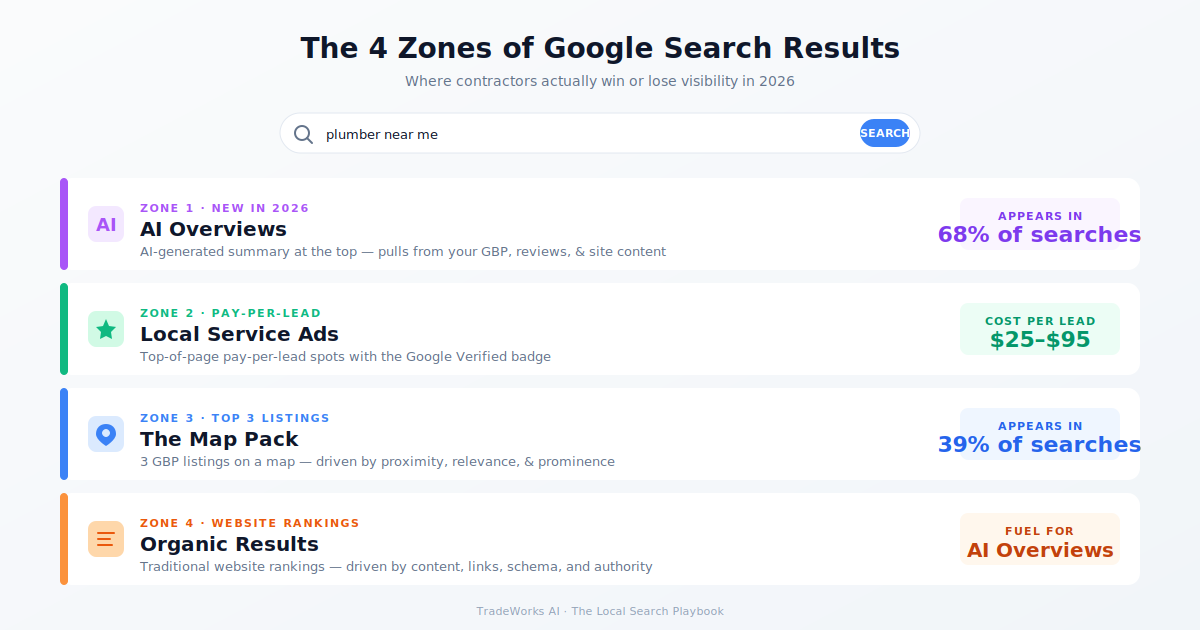
Local Service Ads (LSAs) and Google Ads PPC are fundamentally different paid channels serving different purposes for contractors. LSAs operate on pay-per-lead pricing (you pay only when a customer contacts you), appear above everything on the search results page, require Google Verified badge, give you minimal control over targeting and messaging, and cost 25-95 dollars per lead depending on trade. Google Ads PPC operates on pay-per-click pricing (you pay for every click whether it converts or not), appears below LSAs but above organic results, gives you full control over keywords, ad copy, landing pages, and audience targeting, and costs 15-75 dollars per click for contractor keywords with conversion rates of 5-15 percent. The decision is not either-or for most contractors. LSAs capture highest-intent emergency and immediate-need traffic with simplicity. PPC captures research-phase and comparison traffic with precision. Running both occupies two paid positions on the results page simultaneously. This article covers the head-to-head comparison across 8 dimensions, the 4 scenarios where LSAs win, the 4 scenarios where PPC wins, when to run both, and the budget allocation framework by contractor stage.
The core distinction is simple: LSAs charge per lead, PPC charges per click. Everything else flows from this.
With LSAs, you pay 50 dollars when a homeowner calls or messages through the ad. If they click and do not contact you, you pay nothing. The risk is lower per interaction, but you have almost no control over which queries trigger your ad, what your ad says, or where the customer lands.
With PPC, you pay 35 dollars when someone clicks your ad regardless of whether they call. Many clicks do not convert. But you control exactly which keywords trigger your ad, exactly what your ad copy says, exactly which landing page the customer sees, and exactly which audiences and demographics you target.
LSAs are a simple, low-control, high-trust-signal channel. PPC is a complex, high-control, precision-targeting channel. Both have a place in a contractor paid search strategy.
1. Cost Model
LSA: pay per lead. 25-95 dollars per contact depending on trade. You pay only when a customer calls or messages.
PPC: pay per click. 15-75 dollars per click for contractor keywords. Conversion rate of 5-15 percent means effective cost per lead is 100-500 dollars before optimization.
Winner: LSAs for raw cost efficiency on immediate-need queries. PPC costs more per lead but offers targeting precision that can improve over time.
2. Placement
LSA: very top of the results page. Above PPC, above Map Pack, above organic.
PPC: below LSAs, above organic. Sometimes above Map Pack, sometimes alongside.
Winner: LSAs for placement. Running both occupies the top two paid positions.
3. Trust Signal
LSA: Google Verified badge. Green checkmark. Google-verified license, insurance, background check. Highest-trust ad format.
PPC: no trust badge. Standard ad label. Trust comes from ad copy, reviews in extensions, and landing page quality.
Winner: LSAs for built-in trust. PPC requires you to build trust through copy and landing page.
4. Control
LSA: minimal. You select service categories and set budget. Google controls which queries trigger your ad, what information displays, and how leads are delivered.
PPC: full. You control keywords (including negatives), ad copy, extensions, landing pages, bid strategy, audience targeting, demographic targeting, daypart scheduling, and geographic precision.
Winner: PPC by a wide margin. PPC gives you a level of strategic control LSAs cannot match.
5. Targeting Precision
LSA: broad service category targeting. Google matches your categories to queries it determines are relevant. You cannot add negative keywords or exclude specific query types.
PPC: keyword-level targeting. Match types (exact, phrase, broad). Negative keywords to exclude irrelevant traffic. Audience layering. Demographics. Income targeting. In-market audiences.
Winner: PPC for precision. LSAs capture broad intent but cannot filter for quality.
6. Ad Copy and Messaging
LSA: you cannot write ad copy. Google constructs the ad from your GBP data, reviews, and service categories. Your messaging is your GBP profile.
PPC: full ad copy control. Headlines, descriptions, sitelinks, callouts, structured snippets, call extensions, location extensions. A/B testing of messaging.
Winner: PPC for messaging control. LSAs are your GBP speaking for you.
7. Landing Page
LSA: no landing page. Leads come directly through phone call or message from the ad. No website visit involved.
PPC: full landing page control. You build the page the customer sees after clicking. Conversion optimization, tracking, retargeting pixels all possible.
Winner: PPC for funnel control. LSAs skip the website entirely.
8. Scalability
LSA: limited scalability. Google controls lead volume based on budget and market demand. You cannot target new keyword categories or expand beyond your service area easily.
PPC: highly scalable. Add new keyword campaigns, expand geographies, increase budgets, layer new audiences. The complexity scales with investment but so does control.
Winner: PPC for scalability. LSAs plateau when market demand plateaus.
Four scenarios where LSAs outperform PPC.
Emergency and immediate-need queries. AC broken, pipe burst, power out. The homeowner is calling the first result they see. LSAs capture this traffic at the top of the page with a trust badge and a phone number. Speed wins.
Contractors with limited marketing resources. LSAs require minimal setup and no ongoing optimization expertise. Set budget, get leads. PPC requires keyword research, ad copy, landing pages, and ongoing optimization.
Markets with low PPC competition. In markets where few competitors run PPC but many run LSAs, the LSA cost per lead can be substantially lower than building a PPC campaign from scratch.
Contractors prioritizing simplicity. If the marketing budget is under 2,000 dollars per month and the goal is simply more phone calls, LSAs produce results with the least complexity.
Four scenarios where PPC outperforms LSAs.
High-ticket project services. AC installation, roof replacement, panel upgrades. Homeowners research before calling. PPC captures research-phase traffic and directs them to a conversion-optimized landing page that educates and builds value.
Contractors who want to control messaging. If your differentiator is financing, warranty, or a specific offer, PPC lets you communicate that in the ad. LSAs show your reviews and categories - nothing custom.
Commercial and B2B services. Commercial queries often involve longer sales cycles and specific qualification criteria. PPC audience targeting and landing page control serve B2B better than the consumer-focused LSA format.
Retargeting and full-funnel strategy. PPC places tracking pixels for retargeting website visitors. LSA leads never visit your website. PPC enables retargeting, lookalike audiences, and multi-touchpoint campaigns that LSAs cannot.
Most established contractors should run both. Here is why.
Running LSAs and PPC simultaneously occupies two paid positions on the search results page. The homeowner sees your business in the LSA section AND in the Google Ads section. Dual presence reinforces credibility and captures more of the results page.
The channels serve different parts of the customer journey. LSAs capture ready-to-call emergency traffic. PPC captures research and comparison traffic. Together they cover more of the journey than either alone.
Budget allocation when running both:
60-70 percent LSA / 30-40 percent PPC for service-call-heavy businesses (plumbing, electrical, HVAC repair). Emergency intent dominates.
40-50 percent LSA / 50-60 percent PPC for project-heavy businesses (roofing, remodeling, HVAC installation). Research phase dominates.
Start with LSAs only at 1,000-2,000 dollars per month. Add PPC once LSA performance is stable and you want to capture research-phase traffic.
Budget allocation depends on your stage, trade, and business model.
Stage 1-2 Contractors (Under 750K Revenue)
LSAs only. 1,000-2,000 dollars per month. PPC complexity is not justified at this stage. Focus on LSA optimization (response time, reviews, GBP quality) before adding channels.
Stage 3 Contractors (750K-1.5M Revenue)
LSAs primary, PPC secondary. 2,000-5,000 dollars per month total. 60-70 percent LSA, 30-40 percent PPC. PPC targets high-ticket services and branded queries.
Stage 4-5 Contractors (1.5M+ Revenue)
Dual-channel optimization. 5,000-15,000 dollars per month total. Budget split varies by trade and business model (service-heavy vs project-heavy). Dedicated marketing resource managing both channels.
The highest-performing contractors do not treat LSAs and PPC as separate channels. They integrate them.
LSA lead data informs PPC keyword strategy. The queries generating LSA leads reveal high-intent keywords to target with PPC.
PPC landing page data informs GBP optimization. The messaging that converts on landing pages should inform your GBP description and Q&A content.
Shared conversion tracking. Both channels should report into the same CRM or FSM so you can compare cost per booked job - not just cost per lead - across channels.
Seasonal budget shifting. Move budget toward LSAs during peak emergency seasons (summer for HVAC). Move budget toward PPC during research seasons (spring for installation planning).
LSAs and PPC are not competitors. They are complementary channels serving different intents at different stages of the customer journey. LSAs capture the homeowner calling now. PPC captures the homeowner researching next.
Start with LSAs because they are simpler, lower-risk, and higher-converting for immediate-need traffic. Add PPC when you are ready to capture research-phase traffic with landing page control and targeting precision.
Read Part 9 next: Local Search Tracking - The Dashboard That Shows What Is Working. The measurement part that ties all your local search channels together.
LSAs typically produce a lower cost per lead for immediate-need queries because you only pay for actual contacts. PPC produces a higher cost per lead initially but can be optimized over time through keyword refinement, negative keywords, and landing page optimization. The cheapest option depends on your trade, market, and optimization capability.
Yes. Running both simultaneously is common and recommended for established contractors. You can appear in the LSA section and the PPC section of the same search results page, occupying two paid positions and increasing your visibility.
You need a Google Business Profile (mandatory linking), but LSA leads do not visit your website. Leads come through direct phone call or message from the ad. PPC requires a landing page (and therefore a website). If you have no website, LSAs are your only paid search option.
Use separate phone tracking numbers for LSA and PPC leads. Record both in your CRM or FSM. Compare cost per booked job (not just cost per lead) across channels. Part 9 covers the full tracking dashboard.
PPC at scale (3,000-plus dollars per month) typically benefits from specialist management - either an in-house marketing hire or an agency partner. LSAs can be self-managed by most contractors. The complexity gap between the channels is significant. Poor PPC management wastes money faster than poor LSA management.
Performance Max (PMax) is an AI-driven Google Ads campaign type that runs across multiple Google surfaces simultaneously. It is gaining traction for contractors but reduces control further than standard PPC. For most contractors starting with PPC, standard Search campaigns offer the most learning and control. PMax is a consideration for Stage 4-5 contractors with established conversion data.
Most contractors build one or two layers and ignore the rest. Our free audit checks all five layers of the Local Search Stack — GBP, Map Pack, LSAs, reviews, and AI search visibility — and shows you exactly which gaps are costing you revenue this quarter.
Continue the Local Search Playbook with Part 7 of 10.
Continue the Local Search Playbook with Part 9 of 10.