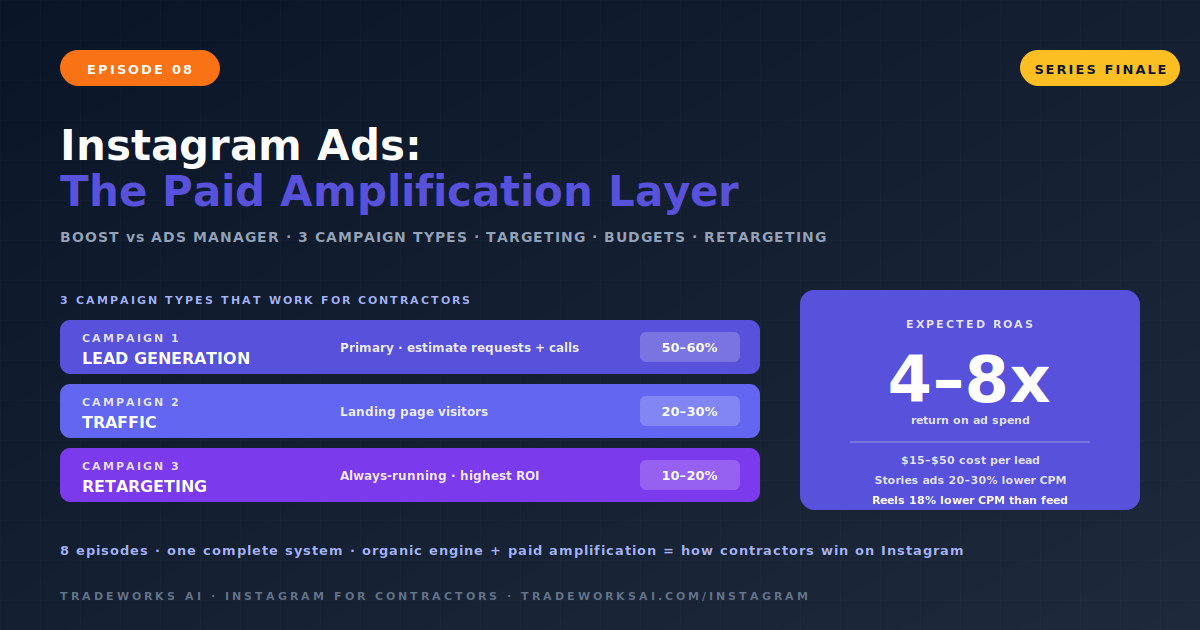
Instagram · Part 8
Instagram Ads for Contractors: The Paid Amplification System for Home Service Businesses (Series Finale)
Continue the Instagram for Contractors series with Part 8 of 8.
Instagram generates leads for contractors through a specific pipeline: content creates attention, attention drives profile visits, profile visits convert into actions—phone calls, DM conversations, website visits, and booked estimates. In 2026, the contractors who generate consistent leads from Instagram are not the ones with the most followers or the flashiest Reels. They are the ones who have built a clear pipeline from every piece of content to a specific conversion action. Every Reel ends with a reason to visit the profile. Every profile visit leads to a link, a call button, or a DM. Every DM conversation moves toward a booked job.
Over the first six episodes of this series, we built the content system: profile optimization, content pillars, Reels, carousels, Stories, Highlights, and discovery. This episode connects all of that to revenue. We are building the Instagram-to-Lead Pipeline—the complete system for converting Instagram attention into booked jobs. This covers the bio link strategy that outperforms multi-link pages, the four CTA patterns that drive action, DM conversation frameworks, comment-to-DM automation, Story-based lead capture, and the tracking system that tells you exactly how many leads Instagram is generating for your business.
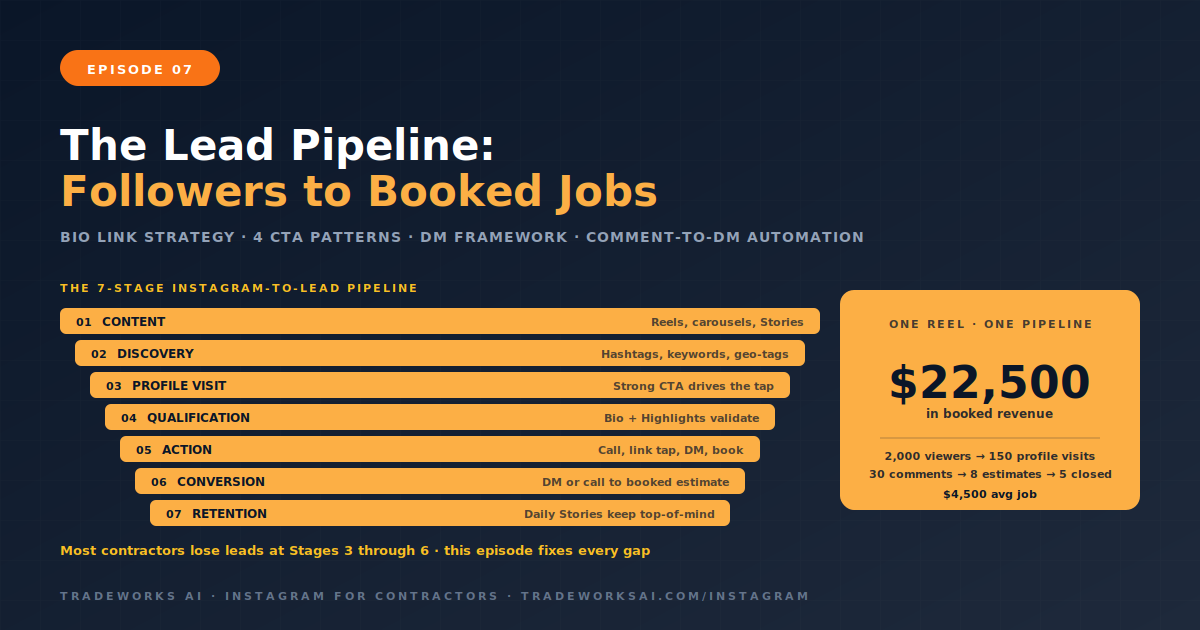
Before we dive into tactics, let me map the complete pipeline so you can see how every episode in this series feeds into lead generation.
Most contractors lose leads at Stages 3 through 6. They create great content but have no CTA, a weak profile, a broken link, or no system for handling DMs. This episode fixes every gap between content creation and booked revenue.
Your bio link is the most important conversion element on your Instagram profile. It is the single path from your profile to your booking system. And most contractors get it wrong.
Linktree and similar multi-link tools give your visitor five to ten options: your website, your Facebook, your Google reviews, your blog, your latest promotion. The problem is decision fatigue. When a homeowner who just watched your Reel taps your bio link and sees eight choices, they either pick the wrong one or pick none. Conversion rates on multi-link pages typically sit at two to three percent.
A single dedicated landing page with one clear purpose outperforms multi-link pages by three to five times for contractors. This page should have:
Your phone number—large, tappable, and above the fold
A booking form or estimate request form—name, phone, service needed, zip code
A specific offer or value proposition tied to your current Instagram content (“Free AC inspection for Instagram followers”)
Trust signals: star rating, review count, license numbers, years in business
No navigation menu, no links to other pages, no distractions. One page. One action.
If you must use a multi-link tool, limit it to three options maximum: Book an Estimate (primary), Call Now (secondary), and one rotating link for your latest content or promotion. But a dedicated landing page almost always wins for contractors because the homeowner’s intent is clear—they want to contact you, not browse your digital ecosystem.
Add UTM parameters to your bio link so you can track exactly how much traffic and how many leads come from Instagram. The format: yourwebsite.com/instagram-estimate?utm_source=instagram&utm_medium=bio_link&utm_campaign=instagram_profile. This appears in your Google Analytics as a distinct traffic source, letting you measure Instagram’s contribution to your lead pipeline with precision.
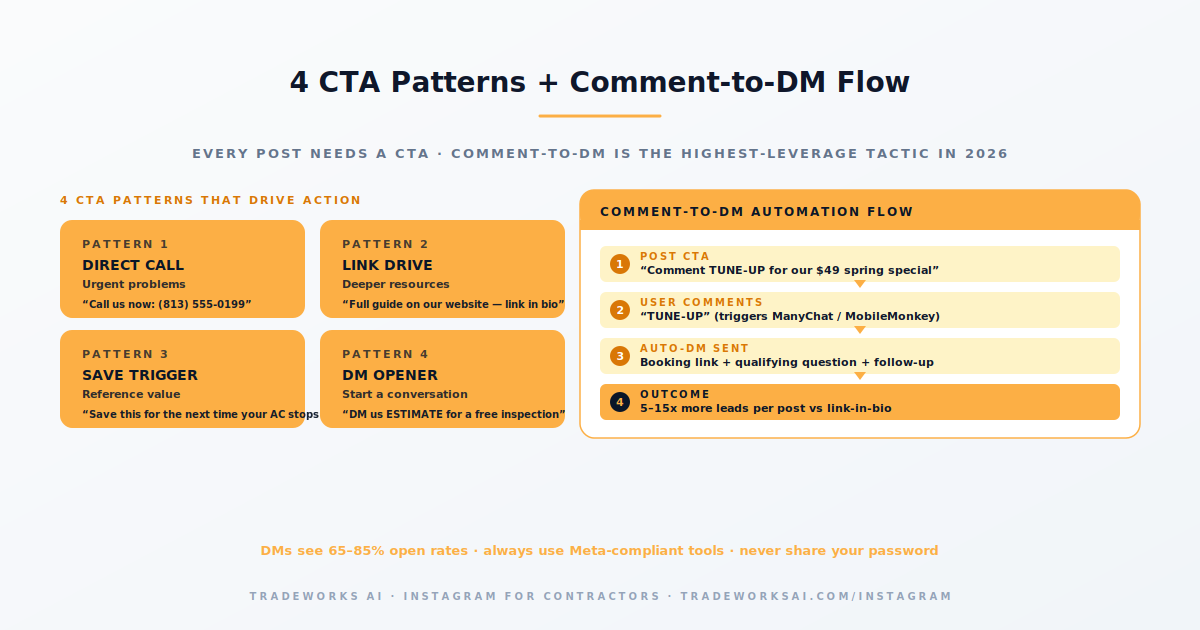
Every piece of content needs a CTA—a specific reason for the viewer to do something next. Contractors who generate consistent leads from Instagram use four CTA patterns, rotating them based on the content type and the desired action.
| CTA Pattern | When to Use | Example |
|---|---|---|
| The Direct Call | When the content solves an urgent problem | “If your AC is doing this, call us now: (813) 555-0199.” |
| The Link Drive | When the content connects to a deeper resource | “Full cost breakdown on our website—link in bio.” |
| The Save Trigger | When the content has reference value | “Save this for the next time your AC stops cooling.” |
| The DM Opener | When you want to start a conversation | “DM us ‘ESTIMATE’ for a free AC inspection.” |
Reels: Verbal CTA in the final 3 seconds + text overlay CTA on screen. “Link in bio for the full guide” or “Call the number on screen.”
Carousels: CTA on the final slide (Slide 8 or 10). After delivering value, the viewer is primed.
Stories: Link sticker for website/booking CTAs. “DM me” text overlay for DM-based CTAs.
Feed posts: CTA in the last one to two sentences of the caption. Phone number or “link in bio.”
Every post, every format, every time. A post without a CTA is a post that generates zero leads.
Instagram DMs have become one of the highest-converting lead channels available to contractors in 2026. DMs see 65 to 85 percent open rates compared to 20 to 25 percent for email. The speed of response matters enormously—leads who receive a reply within five minutes are dramatically more likely to convert than those who wait five hours. For contractors, DMs are where casual interest becomes a booked estimate.
The key principle: DMs start the conversation, but the goal is always to move to phone or booking as fast as possible. Do not try to close a $5,000 job over Instagram DM. Use the DM to qualify, build rapport, and bridge to the next step.
Comment-to-DM is the highest-leverage lead generation tactic on Instagram in 2026. The system works like this: you post a Reel or carousel with a CTA asking viewers to comment a specific keyword (“Comment ESTIMATE for a free AC inspection”). When they comment, an automation tool instantly sends them a DM with the offer, a qualifying question, or a booking link.
This approach generates five to fifteen times more leads per post compared to a standard “link in bio” CTA because the barrier is a single comment rather than navigating away from the app. The comment also sends a strong engagement signal to the algorithm, which boosts the post’s reach—creating a virtuous cycle where more reach generates more comments, which generate more DMs, which generate more leads.
Tools for comment-to-DM automation include ManyChat (the industry standard for Meta-compliant DM automation), MobileMonkey, and several newer platforms. All operate through Meta’s official Messenger API, which is critical—never use tools that require your Instagram password, as these violate Meta’s terms and risk account suspension.
Stories offer three lead capture mechanisms that no other format provides:
Every Story about a completed job, a seasonal promotion, or a service explanation should include a link sticker pointing to your booking page or landing page. “Book your free estimate” or “Schedule your tune-up” with a direct link. This is the most frictionless path from Story to lead—one tap.
Story CTAs that ask viewers to reply generate DM conversations directly. “Reply YES if you want our spring checklist.” “Reply with your zip code and we will tell you if we serve your area.” Every reply opens a DM thread where you can qualify and convert.
The question box sticker generates two things simultaneously: content ideas for future posts AND lead conversations. When a homeowner asks “How much does a panel upgrade cost?” through your question box, you answer publicly in a future Story (content) and reply privately via DM with a link to schedule an estimate (lead). One sticker, two outputs.
If you cannot measure it, you cannot improve it. Here is the tracking system that tells you exactly how many leads Instagram generates and what they are worth.
| Tracking Layer | What It Measures | How to Set It Up |
|---|---|---|
| UTM-tagged bio link | Website traffic from Instagram | Add UTM parameters to your bio link; track in Google Analytics |
| Call tracking number | Phone calls from Instagram | Use a dedicated tracking number on your Instagram profile and landing page |
| Instagram Insights | Profile visits, website taps, call button taps, DM starts | Native Instagram analytics (Business account required) |
| DM lead log | DM conversations that convert to estimates/jobs | Simple spreadsheet: date, name, service requested, outcome |
| CRM tag | Instagram-sourced leads through your booking system | Tag leads as “Instagram” in your CRM or field service software |
| Monthly attribution | Total leads and revenue attributable to Instagram | Monthly report: Instagram traffic + calls + DMs + bookings + revenue |
| The Weekly Instagram Lead Scorecard Profile Visits: ____ Website Taps (bio link clicks): ____ Call Button Taps: ____ DM Conversations Started: ____ Estimates Booked from Instagram: ____ Jobs Closed from Instagram Leads: ____ Revenue from Instagram-Sourced Jobs: $____ Track weekly. Review monthly. This is the data that justifies your Instagram investment. |
Here is the full Instagram-to-Lead Pipeline as a single connected system:
You post a Reel showing a before-and-after AC installation with a CTA: “Comment ESTIMATE for a free AC inspection.” (Content + CTA)
The Reel reaches 2,000 homeowners in your service area through geo-tags and keywords. (Discovery — Ep 6)
150 viewers tap your profile. Your bio says “Residential HVAC | Tampa Bay | 500+ 5-Star Reviews | Book Your Free Estimate ⬇.” (Profile — Ep 1)
They browse your Highlights: Services confirms you do AC work, Reviews shows 5-star experiences, Before/After shows quality, Team introduces the crew. (Validation — Ep 5)
30 people comment ESTIMATE on the Reel. Your automation sends each one a DM with a booking link and a qualifying question. (Comment-to-DM)
15 click the booking link. 8 book estimates. Your team closes 5 jobs averaging $4,500 each. (Conversion)
Meanwhile, 80 of those 150 profile visitors follow your account. Your daily Stories keep you top-of-mind. When they need service next quarter, you are the first call. (Retention — Ep 5)
That is $22,500 in revenue from one Reel, one CTA, and a system that was built across seven episodes. The Reel took 15 seconds to film. The pipeline did the rest.
Results vary based on account size, content quality, posting consistency, and local market competition. A contractor with 500 to 2,000 local followers posting three to five times per week with consistent CTAs typically generates 10 to 30 DM conversations per month and 5 to 15 estimate requests per month within 90 days of implementing the full pipeline. The key metric is not raw lead count but the conversion chain: content → profile visits → actions → estimates → closed jobs.
Yes. A dedicated tracking number for your Instagram profile and landing page lets you measure exactly how many phone calls Instagram generates. Without it, Instagram calls blend into your general call volume and you cannot attribute them. Call tracking services are inexpensive and provide call recording and analytics that help you measure ROI.
For contractors generating more than 10 DM conversations per week, automation becomes essential. Comment-to-DM automation alone generates five to fifteen times more leads per post than link-in-bio strategies. Automated DMs see 65 to 85 percent open rates. The key is using Meta-compliant tools that operate through the official API and starting with a simple automation before adding complexity.
Use the five-layer tracking system: UTM-tagged bio link for website traffic, a dedicated call tracking number for phone calls, Instagram Insights for profile visits and actions, a DM lead log for conversation tracking, and a CRM tag for leads through your booking system. Combine these into a monthly attribution report that shows total leads and revenue traceable to Instagram.
Most contractors post inconsistently with low-quality photos and no strategy. The bar is low. The Instagram Audit grades your profile, content pillars, posting cadence, and bio-to-lead pipeline — and identifies the one change that turns followers into booked jobs this month.
Continue the Instagram for Contractors series with Part 8 of 8.
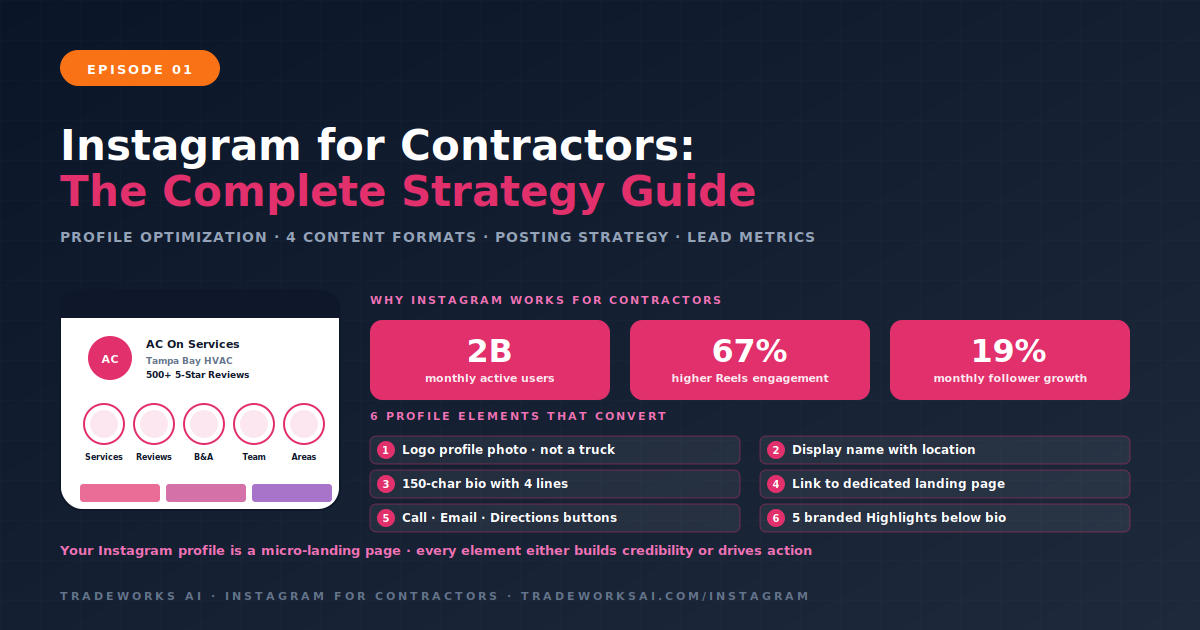
Continue the Instagram for Contractors series with Part 1 of 8.