Instagram · Part 4
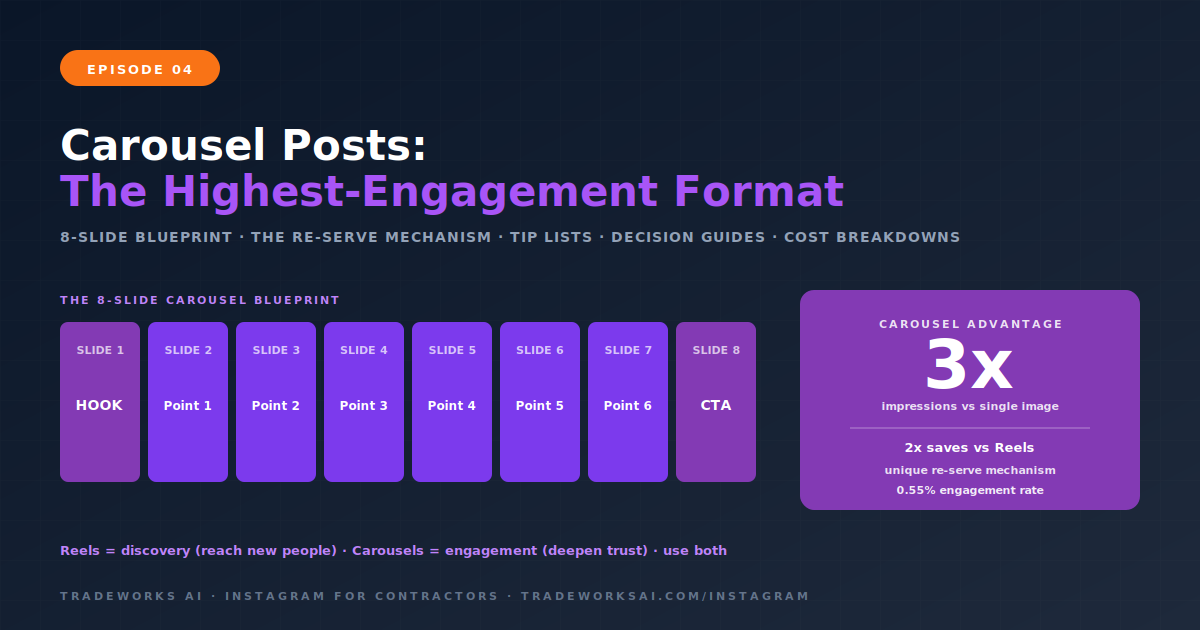
Instagram Carousel Posts for Contractors: The Highest-Engagement Feed Format in 2026
Continue the Instagram for Contractors series with Part 4 of 8.
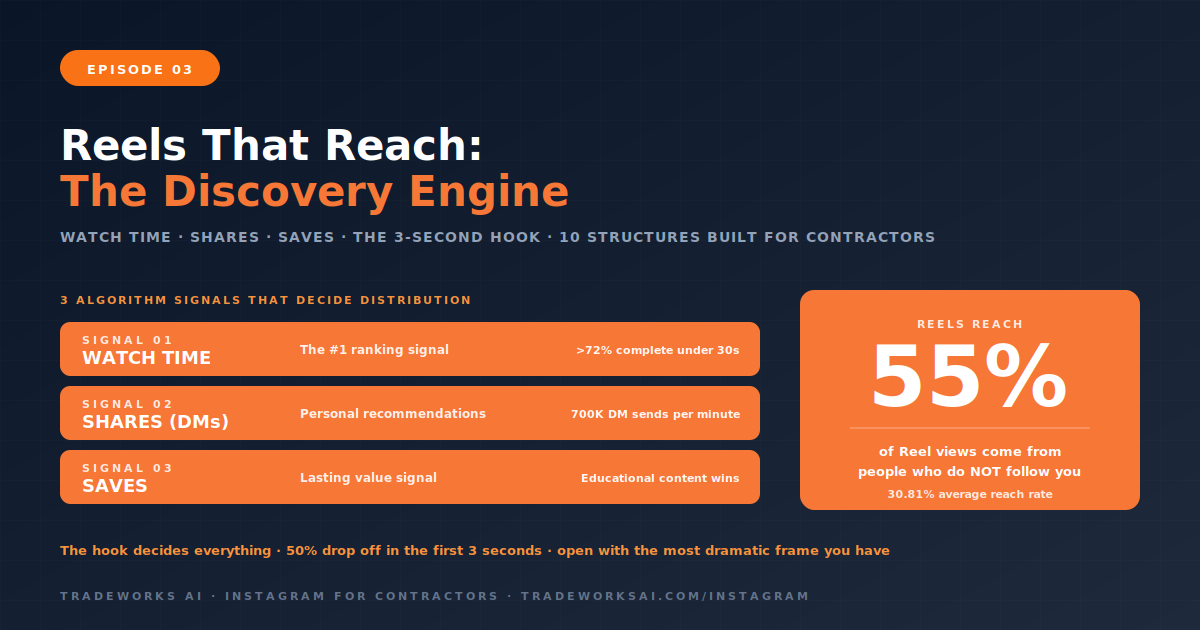
Instagram Reels are the single most effective format for contractors to reach homeowners who have never heard of their business. Reels are short vertical videos—15 to 90 seconds—that Instagram distributes to users who do not follow you, making them the platform’s primary discovery engine. In 2026, Reels account for 50 percent of all time spent on Instagram, generate a 30.81 percent average reach rate (more than double any other format), and 55 percent of Reel views come from non-followers. For a local contractor whose growth depends on reaching new homeowners in their service area, no other content format on any social platform offers this combination of reach and discovery.
This guide covers everything a contractor needs to create Reels that actually generate leads: the three algorithm signals that determine distribution, hook formulas that stop the scroll in the first three seconds, ten Reel content structures built for home service businesses, filming and editing tips that require nothing beyond a smartphone, and the metrics that tell you whether your Reels are working. You do not need a production crew, trending dances, or a personality made for camera. You need real work, a phone, and the system in this guide.
The Instagram Reels algorithm uses three primary signals to determine whether your video reaches 500 people or 50,000. Understanding these signals is not optional—it is the difference between creating content that grows your business and content that disappears.
Watch time is confirmed as the number one ranking signal for Reels. How long people watch your video matters more than likes, comments, or any other metric for initial distribution. Instagram measures both total watch time and completion rate. Reels under 30 seconds have completion rates above 72 percent because they are easier to watch all the way through. For contractors just starting with Reels, keeping videos between 15 and 30 seconds maximizes this signal.
The critical threshold is the first three seconds. Research shows that up to 50 percent of viewers drop off before the three-second mark. Instagram interprets early drop-off as a signal that the content is not worth promoting. Reels with strong three-second hold rates—above 60 percent—outperform those with weak holds by five to ten times in total reach. Your hook determines everything.
DM shares are the strongest signal for reaching new audiences. When someone sends your Reel to a friend via direct message, Instagram reads that as a personal recommendation—and personal recommendations are the highest-value distribution signal on the platform. Nearly 700,000 Reels are sent via DM every single minute across Instagram. Content that gets shared reaches exponentially more people than content that only gets liked.
For contractors, share-worthy content includes: surprising cost reveals (“This $4 part saved $9,000”), common mistake callouts that make someone think “my neighbor needs to see this,” and before-and-after transformations that are dramatic enough to forward to a friend who is considering a similar project.
Saves signal lasting value. When a viewer saves your Reel, it tells the algorithm this content is worth returning to—which is a stronger quality signal than a like. Educational content, checklists, step-by-step processes, and “save this for later” tips are the formats that earn the most saves. For contractors, a Reel titled “3 things to check before you call an electrician” or “save this for the next time your AC stops cooling” is designed to trigger saves.
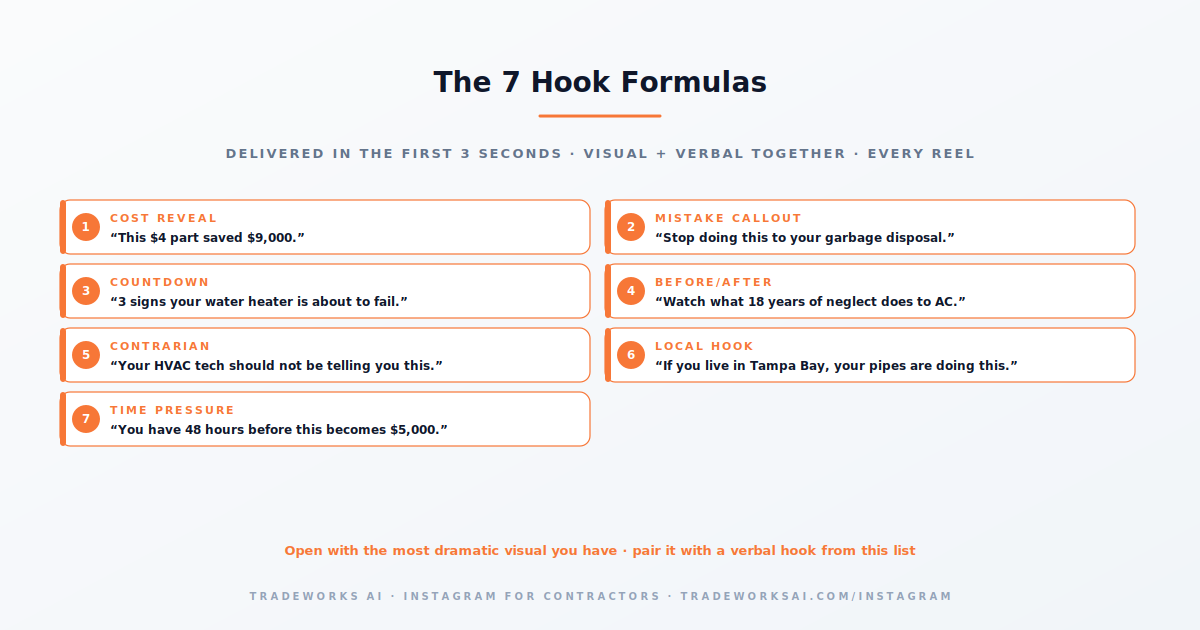
Your Reel lives or dies in the first three seconds. Viewers decide in under two seconds whether to keep watching or scroll past. For contractors, the hook needs to create an information gap, show something surprising, or make a bold claim that demands proof.
| Hook Type | Example | Why It Works |
|---|---|---|
| The Cost Reveal | “This $4 part saved a Tampa homeowner $9,000.” | Specific dollar amounts create an information gap—the viewer needs to know how. |
| The Mistake Callout | “Stop doing this to your garbage disposal.” | Implies the viewer might be making this mistake right now. Creates urgency. |
| The Countdown | “3 signs your water heater is about to fail.” | Numbered lists promise structured value and trigger saves. |
| The Before/After Tease | “Watch what 18 years of neglect does to an AC system.” | Curiosity about the reveal keeps viewers watching. |
| The Contrarian | “Your HVAC tech should not be telling you this.” | Challenges expectations. The viewer needs to know the secret. |
| The Local Hook | “If you live in Tampa Bay, your pipes are doing this right now.” | Geographic specificity makes it personal and urgent. |
| The Time Pressure | “You have 48 hours before this becomes a $5,000 repair.” | Creates urgency through a specific time window. |
The hook is not just the first sentence—it is the first visual frame. Open with the most dramatic, surprising, or specific image you have. A corroded coil. A burst pipe. A panel with melted wiring. Then pair it with the verbal hook. Visual plus verbal, simultaneously, in the first second.
These are not vague “content ideas.” These are repeatable structures—specific formats you can film over and over with different jobs, different problems, and different outcomes. Each structure works across HVAC, plumbing, electrical, roofing, painting, and cleaning.
Structure: Problem shot (2s) → text overlay naming the issue (2s) → quick montage of the work (5s) → reveal of the completed job (3s) → text overlay with the result + CTA (3s). This is the bread and butter. Film every job with a “before” clip and an “after” clip. The Reel practically edits itself.
Structure: Hook naming the mistake (3s) → show the mistake in action or its consequences (7s) → explain why it is a problem (7s) → show the correct approach (7s) → CTA (3s). Example: “Stop closing your vents to save money. Here is what actually happens when you do that.”
Structure: Show the small part or simple fix (3s) → reveal what ignoring it would have cost (5s) → explain the difference (10s) → CTA (3s). Example: “This $8 capacitor. If it fails, it kills your compressor. Compressor replacement: $3,500. The capacitor check: included in a $99 tune-up.”
Structure: Morning departure (3s) → first call overview (5s) → key moment from the job (10s) → second call or interesting problem (10s) → end of day recap (5s) → sign-off + CTA (3s). This builds Culture pillar while using the Reels format. The technician should narrate naturally.
Structure: Hook with the count (3s) → Tip 1 with visual (7s) → Tip 2 with visual (7s) → Tip 3 with visual (7s) → “Save this” + CTA (3s). This format is specifically designed to trigger saves. Numbered lists are the highest-saved Reel format on the platform.
Structure: Close-up of the problem (3s) → the repair process (8s) → the satisfying result—system running, water flowing, lights on (5s) → CTA (2s). No narration needed. Music and sound effects carry it. The visual transformation is the content.
Structure: State the myth (3s) → “Here is the truth” (3s) → explain with visual evidence (15s) → summary + CTA (5s). Example: “Myth: You need to change your filter every month. Truth: It depends on your system, your home, and your filter type. Here is how to know.”
Structure: Show the tool or product (3s) → explain what it does and why it matters (10s) → show it in action (7s) → CTA (3s). Example: “This is a combustion analyzer. It tells me in 30 seconds if your furnace is producing carbon monoxide. Every tune-up should include this test.”
Structure: Quick context setup (3s) → the reveal to the customer (5s) → the reaction (5s) → CTA overlay (3s). Get permission first. A genuine smile, a “wow,” or a thank-you handshake on camera is the most powerful Social Proof Reel you can create.
Structure: Arrive at the job (2s) → “The homeowner called us for [symptom]” (3s) → show what you actually found (10s) → explain why this happens (7s) → solution + CTA (5s). Example: “They called for a leak under the sink. What we found was a corroded main supply line that was about to burst behind the wall.”
You do not need a camera crew. Every Reel in this guide can be filmed on a smartphone. Here is the minimum-viable production system for contractors:
Your smartphone (any phone made after 2020 shoots acceptable vertical video)
A $15 clip-on phone mount for your truck visor or a pocket tripod for stable shots
Natural lighting—shoot near windows or outside whenever possible
Your phone’s built-in microphone (acceptable for most content; a $20 clip-on lav mic upgrades narration quality significantly)
Always film in portrait mode (9:16 vertical). This is non-negotiable for Reels.
Film the “before” at the start of every job. It takes 5 seconds. Build the habit.
Get close. Detail shots of corroded parts, damaged wiring, or clogged drains are more compelling than wide shots.
Narrate while you work. A 15-second explanation of what you are looking at while holding the camera is a complete Reel.
Do not worry about perfection. Authenticity outperforms polish on Reels. Real job sites, real hands, real equipment.
Use Instagram’s native editor or CapCut (free) for basic cuts, text overlays, and music.
Add text overlays for every key point—70 percent of Reels are watched with sound off.
Keep transitions simple: hard cuts between scenes. No spinning transitions or flashy effects.
Add captions (burned-in subtitles) to every Reel. Accessibility and sound-off viewing.
Add trending or popular audio when it fits naturally. Original audio with your narration is equally effective for educational content.
| Metric | What It Means | Good Benchmark |
|---|---|---|
| Plays | Total number of times the Reel was viewed | Track for growth trend, not absolute number |
| Accounts Reached | Unique users who saw the Reel | Higher than your follower count = reaching new people |
| Shares (Sends) | Times sent via DM | Any share is valuable; 1–3% of reach is strong |
| Saves | Times saved for later | 1–2% of reach; higher for educational content |
| Average Watch Time | How long viewers watched on average | Above 50% of total length = strong retention |
| Profile Visits | Viewers who tapped your profile after watching | The bridge from viewer to potential lead |
| Follows from Reel | New followers gained from this Reel | Growing = your content attracts the right audience |
The most important metric chain for contractors: Plays → Profile Visits → Website Taps → Calls. If a Reel gets high plays but zero profile visits, it entertained but did not connect to your business. If it gets profile visits but no website taps, your profile is not optimized (go back to Episode 1). Track this chain weekly.
Start with 15 to 30 seconds. Reels under 30 seconds achieve completion rates above 72 percent, which is the strongest signal to the algorithm for initial distribution. As you gain confidence and data, test 30-to-60-second Reels for more complex content like day-in-the-life or diagnostic walkthroughs. Avoid exceeding 90 seconds—distribution drops significantly beyond that length.
Not necessarily, but Reels where a person speaks directly to camera consistently outperform faceless content on engagement metrics. If the owner or a technician is willing to narrate on camera, that is ideal. If not, a “hands and tools” approach—showing the work being done with a voiceover—is the next best option. Avoid text-only Reels with stock music; they underperform both approaches.
Two to three Reels per week is the optimal range for contractor accounts. Consistency matters more than volume—two Reels every week for 12 weeks will outperform six Reels in one week followed by silence. The algorithm rewards accounts that post regularly, and inconsistent posting now takes longer to recover from than in previous years.
Two hundred views on a geo-tagged Reel in your service area is 200 local homeowners who now know your business exists. Do not compare your views to entertainment accounts with millions of followers. A contractor Reel that reaches 500 local homeowners and drives 15 profile visits and 3 website taps has done more for your business than a viral video seen by 100,000 people in another state. Track profile visits and website taps, not just views.
Trending audio can boost distribution, but it is not required. Original audio where you narrate or explain performs equally well for educational content. If you use trending audio, make sure it fits the content naturally—do not force a trending sound onto a before-and-after Reel where it feels disconnected. Instagram’s 2026 algorithm also penalizes reposted content with watermarks from other platforms, so always add audio natively in Instagram or through a clean editing app.
Most contractors post inconsistently with low-quality photos and no strategy. The bar is low. The Instagram Audit grades your profile, content pillars, posting cadence, and bio-to-lead pipeline — and identifies the one change that turns followers into booked jobs this month.
Continue the Instagram for Contractors series with Part 4 of 8.
Continue the Instagram for Contractors series with Part 5 of 8.