Instagram · Part 3
Instagram Reels for Contractors: How to Create Short Videos That Generate Leads
Continue the Instagram for Contractors series with Part 3 of 8.
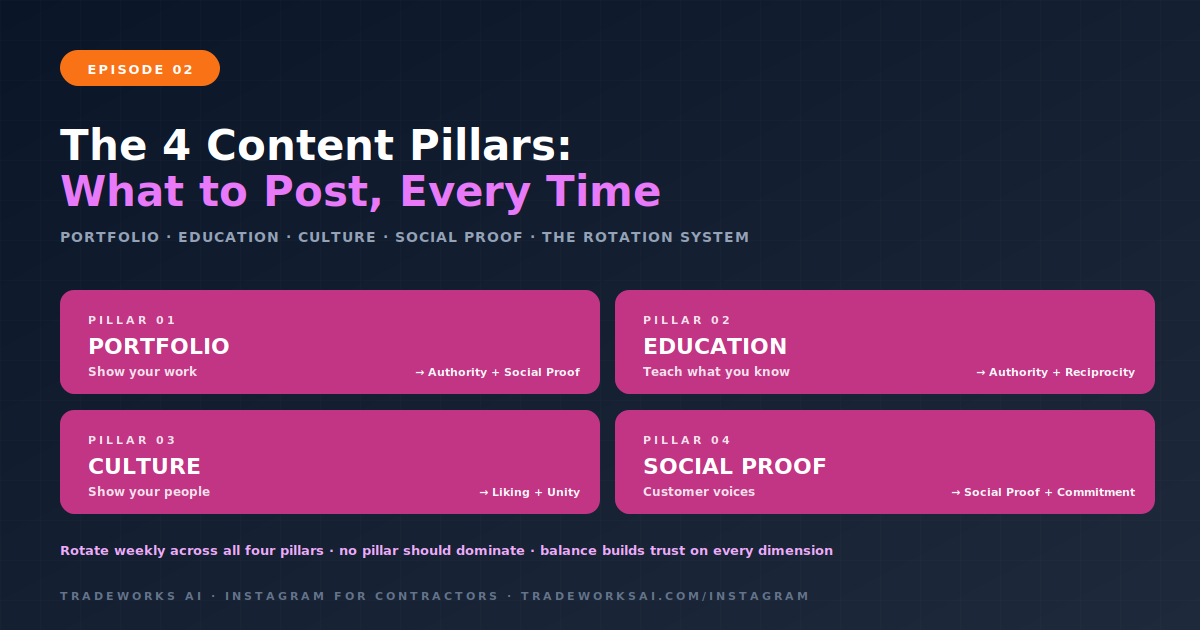
The four content pillars every contractor needs on Instagram are Portfolio, Education, Culture, and Social Proof. Portfolio content showcases your completed work and before-and-after transformations. Education content teaches homeowners useful information about their home systems. Culture content introduces your team and shows behind-the-scenes operations. Social Proof content highlights customer reviews, testimonials, and real results. Rotating through these four pillars weekly ensures your Instagram feed builds trust across every dimension a homeowner evaluates before hiring a contractor—quality of work, depth of knowledge, personality of the people, and validation from past customers.
This is the system that eliminates the question every contractor asks when they open Instagram: “What am I supposed to post today?” Content pillars replace guessing with a repeatable framework. When you know your four categories and assign each one to specific days, content creation becomes a production process rather than a creative burden. In this guide, we break down each pillar with specific post ideas for HVAC, plumbing, electrical, roofing, painting, and cleaning contractors, plus a monthly rotation template you can implement the same day you read this.
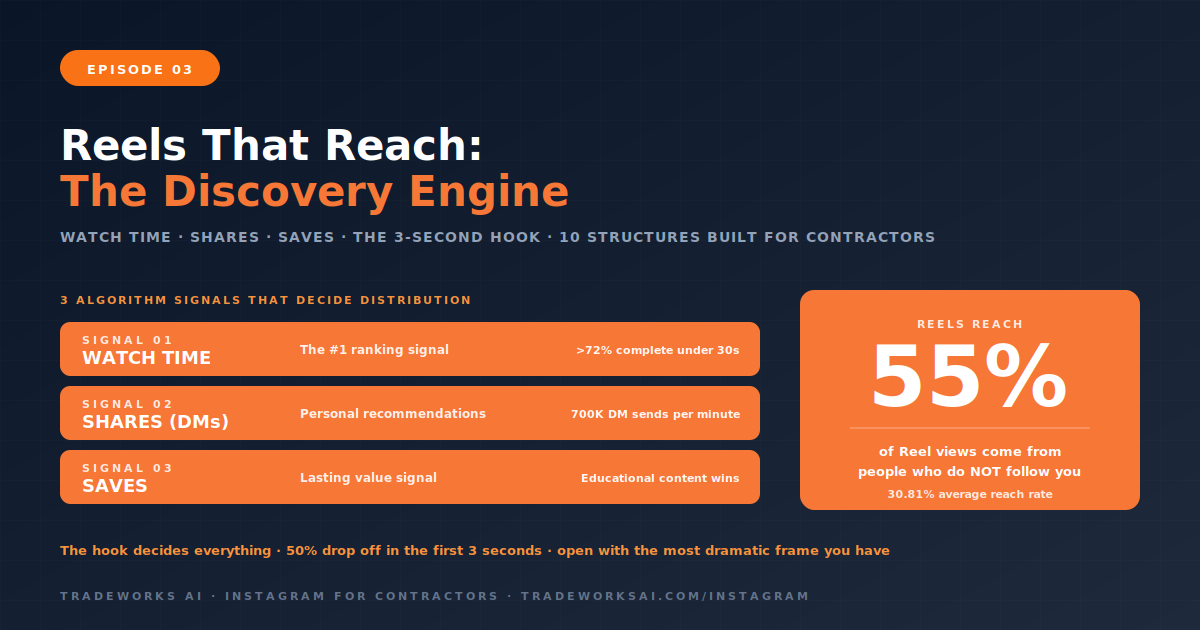
Random content creates random results. Posting a finished-job photo on Monday, an inspirational quote on Wednesday, and a meme on Friday tells the Instagram algorithm—and your audience—nothing coherent about who you are or what you do. Instagram’s algorithm in 2026 rewards accounts that consistently produce content around specific themes because it helps the platform classify your account and show it to the right people.
Content pillars solve three problems that kill contractor Instagram accounts:
The blank-screen problem. “I do not know what to post” disappears when you have four defined categories and a rotation system. Monday is Portfolio day. Wednesday is Education day. You open the app knowing exactly what type of content you are creating.
The one-dimensional problem. A feed full of nothing but finished-job photos feels like a portfolio, not a relationship. Homeowners hire contractors they trust—and trust is built across multiple dimensions. Your work quality is one. Your knowledge is another. Your team’s personality is a third. Past customer experiences are a fourth. Four pillars ensure you are building trust on all fronts.
The burnout problem. Accounts without a system tend to post intensively for two to three weeks, run out of ideas, and go silent. Inconsistency is the single fastest way to lose algorithmic reach. A pillar system makes content production sustainable because you are rotating through proven categories rather than inventing something new every day.
Research from 2026 shows that accounts posting content across defined pillars two to three times per week grow followers 19 percent monthly, while accounts posting random content once per week or less actually lose followers. The pillar system is not about posting more—it is about posting with purpose.
Portfolio content proves you can do the job. This is the visual evidence that your work meets or exceeds the homeowner’s expectations. For contractors whose work is inherently visual—installations, repairs, transformations, builds—portfolio content is your strongest trust signal on a visual platform.
Before-and-after carousel posts (the single highest-performing portfolio format)
Completed project photo sets with multiple angles
Close-up detail shots showing craftsmanship
Time-lapse videos of installations or repairs
Job-site walkthroughs narrated by the technician
| Trade | Portfolio Post Ideas |
|---|---|
| HVAC | New system installation reveal, corroded coil vs. new coil, ductwork transformation, before/after of a dirty vs. clean air handler, commercial rooftop unit installation |
| Plumbing | Pipe replacement (corroded vs. new), water heater swap, bathroom remodel reveal, slab leak repair documentation, commercial backflow installation |
| Electrical | Panel upgrade (old Federal Pacific to new Square D), EV charger installation, whole-house generator install, lighting transformation, smart home wiring |
| Roofing | Drone shots of completed roof, shingle vs. metal comparison on the same structure, storm damage repair sequence, underlayment detail shots |
| Painting | Full exterior transformation, accent wall reveals, cabinet refinishing, commercial property refresh, color consultation results |
| Cleaning | Deep clean time-lapse, move-out to move-in ready, post-construction cleanup, before/after kitchen and bathroom details |
Always shoot the “before” from the exact same angle as the “after.” Same lighting, same distance, same perspective. The contrast does the selling.
Add technical context in the caption. Do not just show the photo—explain what was wrong, what you did, and what the homeowner gained. “This 18-year-old R-22 system was running at 40 percent efficiency. The new 16-SEER2 unit cuts this homeowner’s cooling bill by an estimated $1,200 per year.”
Tag the location. Every portfolio post should be geo-tagged to the city or neighborhood where the work was done. This feeds Instagram’s local discovery algorithm.
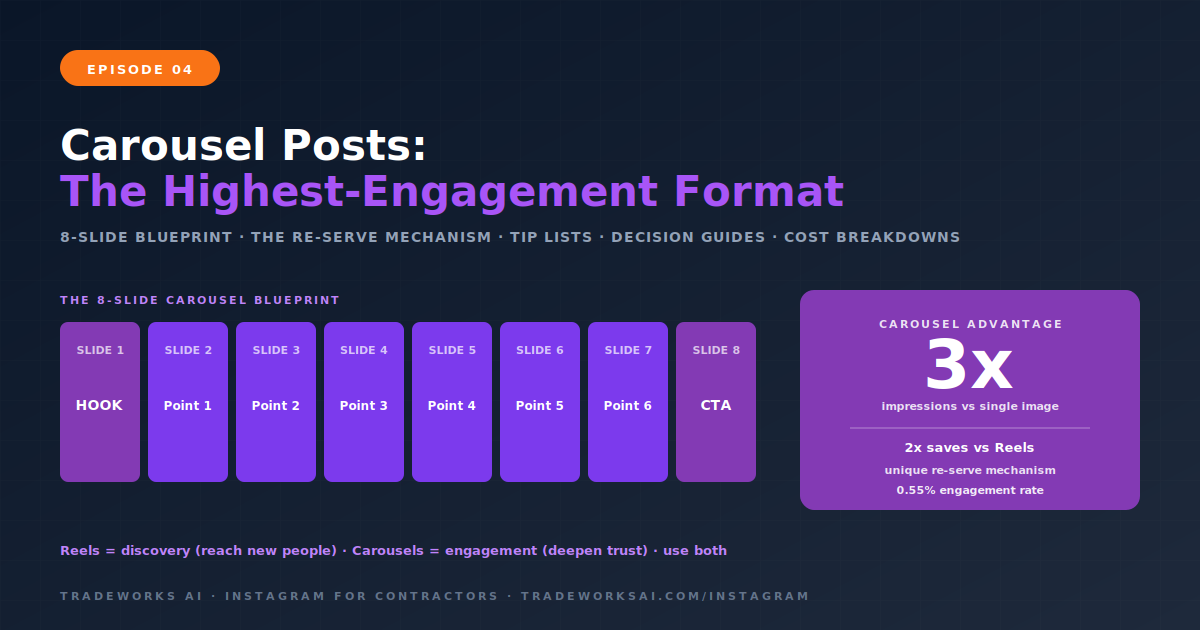
Post carousels, not single images. Multi-image posts showing the progression—before, during, after—consistently outperform single images in both engagement and impressions.
Education content positions you as the expert. When a homeowner learns something useful from your Instagram post, two things happen: they save or share that post (the two strongest algorithm signals in 2026), and they associate your brand with knowledge and competence. A contractor who teaches earns authority before they ever step foot in a home.
Tip carousels (5–10 slides teaching homeowners something actionable)
Common mistake callouts (“Stop doing this to your garbage disposal”)
Seasonal maintenance checklists
Explainer Reels (“Here is why your AC runs but does not cool”)
“Should I repair or replace?” decision guides
Cost breakdowns (“What a panel upgrade actually costs in Tampa”)
Myth-busting content (“No, closing your vents does not save energy”)
| Trade | Education Post Ideas |
|---|---|
| HVAC | Filter change frequency guide, thermostat programming tips, “why your AC freezes,” SEER2 rating explained, humidity control in Florida, maintenance plan value breakdown |
| Plumbing | “What NOT to flush,” water heater anode rod explained, when to call a plumber vs. DIY, tankless vs. tank comparison, water softener benefits for Florida well water |
| Electrical | When to upgrade your panel, GFCI vs. AFCI explained, generator sizing guide, surge protector vs. whole-house surge protection, “signs your wiring is outdated” |
| Roofing | How to spot storm damage, insurance claim process explained, shingle vs. metal vs. tile comparison, roof age and insurance requirements in Florida, gutter maintenance checklist |
| Painting | Prep is 80% of the job (show why), exterior paint longevity in Florida sun, color selection tips, when to paint vs. when to power wash, VOC and eco-friendly options |
| Cleaning | Deep clean vs. regular clean explained, eco-friendly product guide, post-construction cleaning checklist, Airbnb turnover cleaning standards, stain removal tips |
Lead with the value in the first sentence. “Here are three signs your water heater is about to fail” beats “Water heaters are an important part of your home.”
Make it saveable. Education content earns saves—the strongest signal to Instagram’s algorithm that your content has lasting value. Checklists, step-by-step guides, and numbered lists are the most-saved formats.
Do not gatekeep. Teaching homeowners how their systems work does not lose you business—it builds the trust that wins you business. The plumber who explains what causes root intrusion gets called when it happens.
Use carousel format for multi-step content. Each slide should be scannable on its own and compelling enough to drive the next swipe.
Culture content builds the personal connection. Homeowners do not hire companies—they hire people. The technician who walks into their living room, the dispatcher who answers their call, the owner who stands behind the work. Culture content introduces these people before the homeowner ever meets them in person, and that familiarity translates directly into trust.
Research consistently shows that Instagram audiences respond more to behind-the-scenes and personality-driven content than to polished brand content. In 2026, 64 percent of consumers say they value brands whose content matches their stated values—and for contractors, the core value is “real people doing real work.” Culture content proves that.
Team introductions (name, role, years of experience, fun fact)
Day-in-the-life Reels following a technician through a service day
Truck and equipment showcases
Training and certification milestones
Community involvement (charity events, sponsorships, local partnerships)
Office and warehouse behind-the-scenes
New hire welcomes and work anniversary celebrations
Holiday and team event content (with genuine moments, not staged poses)
Let your team be the face. Accounts where the technician or the owner speaks directly to camera outperform branded voice content on engagement. Real faces build familiarity—and the psychology of familiarity (the mere exposure effect from the Marketing Playbook) means the more someone sees your team, the more they trust you.
Show the messy middle. A perfectly staged team photo communicates less trust than a genuine shot of your crew loading the truck at 6 AM or high-fiving after a tough install. Authenticity is the primary content demand on Instagram in 2026.
Introduce by first name. “This is Mike. He has been with us for 12 years and has installed over 3,000 systems across Tampa Bay” is more powerful than “Our experienced technicians are here to serve you.”
Use Stories for daily culture content. Behind-the-scenes moments are perfect for the ephemeral, casual format of Stories. Save the strongest ones to a “Team” Highlight.
Social Proof content validates everything the other three pillars claim. Your portfolio shows you do good work—but a customer saying it carries ten times the weight. Your education content shows you are knowledgeable—but a Google review mentioning that your technician explained everything patiently seals it. Social proof is the external validation that converts interest into action.
Ninety-three percent of consumers say reviews influence their decisions. Eighty-eight percent trust online reviews as much as personal recommendations. These are not new statistics, but they remain the most important numbers in contractor marketing.
Review spotlight graphics (a formatted quote from a real customer review with their first name, city, and star rating)
Video testimonials (a customer on camera explaining their experience—even 15 seconds is powerful)
Screenshot compilations of positive reviews from Google, Facebook, Yelp
Customer story carousels (the problem, the solution, the result, the review)
Milestone posts (“500 five-star reviews” or “10,000 systems installed”)
User-generated content (photos or videos the customer shares of the completed work, reposted with permission and credit)
Post reviews consistently, not just when you get a great one. A steady stream of review content tells the algorithm and your audience that positive experiences are the norm, not the exception.
Always include first name and city. “John M., Riverview” adds local credibility that “Satisfied Customer” never will.
Pair reviews with the corresponding work photo when possible. A five-star review about a panel upgrade next to the before-and-after photo of that panel upgrade is exponentially more convincing than either one alone.
Ask for permission before reposting customer content. A simple DM asking “Would you mind if we shared this on our page? We’d love to give you a shoutout” converts most customers. Tag them in the post.
Use review request automation. Text-based review requests outperform email by three to five times. Build the system to generate reviews consistently so your Social Proof pillar never runs dry.
Here is the monthly rotation framework that eliminates guessing and ensures balanced coverage of all four pillars. This is the signature asset of this episode—print it, pin it next to your desk, and use it as your content planning backbone.
| Day | Pillar | Suggested Format |
|---|---|---|
| Monday | Portfolio | Carousel (before/after) |
| Tuesday | Education | Carousel or Reel (tip/explainer) |
| Wednesday | Culture | Reel (day-in-the-life or team intro) |
| Thursday | Social Proof | Feed post (review spotlight) |
| Friday | Education or Portfolio | Reel (common mistake or transformation) |
The key principle: no pillar should dominate. If your feed is 80 percent portfolio and 10 percent everything else, you are building a portfolio, not a relationship. Balanced rotation ensures homeowners see all four dimensions of your business.
Each content pillar naturally activates the influence principles covered in the Marketing Playbook series. Understanding these connections helps you see why the four-pillar system works psychologically, not just tactically.
| Pillar | Primary Influence Principles | How It Works |
|---|---|---|
| Portfolio | Authority + Social Proof | Visible proof of completed work demonstrates competence. This is Authority through evidence, not claims. |
| Education | Authority + Reciprocity | Teaching useful information positions you as the expert (Authority) while giving value before asking for anything in return (Reciprocity). |
| Culture | Liking + Unity | Familiarity with your team triggers the Liking principle. Shared identity (local, family-owned, community-involved) activates Unity. |
| Social Proof | Social Proof + Commitment | Customer reviews validate the decision. Milestone posts reinforce that thousands of homeowners have already committed. |
This is not accidental. The four pillars are designed to cover every influence lever that drives a homeowner’s decision to hire. A feed that rotates through all four is doing influence work on every post—whether you think about the psychology or not.
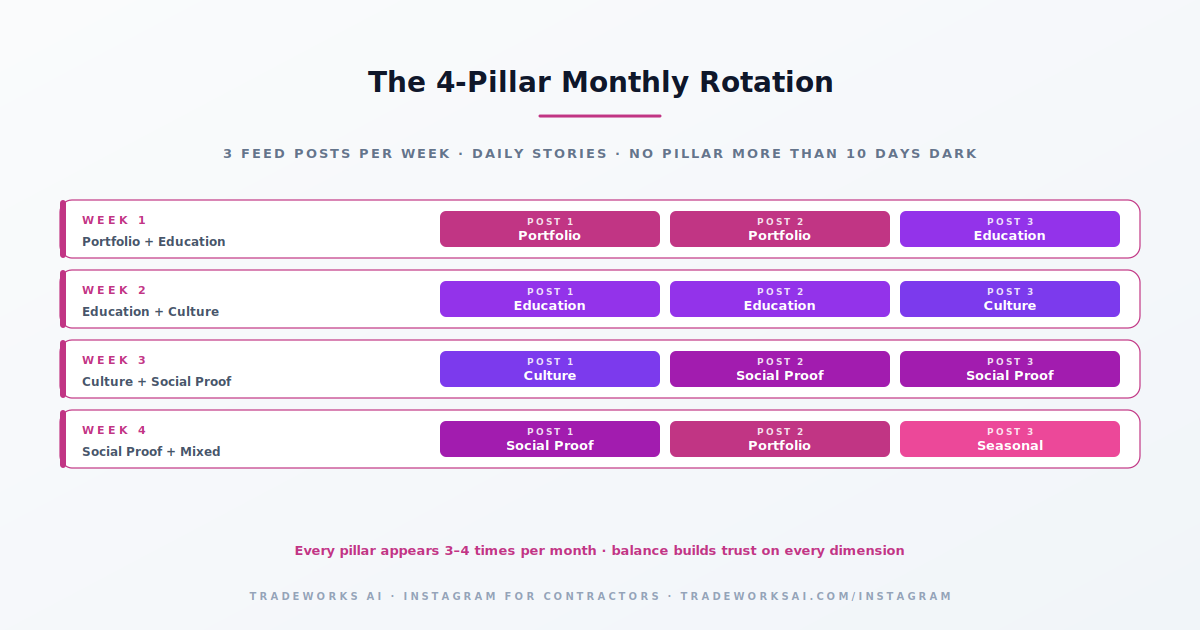
Four is the optimal number for most contractor accounts: Portfolio, Education, Culture, and Social Proof. Research from 2026 confirms that four to five pillars is the sweet spot—enough variety to keep your feed interesting and build trust across multiple dimensions, but not so many that you lose focus. More than five pillars creates noise and weakens your positioning. Fewer than three makes your feed one-dimensional.
Each pillar can be subdivided into three to five sub-topics. Portfolio alone includes before-and-after posts, completed project showcases, detail shots, time-lapses, and job-site walkthroughs. Each sub-topic can be covered in multiple formats: a carousel, a Reel, a Story, a static post. Five sub-topics covered in four formats gives you 20 post ideas from a single pillar—more than most contractors produce in a quarter. If you feel stuck, you are probably thinking too narrowly about the pillar, not too broadly.
The four categories—Portfolio, Education, Culture, and Social Proof—apply to every home service trade because they map to the four dimensions homeowners evaluate: quality of work, depth of knowledge, personality, and validation from others. The specific post ideas within each pillar change by trade (an HVAC carousel looks different from a roofing carousel), but the framework is universal.
It is normal for one pillar to outperform the others—Education and Social Proof carousels typically earn the most saves and shares. Do not abandon the other pillars to chase engagement metrics on one category. The pillar system works because of balance. The lower-engagement Culture post that introduces your technician by name contributes to the trust that makes the high-engagement Education post convert into a booked job. Measure the system as a whole, not each pillar in isolation.
Review pillar performance quarterly. Look at which pillar consistently underperforms across all metrics (not just likes—check saves, shares, profile visits, and website taps). If a pillar consistently underperforms after 90 days of consistent posting, adjust the sub-topics or formats within that pillar before replacing it entirely. The four core pillars rarely need to change—but the specific content angles within them should evolve based on what your audience responds to.
Most contractors post inconsistently with low-quality photos and no strategy. The bar is low. The Instagram Audit grades your profile, content pillars, posting cadence, and bio-to-lead pipeline — and identifies the one change that turns followers into booked jobs this month.
Continue the Instagram for Contractors series with Part 3 of 8.
Continue the Instagram for Contractors series with Part 4 of 8.