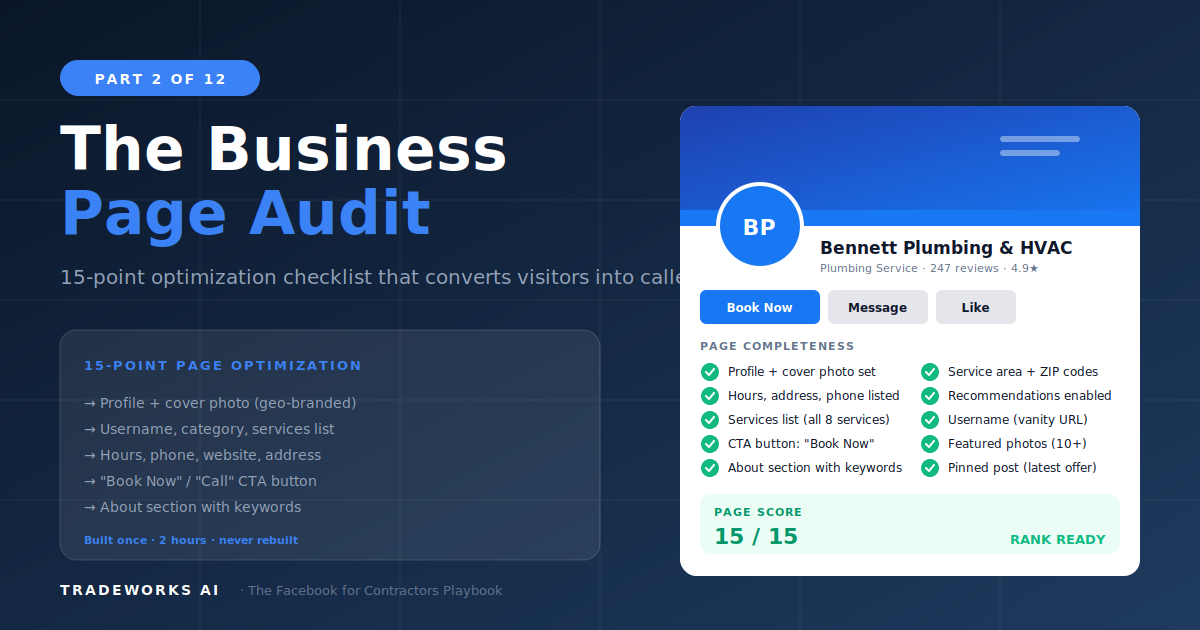
Facebook · Part 2
Business Page Optimization
The 15-point optimization checklist that converts Facebook visitors into callers.
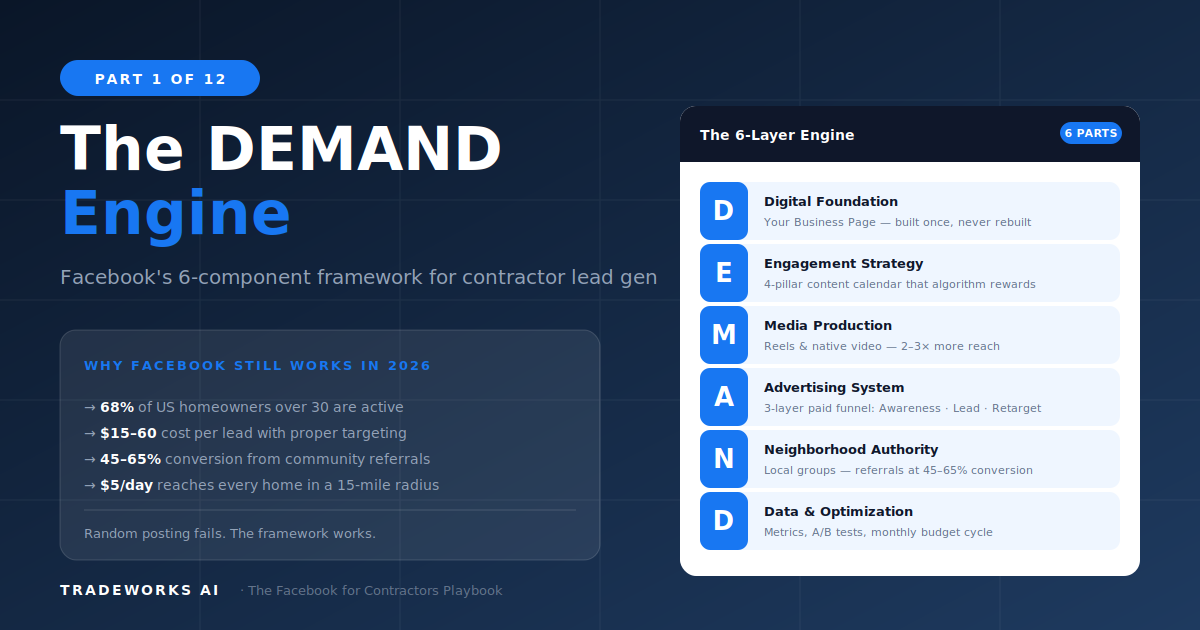
Facebook generates more leads for home service contractors than any other social media platform, and it is not close. In 2026, Facebook remains the platform where 68% of US adults over 30 maintain an active presence, where local community groups drive real buying decisions, where homeowners research and recommend contractors to their neighbors, and where targeted advertising can reach every homeowner in a 15-mile radius for as little as $5 per day.
The contractors who dismiss Facebook as outdated or irrelevant are ceding the single largest digital audience of homeowners to their competitors. This series introduces the DEMAND Engine, a six-component framework that transforms Facebook from a random posting habit into a structured lead generation and community trust system.
This is Part 1 of the TradeWorks AI Facebook for Contractors Playbook, a 12-part series that takes you from foundational page setup through advanced ad campaigns, community engagement, and AI-era Facebook strategy. If you completed the Email Marketing Playbook, this series integrates directly: Facebook drives the top-of-funnel awareness that email converts into booked jobs.
Every year, someone declares Facebook dead. Every year, the data says otherwise. Facebook's advantage for contractors is the intersection of three things no other platform matches simultaneously: audience density (most homeowners in your service area are on Facebook), local discovery infrastructure (groups, recommendations, Marketplace, check-ins), and advertising precision (target by homeownership status, income bracket, ZIP code, and life events like recent home purchase).
The contractors who report that Facebook does not work are almost always making one of three mistakes:
The DEMAND Engine is a six-component system designed specifically for home service contractors. Each letter represents a layer of the framework, and each layer builds on the one before it:
Your Facebook Business Page is the storefront of your Facebook presence. For most homeowners in your service area, your Facebook page is the second thing they check after your Google Business Profile, and sometimes the first. A poorly optimized page with a blurry logo, no hours listed, and the last post from 2023 tells potential customers that your business is either inactive or unprofessional.
Part 2 covers the complete page setup and optimization. The digital foundation takes approximately 2 hours to build correctly and should never need to be rebuilt.
Content without a strategy is noise. The engagement strategy component defines what you post, when you post, and how you interact with the community. It is built around a four-pillar content calendar:
Part 3 builds the complete content strategy with a month-by-month calendar.
Facebook's algorithm in 2026 prioritizes video content, particularly Reels (short-form vertical video under 90 seconds) and native video. Photo posts still perform, but video earns 2–3 times more reach and engagement. For contractors, the content that works is not polished studio production. It is authentic, on-the-job footage filmed on a phone in the truck. Part 8 covers video content in depth.
Organic Facebook reach is a starting point, not a strategy. The advertising component is where Facebook generates predictable, measurable lead flow. The advertising system has three layers:
Parts 4, 5, and 6 cover the advertising system in depth.
The most underutilized feature of Facebook for contractors is local community groups. In most US metro areas, there are neighborhood-specific Facebook groups with 5,000 to 50,000 members where homeowners ask for contractor recommendations multiple times per week. A contractor who is an active, helpful presence in these groups generates a steady stream of organic referrals that cost nothing and convert at referral-level rates (45–65%). Part 7 covers the neighborhood authority strategy.
The final component closes the loop. The metrics that matter for contractors:
Part 11 covers the metrics dashboard, A/B testing, and the monthly optimization cycle.
Facebook is the top of the funnel. Email is the conversion engine. Together, they create a closed-loop system where Facebook generates awareness and leads, email nurtures and converts those leads, and the resulting customer data feeds back into Facebook advertising for more precise targeting.
Before building the DEMAND Engine, assess your current Facebook presence:
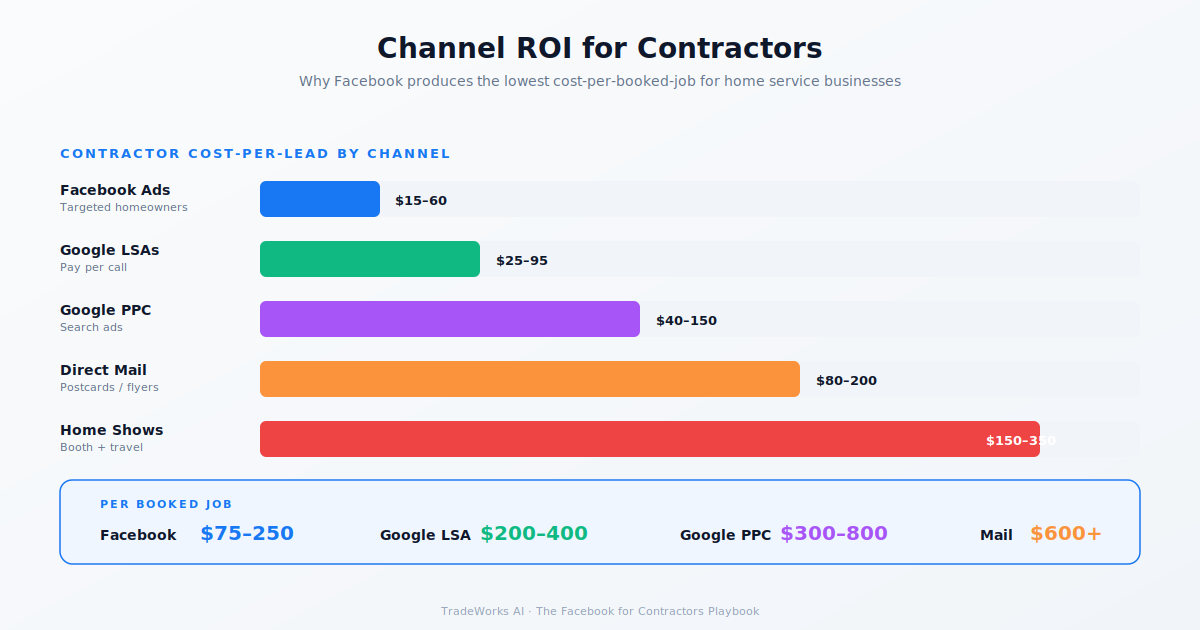
For contractors targeting homeowners ages 30 to 65, Facebook remains the dominant platform by active user count. TikTok and Instagram skew younger and are excellent supplementary channels (Part 8 covers Reels strategy), but Facebook's local infrastructure, community groups, Marketplace, and advertising precision are unmatched for local service businesses.
Start with $300 to $500 per month for a contractor running 1 to 10 trucks. This funds a consistent awareness and lead generation campaign. Scale to $750 to $2,000 per month as you optimize targeting and creative. Part 11 covers the complete budget framework.
The DEMAND Engine is designed to be implemented by the business owner, an office manager, or a marketing-savvy team member. Each part provides the exact steps, templates, and frameworks to execute without agency support. Many contractors implement organically and then hire an agency to manage the advertising component once the system is generating measurable results.
Facebook drives top-of-funnel awareness and mid-funnel engagement. Google captures bottom-of-funnel intent. Your website converts both. The retargeting layer (Part 6) connects Facebook to website visitors. The email layer connects both to long-term nurturing. All three channels work together as a system.
Facebook content is increasingly surfaced in AI search results, particularly through Gemini, which can reference Facebook posts, reviews, and group discussions. Part 12 covers how to optimize your Facebook presence for AI search visibility.
Page optimization (Part 2) and content (Part 3) start improving organic visibility within 2 to 4 weeks. The first lead gen campaign (Part 5) produces leads within 7 to 14 days of launch. Community engagement (Part 7) reaches its full effect at 90 days. Plan for 90 days of consistent execution to see the full system working.
Most contractors run Facebook without a framework, then conclude it does not work. Our free audit grades your page against the DEMAND Engine and shows you the gaps producing the missed leads.
The 15-point optimization checklist that converts Facebook visitors into callers.
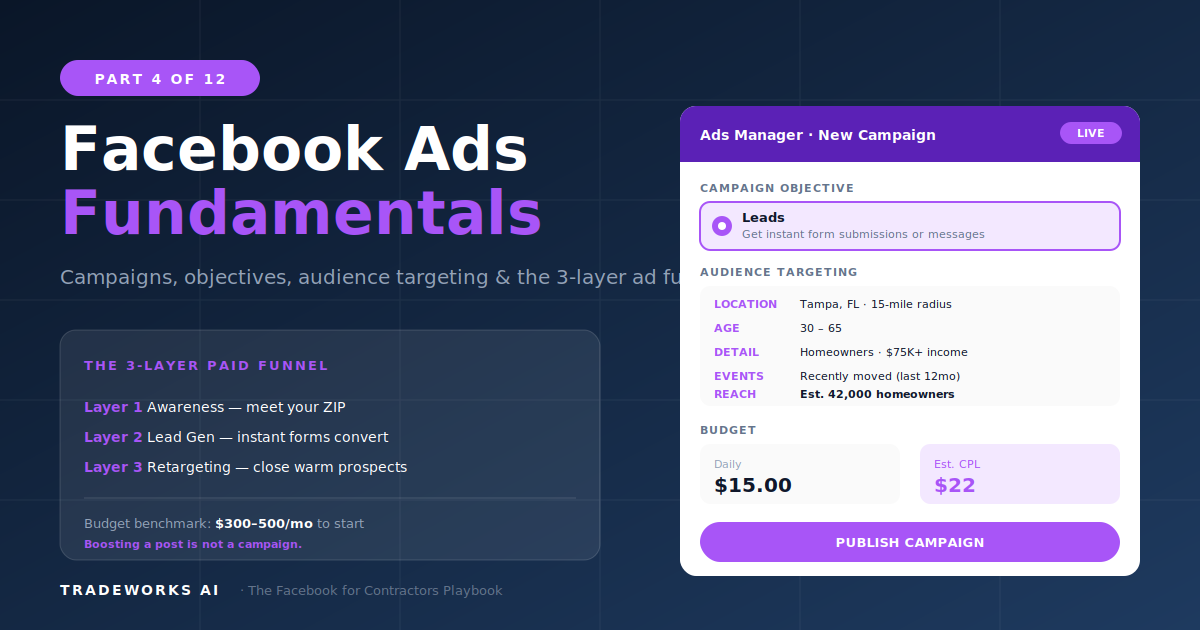
Campaigns, objectives, audience targeting, and the 3-layer ad funnel for contractors.