Facebook · Part 6
Retargeting Warm Audiences
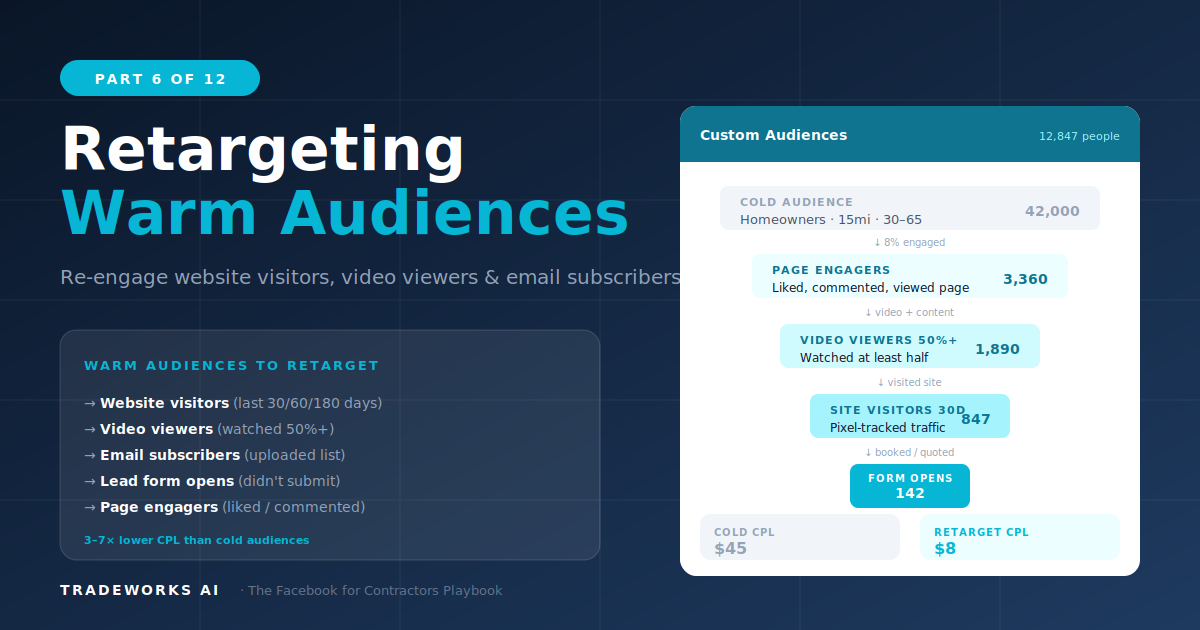
The 5 retargeting audiences every contractor needs and the email-to-Facebook sync.
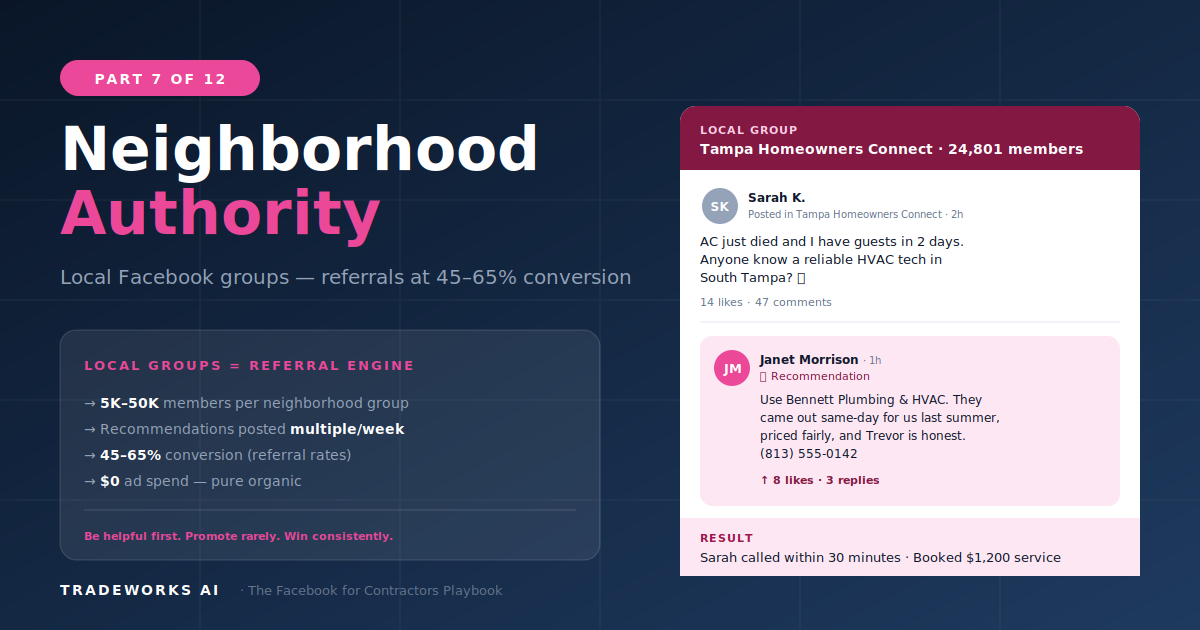
In most US metro areas, neighborhood-specific Facebook groups with 5,000 to 50,000 members produce contractor recommendation requests multiple times per week. A homeowner posts "Does anyone know a good AC company?" and within hours, dozens of residents respond with personal recommendations.
The contractor whose name appears most frequently in those recommendation threads generates a steady stream of leads that cost nothing, convert at referral-level rates of 45–65%, and compound over time as name recognition builds within the community. This is the Neighborhood Authority component of the DEMAND Engine, and it is the most underutilized Facebook strategy for contractors.
Most contractors approach Facebook groups like advertising: they join, post their latest promotion, and get removed within a week. The 80/20 rule inverts this. 80% of your activity is genuine value: answering questions, offering advice, sharing knowledge. 20% is business-related: responding to recommendation posts, sharing seasonal tips when relevant, mentioning your business when invited.
You lead with expertise, and the business follows organically. A plumber who answers 10 questions about water heater noise, garbage disposal problems, and toilet running issues over 3 weeks becomes the plumber that group members think of when they need actual service.
Target groups that match these criteria:
How to find them: Search Facebook for "[your city] neighborhood," "[your city] homeowners," "[your city] community," "[your city] recommendations." For Tampa: "South Tampa neighbors," "Brandon FL community," "Riverview homeowners."
How many to join: Start with 5–8 groups covering your primary service area. Quality of participation in fewer groups outperforms shallow presence in many.
The post: "Does anyone know a good AC company / plumber / electrician?"
Your response (from personal profile): "Hi [name]! We have been serving [area] for [years] years. Happy to help. Our team has [4.8 stars on Google with 300+ reviews]. We have availability [this week / today]. Feel free to DM me or call [phone]. No pressure either way!"
Why it works: Personal (from owner, not brand), specific (years in business, review link, scheduling), low-pressure.
What NOT to do: Just posting your business page link. Copy-pasting the same response. Tagging your business page. Personalize each response.
The post: "Is $4,500 a fair price for a new water heater? Just got this quote."
Your response: "[Name], that price is in range for [tank type/size/installation complexity], but the variable is what is included. Are they pulling permits? What is the warranty term? Is removal of the old unit and code-required upgrades included? Happy to look at the quote and explain in plain English — no pressure to switch contractors."
Why it works: Demonstrates expertise without undercutting the competitor. Opens a DM. Many DMs convert to quote requests because the homeowner now trusts your judgment.
The post: "Water is flooding my garage! Who can come NOW?"
Your response: "Calling you in 60 seconds — what is your number? Or call [phone] now and ask for [owner]. We are 15 minutes from [neighborhood]."
Why it works: Speed wins emergencies. By the time 15 others respond with "I recommend XYZ," you are already in the DM and on the phone.
The critical factor is consistency. A contractor who participates for 30 days and disappears loses all authority. The algorithm and the community forget. But 15 minutes per day of genuine engagement for 90 days builds an indefinite zero-cost lead source.
After 90 days, the system becomes self-reinforcing:
A private referral reaches one person. A group recommendation reaches 5,000 to 50,000.
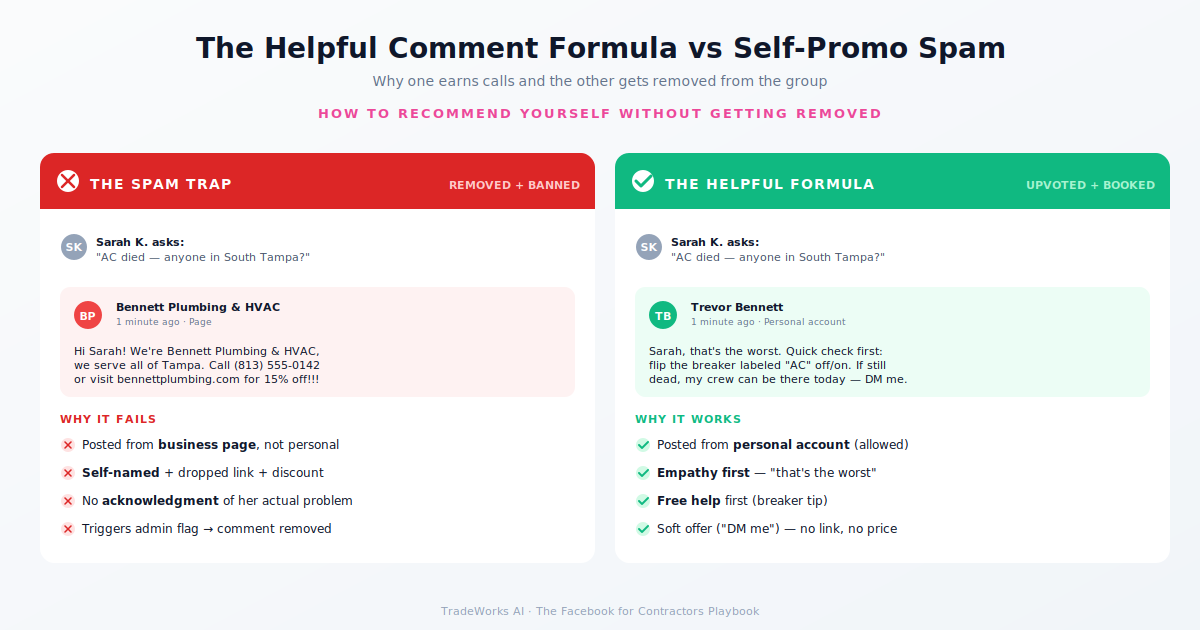
As yourself (personal profile), with your business identified in your personal bio. Most groups do not allow business page posts in discussions. Personal responses feel more authentic, are less likely to be flagged as spam, and build a personal connection. Your personal profile should list your business in the work section and link to your page.
15 minutes per day once established. During the first 30 days, budget 20–25 minutes per day as you learn group dynamics. After foundation phase, the 15-minute daily commitment is sufficient to maintain and grow authority.
Create one. A '[City/Neighborhood] Homeowner Tips' group with genuinely useful content moderated by your team can grow to 1,000+ members within 6 months if promoted through your existing customer base, business page, and local partnerships. You control the environment and become the default expert.
Nextdoor operates on similar principles (hyper-local, recommendation-based) but as a separate platform. The same 80/20 rule, response templates, and authority-building timeline apply. Many contractors run the same community strategy across both Facebook groups and Nextdoor for complete local coverage.
Carefully. Community engagement works because it is personal and authentic. A social media manager can handle the 80% (general questions, sharing content), but recommendation responses and emergency responses should come from the owner or a senior team member who can make real commitments (scheduling, pricing). The human element is what makes this work.
Use Facebook's saved-post feature to bookmark threads you are participating in. For higher-volume tracking, a simple spreadsheet (group name, date, post topic, status) maintained weekly takes 5 minutes and prevents missed follow-ups.
Most contractors miss the recommendation threads in their local Facebook groups every single day. Our free audit identifies the high-value groups in your service area and grades your current community presence.
The 5 retargeting audiences every contractor needs and the email-to-Facebook sync.
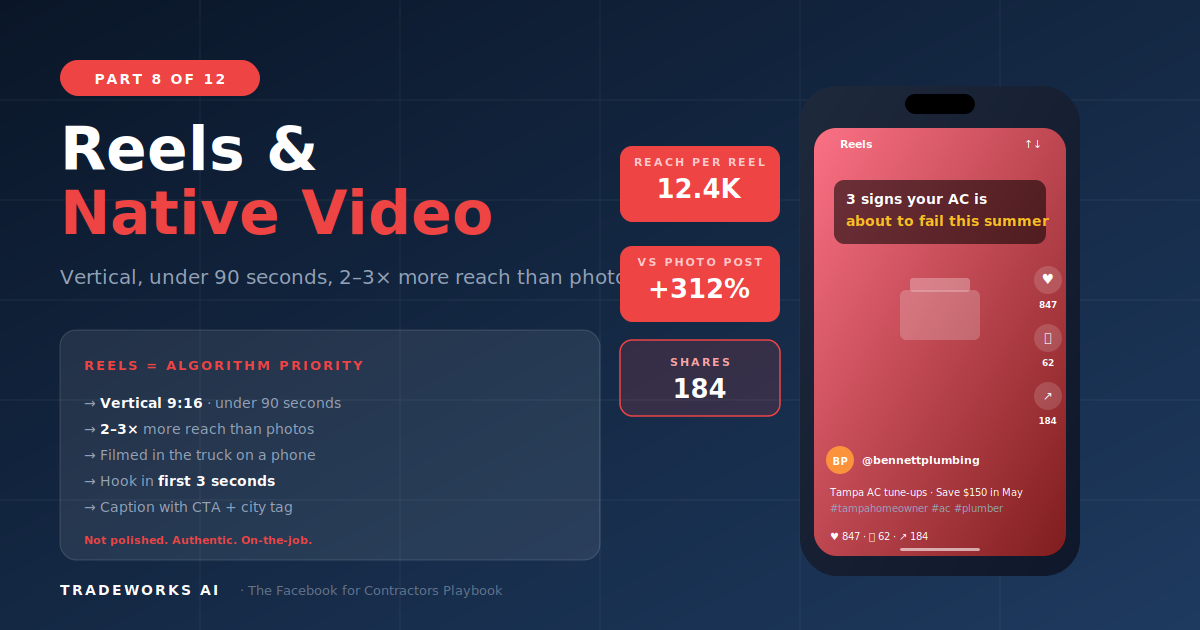
10 video frameworks for contractors plus phone-filming production standards.