Facebook · Part 9
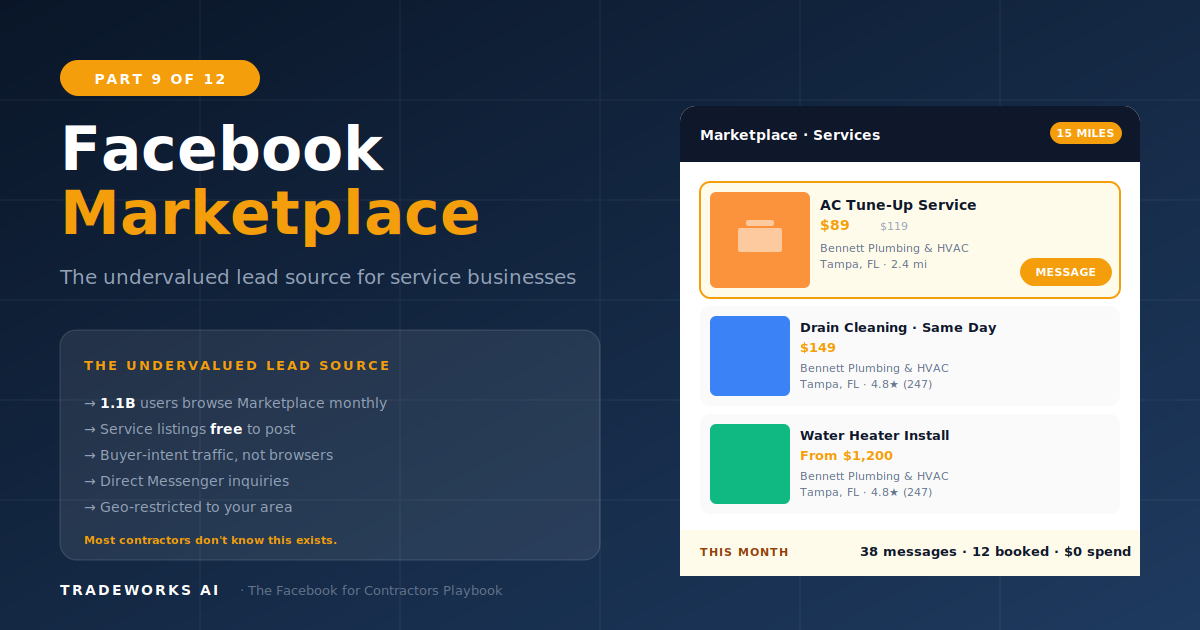
Facebook Marketplace
The hidden lead channel: list services, generate free leads, beat competitors who ignore it.
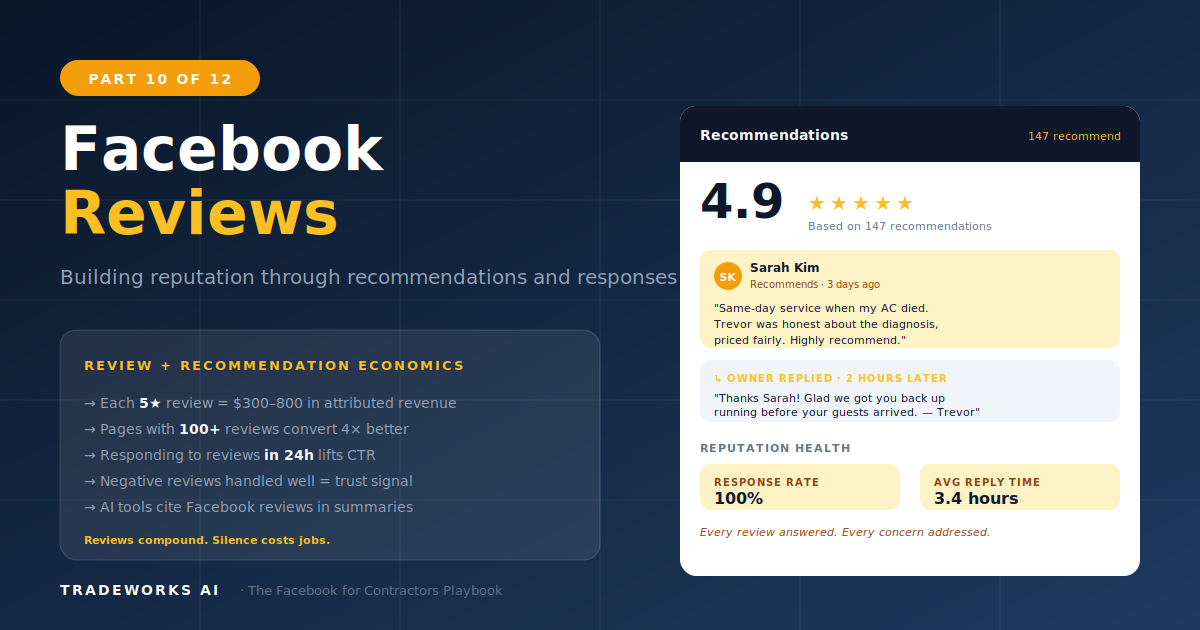
Facebook's recommendation system is the second most important review platform for home service contractors after Google, and in 2026 it is increasingly the first place AI search engines look when a homeowner asks Gemini or ChatGPT for a local contractor recommendation. Pages with 20 or more recommendations display a percentage ("97% of people recommend this business") that functions as a powerful trust signal visible on your page, in your ads, and in AI search results.
This part covers the review strategy that builds Facebook recommendations, the response protocols that protect your reputation, and the AI search implications that make Facebook reviews a long-term competitive advantage.
Different systems, complementary value:
Google is your primary platform. Facebook is your secondary platform that provides three advantages Google cannot: social context (homeowners see which of their friends recommended you), Facebook ad integration (recommendation count appears in ads as trust signal), and growing AI search citations.
The strategy is not either/or. It is both, with an alternating cadence.
When a visitor clicks "Recommend" on your page, they can write a review, tag attributes (great service, professional, good value), and optionally attach photos. The recommendation is visible on your page's Reviews tab, in the recommender's personal timeline (visible to their friends), and in Facebook search results.
Facebook displays the recommendation percentage once you reach 20 recommendations. Reaching 20 should be an immediate priority because the percentage display is one of the strongest trust signals available. It appears on your page, in search results, and in ad previews.
Unlike Google reviews, which are relatively anonymous, Facebook recommendations are tied to real profiles. When Sarah recommends your plumbing company, her 500 Facebook friends can see that recommendation. If one of those friends needs a plumber next month, they remember seeing Sarah's recommendation. This organic social distribution generates referral-quality trust without any advertising cost.
Alternative: Review by channel. Customers who found you through Facebook get a Facebook review request. Customers who found you through Google get Google. Natural platform match.
The review request email template from the Email Playbook Part 9 works identically for Facebook. Change the link from Google's review URL to facebook.com/[your-page]/reviews. Satisfaction gate, timing (Day 7), and follow-up sequence remain the same.
Technicians can request Facebook recommendations in person. Script: "If you have 30 seconds, a Facebook recommendation helps our neighbors find us. Most people leave one because they appreciate when we show up the same way for their neighbors. Here is the QR code [or link]."
The "helps our neighbors find us" framing is specific to Facebook because it is literally true: the recommendation appears in friends' feeds.
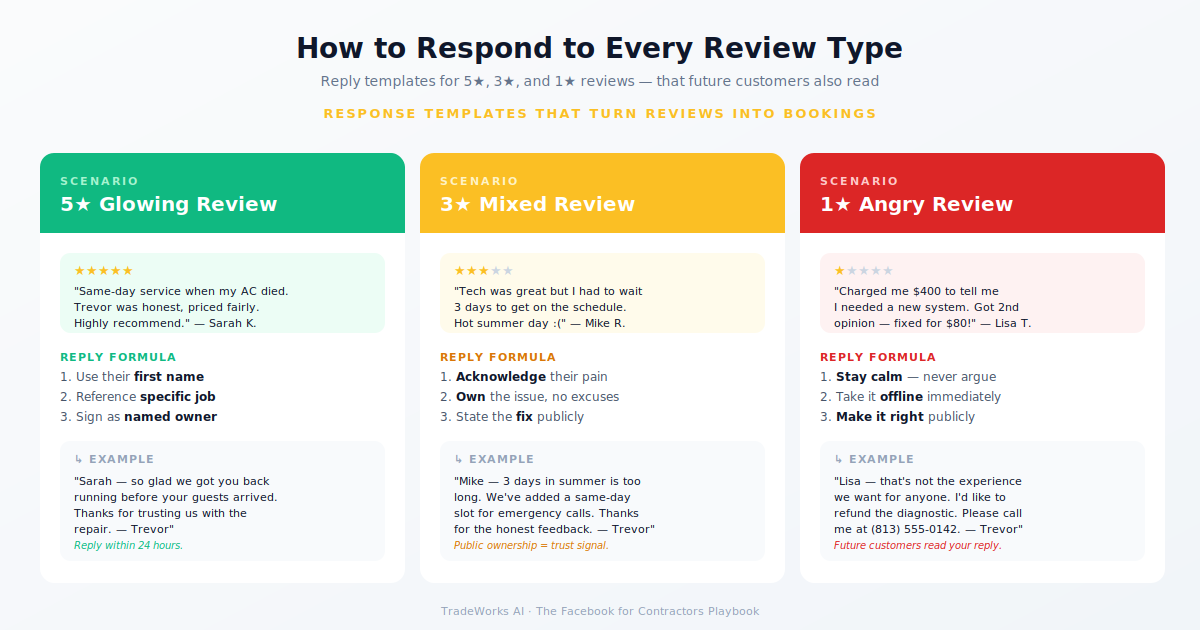
Example: "Thank you so much, Sarah! We are glad the team got your AC running smoothly before the summer heat hit. Mike mentioned your system was in great shape overall. Do not forget, your maintenance plan tune-up is scheduled for September. See you then!"
Every response is a mini-advertisement that future prospects will read.
Quality and recency matter more than total count once you pass 50. A page with 75 recent, detailed recommendations outperforms one with 200 generic recommendations from 3 years ago.
First milestone: 20 (unlocks percentage display). Aim for 50 within 6 months and 150 within 18 months. Quality and recency matter more than total count once you pass 50. A page with 75 recent, detailed recommendations outperforms one with 200 generic recommendations from 3 years ago.
Both. Google is your primary platform because it directly impacts Google Search, Maps, and LSAs. Facebook is your secondary platform that provides social proof, ad trust signals, and growing AI search citations. The alternating monthly cadence ensures both grow without competing.
Yes. Respond as your Business Page (not your personal profile) for professionalism and brand consistency. The response appears under your business name with your logo, reinforcing your brand with every reply.
Respond professionally regardless (the response is for future readers). Then report to Facebook if it violates community standards. Do not engage in a public argument. If the reviewer is a real customer with a legitimate complaint, resolve it offline and they may voluntarily update.
Not directly. Google does not use Facebook data in its search algorithm. However, Facebook recommendations contribute to your overall online entity authority, which AI search engines (including Gemini) synthesize across platforms. Strong Facebook + strong Google creates a comprehensive digital reputation that AI treats as more authoritative than either alone.
Direct outreach to your 30-50 most loyal customers via personal text or email asking them to leave a Facebook recommendation, with the explicit link (facebook.com/[your-page]/reviews). Most contractors hit 20 within 2 weeks of asking deliberately.
Without 20+ recommendations, you are missing the percentage display that converts page visitors into callers. Our free audit benchmarks your current Facebook reputation against your top local competitors.
The hidden lead channel: list services, generate free leads, beat competitors who ignore it.
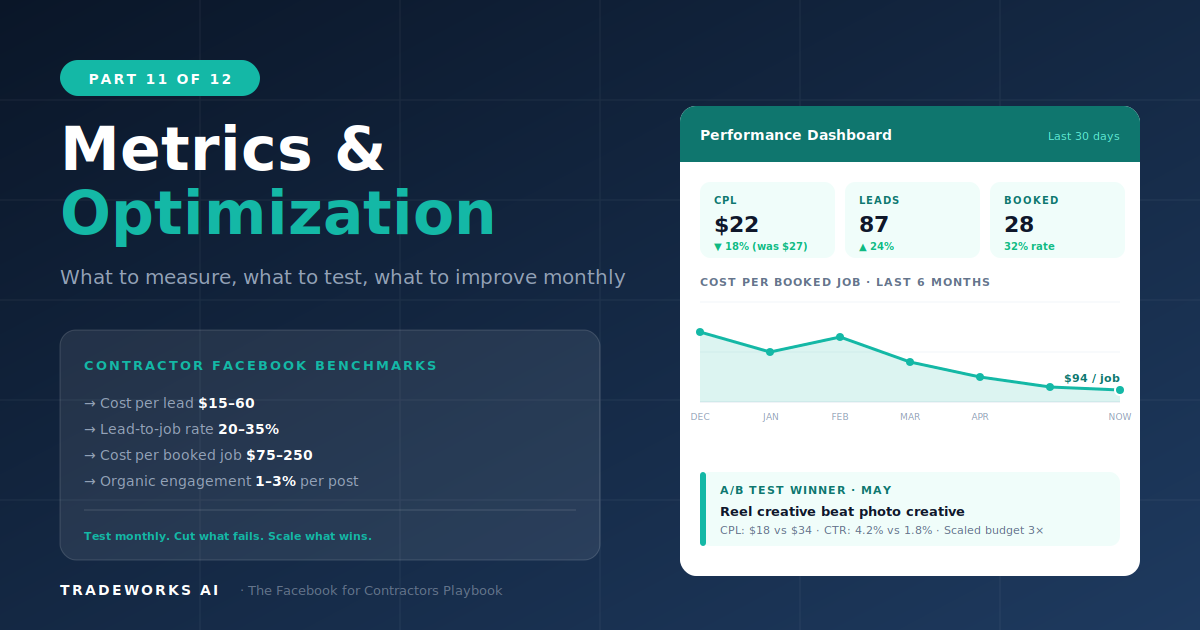
The Weekly Six dashboard, A/B testing, and the budget scaling rules.