Facebook for Contractors Playbook · Part 12 of 12

Facebook + AI Search: How the DEMAND Engine Positions You for the Next 18 Months

By Trevor Bennett · May 2026 · 11 min read

Series

The Facebook for Contractors Playbook

Part 12 of 12
DEMAND Engine hexagonal diagram with AI neural-network overlay extending into a 2026-2028 timeline

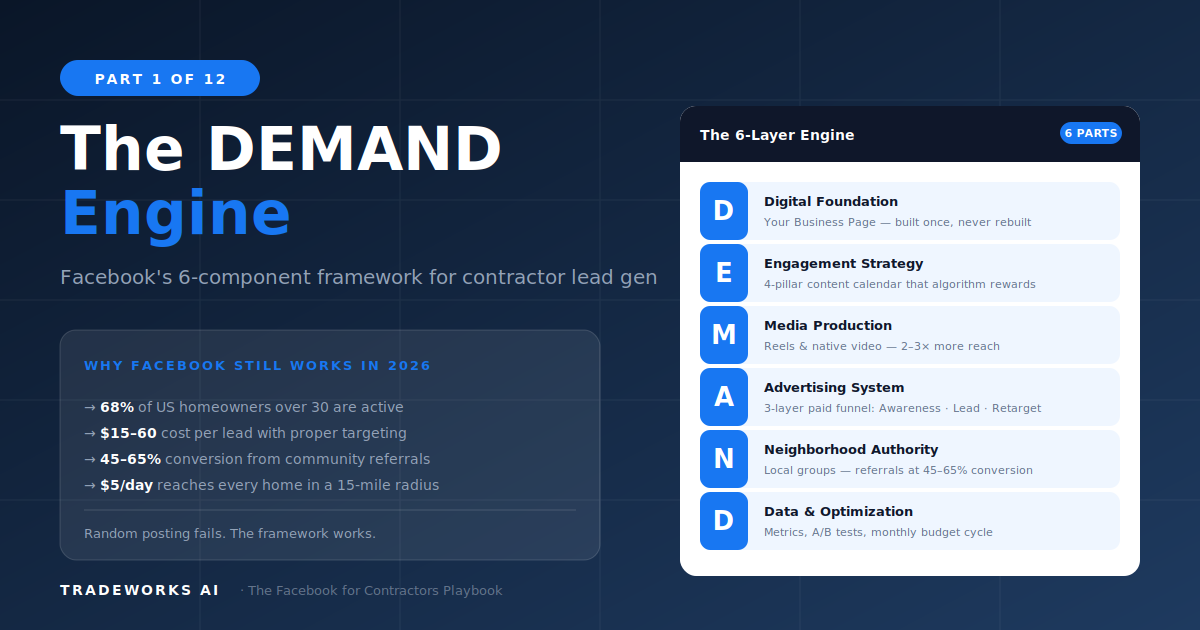
The Facebook marketing system built across 12 parts, the DEMAND Engine with its Digital Foundation, Engagement Strategy, Media Production, Advertising System, Neighborhood Authority, and Data Optimization, is the infrastructure that AI will amplify over the next 18 months.

Three shifts are reshaping how Facebook works for contractors: AI-powered ad optimization is making campaign management increasingly automated, Meta's AI creative tools are lowering the barrier to producing high-performing ad content, and AI search engines are increasingly sourcing Facebook data when recommending local businesses. The contractors who have the DEMAND Engine in place will benefit immediately. Those still boosting posts will find the gap widening into a competitive moat they cannot cross by simply buying new tools.

Shift 1: AI-Powered Ad Optimization

Meta has been integrating AI into Ads Manager progressively since 2023. In 2026, the AI optimization layer handles more decisions than ever:

  • Advantage+ campaigns: Meta's AI-driven campaign type automatically tests audiences, placements, and creative variants. For contractors, Advantage+ Audience and Advantage+ Creative are increasingly effective for lead gen. The AI tests broader audiences than a human would and finds pockets manual targeting misses.
  • Predictive budget allocation: Meta's AI automatically shifts budget between ad sets based on real-time performance. A campaign with 3 ad sets no longer needs manual reallocation.
  • Conversion optimization learning: The more conversion data you feed Facebook (Pixel + CAPI + Offline Conversions), the better the AI optimizes delivery. Contractors uploading booked-job data monthly are training the algorithm to find people who look like their actual paying customers.

What this means for the DEMAND Engine: The three-layer funnel becomes more effective over time as the AI accumulates data. The Offline Conversions upload is no longer optional. It is the training data that makes the AI better. The system improves itself.

Shift 2: Meta's AI Creative Tools

  • AI-generated ad variations: Upload one image or video. Meta's AI generates multiple background variations, text overlays, and aspect ratios. A single photo produces 5–10 variants automatically.
  • AI text generation: Meta's AI suggests headlines and primary text variants based on objective and audience. Output requires review (it produces generic copy rather than trade-specific language), but it accelerates the A/B testing cycle.
  • Dynamic creative optimization: Provide multiple headlines, images, and descriptions. The AI assembles the best-performing combination per individual viewer. Same campaign, different creative per person.

Shift 3: Facebook Content as AI Search Training Data

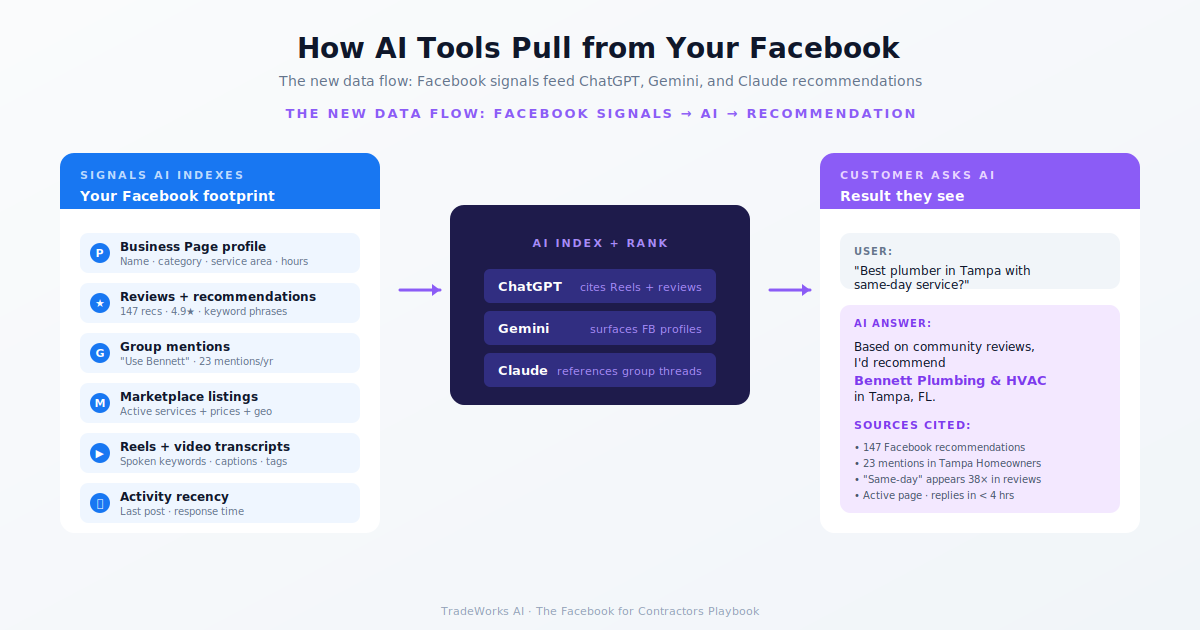
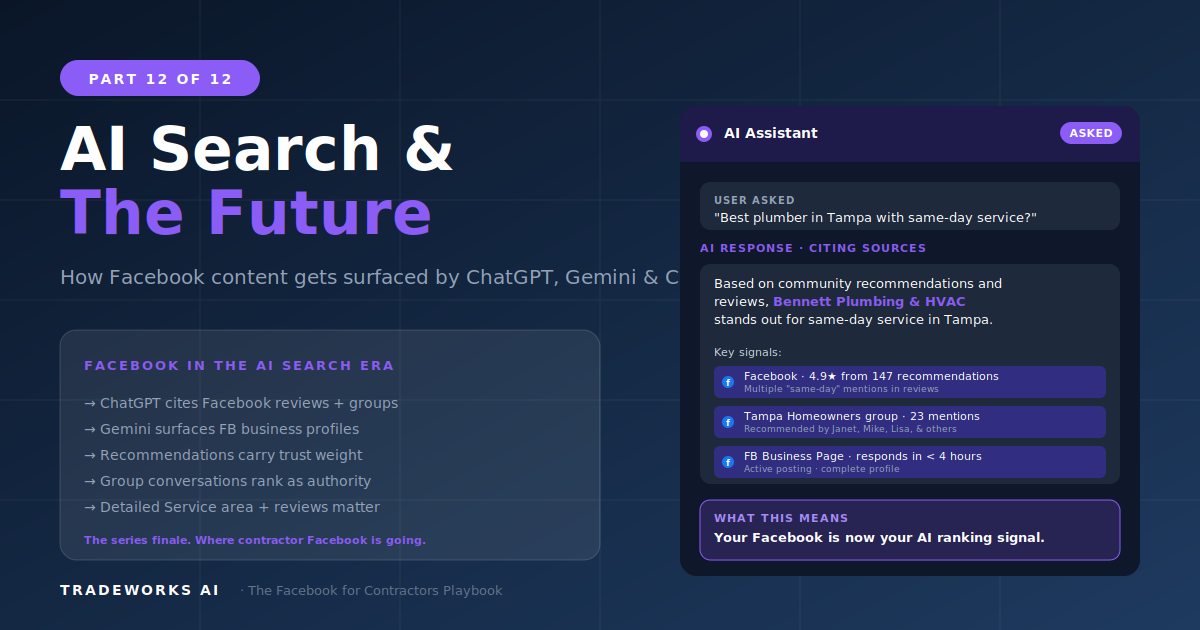
This is the most significant long-term shift. AI search engines (Gemini, ChatGPT with browsing, Perplexity) are increasingly sourcing data from Facebook when answering local service queries.

When a homeowner asks AI "Who is the best HVAC company in Tampa?" the AI synthesizes signals from multiple platforms:

  • Google Business Profile + reviews
  • Website content (services, FAQs, schema)
  • Facebook Business Page + posts + recommendations
  • Facebook group mentions and recommendation threads
  • Marketplace listings and response patterns
  • Video content engagement signals

The DEMAND Engine is not just a Facebook marketing system. It is a multi-signal entity reinforcement engine that feeds every AI system evaluating your business. Each component generates a different type of signal that AI uses to build confidence in recommending you.

The 18-Month Facebook Technology Roadmap

Adopt Now (Mid-2026)

  • The complete DEMAND Engine (Parts 1–11). Non-negotiable foundation.
  • Advantage+ Audience on lead gen. Let Meta's AI find audiences beyond your manual targeting.
  • Dynamic creative optimization. Multiple headlines, images, descriptions per ad.
  • Offline Conversions upload monthly.
  • Reels production consistency. The algorithm bonus will not last forever. Build the habit and audience now.

Evaluate Late 2026 to Early 2027

  • Advantage+ Creative tools for AI-generated ad variations. Test on one campaign first. Review all output for trade accuracy.
  • AI-generated text suggestions for headlines and ad copy. Use as starting points, not final copy.
  • Meta's AI chatbot integrations for Messenger. Automated lead qualification beyond simple auto-responses.
  • Facebook Shops for service businesses. Evaluate when service listing capabilities formalize.

Watch for 2027 to 2028

  • Fully autonomous campaign management. AI proactively suggests campaign changes based on performance prediction.
  • AI-to-AI discovery. Homeowners' AI assistants query Facebook directly to find contractors.
  • Predictive customer intent signals. Meta's AI identifies homeowners likely to need your services before they explicitly search.
  • AR/VR integration for home services. Meta's AR investment could enable visualization of equipment placement through Facebook-connected tools.

The Complete DEMAND Engine: Series Summary

  • Part 1: Business case + the DEMAND framework.
  • Part 2: Business Page setup + 15-point optimization checklist.
  • Part 3: 4-pillar content calendar.
  • Part 4: Ads fundamentals + 3-layer funnel.
  • Part 5: Lead gen with Instant Forms + 5 offer frameworks.
  • Part 6: Retargeting with 5 audiences + email-to-Facebook sync.
  • Part 7: Community groups + the 80/20 rule + 90-day timeline.
  • Part 8: Video, Reels, and Lives + 10 frameworks.
  • Part 9: Marketplace as a hidden lead channel.
  • Part 10: Reviews and recommendations as trust + AI signals.
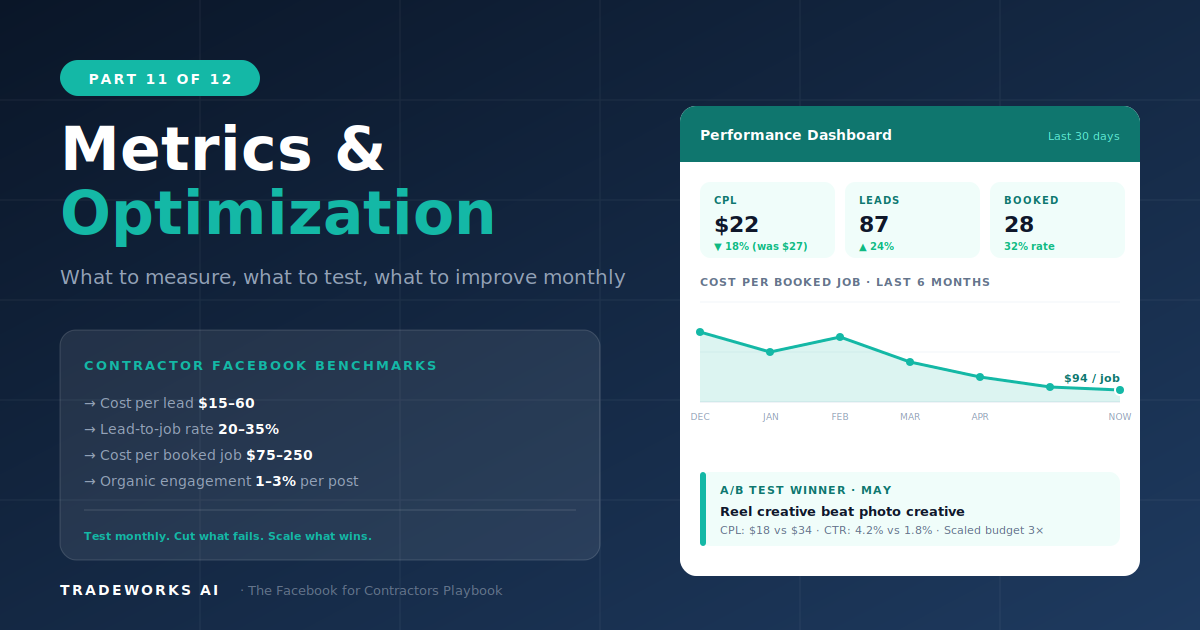
  • Part 11: Weekly Six dashboard + budget scaling rules.
  • Part 12 (this article): AI search and the future.

Each part connects through shared infrastructure (Pixel, Business Suite, CRM integration), shared content (organic posts becoming ad creative, reviews becoming trust signals), and shared data. The DEMAND Engine is not 12 separate tactics. It is one system with six interlocking components.

Implementation: Where to Start and How to Build

  1. Part 2. Build the Digital Foundation. 2 hours one-time.
  2. Part 3. Launch the content calendar. 2–3 hours first month, then 2–3 hours monthly.
  3. Part 7. Join 5–10 community groups, begin the 80/20 strategy. 15 min/day.
  4. Part 4. Set up Ads Manager with the three-layer funnel. $10/day starter.
  5. Part 5. Build first lead gen campaign with Instant Forms.
  6. Part 6. Configure retargeting once Pixel has 2–4 weeks of data.
  7. Part 8. Begin video production. First batch of 8–12 clips.
  8. Part 9. Create 3–5 Marketplace listings.
  9. Part 10. Launch alternating review request strategy.
  10. Part 11. Set up Weekly Six dashboard. Begin monthly optimization.

Total implementation: 15–25 hours over the first month, then 5–8 hours/month ongoing. Expected results after 90 days: 15–40 Facebook-generated leads/month at $15–60 CPL, converting at 20–35%, producing $4,000–25,000 in monthly revenue depending on business size.

How Facebook and Email Work as One System

The Facebook for Contractors Playbook and the Email Marketing Playbook are two halves of a complete digital marketing system:

  • Facebook generates top-of-funnel awareness and mid-funnel leads.
  • Email converts leads into booked jobs and nurtures long-term relationships.
  • Data flows bidirectionally. Email lists become Facebook Custom Audiences. Facebook engagement informs email segmentation. Reviews from email power Facebook social proof.

Together, 24 parts across two series, they create a closed-loop marketing system where every channel amplifies every other channel. The contractors who build both are not doing twice the marketing. They are doing exponentially more effective marketing because the compound effects of integration produce results that neither system achieves alone.

Frequently Asked Questions

Do I need to implement all 12 parts to see results?

No. Parts 2 (page setup), 3 (content), and 4–5 (first ad campaign) produce results within the first month. Each additional part adds incremental value. But the compounding effect of the complete DEMAND Engine is where the transformative results come from. A contractor running all six components outperforms one running three by 3–5x, not 2x, because the integration effects multiply rather than add.

How does this series connect to the upcoming Contractor Stack series?

The Contractor Stack series covers every piece of software and technology a modern contracting business needs. The Facebook and Email systems are marketing components within the larger technology stack. The Stack series covers CRM selection, FSM platforms, scheduling, accounting integration, and how everything connects.

Will AI replace the need for Facebook marketing?

No. AI amplifies Facebook marketing. AI search engines reference your Facebook content. AI tools optimize ad delivery and creative. AI analytics improve your optimization cycle. Every AI advancement makes the DEMAND Engine more effective, not less relevant. The infrastructure you built is what AI needs to work with.

What is the single most important thing I can do on Facebook right now?

If your page is not optimized (Part 2), start there. If it is optimized, launch a $10/day lead gen campaign (Part 5) with one specific offer targeting homeowners in your service area. That single action generates data, leads, and learning faster than any amount of planning.

What comes after the Facebook Playbook?

The Contractor Stack series, the Website CRO series, and the Video Marketing series. Each builds on the marketing foundation established in the Email and Facebook Playbooks.

Should I wait for Meta's AI tools to mature before building the DEMAND Engine?

No. The opposite. Building now gives Meta's AI tools historical engagement data, conversion data, and audience signals to learn from when you adopt them. Contractors who wait until 2028 will be 18-24 months behind on the data foundation that makes AI optimization actually work.

Get the Complete DEMAND Engine Built for You

We have now covered all 12 parts. If you would rather have it implemented end-to-end against your business, our free audit is the first step. We map your gaps and stage the rollout.

Continue the Series

The DEMAND Engine
Facebook · Part 1

The DEMAND Engine

Why Facebook still works for contractors and the 6-component framework that makes it work.
Related Services

Digital Marketing Pricing