Local Search · Part 5
How Google Map Pack Ranking Actually Works
Continue the Local Search Playbook with Part 5 of 10.
Google reviews are the single largest sub-signal within the prominence factor that determines Map Pack ranking. Six specific review signals feed the algorithm: total review count (200-plus threshold for competitive markets), average star rating (4.5-plus for ranking advantage), review velocity (5-10 new reviews per month maintains recency), review content keywords (service and location mentions in review text reinforce relevance), owner response rate (100 percent response signals engagement), and review recency (last 6 months weighted heavily, 12-month-old reviews contribute minimally). In 2026, the same review signals also feed AI recommendation engines - ChatGPT, Gemini, Perplexity, and Google AI Overviews all extract review data to decide which contractors to recommend. Reviews are the only ranking signal that simultaneously drives Map Pack position, AI recommendation eligibility, and customer conversion. This article covers the 6 review signals for ranking, the acquisition strategy specific to local search impact, the response framework that adds SEO value, and the cross-platform review strategy that captures AI visibility beyond Google. For the full 8-article deep dive, see the companion Reputation and Reviews series in the TradeWorks AI content library.
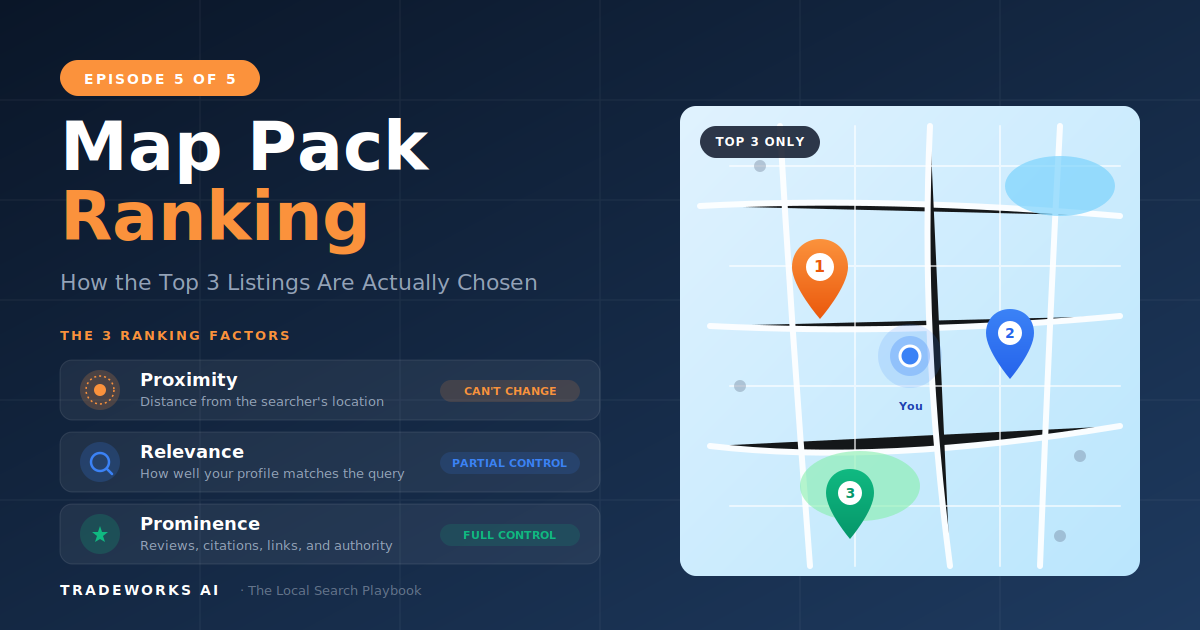
Part 5 broke down Map Pack ranking into three factors: proximity (25-35 percent), relevance (20-25 percent), and prominence (40-50 percent). Within prominence, review signals are the largest single component.
Industry testing consistently shows that review volume and velocity produce the most measurable ranking movement of any single optimization action. A contractor who adds 50 reviews over 90 days while making no other changes will typically see Map Pack improvement. A contractor who optimizes GBP categories, fixes NAP, and builds city pages but has stagnant reviews will see less movement.
Reviews are also the only signal that serves triple duty: they drive ranking, they drive AI recommendations, and they drive customer conversion. No other single signal impacts all three simultaneously.
Google does not just count reviews and average ratings. The algorithm extracts six specific signals from your review profile.
Signal 1: Total Review Count
Volume establishes credibility. In competitive contractor markets, the Map Pack consistently favors businesses with higher review counts. The threshold varies by market - 200-plus reviews for competitive metros, 50-100 for smaller markets. Below the competitive threshold in your market, review volume is the highest-priority lever.
Signal 2: Average Star Rating
4.5 stars is the threshold that matters for both ranking and conversion. Businesses below 4.5 show measurably lower Map Pack visibility and significantly lower click-through rates. Above 4.5, the difference between 4.6 and 4.9 has minimal ranking impact.
Signal 3: Review Velocity
How many new reviews you receive per month. Google treats velocity as a freshness signal. A business adding 10 reviews per month signals active, current operation. A business that gained 200 reviews two years ago and has added 3 since signals stagnation. Target: 5-10 new reviews per month minimum, sustained indefinitely.
Signal 4: Review Content Keywords
Google extracts keywords from review text and uses them as relevance signals. A review that mentions AC repair in Tampa reinforces your relevance for AC repair Tampa queries. A review that says great service reinforces nothing specific.
This is why the specificity signal from the Reputation and Reviews series (Article 7) matters for ranking, not just AI citations. Reviews with specific service names, location references, and technical details contribute ranking-relevant keywords that generic reviews do not.
You cannot script customer reviews - that violates Google TOS. But you CAN use guiding questions in your review requests that encourage customers to mention the specific service and their location. What service did our team provide for you today? naturally produces keyword-rich content.
Signal 5: Owner Response Rate
Google tracks whether business owners respond to reviews. A 100 percent response rate signals active engagement with customers. Google has confirmed that owner responses are a factor in local search ranking.
The response adds a second layer of indexable content to each review. A well-crafted owner response that naturally includes service keywords and location references doubles the keyword-relevant content per review.
The R-A-T-E framework from the Reputation and Reviews series (Article 3) is designed specifically for this - Recognize, Address, Transition, End - with natural keyword integration at the Transition step.
Signal 6: Review Recency
Reviews from the last 6 months are heavily weighted. Reviews older than 12 months contribute minimally to current ranking calculations. This is why velocity matters as much as volume - a contractor with 300 reviews from 2019-2023 and zero recent reviews can rank below a competitor with 100 reviews, 30 of which are from the past 6 months.
The Reputation and Reviews series (Article 2) covers the full 5-Pillar Acquisition System in exhaustive depth. This section covers the ranking-specific considerations that complement that system.
Timing Matters for Ranking
Reviews received within 4 hours of job completion carry the strongest recency signal because the review timestamp is closest to the service event. The same-day SMS workflow from the 5-Layer Review Automation Architecture (Reviews Article 6) optimizes for this timing.
Steady Velocity Beats Bursts
10 reviews per week for 4 weeks produces stronger ranking signals than 40 reviews in one week followed by silence. Google rewards consistency over bursts. Sustained velocity signals an actively operating business. Bursts can trigger review-gating algorithms if the pattern looks unnatural.
Keywords in Reviews Come From Customer Experience
You cannot control what customers write. But you can influence it by asking guiding questions in your review request: What service did our team provide? Would you mention your technician by name? What was the outcome? These prompts naturally produce reviews with service keywords, technician names, and outcome descriptions - all of which are ranking-relevant content.
Multi-Platform Reviews Extend AI Visibility
Google reviews drive Map Pack ranking. But AI tools source from multiple platforms. ChatGPT extracts from Angi, Yelp, BBB, and Google. Gemini extracts from Facebook and Nextdoor. The Multi-Platform Tier System from Reputation and Reviews Article 5 covers which platforms to prioritize by trade.
Most contractors treat review responses as customer service. They are also SEO.
Each owner response adds indexable content to the review. Google crawls and indexes review responses alongside the original review text. A response that naturally mentions the service performed, the location served, and the outcome doubles the keyword surface area of that review.
The R-A-T-E framework (Reputation and Reviews Article 3) structures responses for both customer experience and SEO value:
Recognize: acknowledge the customer by name and thank them.
Address: reference the specific service mentioned in the review.
Transition: naturally include a keyword-relevant phrase (we appreciate serving the [neighborhood] community or AC repair is what our team does best in [city]).
End: close with a forward-looking CTA.
Respond to every review within 48 hours. Positive reviews get full R-A-T-E responses. Negative reviews get owner-direct resolution paths per the Crisis Playbook (Reviews Article 4). The response rate itself is a ranking signal regardless of response content.
In 2026, the same reviews that drive Map Pack ranking also drive AI recommendations. The connection is direct.
ChatGPT sources from Google reviews plus Angi, Yelp, and BBB. The 5 AI Review Signals from Reputation and Reviews Article 7 - volume, rating, recency, sentiment, and specificity - determine whether AI tools recommend you.
AI-referred leads convert at 73 percent compared to 31 percent for Google organic. The review investment that drives Map Pack ranking simultaneously builds the AI recommendation profile that captures the fastest-growing customer discovery channel.
Contractors who treat reviews as a Google-only ranking factor are optimizing for one surface. Contractors who treat reviews as a multi-surface visibility investment capture Map Pack ranking, AI recommendations, and customer conversion simultaneously.
How quickly do new reviews impact ranking?
Week 1-2: new reviews appear on GBP. Review count and rating update reflected in search results within 1-3 days. Minimal ranking movement yet.
Week 3-4: Google begins incorporating velocity signals. If the review pace is sustained, early ranking movement may appear in less competitive queries.
Month 2-3: sustained velocity produces measurable Map Pack movement for competitive queries. The compounding effect begins - higher ranking generates more clicks, more clicks are a behavioral signal, behavioral signals reinforce ranking.
Month 4-6: the full review investment compounds across all surfaces. Map Pack position stabilizes at higher position. AI recommendations begin reflecting the improved review profile.
Plan for 90 days of sustained review acquisition before expecting competitive ranking movement. Quick wins happen in less competitive markets. Competitive metros require the full 90-day investment.
This part covers reviews from the local search ranking perspective. The full Reputation and Reviews series (8 articles) in the TradeWorks AI content library covers the complete operating model:
Article 1: Why Reviews Are the Highest-Leverage Marketing Asset (business case + Three Returns).
Article 2: The 5-Pillar Acquisition System (100-plus reviews in 90 days).
Article 3: How to Respond to Every Review (R-A-T-E framework).
Article 4: The Negative Review Crisis Playbook (60-Minute Framework).
Article 5: Beyond Google - Multi-Platform Tier System.
Article 6: Review Automation - 5-Layer Architecture.
Article 7: Reviews in the AI Era - 5 AI Review Signals.
Article 8: Building a Review-First Culture.
Reviews are the highest-leverage single investment in the Local Search Stack. They are the only signal that simultaneously drives Map Pack ranking, AI recommendations, and customer conversion. The 6 review signals are specific and actionable. The acquisition strategy rewards consistency over bursts. The response framework adds SEO value to every interaction.
If you implement one thing from this series, implement a sustained review acquisition system. Everything else in the Local Search Stack works better when reviews are strong.
Read Part 7 next: Google Local Service Ads Setup and Optimization - the paid layer of the Local Search Stack.
Yes. Google has confirmed that reviews are a factor in local search ranking. Industry testing consistently shows review volume and velocity produce the most measurable ranking movement of any single optimization. Reviews are the largest sub-signal within the prominence factor.
Market-dependent. Competitive metros: 200-plus reviews for Map Pack contention. Mid-size markets: 100-150. Smaller markets: 50-100. The number that matters most is your count relative to the top 3 Map Pack competitors in your specific trade and market.
Yes. Google extracts keywords from review text and uses them as relevance signals. Reviews mentioning specific services and locations reinforce your relevance for matching queries. You cannot script reviews (TOS violation), but guiding questions in your request naturally produce keyword-rich content.
Yes. Google tracks response rate as an engagement signal. Each response adds indexable content. A well-crafted response with natural keyword inclusion doubles the keyword surface area per review. Respond to every review within 48 hours.
No. Purchased reviews violate Google TOS and risk profile suspension. Google detection of fake reviews has improved substantially. The consequences (suspension, review removal, permanent trust damage) far outweigh any temporary ranking benefit. Build reviews through genuine customer acquisition systems.
This part covers reviews from the local search ranking perspective specifically. The Reputation and Reviews series covers the complete operating model across 8 articles: business case, acquisition system, response framework, crisis playbook, multi-platform strategy, automation, AI-era optimization, and cultural implementation. Start with this part for ranking context, then read the full series for operational depth.
Most contractors build one or two layers and ignore the rest. Our free audit checks all five layers of the Local Search Stack — GBP, Map Pack, LSAs, reviews, and AI search visibility — and shows you exactly which gaps are costing you revenue this quarter.
Continue the Local Search Playbook with Part 5 of 10.
Continue the Local Search Playbook with Part 7 of 10.