Local Search · Part 9
Local Search Tracking — The Dashboard That Shows What's Working
Continue the Local Search Playbook with Part 9 of 10.
45 percent of consumers now use AI tools to find local services in 2026, up from 6 percent in 2025. ChatGPT recommends only 1.2 percent of local businesses. AI-referred leads convert at 73 percent compared to 31 percent for Google organic. The contractor who built the entire Local Search Stack across the first 9 parts of this series - GBP foundation, Map Pack optimization, LSAs, reviews, citations, content authority, link building, tracking - has not just built a Google strategy. They have built the infrastructure that every AI tool on the market sources from when generating contractor recommendations. This is the series finale. It covers how AI tools actually select which contractors to recommend (the B2A framework from business-to-agent optimization), the entity reinforcement principle that connects every layer of the Local Search Stack to AI recommendation logic, the Share of Model audit that measures your current AI visibility, the platform-specific behaviors of ChatGPT, Gemini, Perplexity, Google AI Overviews, and Apple Siri, and the 18-month outlook toward A2A (agent-to-agent) commerce where customer AI agents negotiate directly with contractor AI systems. Everything you built in Parts 1-9 is the foundation for being recommended by every AI on the market.
Right now, somewhere in your service area, a homeowner is asking ChatGPT for a contractor recommendation. ChatGPT is pulling from your Google Business Profile, your reviews on Angi and Yelp, your website content, and your citation profile to decide whether to recommend you or your competitor.
The numbers that define the moment:
45 percent of consumers use AI tools for local services, up from 6 percent one year ago.
1 in 3 homeowners under 45 used an AI assistant to find a home service provider in the past 90 days.
ChatGPT recommends only 1.2 percent of local businesses (SOCi 2026 Local Visibility Index).
AI-referred leads convert at 73 percent. Google organic at 31 percent.
62 percent of AI-referred customers call within 30 minutes of the recommendation.
41 percent of consumers trust AI recommendations as much as personal referrals, up from 12 percent in 2024.
This is not emerging. This is here. And the contractors who are not visible to AI tools are invisible to a growing share of their potential customers.
B2A stands for Business-to-Agent. It describes the optimization of your business to be recommended by AI agents (ChatGPT, Gemini, Perplexity, Apple Siri) rather than just found by human searchers on Google.
Traditional local SEO optimizes for Google algorithms. B2A optimizes for AI recommendation logic. The inputs overlap substantially - but AI tools weight signals differently and source from different platforms than Google does.
The B2A framework has three components:
Entity clarity: AI tools must be certain your business is a single real entity operating at a verified location with verified services. This is what NAP consistency (Part 3), schema markup (Part 4), and GBP completeness (Part 2) provide.
Signal depth: AI tools must have enough data to construct a confident recommendation. This is what review volume and specificity (Part 6 + Reputation and Reviews series), website content depth (Part 4), and multi-platform presence (Reviews Article 5) provide.
Cross-source consistency: AI tools cross-reference multiple sources. Consistent information across Google, Angi, Yelp, Facebook, BBB, Nextdoor, and your website produces high entity resolution confidence. Contradictory information produces uncertainty and defaults to competitors.
Here is the connection that ties this entire series together. Every layer of the Local Search Stack is also a layer of AI recommendation infrastructure.
Layer 1 GBP Foundation (Part 2): your GBP is the primary data source for Google AI Overviews and a secondary source for ChatGPT, Gemini, and Perplexity. Complete GBP = complete AI data feed.
Layer 2 Map Pack / Content Authority (Parts 4-5): your website content is what Perplexity cites directly. FAQ content with schema is what Google AI Overviews extract. Service pages provide the depth AI tools use to categorize your capabilities.
Layer 3 LSAs (Parts 7-8): LSA presence signals commercial viability and active operation. Google AI Overviews may favor businesses with active paid presence as a trust signal.
Layer 4 Citations / NAP (Part 3): clean NAP across all sources creates entity resolution confidence for AI tools. The 4 data aggregators feed the directories AI tools cross-reference.
Layer 5 Reviews (Part 6 + Reviews series): the 5 AI Review Signals (volume, rating, recency, sentiment, specificity) are the dominant input for AI recommendation logic. Reviews are the currency of AI trust.
The contractor who built all 5 layers across this series has not just built a Google strategy. They have built the infrastructure for AI recommendation across every platform simultaneously.
Each AI tool sources from different signals and produces different recommendations for the same query.
ChatGPT (60 Percent Market Share)
Primary sources: Angi (direct integration), Yelp, BBB, Google. Favors national franchises for emergency queries. Local independents need stronger signals across all 5 review categories to compete with franchise brand recognition. Typically recommends 2-3 contractors per query.
Gemini (15 Percent, Growing 12 Percent QoQ)
Primary sources: Facebook, Nextdoor, broader web verification. Weights neighborhood-level recommendations heavily. A contractor mentioned positively in Nextdoor threads gets recommended for queries from that geography even with thinner signals elsewhere.
Perplexity (6 Percent)
Primary signal: your own website depth. Cited 17 sources for a single AC repair query including 14 contractor websites directly. Less platform-review dependent, more original-content dependent.
Google AI Overviews (68 Percent of Local Searches)
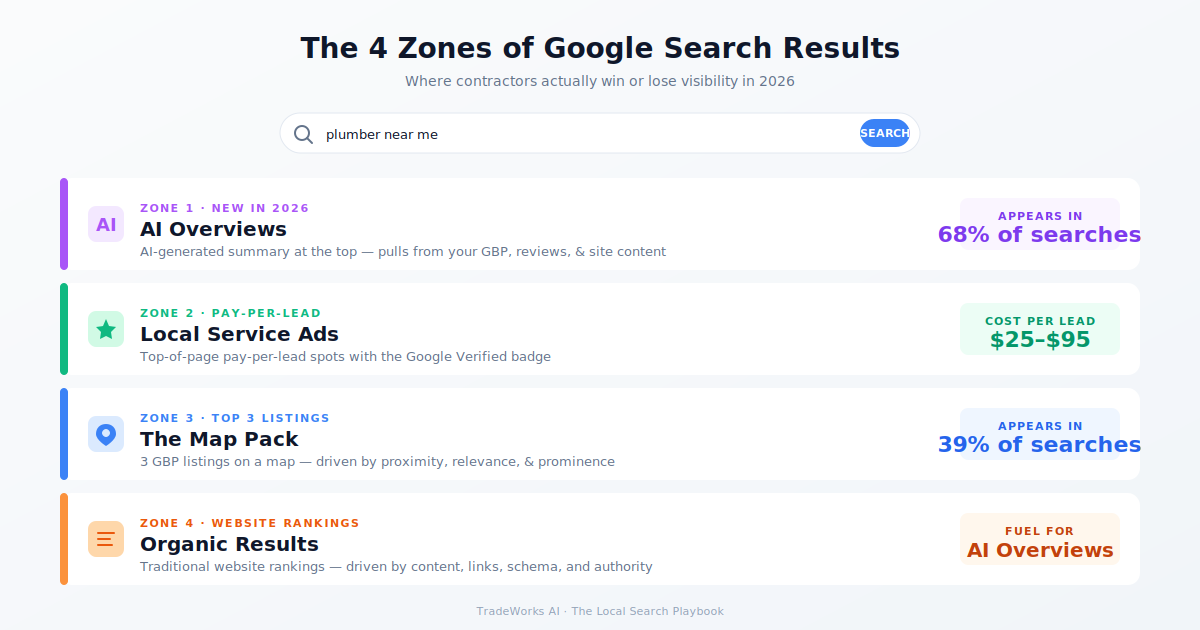
Primary source: Google Business Profile. The closest AI behavior to traditional local SEO. Map Pack 39 percent, AI Overviews 68 percent - the AI summary is increasingly the dominant Google surface.
Apple Siri / World Knowledge Answers
Launched spring 2026. Expected primary sources: Yelp, Apple Maps. Early data suggests heavy weighting on Apple Maps presence and Yelp profile consistency.
Share of Model measures how often AI tools recommend your business across a set of queries your customers might ask. It is the AI equivalent of market share.
How to run the audit:
Build a list of 25 queries your customers might ask an AI tool. Include near-me queries, best-in-city queries, problem queries (AC not cooling Tampa), pricing queries (how much does roof replacement cost), and specific-service queries (tankless water heater installation).
Run each query in ChatGPT, Gemini, Perplexity, and Google AI Mode (4 tools x 25 queries = 100 data points).
Log: did you appear? Who else appeared? What sources got cited? What recommendation reasoning was used?
Calculate: Share of Model = number of times you appeared divided by total queries. Most local contractors start under 10 percent.
Run the audit quarterly. Improvement in Share of Model correlates with the AI-referred lead volume you capture.
Looking forward 18 months, the customer journey shifts again.
B2A (business-to-agent) is the present. Customer asks AI for a recommendation. AI surfaces 2-3 contractors. Customer calls one.
A2A (agent-to-agent) is the near future. The customer delegates the entire booking workflow to an AI agent. The customer AI checks availability, evaluates reviews and credentials, books the appointment, and handles payment - potentially without the homeowner making a single phone call.
In an A2A world, your AI voice agent (covered in Cat 10 Part 2 of the TradeWorks AI content library) talks to the customer AI agent. Reviews remain the dominant trust currency. Entity clarity remains the foundation. The Local Search Stack you built across this series is the infrastructure for the agent commerce era.
The contractors building this infrastructure in 2026 are building for 2028. Citation history hardens. AI recommendation positions compound. The cost of waiting rises every quarter.
Ten parts. Five layers. One system.
Part 1: The Local Search Math. The 5-Layer Stack. Why 2026 is different.
Part 2: GBP Mastery. 12-point completeness checklist. The foundation layer.
Part 3: NAP Consistency. The 45-minute audit. Entity verification.
Part 4: Website and Local SEO. Schema, landing pages, FAQ content. Content Authority.
Part 5: Map Pack Ranking. 3 factors, 8 levers, 5 myths.
Part 6: The Reviews Playbook. 6 review signals. Triple-duty ranking + AI + conversion.
Part 7: Local Service Ads. Setup, Google Verified, 5 optimization tactics.
Part 8: LSAs vs PPC. 8 dimensions, when each wins, budget allocation.
Part 9: Local Search Tracking. 6 metrics, call tracking, monthly dashboard.
Part 10: AI Search. B2A, entity reinforcement, Share of Model, A2A outlook.
Together, these ten parts provide the complete operating model for contractor local search in 2026 and beyond. The system serves Google and AI simultaneously because the foundation is the same: entity clarity, signal depth, and cross-source consistency.
The contractors who built the Local Search Stack across this series have not just built a Google strategy. They have built the trust infrastructure that every AI tool on the market sources from when deciding which 1.2 percent of local businesses to recommend.
AI search adoption is climbing 40-50 percent year over year. AI-referred leads convert at more than twice the rate of Google organic. Citation history hardens fast - the contractors who own AI recommendations in 2026 will likely own them through 2028.
The complete Local Search Playbook is the operating system. Build the 5 layers. Track the 6 metrics. Maintain the foundation. The compounding advantages are already in motion for the contractors who started.
For the full AI-era deep dive, see the companion Reputation and Reviews series (8 articles) and Cat 10 AI and Technology series (10 parts) in the TradeWorks AI content library.
The foundation is the same - GBP, reviews, citations, content, links. AI search adds emphasis on multi-platform review presence (ChatGPT sources from Angi/Yelp/BBB, Gemini from Facebook/Nextdoor), website content depth (Perplexity rewards this), and entity consistency across all sources. Build the Local Search Stack from this series and you serve both Google and AI simultaneously.
Run the Share of Model audit. 25 queries across 4 AI tools. Log whether you appear, who else appears, and what sources get cited. Most local contractors start under 10 percent. Run quarterly to track improvement.
ChatGPT at 60 percent market share is the highest-volume target. But single-platform optimization is fragile. The Local Search Stack serves all platforms simultaneously because the foundation (entity clarity, reviews, content, citations) feeds every AI tool.
It matters now. 45 percent of consumers already use AI tools for local services. AI-referred leads already convert at 73 percent. The question is not when - it is whether you are visible to the 45 percent who are already searching this way.
A2A (agent-to-agent) is 12-18 months away from mainstream impact. Your preparation is the same: build the Local Search Stack, maintain review velocity, ensure entity clarity, and invest in an AI voice agent capability that can interact with customer AI agents. The infrastructure you build for B2A today serves A2A tomorrow.
If you have built the Local Search Stack from this series, you have already done most of the work. AI search optimization is an extension of local SEO, not a separate discipline. Specialist help is most valuable for Share of Model auditing, multi-platform review strategy, and schema optimization - areas where dedicated tools and expertise produce faster results.
Most contractors build one or two layers and ignore the rest. Our free audit checks all five layers of the Local Search Stack — GBP, Map Pack, LSAs, reviews, and AI search visibility — and shows you exactly which gaps are costing you revenue this quarter.
Continue the Local Search Playbook with Part 9 of 10.
Continue the Local Search Playbook with Part 1 of 10.