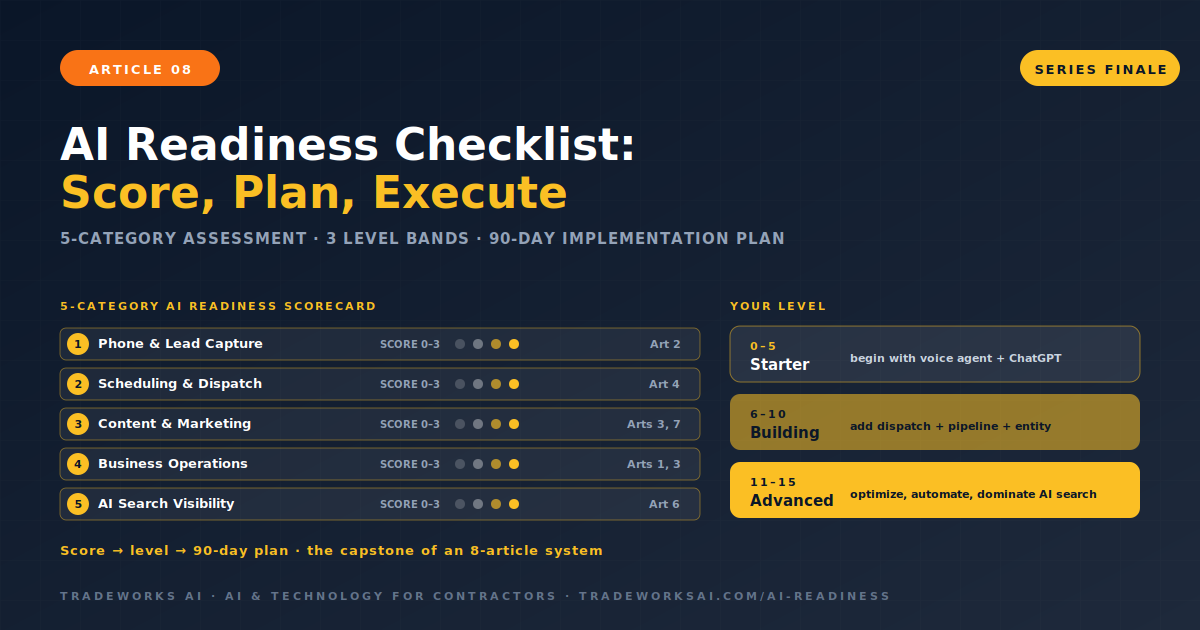
AI & Tech · Part 8
The Contractor’s AI Readiness Checklist: What to Adopt Now, What to Watch, and Your 90-Day Implementation Plan (Series Finale)
Continue the AI & Tech series with Part 8 of 8.
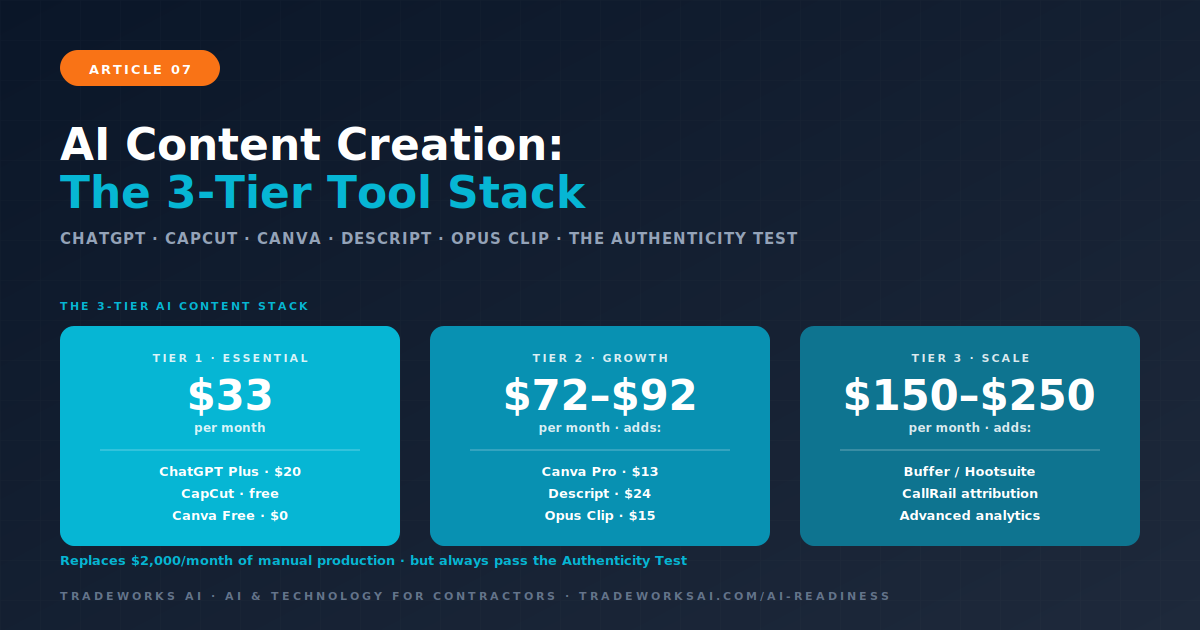
The AI content creation stack for contractors in 2026 has three tiers. The Essential Stack ($33/month): ChatGPT Plus ($20) for writing blog posts, emails, and social content; CapCut (free) for video editing and auto-captions; Canva Free for graphics and thumbnails. The Growth Stack ($70–$100/month): adds Canva Pro ($13), Descript ($24) for podcast and interview editing, and Opus Clip ($15) for automated short-form clip generation from long videos. The Scale Stack ($150–$250/month): adds scheduling tools, advanced analytics, and agency-grade production capabilities. AI content tools cut production time by 70–80% but require human oversight to pass the Authenticity Test: every piece of content must include at least one element only you could create—a real job photo, a local reference, a personal experience, or trade-specific expertise.
Contractors know they should be creating marketing content. Blog posts for SEO. Social media for awareness. Videos for trust. Email campaigns for retention. The problem is not knowledge—it is time. Creating a single blog post from scratch takes 2 to 4 hours. Filming, editing, and publishing a video takes 3 to 6 hours. Writing a week of social media posts takes 2 to 3 hours. Most contractor owners have zero of those hours available. AI content tools solve the production bottleneck by handling 70 to 80% of the creation work. The contractor provides the expertise, the authenticity, and the final review. AI handles the drafting, editing, formatting, and distribution preparation.
Three tools that cover the core content needs. ChatGPT Plus at $20 per month handles all written content: blog post drafts, email campaigns, social media captions, estimate descriptions, SOPs, and ad copy (the 10 uses from Article 3 in this series). CapCut (free tier) handles video editing: auto-captions that are critical for the 85% of social video watched without sound, basic trimming and effects, and export in platform-specific formats for Reels, Shorts, and TikTok. Canva Free handles visual design: thumbnails for YouTube videos, social media graphics, simple infographics, and branded templates. Total cost: $33 per month. This stack covers a solo contractor or small team producing 1 to 2 blog posts, 3 to 5 social posts, and 1 to 2 videos per week.
Adds three tools for contractors ready to scale content production. Canva Pro at $13 per month upgrades to brand kits, premium templates, background removal, and the full design library. Descript at $24 per month transforms video editing for interview and talking-head content: edit video by editing the transcript, remove filler words automatically, Studio Sound for professional audio cleanup. If you film testimonials (Article 4 in our Content series) or any dialogue-based content, Descript cuts editing time by 50% or more. Opus Clip at $15 per month automates short-form clip creation: upload a long YouTube video and Opus Clip identifies the 10 to 20 strongest moments, formats them as vertical clips with captions, and scores each clip by predicted engagement. This is the 1-to-10 repurposing system from our Content series (Category 9 Episode 7) automated. Total: $72 to $92 per month depending on plan tiers.
For contractors with dedicated marketing staff or agency support. Adds scheduling and analytics tools: Buffer or Hootsuite ($15–$50/month) for multi-platform scheduling, Google Analytics and Search Console (free but requires setup and monitoring time), and CallRail ($45–$145/month) for attribution tracking from content to phone calls. At this tier, the content production pipeline is fully operationalized: AI drafts, human reviews, design tools format, scheduling tools distribute, and analytics tools measure. The contractor or marketing coordinator reviews and approves content rather than creating it from scratch.
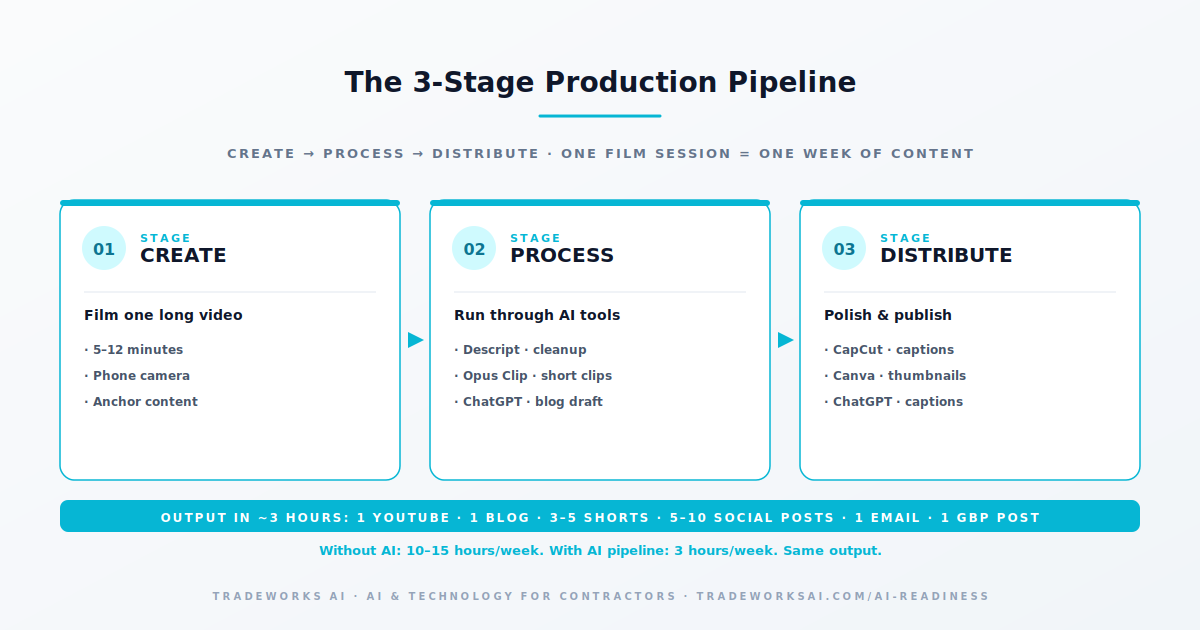
The most efficient content operations use AI tools in a three-stage pipeline. Stage 1 — Create: film one long-form video per week (5 to 12 minutes on your phone). This is the anchor content. Stage 2 — Process: run the video through Descript for editing and transcript cleanup. Feed the edited video to Opus Clip for short-form extraction. Use the transcript as the foundation for a ChatGPT-drafted blog post. Stage 3 — Distribute: CapCut polishes the short clips with platform-specific captions and formatting. Canva creates the thumbnail and social graphics. ChatGPT drafts the social captions, email segment, and GBP post. Total time beyond filming: approximately 2 hours per week using this pipeline. Output: 1 YouTube video, 1 blog post, 3 to 5 Shorts or Reels, 5 to 10 social posts, 1 email segment, and 1 GBP post. That is the Content Flywheel from Category 9 fully automated.
AI tools accelerate production but create a risk: content that sounds like everyone else. A dermatology practice invested $3,000 in AI-generated content—synthetic presenters, AI voiceover, automated editing—and saw patient inquiries drop 30%. The content was technically correct but emotionally empty. The Authenticity Test from our Content series (Category 9 Episode 8) applies to every piece of AI-assisted content. Three questions before publishing. Question 1: could a competitor create this exact content with the same AI prompt? If yes, add your specific expertise, local examples, and personal experience. Question 2: does this content include at least one element only you could create—a real job photo, a real customer name, a local neighborhood reference, a personal trade story? If no, add one. Question 3: would a customer watching or reading this content know it was created by a real contractor with real experience? If uncertain, the human element needs strengthening.
AI produces excellent drafts, edits, and formatting. It cannot produce the elements that make contractor content valuable: real job-site footage (the before-and-after photos, the diagnostic video, the installation time-lapse), real customer testimonials (the genuine voice of a satisfied homeowner), real expertise applied to local conditions (Florida humidity, coastal corrosion, limestone soil, hurricane prep), the contractor’s face and voice on camera (trust requires a human). These elements are your competitive advantage because they cannot be replicated by a competitor running the same AI tools. The contractor who uses AI for production efficiency while providing authentic human content wins both the speed game and the trust game.
The Essential Stack costs $33 per month: ChatGPT Plus ($20), CapCut (free), and Canva Free ($0). An additional $13 for Canva Pro is the highest-value upgrade. This covers writing, video editing, and design for a solo contractor.
AI can draft, edit, and format 70–80% of production work. The remaining 20–30%—real job photos, on-camera presence, local expertise, customer testimonials—must come from you. This human element is what makes your content authentic and trustworthy.
The 3-stage production pipeline (film, process, distribute) produces a full week of content in approximately 3 hours total: 1 hour filming and 2 hours processing with AI tools. Without AI, the same output would require 10 to 15 hours per week.
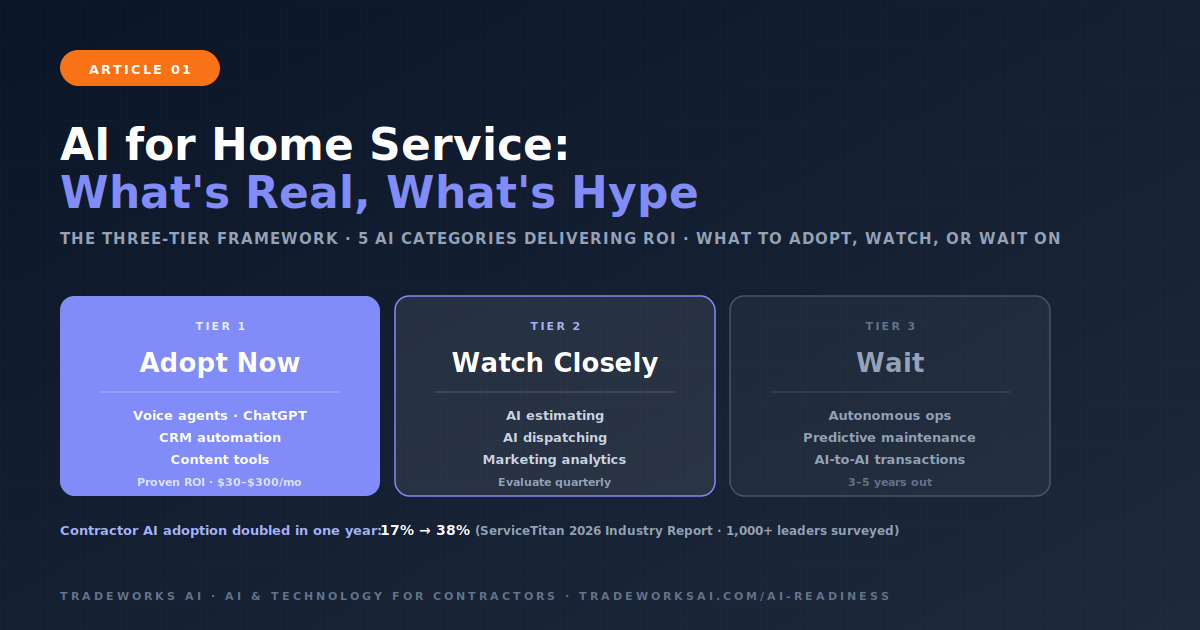
Adoption among contractors doubled in one year. The gap between businesses using AI and those still resisting is widening every quarter. The AI Readiness Audit grades your business across 5 categories, identifies the highest-leverage tools to adopt now, and gives you a stage-matched 90-day plan.
Continue the AI & Tech series with Part 8 of 8.
Continue the AI & Tech series with Part 1 of 8.