AI & Tech · Part 5
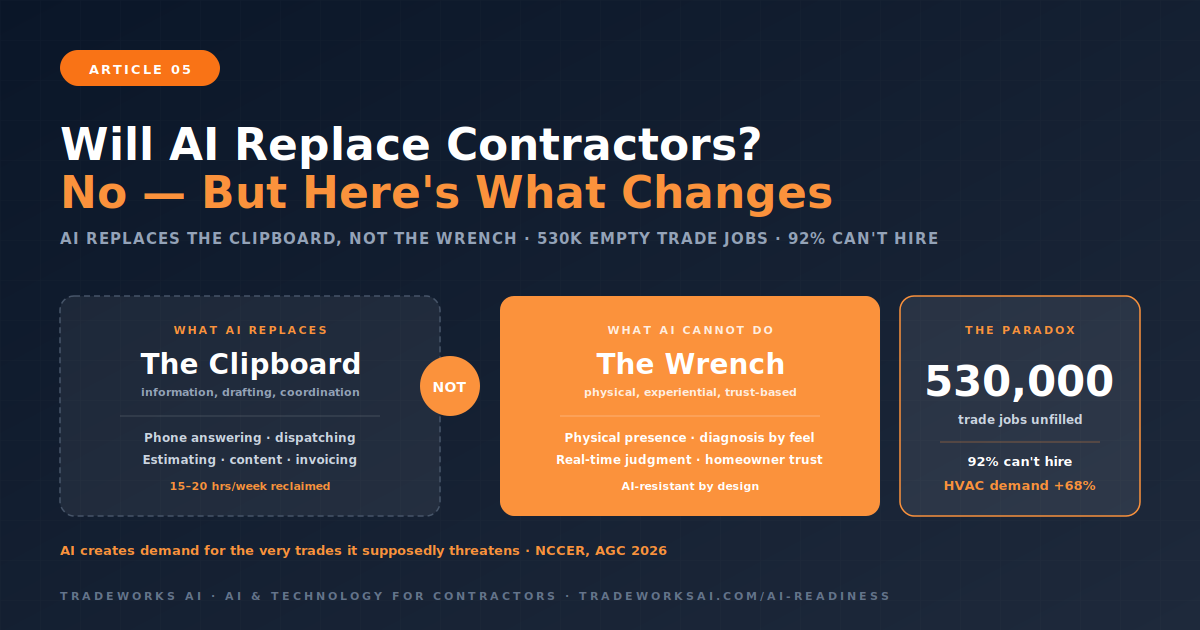
Will AI Replace Contractors? No — But Here’s What It WILL Change
Continue the AI & Tech series with Part 5 of 8.
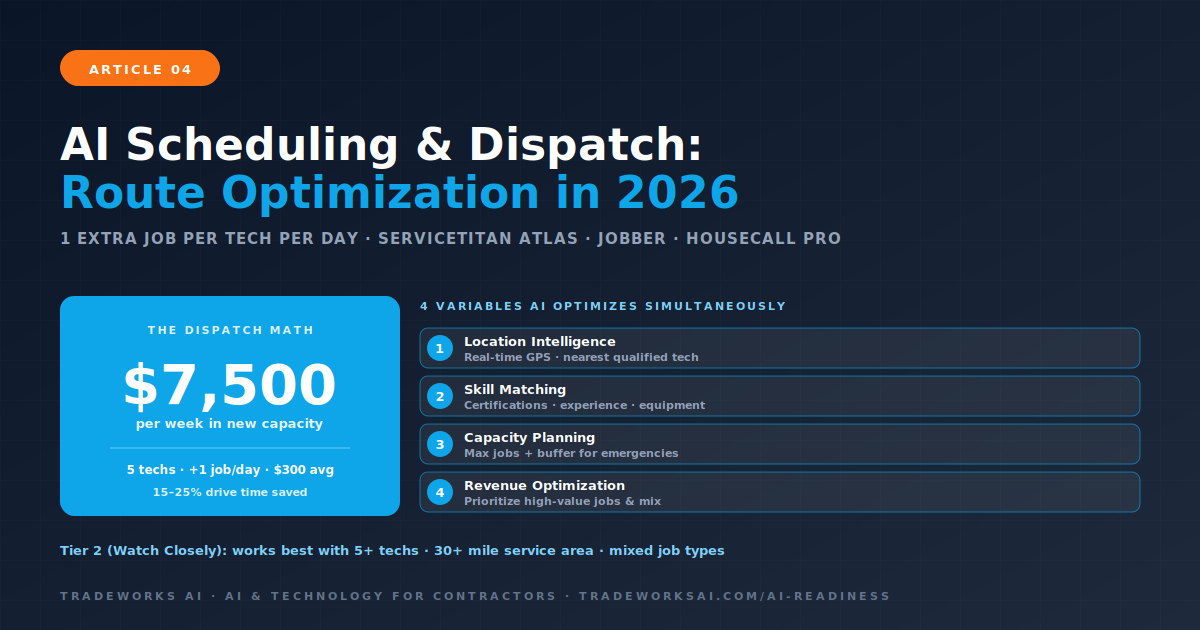
AI-powered scheduling and dispatch for contractors uses machine learning to optimize technician assignments based on location, skill set, job type, traffic patterns, and availability. The primary benefit is route optimization that reduces drive time by 15–25% and enables 1–2 additional jobs per technician per day. For a 5-technician team averaging $300 per job, that represents $1,500–$3,000 in additional daily capacity. The leading platforms are ServiceTitan with Atlas (deepest AI integration, capacity planning, map-based optimization), Jobber (route optimization for small to mid-size teams), and Housecall Pro (real-time GPS tracking, simple drag-and-drop dispatch). AI dispatching is classified as Tier 2 (Watch Closely) in the Three-Tier Framework from Article 1: the technology is real and available in major FSM platforms, but the impact varies by team size, service area, and job mix.
A busy contractor dispatcher handles 30 to 50 calls per day during peak season. Each call requires 3 to 5 minutes of phone time plus 2 to 3 minutes of data entry—150 to 400 minutes per day just on phone work. Add technician coordination, route adjustments, customer callbacks, and rescheduling, and the dispatcher has zero time for actual dispatch strategy: analyzing which technician should take which job based on location, skill, drive time, and revenue opportunity. AI dispatch separates the phone function from the optimization function. The AI answering service from Article 2 handles the inbound calls. The AI dispatch engine handles the routing intelligence. The human dispatcher manages exceptions and customer relationships—the work that requires judgment.
AI dispatch systems analyze four variables simultaneously to optimize job assignments. Location intelligence: the AI knows where every technician is in real time (GPS), calculates drive time to the next potential job, and routes the nearest qualified technician. Skill matching: certain jobs require specific certifications, experience levels, or equipment. AI matches the job requirements to the technician’s profile automatically. Capacity planning: AI balances the day’s schedule to maximize completed jobs while maintaining buffer time for emergency calls. Revenue optimization: some systems can prioritize higher-revenue jobs or balance the mix of maintenance and emergency work across the team.
The math is straightforward. Reducing drive time by 15–25% through optimized routing means each technician spends more time on billable work. If a technician averages 4 jobs per day and optimization adds 1 additional job, that is a 25% increase in daily capacity per technician without additional labor cost. For a 5-person team at $300 average job value, one extra job per technician per day adds $1,500 per day, or $7,500 per week, or approximately $30,000 per month in additional capacity. Not all of that capacity converts to billed work—some slots fill with lower-value jobs or remain empty—but even realizing 50% of the additional capacity adds $15,000 per month in revenue potential.
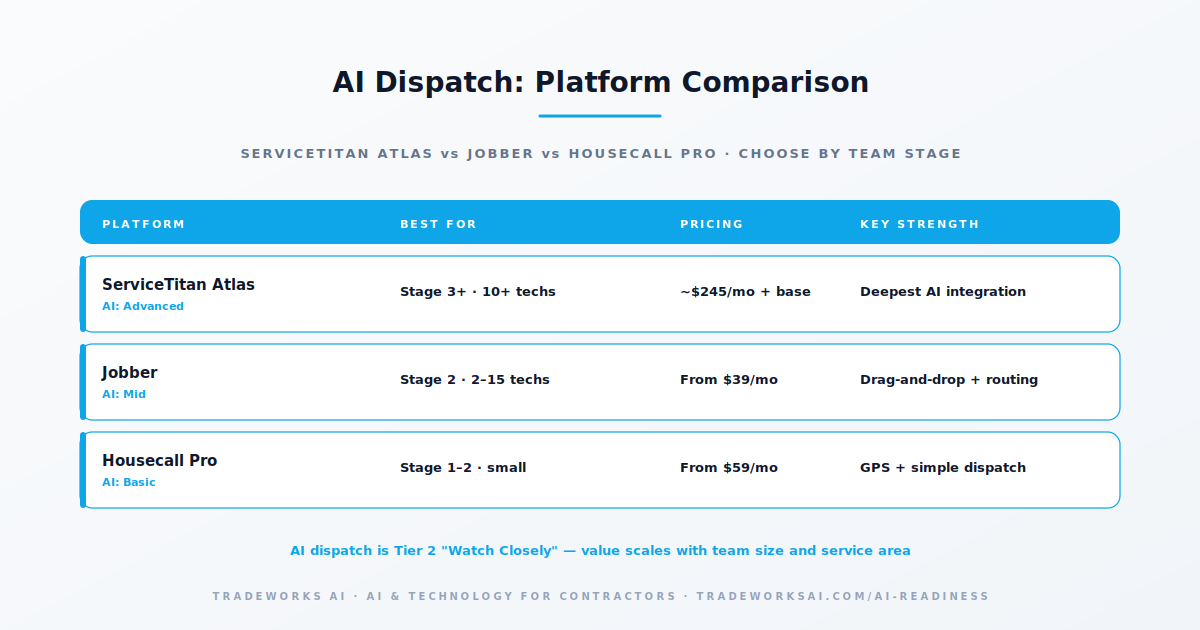
The deepest AI dispatch integration in the contractor space. Atlas is ServiceTitan’s AI platform that embeds intelligence across dispatching, invoicing, job costing, and technician performance. For dispatch specifically, Atlas provides configurable multi-view schedule boards, map-based route optimization that shows technician locations and drive times visually, capacity planning rules that optimize the schedule to maximize revenue, and technician progress tracking that updates job status in real time. The advantage is vertical depth—Atlas was built specifically for HVAC, plumbing, and electrical workflows. The limitation is cost and complexity: ServiceTitan starts at approximately $245 per month and requires significant onboarding time. Best for: Stage 3+ contractors with 10 or more technicians.
Jobber offers route optimization specifically designed for small to mid-size teams. The AI calculates the most efficient route across the day’s jobs, reducing drive time and fuel costs. The drag-and-drop calendar makes rescheduling fast, and the mobile app provides technicians with GPS navigation to each job. Jobber’s AI-enhanced routing is simpler than ServiceTitan’s but covers the core optimization need for teams of 2 to 15 technicians. Pricing starts at approximately $39 per month for basic plans with route optimization available in higher tiers. Best for: Stage 2 contractors and small teams.
Housecall Pro focuses on real-time GPS tracking and simple dispatch rather than AI-powered route optimization. The drag-and-drop calendar is intuitive, and dispatchers can see where technicians are and assign the nearest available team member. However, the platform lacks AI-powered skill-based matching and automated route optimization—dispatchers handle every assignment decision manually. As team size grows beyond 8 to 10 technicians, this manual approach creates a bottleneck. Housecall Pro’s AI investments are focused more on the customer-facing side (CSR AI assistant, automated booking) than on dispatch intelligence. Pricing starts at approximately $59 per month. Best for: Stage 1–2 contractors who need simple, reliable dispatch.
AI dispatch optimization delivers the most value when three conditions are met: your team has 5 or more technicians (below this, manual dispatching is manageable), your service area spans 30 or more miles (shorter areas reduce the drive-time savings), and your job mix includes both scheduled and emergency work (the real-time optimization handles competing priorities). If you are a 2-person team working a 10-mile radius doing only scheduled maintenance, AI dispatch will not meaningfully change your operations. The investment in learning and configuring the platform outweighs the optimization gain. This is why AI dispatching sits in Tier 2 (Watch Closely) of the Three-Tier Framework rather than Tier 1 (Adopt Now)—the ROI is conditional on team size and complexity.
AI dispatch does not eliminate the dispatcher. It transforms the role from phone-answerer and job-assigner into schedule strategist and exception manager. The AI handles the routine: nearest qualified technician, optimized route, standard job assignment. The human handles the exceptions: angry customer who needs a specific technician, emergency that requires rescheduling three jobs, VIP commercial client who needs priority treatment, or a complex multi-day project that requires coordination. The best dispatch operations in 2026 are hybrid: AI handles 70–80% of routine assignments, the dispatcher handles 20–30% of exceptions and strategy. This hybrid model is more effective than either fully manual or fully automated dispatch.
Teams of 5 or more technicians see meaningful benefits. Below 5 technicians, manual dispatching is typically sufficient and the configuration investment may not be justified. Route optimization tools in Jobber can benefit even 2–3 person teams for reducing drive time.
Route optimization typically reduces drive time by 15–25%, translating to proportional fuel savings. For a 5-truck fleet driving 100 miles per day per truck at $4 per gallon fuel costs, a 20% reduction saves approximately $200–$400 per month in fuel alone.
Yes. AI dispatch systems can prioritize emergency calls, identify the nearest available technician with the required skills, and automatically rearrange the remaining schedule to accommodate the disruption. The best systems recalculate the entire day’s routing in seconds when an emergency is inserted.
Adoption among contractors doubled in one year. The gap between businesses using AI and those still resisting is widening every quarter. The AI Readiness Audit grades your business across 5 categories, identifies the highest-leverage tools to adopt now, and gives you a stage-matched 90-day plan.
Continue the AI & Tech series with Part 5 of 8.
Continue the AI & Tech series with Part 6 of 8.