AI & Tech · Part 1
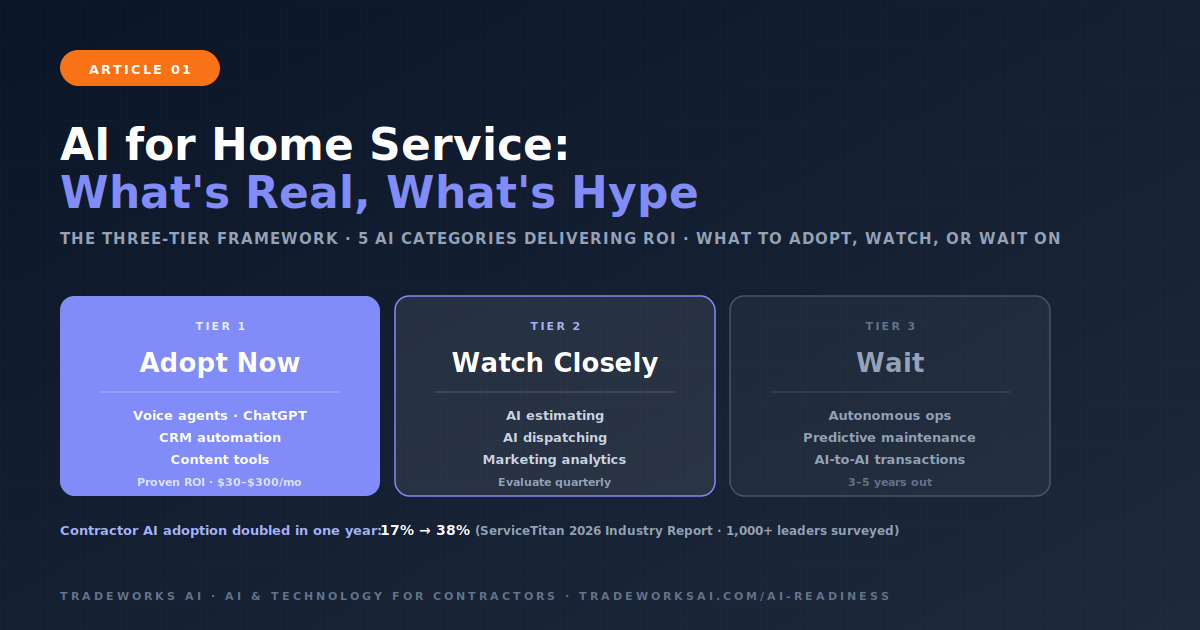
AI for Home Service Businesses: What’s Real and What’s Hype in 2026
Continue the AI & Tech series with Part 1 of 8.
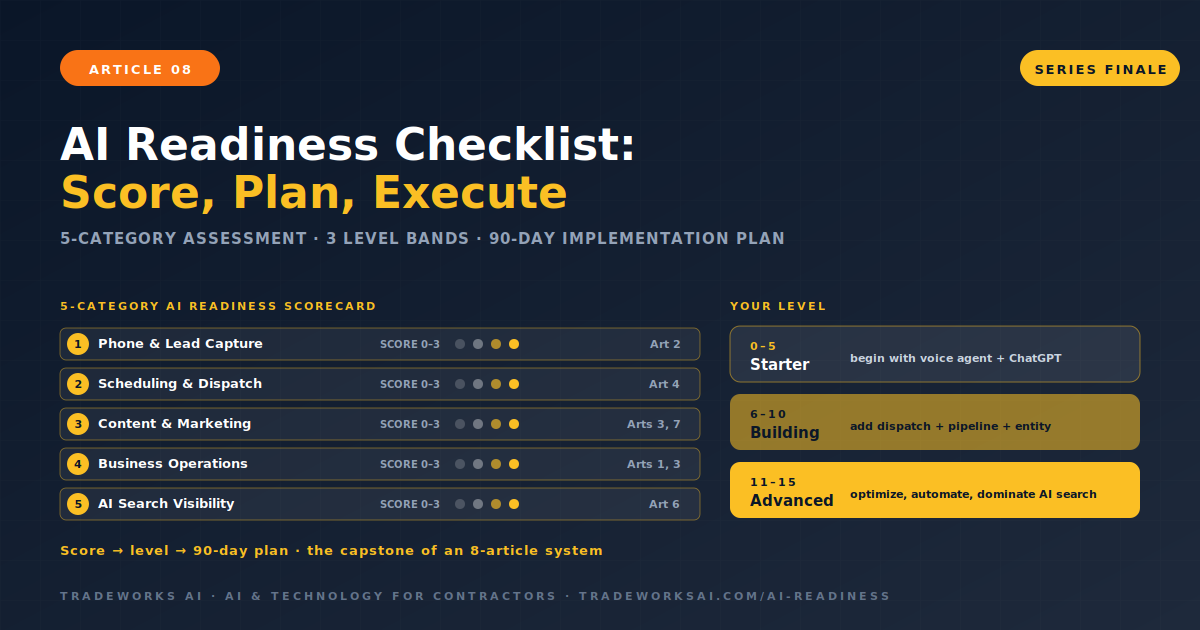
The Contractor’s AI Readiness Checklist evaluates your business across five categories: phone answering and lead capture, scheduling and dispatch, content and marketing, business operations, and AI search visibility. Each category is scored as Not Started (0), Exploring (1), Implemented (2), or Optimized (3), for a maximum score of 15. Stage-matched recommendations: Score 0–5 (Starter) — begin with an AI voice agent and ChatGPT. Score 6–10 (Building) — add AI dispatching, content pipeline, and entity optimization. Score 11–15 (Advanced) — optimize existing AI tools, automate workflows end-to-end, and build AI search dominance. The 90-Day Implementation Plan: Month 1 deploy the highest-ROI tool (voice agent), Month 2 build the content pipeline, Month 3 optimize AI search visibility and measure results.
This is the final article in the AI & Technology for Contractors series. Over the previous seven articles, we covered the landscape (Article 1: what’s real and what’s hype), the highest-ROI tool (Article 2: AI answering services), the most versatile tool (Article 3: ChatGPT for contractors), the operations optimizer (Article 4: AI scheduling and dispatch), the mindset reset (Article 5: AI won’t replace contractors but will change the business), the visibility frontier (Article 6: GEO and AEO for AI search), and the production accelerator (Article 7: AI content creation tools). This final article synthesizes everything into one assessment and one plan. Where does your business stand today? And what should you do in the next 90 days?
Score your business in each category. Not Started (0): you have not explored or implemented any AI tools in this area. Exploring (1): you have researched tools or experimented briefly but have no consistent implementation. Implemented (2): you have an AI tool actively running in this category. Optimized (3): the AI tool is integrated into your workflows, measured for ROI, and producing documented results.
Do you have an AI voice agent answering calls when you cannot? Is it answering after hours, during busy periods, and routing emergencies? Is it integrated with your CRM or FSM? Are you tracking recovered leads and measuring ROI? Reference: Article 2 (AI Answering Services). Scoring: 0 = voicemail only. 1 = researching Rosie, Goodcall, or ServiceTitan Phones Pro. 2 = AI voice agent active and answering calls. 3 = integrated with FSM, tracking recovery rate, and measuring monthly ROI.
Does your FSM use AI-powered route optimization? Are technician assignments optimized by location, skill, and availability? Is your dispatcher a strategist managing exceptions or a phone jockey handling every assignment manually? Reference: Article 4 (AI-Powered Scheduling and Dispatch). Scoring: 0 = fully manual dispatch. 1 = using FSM scheduling but no AI optimization. 2 = AI route optimization active. 3 = AI dispatch integrated with skill matching, capacity planning, and measurable drive-time reduction.
Are you using ChatGPT or similar tools for content drafting? Do you have a video editing pipeline using AI tools (CapCut, Descript, Opus Clip)? Is your content production following the 3-stage pipeline (film, process, distribute)? Reference: Articles 3 and 7 (ChatGPT for Contractors, AI Content Creation Tools). Scoring: 0 = no AI content tools used. 1 = occasional ChatGPT use for one-off tasks. 2 = consistent AI-assisted content production with a defined pipeline. 3 = full 3-stage pipeline producing a week of content in 3 hours with Authenticity Test applied.
Are your CRM automations AI-optimized (review requests, follow-up sequences, maintenance plan enrollment)? Are you using AI for estimates, SOPs, employee training materials, or financial reporting? Reference: Articles 1 and 3 (AI Overview, ChatGPT practical uses). Scoring: 0 = no AI in operations. 1 = occasional ChatGPT use for writing tasks. 2 = AI-optimized CRM automations running consistently. 3 = AI embedded across operations: automated review requests, AI-drafted estimates, documented SOPs, and optimized workflows.
Have you run the Share of Model Audit? Are your service pages written with AEO opening paragraphs? Is your business entity standardized across all platforms? Are you publishing on AI source platforms weekly? Reference: Article 6 (GEO and AEO for Contractors). Scoring: 0 = no AI search optimization. 1 = aware of GEO/AEO but no action taken. 2 = AEO paragraphs on service pages, entity audit completed, publishing consistently. 3 = Share of Model score above 15%, all 5 actions from Article 6 implemented, quarterly audit tracking improvement.
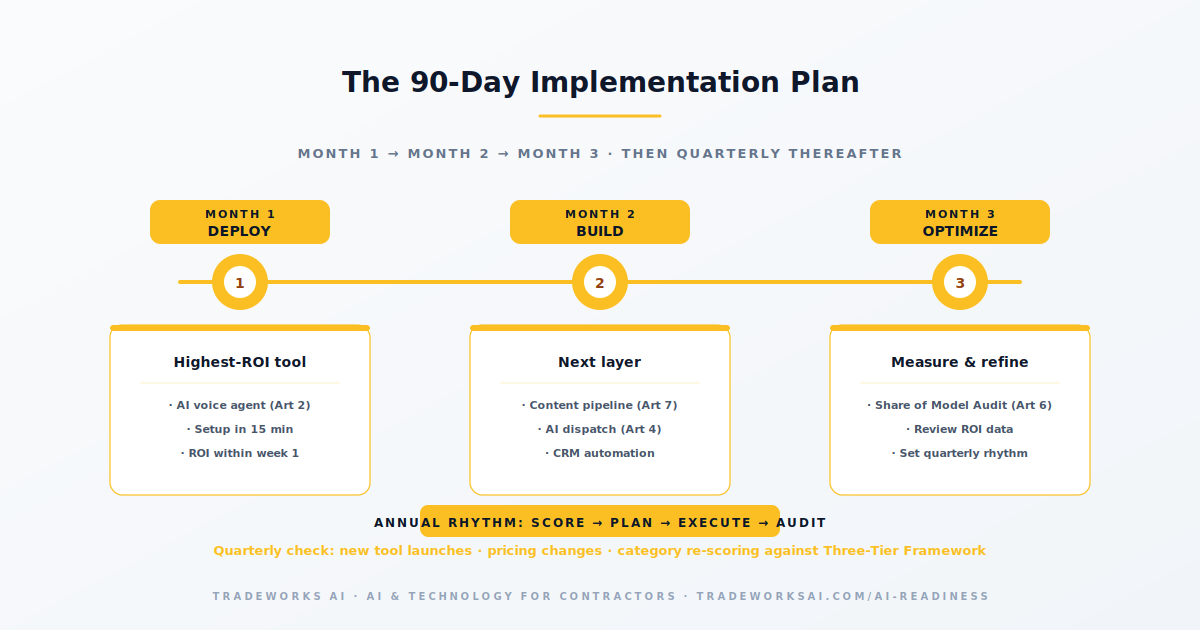
Regardless of your starting score, the 90-day plan follows the same structure. Month 1: deploy your highest-ROI tool. For most contractors, this is an AI voice agent (Article 2). Setup takes 15 minutes. ROI is measurable within the first week through recovered leads. If you already have a voice agent, Month 1 is your content pipeline setup (Article 7). Month 2: build the next layer. If Month 1 was voice, Month 2 is content (ChatGPT plus the 3-stage pipeline). If Month 1 was content, Month 2 is AI dispatch evaluation or CRM automation optimization. Month 3: measure and optimize. Run the Share of Model Audit (Article 6). Review Month 1 and Month 2 ROI data. Adjust tools and workflows based on results. Set the annual review rhythm: quarterly AI audits aligned with your Stack Audit from the Contractor Stack series.
AI tools evolve rapidly. The Three-Tier Framework from Article 1 should be re-evaluated quarterly. Tools in Tier 2 (Watch Closely) in January may move to Tier 1 (Adopt Now) by July. New tools launch monthly. The annual AI review: January, run the full 5-category assessment. Score your business. Compare to last year. Identify the category with the lowest score and prioritize it for Q1. Quarterly, check for new tool launches, pricing changes, and platform updates in your active categories. This rhythm prevents both over-adoption (chasing every new tool) and under-adoption (falling behind while competitors accelerate).
Take the 5-category AI Readiness Assessment. Score each category (phone, dispatch, content, operations, AI search) from 0 to 3. Your total score determines your level (Starter, Building, or Advanced) and your priority actions for the next 90 days.
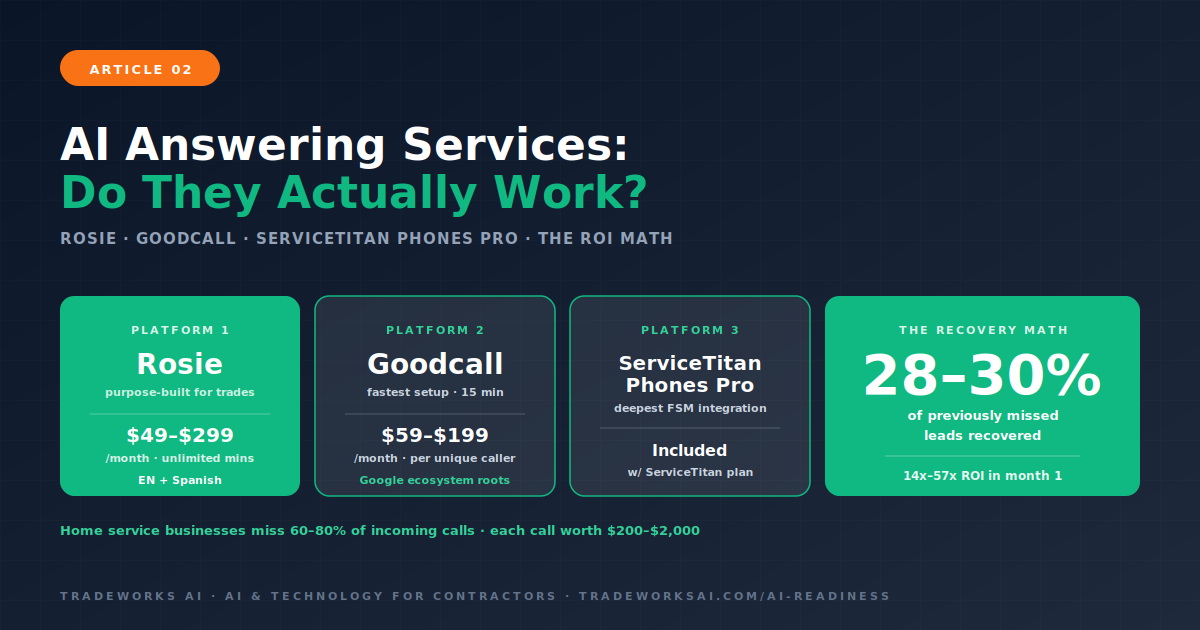
An AI voice agent that answers phone calls 24/7. Home service businesses miss 60–80% of incoming calls. An AI voice agent at $49–$199/month recovers 28–30% of lost leads—producing the fastest, most measurable ROI of any AI investment.
The Essential AI stack (voice agent + ChatGPT + CapCut + Canva) costs approximately $80–$180 per month. The Growth stack adds Descript, Opus Clip, and Canva Pro for $150–$300 per month total. ROI typically exceeds total cost within the first month through recovered leads and production time savings.
Adoption among contractors doubled in one year. The gap between businesses using AI and those still resisting is widening every quarter. The AI Readiness Audit grades your business across 5 categories, identifies the highest-leverage tools to adopt now, and gives you a stage-matched 90-day plan.
Continue the AI & Tech series with Part 1 of 8.
Continue the AI & Tech series with Part 2 of 8.