AI & Tech · Part 6
GEO and AEO for Contractors: How to Show Up When Homeowners Ask AI Who to Hire
Continue the AI & Tech series with Part 6 of 8.
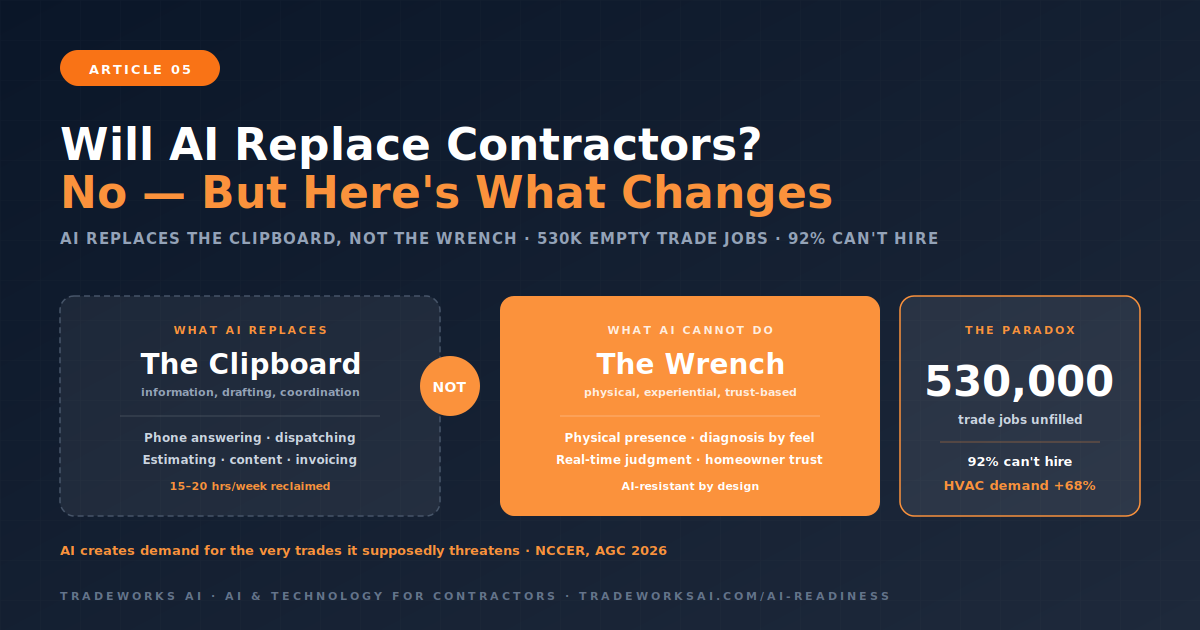
AI will not replace contractors. Skilled trades are among the most AI-resistant careers because they require physical presence, manual dexterity, real-time judgment in unpredictable environments, and trust-based customer relationships. The data confirms this: 530,000 skilled trade jobs sit empty across the United States, 92% of construction firms struggle to hire, and demand for HVAC engineers grew 68% between 2022 and 2026. What AI WILL change is the back office: dispatching, scheduling, phone answering, invoicing, content creation, estimating, and administrative work that currently consumes 15 to 20 hours per week. The contractor who uses AI for the business side while staying human on the trade side will outperform the contractor doing everything manually. AI does not replace the technician. It replaces the paperwork.
No. And it is not close. AI replaces tasks involving information processing, text generation, data analysis, and predictable decision trees. Skilled trade work involves crawling into attics, diagnosing systems by sound and smell, adapting to unique building configurations, working in weather, handling emergencies under pressure, and earning the trust of homeowners letting a stranger into their home. A homeowner with a burst pipe at 2 AM needs a human being with a wrench, not a chatbot with a recommendation.
While AI threatens knowledge work, the trades face the opposite problem: not enough workers. Approximately 530,000 skilled trade jobs sit empty nationwide. NCCER and AGC reported that 92% of construction firms struggle to hire, with 45% saying shortages cause project delays. HVAC engineer demand grew 68% between 2022 and 2026. Industrial automation technician vacancies grew 51%. General trades grew by 30%, far outpacing the overall job market. The National Association of Manufacturers projects a 1.9 million worker shortfall by 2033. The AI boom requires massive physical infrastructure—data centers, power grids, cooling systems—all built and maintained by skilled tradespeople.
Four characteristics make trades AI-resistant. Physical presence: the technician must be at the job site. Unpredictable environments: every house is different, every repair has variables discovered on site. Experience-based judgment: diagnosing a compressor by sound, vibration, temperature, and smell developed over thousands of service calls. Trust and human connection: homeowners choose contractors based on trust that AI cannot replicate.
AI is coming for the clipboard, not the wrench. Phone answering: AI voice agents recovering 28–30% of missed leads. Dispatching: AI optimizing routes adding 1–2 jobs per tech per day. Estimating: AI generating proposals in minutes. Content creation: ChatGPT cutting production time 50–80%. Invoicing: AI-triggered automations. Administrative work: scheduling, payroll prep, data entry. The impact is role transformation, not elimination. The contractor owner reclaims 7–10 hours per week. The dispatcher becomes a strategist. The coordinator manages AI systems.
AI is making skilled trades more valuable. As AI automates knowledge work, displaced white-collar workers cannot easily transition into trades requiring years of apprenticeship and licensing. Supply shrinks while demand grows. HVAC wages increased 10–15% in four years. Data center electricians earn $85,000 to $280,000+. AI creates demand for the trades it supposedly threatens.
Three actions: adopt Tier 1 AI tools to reclaim 7–10 hours/week, invest reclaimed time in revenue or sellability, and use AI tools as a hiring advantage for younger technicians who want modern workplaces. The contractor combining trade expertise with AI-powered operations builds a more efficient, profitable, and sellable business.
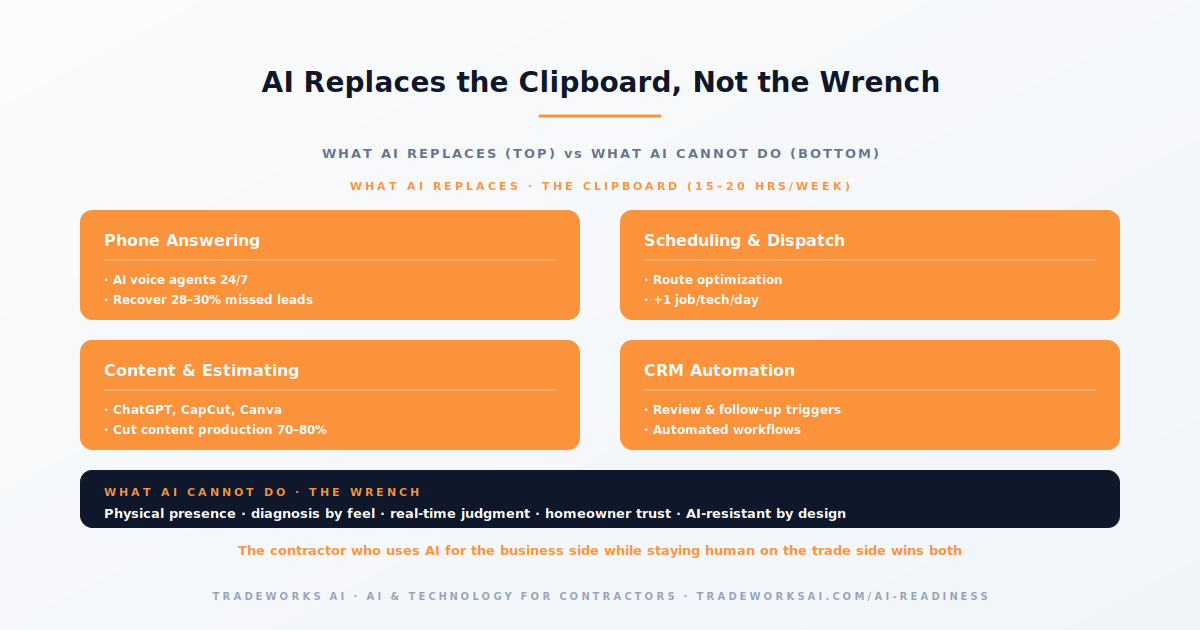
Skilled trades are among the most AI-resistant careers: physical presence, manual dexterity, real-time judgment, and trust-based relationships. AI automates information tasks, not physical work in unpredictable environments.
AI transforms contractor office roles into AI system management, exception handling, and strategic coordination. The 70/30 hybrid model is the emerging standard.
Approximately 530,000 skilled trade jobs sit empty. 92% of construction firms report difficulty hiring. The shortage is projected to worsen as 40% of the current workforce approaches retirement.
Yes. AI infrastructure requires massive physical construction. HVAC engineer demand grew 68% from 2022 to 2026, and data center technicians earn $85K–$280K+.
Adoption among contractors doubled in one year. The gap between businesses using AI and those still resisting is widening every quarter. The AI Readiness Audit grades your business across 5 categories, identifies the highest-leverage tools to adopt now, and gives you a stage-matched 90-day plan.
Continue the AI & Tech series with Part 6 of 8.
Continue the AI & Tech series with Part 7 of 8.