SMS Marketing · Part 2
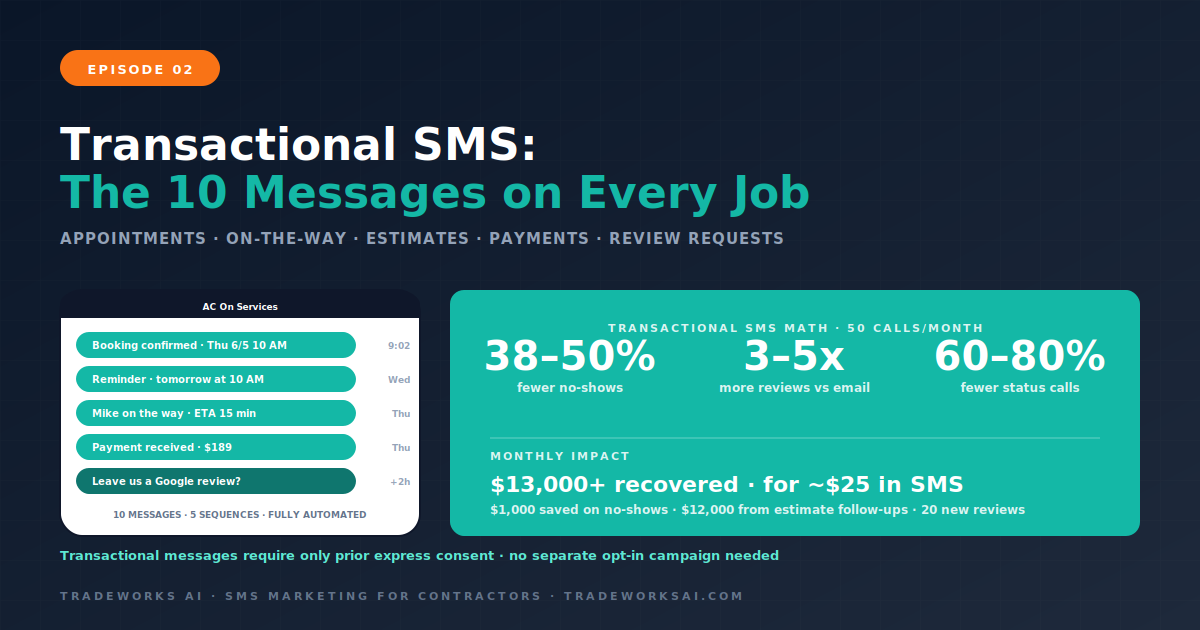
Transactional SMS for Contractors: The 5 Sequences That Improve Every Job
Continue the SMS Marketing series with Part 2 of 4.
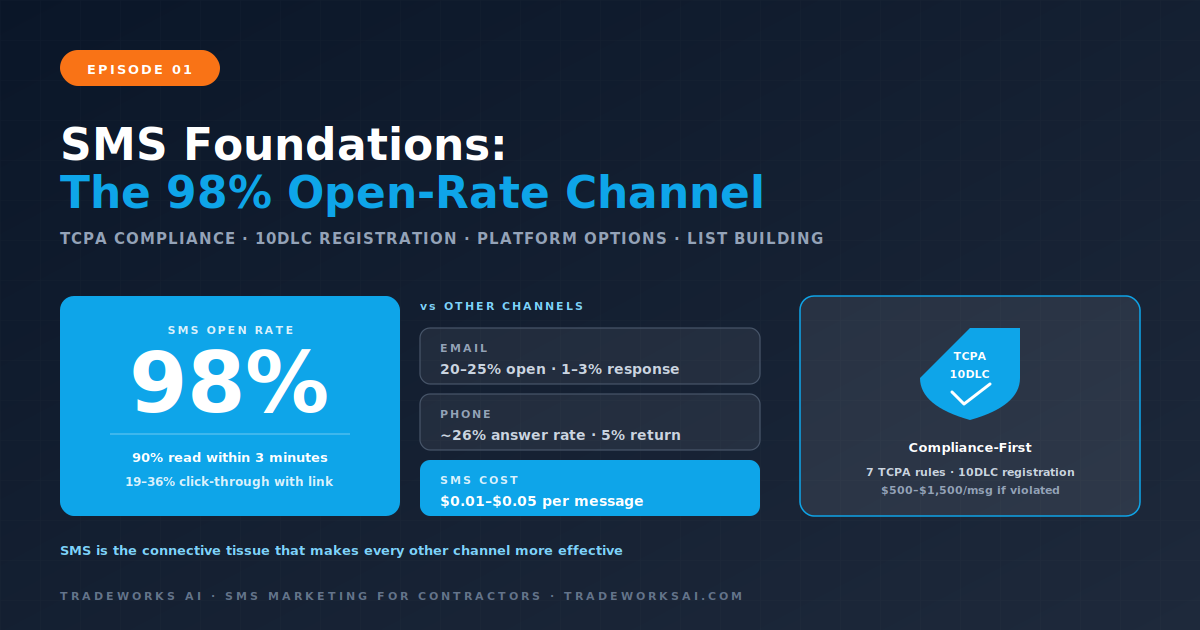
SMS marketing delivers a 98 percent open rate—compared to 20 to 25 percent for email—and 90 percent of text messages are read within three minutes of delivery. For home service contractors who depend on fast communication, appointment confirmations, and timely follow-ups, no other marketing channel matches the speed and visibility of text messaging. A text review request outperforms an email review request by three to five times. An appointment confirmation text reduces no-shows by 30 to 50 percent. A seasonal promotion sent by text reaches nearly every customer on your list within minutes, not hours or days.
This is the first episode of the SMS Marketing for Contractors series—a four-episode mini-series covering everything a home service business needs to launch, automate, and scale text message marketing. This episode covers the business case for SMS, the compliance requirements that are non-negotiable, the platform options built for contractors, and how to build your subscriber list from the customers you already have. Compliance is covered first and referenced throughout because TCPA violations carry fines of $500 to $1,500 per message—and that is not a risk any contractor can afford to ignore.
Home service contractors operate in a communication environment where speed, reliability, and visibility determine whether a lead becomes a customer and whether a customer becomes a repeat client. SMS excels at all three.
For contractors specifically, the math is compelling. Twenty-six percent of contractor calls go unanswered—a stat from the Marketing Playbook that continues to hold. A missed call is often a lost lead. But a text message sits in the customer’s inbox until they read it. It does not go to voicemail. It does not get buried in a spam folder. It arrives in the same app they use to text their family and friends, which is why open rates are near-universal.
Appointment confirmations and reminders — reduce no-shows by 30–50%
Review requests — text-based requests outperform email by 3–5x
Estimate follow-ups — “Hi [name], following up on your AC estimate. Any questions?”
Seasonal promotions — “Spring tune-up: $49. Book by Friday: [link]”
Maintenance plan reminders — “Your annual AC tune-up is due. Schedule here: [link]”
These five use cases cover the entire customer lifecycle: lead follow-up, service delivery, post-service review, ongoing retention, and seasonal reactivation. SMS is not a replacement for email, phone, or social media—it is the connective tissue that makes every other channel more effective.
Before you send a single text message, you must understand TCPA compliance. The Telephone Consumer Protection Act is a federal law that governs all commercial text messages in the United States. Violations carry statutory damages of $500 per unsolicited message, increasing to $1,500 for willful violations. Class-action TCPA lawsuits against businesses—including small businesses—are common. This is not optional. This is not a technicality. This is the legal foundation on which every SMS strategy must be built.
TCPA distinguishes between two message types with different consent requirements:
The critical distinction: a customer who gives you their phone number when booking a service has implicitly consented to transactional texts (appointment confirmations, service updates). They have NOT consented to marketing texts (promotions, offers) unless they explicitly opt in through a separate disclosure. Keep your consent collection clear about which type of messages they are agreeing to receive.
As of 2025, all major U.S. carriers (AT&T, Verizon, T-Mobile) block 100 percent of unregistered business text messages. If you send SMS from a business phone number without 10DLC registration, your messages will not be delivered. Period.
10DLC stands for “10-Digit Long Code”—it is the carrier registration system for business-to-consumer text messaging in the United States. Registration tells carriers that your business is legitimate and that your messages are compliant. Without it, carriers treat your messages as spam and block them.
Choose an SMS platform (see next section)—they handle the registration process
Submit your business information: legal name, EIN, address, website, industry
Describe your messaging use case: appointment reminders, review requests, marketing
Provide sample messages for each use case
Wait for approval (typically 1–3 weeks depending on platform and carrier)
Once approved, your messages are delivered through a verified, trusted channel
Most SMS platforms built for small businesses guide you through this process step by step. Budget one to three weeks for approval before planning any launch campaigns. Do not wait until you need to send a campaign to register—start now.
Contractors need an SMS platform that integrates with their existing workflow—ideally their CRM, field service software, or all-in-one marketing platform. Here are the primary options in 2026.
You do not need to buy a list or start from zero. Every contractor already has a database of customer phone numbers. The challenge is converting those existing numbers into compliant SMS subscribers.
Service booking form: Add an SMS opt-in checkbox to your online booking and estimate request forms. “Text me appointment updates and exclusive offers.” This captures consent at the moment of highest intent.
Technician at the door: Train technicians to ask during service visits: “Would you like to receive appointment reminders and seasonal specials by text?” Use a tablet or phone to capture written consent on the spot.
Review request bridge: When you send a review request (by text or email), include an opt-in for future promotional texts. “Thanks for your review! Want to be the first to hear about our seasonal specials? Reply YES to opt in.”
Website pop-up or banner: “Get $25 off your next service. Text JOIN to (813) 555-0199.” Keyword opt-ins are TCPA-compliant because the customer initiates the conversation.
Invoice and receipt: Add an SMS opt-in line to your digital invoices and payment confirmations. Customers who just had a positive service experience are the most likely to opt in.
Most contractors can build an SMS list of 200 to 500 subscribers within 90 days by implementing all five methods simultaneously. For a contractor with 50 to 100 service calls per month, each call is an opt-in opportunity. At a 30 to 40 percent opt-in rate from service visits alone, that is 15 to 40 new subscribers per month.
The quality advantage of this approach: every subscriber is an existing or recent customer. They already know your business, trust your work, and are likely to need service again. This is not cold outreach—this is permission-based communication with your warmest audience.
Effective contractor SMS messages follow a consistent structure that maximizes readability and action within 160 characters (one SMS segment).
Lead with your business name (required by TCPA and builds instant recognition)
Keep messages under 160 characters when possible (one SMS segment = lowest cost)
Include one clear CTA per message (book, confirm, review, call)
Use the customer’s first name when your platform supports personalization
Include opt-out instructions in the first message of any new campaign or sequence
Never use ALL CAPS for the entire message (reads as spam)
Avoid public URL shorteners like bit.ly (carriers flag them as spam). Use your platform’s built-in link tracking or your own branded short domain.
Send during business hours only: 9 AM to 8 PM in the recipient’s time zone
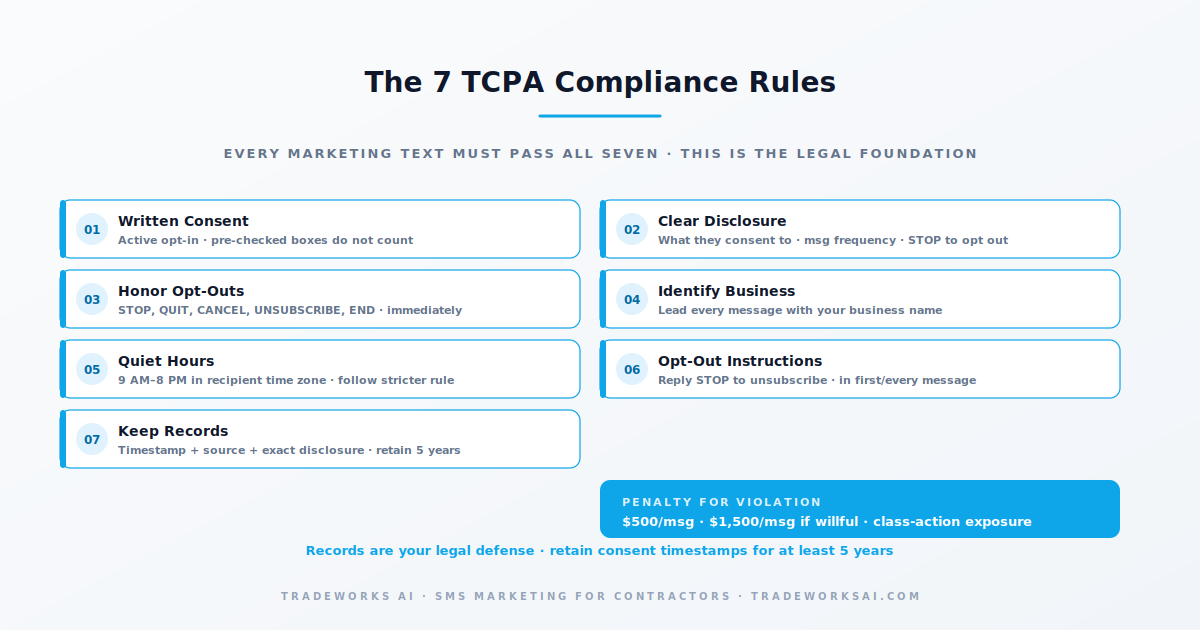
Yes, when done compliantly. The TCPA requires explicit written consent before sending marketing texts, clear opt-out instructions in every campaign, and respect for quiet hours. Transactional messages (appointment confirmations, service updates) require a lower standard of consent—the customer providing their number in a service context qualifies. Marketing messages (promotions, offers) require prior express written consent. Follow the seven-rule compliance checklist in this guide and consult legal counsel for your specific situation.
Per-message costs range from $0.008 to $0.05 depending on platform and volume. Most contractors with 200 to 500 subscribers sending four to six messages per month spend $50 to $150 per month on SMS plus platform subscription fees. Compare this to the value of one additional booked job from a seasonal promotion text—the ROI is typically immediate.
10DLC (10-Digit Long Code) is the carrier registration system for business text messaging. Yes, it is mandatory. As of 2025, all major carriers block unregistered business texts. Your SMS platform handles the registration process, but you must submit business information and sample messages. Allow one to three weeks for approval before launching any campaigns.
Start with existing customers. Add SMS opt-in checkboxes to booking forms, train technicians to collect consent during service visits, include opt-in prompts on review requests, add keyword opt-ins to your website, and include opt-in lines on digital invoices. Most contractors build 200 to 500 compliant subscribers within 90 days using these five methods. Every subscriber is a past or current customer—your warmest audience.
Four to six messages per month is the optimal range for most contractor SMS programs. Research shows 49 percent of subscribers are comfortable receiving at least one text per week, but 53 percent will unsubscribe if they feel bombarded. The key is relevance: appointment confirmations, review requests, and seasonal promotions each serve a specific purpose. Never send a text without a clear reason the customer would find valuable.
98% of texts get read in 3 minutes. 26% of contractor calls go unanswered. The SMS Audit grades your text-message infrastructure: TCPA compliance, 10DLC registration, automation workflows, and the platform fit for your trade. Find the highest-leverage SMS sequence that fills your schedule next month.
Continue the SMS Marketing series with Part 2 of 4.
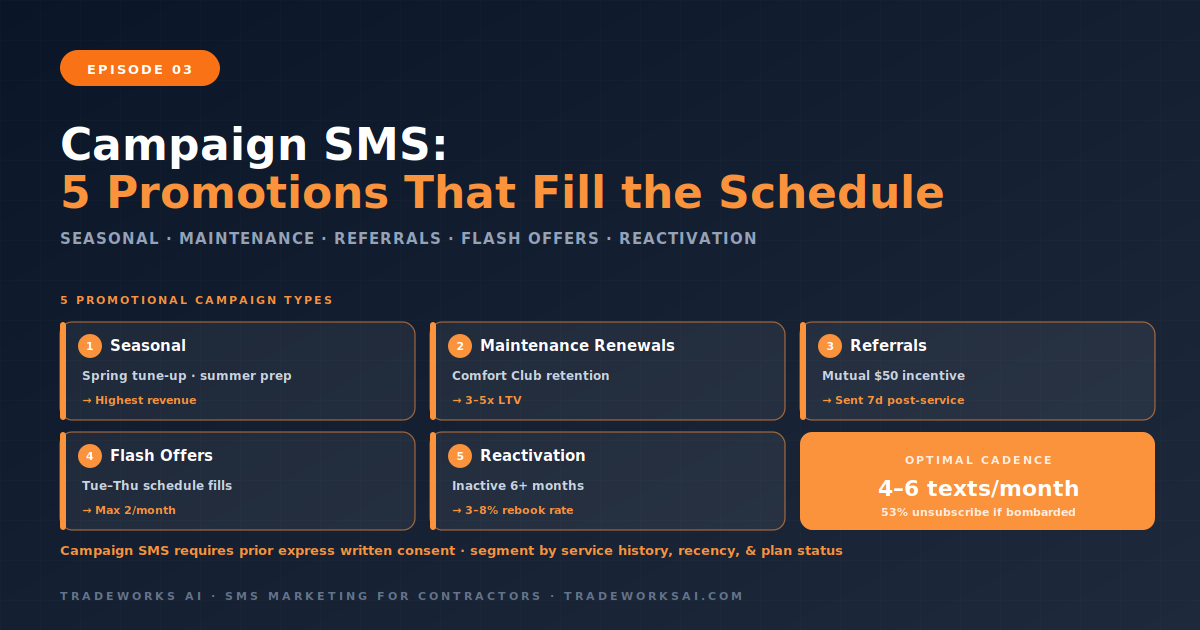
Continue the SMS Marketing series with Part 3 of 4.