SMS Marketing · Part 3
Campaign SMS for Contractors: 5 Promotional Campaign Types That Fill Your Schedule
Continue the SMS Marketing series with Part 3 of 4.
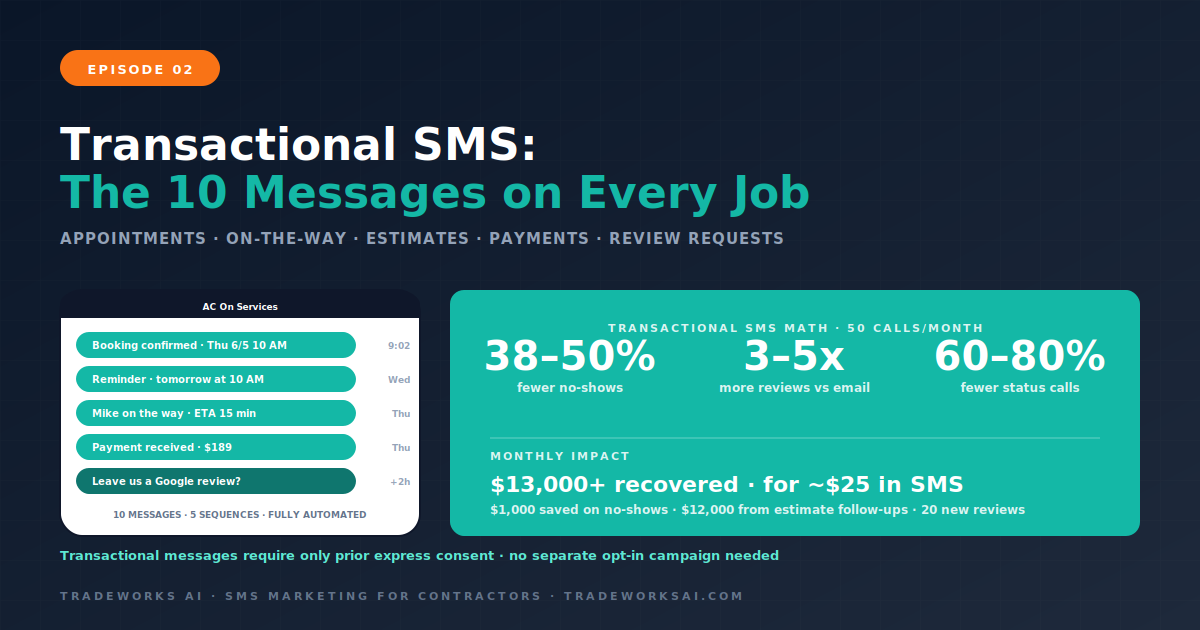
Transactional SMS messages are not marketing. They are service improvements that happen to be the best marketing your business has ever done. An appointment confirmation text cuts no-shows by 38 to 50 percent. An on-the-way notification eliminates the “where is my technician” call. A review request text sent two hours after service generates three to five times more reviews than email. These are not promotions—they are operational messages that improve the customer experience while directly growing your revenue and reputation.
The compliance advantage of transactional SMS is significant: these messages require only prior express consent (not the higher standard of prior express written consent required for marketing texts). A customer who provides their phone number when booking a service has given sufficient consent for appointment confirmations, service updates, and related transactional communications. This means you can implement transactional SMS immediately for every customer who books with you—no separate opt-in campaign required.
This episode covers the five transactional SMS sequences every contractor should automate: appointment confirmations, on-the-way notifications, estimate follow-ups, payment and invoice confirmations, and post-service review requests. Each sequence includes exact message templates, timing guidance, and automation setup instructions.
The single highest-impact transactional SMS sequence for contractors. SMS reminders reduce no-shows by 38 to 50 percent, with some businesses achieving up to 60 to 70 percent reduction when confirmation texts are combined with easy rescheduling options.
Always include: date, time, technician name (when assigned), and a confirmation action (Reply C)
Include prep instructions relevant to the service (clear access, secure pets, locate panel)
Two-way replies are essential—customers must be able to reschedule by replying, not just confirm
If a customer replies R (reschedule), your team or automation should follow up within 30 minutes with available times
Track confirmation rate: 60%+ reply-confirmation rate indicates a healthy sequence
The on-the-way text eliminates the most common customer complaint for home service businesses: “When is the technician coming?” One text, sent when the tech leaves for the job, sets expectations and prevents inbound calls to your office.
Reduces inbound “where is my tech” calls by 60–80%—freeing your office staff
Sets arrival expectations—the homeowner is home and ready
Vehicle description builds security and trust (especially for elderly homeowners)
Opens a two-way text channel the homeowner can use if the tech cannot find the house
When you send a quote and the homeowner goes quiet, the traditional approach is a phone call follow-up. Problem: 74 percent of those calls go to voicemail. The homeowner sees an unknown number and does not answer. A text follow-up gets read by 98 percent of recipients.
Three touches maximum. One at 24 hours, one at 72 hours, one at 7 days. Then stop.
Tone: helpful, not pushy. “Have any questions?” not “Are you ready to schedule?”
Include the technician’s name and direct contact—personal connection converts better than a company number
Mention financing in touch 2 if applicable—price is the #1 objection on large jobs
If the customer responds at any point, transition to the DM/phone framework from Episode 1
This sequence is transactional (following up on a requested estimate), not promotional—standard consent applies
A payment confirmation text closes the service loop and sets up the review request. It also creates a paper trail that reduces billing disputes.
Immediate receipt confirmation builds trust and professionalism
Reduces “did my payment go through” calls to your office
Creates the natural bridge to the review request (sent 2 hours later)
Digital paper trail reduces billing disputes
Customers who receive payment confirmations rate the overall service experience higher
The review request is the single most valuable transactional SMS for contractor marketing. Text-based review requests generate three to five times more reviews than email requests. The 98 percent open rate means nearly every customer sees the request, and the timing—sent while the positive experience is still fresh—maximizes response rates.
Send 2 hours after service—not immediately (feels transactional), not 24 hours later (memory fades)
Use the technician’s first name—personalizes the request and credits the individual
Link directly to your Google review page—not your website, not a review selection page. One tap to the review form.
Maximum 2 texts per service visit. One request, one follow-up. Never a third.
Monitor review velocity: if you are sending 50 review requests per month and getting 15–25 reviews, your sequence is working well (30–50% response rate is strong for SMS review requests)
Do NOT incentivize reviews with discounts or gifts—this violates Google’s review policies and FTC guidelines
Ten messages across five sequences. Each one triggered automatically by an event in your field service workflow. Set it up once and it runs on every job, for every customer, without your team typing a single text manually.
Transactional messages (appointment confirmations, service updates, payment receipts) require prior express consent, which can be verbal or written. A customer who provides their phone number when booking a service has given sufficient consent for transactional communications. This is a lower standard than promotional/marketing texts, which require prior express written consent. However, transactional texts cannot contain promotional content—adding a discount code to a confirmation text may reclassify the entire message as promotional.
Three-touch confirmation sequence: an instant booking confirmation, a day-before reminder (24 hours prior), and a day-of reminder (2 hours prior). Research shows the 24-hour reminder is the most impactful for reducing no-shows, while the day-of reminder catches last-minute changes. Two reminders minimum; three is optimal for most contractor service types.
Two hours after service completion. This timing ensures the positive experience is still fresh while giving the homeowner enough space to not feel pressured during the service visit. Send one follow-up 48 hours later if no review is detected. Maximum two review request texts per service visit. Link directly to your Google review page for one-tap access.
Yes. Every sequence in this guide can be fully automated through your SMS platform or field service software. Booking confirmations trigger on booking creation. Reminders trigger on a time-based schedule. On-the-way texts trigger when the tech marks en route. Payment confirmations trigger on payment processing. Review requests trigger on job completion. Set up once, runs on every job automatically.
98% of texts get read in 3 minutes. 26% of contractor calls go unanswered. The SMS Audit grades your text-message infrastructure: TCPA compliance, 10DLC registration, automation workflows, and the platform fit for your trade. Find the highest-leverage SMS sequence that fills your schedule next month.
Continue the SMS Marketing series with Part 3 of 4.
Continue the SMS Marketing series with Part 4 of 4.