SMS Marketing · Part 4
The SMS Automation Playbook for Contractors: 7 Workflows That Run Without Manual Effort (Series Finale)
Continue the SMS Marketing series with Part 4 of 4.
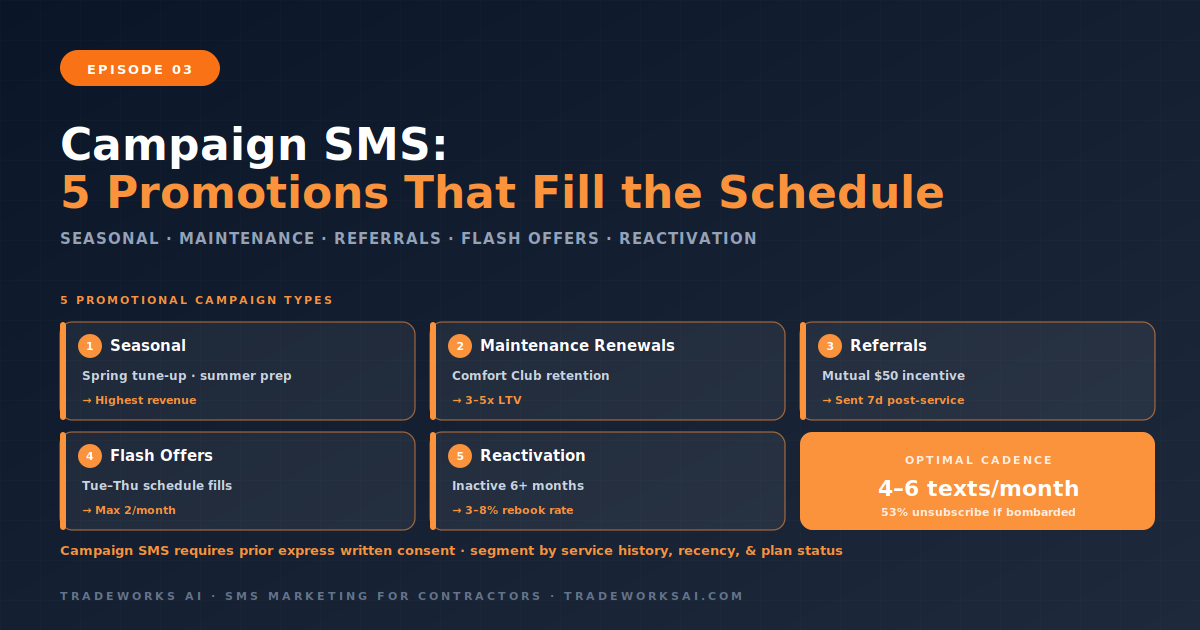
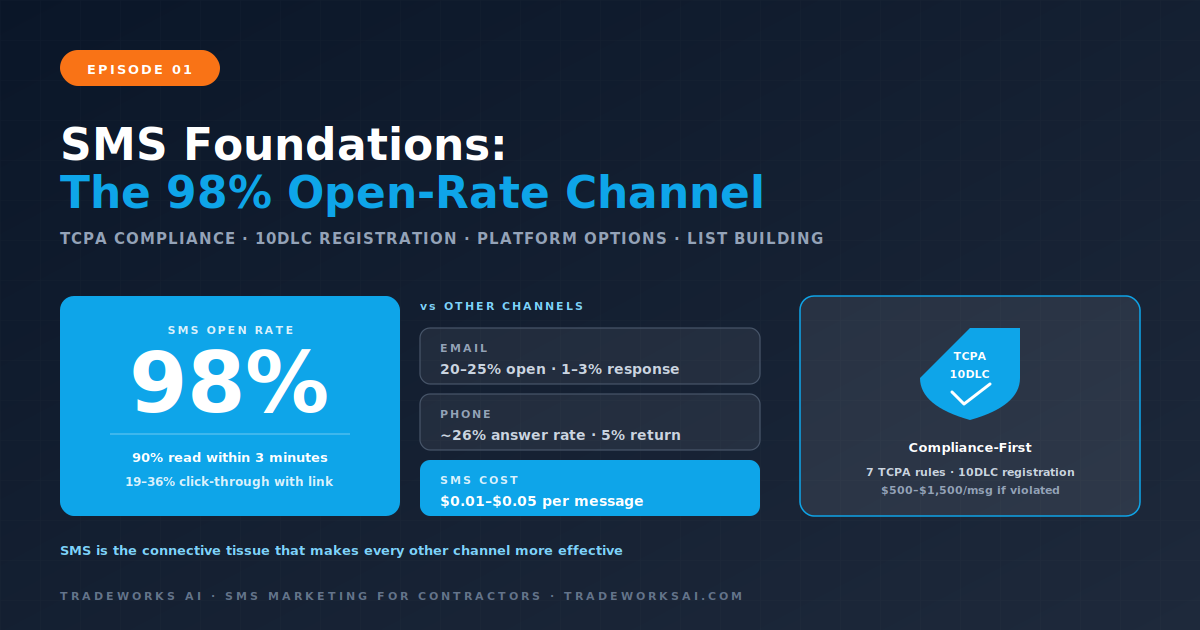
Episode 2 covered transactional SMS—the service messages that run automatically on every job. This episode is the revenue side: promotional campaigns that generate new bookings from your existing subscriber list. Campaign SMS requires prior express written consent (the higher standard from Episode 1), which means every recipient must have explicitly opted in to receive marketing messages from your business. But when you have that consent, campaign SMS delivers results that no other promotional channel can match: 98 percent of your subscribers will see the message, 90 percent within three minutes, and 19 to 36 percent will click a link if one is included.
This guide covers the five campaign types that consistently drive revenue for contractors, the segmentation strategy that makes each campaign relevant, a 12-month campaign calendar by trade, message templates for every campaign type, and the frequency rules that keep subscribers engaged without triggering unsubscribes. Campaign SMS is where your subscriber list turns into booked jobs and recurring revenue.
Seasonal campaigns are the highest-revenue SMS campaign type for contractors because they align your offer with a need the homeowner already feels. When temperatures hit 95 degrees in Tampa, a text about a $49 AC tune-up special is not spam—it is a timely reminder of something they need right now.
Maintenance plan retention is the most profitable long-term metric for contractors. A customer on a maintenance plan is worth three to five times more over their lifetime than a one-time service customer. SMS renewal reminders are the most effective way to prevent plan lapses because the message arrives in a channel with near-universal visibility.
Segment by auto-renew status: customers with auto-renew ON get an informational reminder only (Text 1). Customers without auto-renew get the full 3-text sequence.
Include specific benefit reminders—not just “renew your plan” but “priority scheduling, parts discount, annual tune-ups.” Remind them what they are keeping.
Offer a re-enrollment incentive (waived fee, bonus service) for lapsed members—it is cheaper to retain than to acquire.
Track renewal rate by channel: compare SMS-prompted renewals vs. email vs. phone outreach to justify SMS investment.
SMS referral requests outperform every other referral channel because of the direct, personal nature of text messaging. A text asking for a referral feels like a personal favor, not a mass marketing blast.
Send to customers within 7 days of a completed service—satisfaction is highest and referral intent peaks immediately after a positive experience
Make the incentive mutual: the referrer AND the referred customer both benefit. This removes the “I am selling out my friend” friction.
Provide a unique referral link or code so you can track which customers generate the most referrals
Follow up once if no referral detected: “Just a reminder — you and your friend both get $50 off. Share your link: [link].” Maximum 2 texts per referral campaign.
Top referrers (3+ referrals per year) should receive VIP treatment: handwritten thank-you, upgraded service, or loyalty bonus
Flash offers are short-deadline SMS campaigns designed to fill slow periods—the Tuesday–Thursday dead zone, seasonal slowdowns, or cancellation gaps. The 98 percent open rate and near-instant read time make SMS the only channel fast enough for true flash offers.
Maximum 2 flash offers per month. More than that trains your list to wait for discounts.
Flash offers must be genuinely limited—real scarcity, real deadlines. Fake urgency erodes trust.
Send on Tuesday or Wednesday morning for Thursday/Friday fills. Homeowners need 24–48 hours to respond.
Price the flash offer below your standard rate but above your cost—the goal is to fill dead time productively, not race to the bottom.
Track flash offer redemption rate: 5–15% conversion from subscribers to bookings is a healthy range.
Reactivation campaigns target customers who have not booked a service in 6 to 12+ months. These are the quietest leads in your database—they have used your service before, had a positive enough experience to not complain, but have not returned. A single text can reignite the relationship.
Run quarterly. Target customers with no service in 6+ months.
Personalize with their last service type: “When was your last AC inspection?” vs. generic “We miss you!”
Include a specific incentive: dollar-off is more concrete than percentage-off for contractors
Maximum 2 texts per reactivation cycle. If no response after 2, move them to an annual-only cadence.
Track reactivation rate: 3–8% of inactive customers booking from a text campaign is a strong result
The single biggest factor in SMS campaign success is segmentation—sending the right message to the right subscribers. A seasonal AC offer sent to a subscriber who just had their AC replaced is irrelevant. A maintenance renewal reminder sent to someone who is not on a plan is confusing. Segmentation turns mass-text campaigns into personalized, relevant communications.
Four to six promotional texts per month is the optimal cadence. Research shows 49 percent of subscribers are comfortable receiving at least one text per week, but 53 percent will unsubscribe if they feel bombarded. Quality and relevance over quantity.
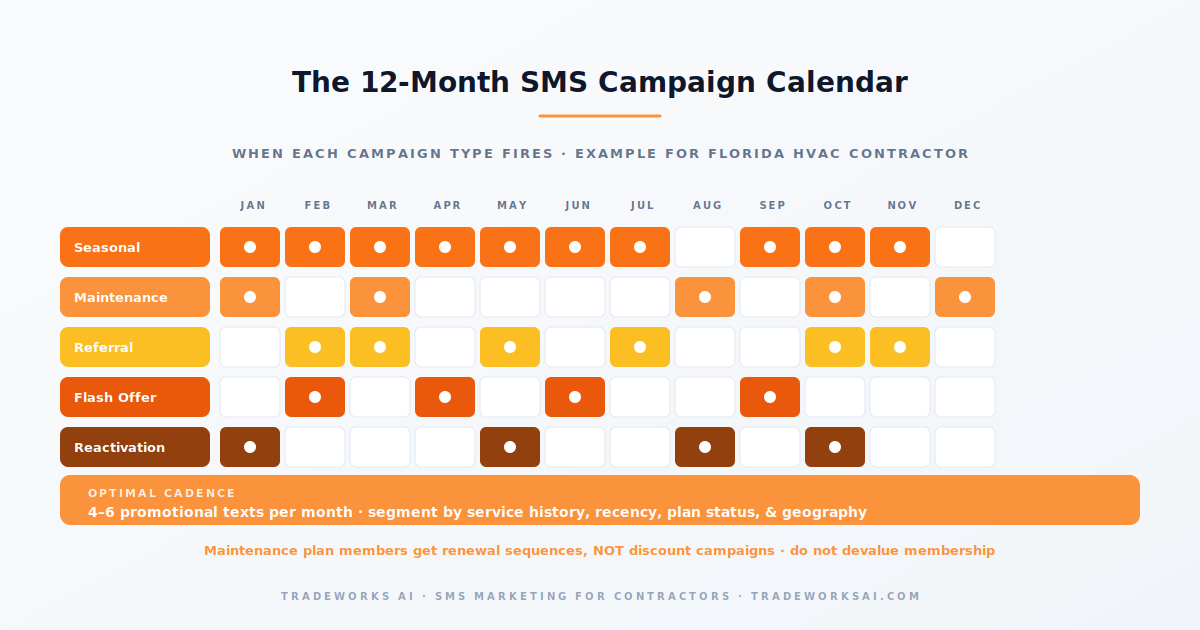
Four to six promotional texts per month is optimal. This cadence keeps you top-of-mind without overwhelming subscribers. Research shows 53 percent of subscribers unsubscribe when they feel bombarded. Every message must have a clear purpose and genuine value. If a text would not prompt you to take action as a homeowner, do not send it.
Transactional SMS includes appointment confirmations, service updates, payment receipts, and review requests—messages directly related to a service the customer requested. Campaign SMS includes seasonal promotions, maintenance plan renewals, referral programs, flash offers, and reactivation campaigns—marketing messages designed to generate new bookings. Campaign SMS requires prior express written consent (higher standard), while transactional SMS requires only prior express consent.
Segment by service history (HVAC vs. plumbing vs. electrical), recency (active, lapsed, dormant), plan status (maintenance plan member vs. non-member), and geography (zip code). Send seasonal AC offers only to HVAC customers. Send reactivation offers only to lapsed customers. Send renewal reminders only to plan members. Segmentation transforms mass blasts into relevant, personalized messages.
98% of texts get read in 3 minutes. 26% of contractor calls go unanswered. The SMS Audit grades your text-message infrastructure: TCPA compliance, 10DLC registration, automation workflows, and the platform fit for your trade. Find the highest-leverage SMS sequence that fills your schedule next month.
Continue the SMS Marketing series with Part 4 of 4.
Continue the SMS Marketing series with Part 1 of 4.