Local Search · Part 1
How Google Actually Sends Contractors Customers
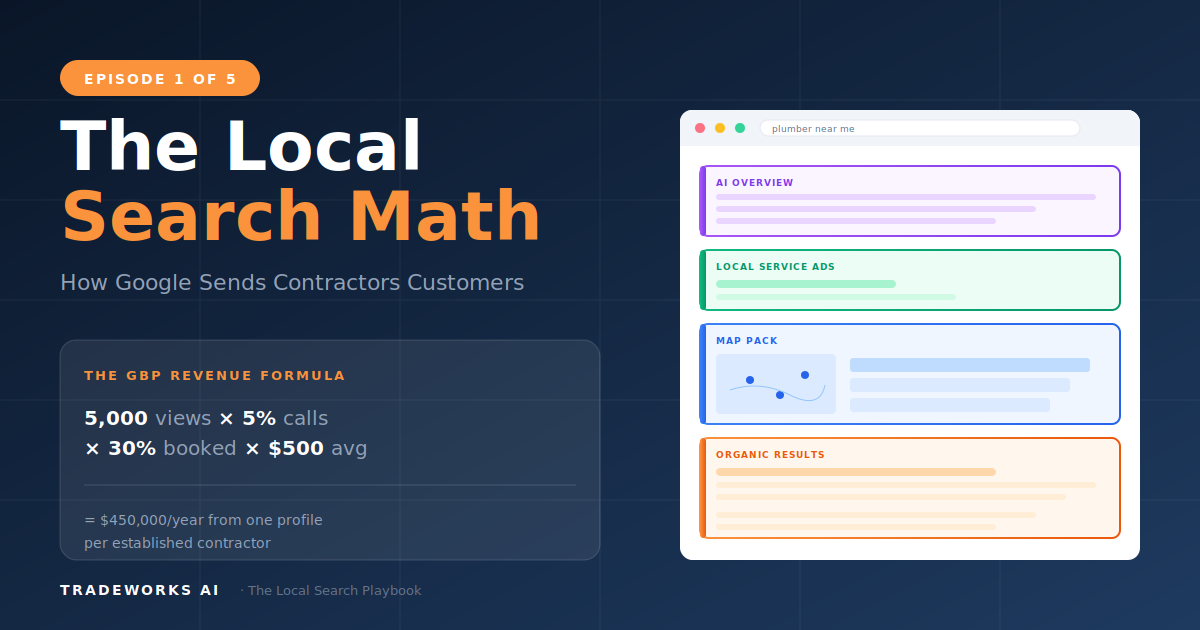
The math behind Google leads, the GBP revenue formula, and the 5-Layer Local Search Stack.
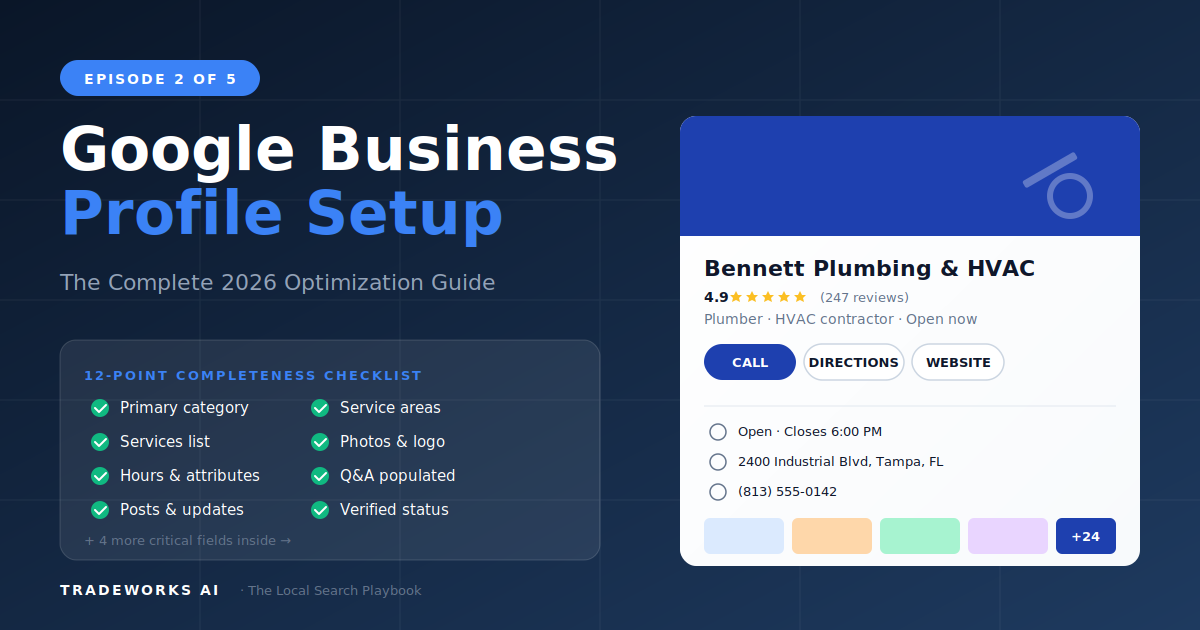
A fully optimized Google Business Profile for a contractor includes a verified primary category matching the core trade, 5–9 secondary categories covering additional services, a complete services list with descriptions and pricing where applicable, 20-plus attributes marking access features and service options, 100-plus photos across 8 content types, weekly GBP Posts maintaining activity signals, a populated Q&A section with owner-seeded answers to the top 10 customer questions, accurate hours including holiday and emergency availability, a defined service area covering actual territory, and a business description written for both customers and AI extraction.
In 2026, the GBP is not just a listing — it is the data feed for Google AI Overviews, the Map Pack, and every AI tool that sources local contractor information. An incomplete GBP breaks the pipeline across every visibility surface simultaneously. This guide walks through every section of the GBP dashboard with specific optimization instructions for home service contractors.
Part 1 introduced the 5-Layer Local Search Stack. Google Business Profile is Layer 1 — the foundation. Every other layer depends on the data in your GBP being complete and accurate.
Map Pack rankings draw directly from GBP data. AI Overviews source from GBP for local queries. ChatGPT, Gemini, and Perplexity all cross-reference GBP data when generating contractor recommendations. Your review profile lives on GBP. Your Local Service Ads require GBP linking.
An incomplete GBP does not just mean weaker Map Pack visibility. It means broken data feeding every surface simultaneously. The ROI on GBP optimization is the highest of any single local SEO activity because it amplifies every other layer in the stack.
Before optimizing, audit current state. Google does not publicly score profile completeness, but internal signals weight it heavily. A profile missing key sections ranks lower than a complete competitor in the same trade and market.
Your primary category is the single most influential ranking factor you control on GBP. It tells Google what you are. An HVAC contractor with primary category set to "Heating Contractor" ranks differently than one set to "Air Conditioning Contractor" — even if both do the same work.
Choose the category that matches your highest-volume service. For HVAC: HVAC Contractor is the broadest match and typically the best primary. For plumbing: Plumber. For electrical: Electrician. For roofing: Roofing Contractor.
Do not keyword-stuff your business name to compensate for category. Google suspends profiles that add keywords to the business name field. Your name should be your legal DBA, nothing more.
Add every category that legitimately describes your services. Most contractors leave these empty — a major missed opportunity.
5–9 secondary categories is the optimal range. Too few leaves ranking opportunities on the table. More than 10 can dilute relevance signals.
The Services section lives within your GBP dashboard and lists every specific service you offer. Google uses this data to match your profile to long-tail queries the categories alone do not cover.
Structure each service entry with: service name, brief description (2–3 sentences), and price range where applicable. Avoid vague descriptions. Specific service descriptions match specific search queries.
Example for an HVAC contractor:
List every service, not just the top 3. Contractors who list 15–25 specific services rank for substantially more long-tail queries than those who list 5.
Photos are the second-most influential element for customer conversion after reviews. Google profiles with 100-plus photos receive 520% more calls than profiles with fewer than 5 photos (BrightLocal 2026).
Target: 100-plus total photos. Upload 5–10 new photos monthly to maintain freshness signals. Geo-tag photos to your service area when possible.
GBP Posts are mini-updates that appear on your profile. Google uses posting activity as a freshness signal. Profiles with weekly posts outperform dormant profiles in Map Pack ranking.
Four post types that work for contractors:
Cadence: minimum 1 post per week. 2–3 per week is optimal. Each post needs a photo, 150–300 words with primary keyword plus city name, and a CTA button (Call, Learn More, Book).
The Q&A section on your GBP allows anyone to ask questions and anyone to answer. If you do not seed this section, strangers will — sometimes with incorrect information.
Owner-seed the top 10 questions your customers actually ask. Ask the question from one Google account, answer from the business account. Mark the answer as the official business response.
Top 10 questions for most contractors:
Each answer should be 2–4 sentences with natural keyword inclusion. These answers appear in search results and AI Overviews.
Attributes are checkbox fields in your GBP dashboard that describe your business characteristics. Many contractors skip them. Google uses attributes to match queries with specific filters.
Key attributes for contractors:
Check every attribute that legitimately applies. More attributes equals more matching signals.
The business description field allows 750 characters. Write it for two audiences: the customer scanning your profile and the AI systems extracting information.
Structure: Lead with what you do and where you do it (primary keyword + city). Follow with key differentiators (years in business, certifications, specialties). Close with a call to action.
Tampa Bay HVAC contractor serving Hillsborough, Pinellas, and Pasco counties since 2008. Residential and light commercial air conditioning installation, repair, and maintenance. Carrier and Trane authorized dealer. 24/7 emergency service. Licensed, insured, and BBB accredited. Call for a free estimate or book online.
Do not include URLs, phone numbers, or promotional language in the description — Google may suppress profiles that violate this guideline.
In 2026, your GBP is the primary data feed for Google AI Overviews and a secondary source for ChatGPT, Gemini, and Perplexity. Every field you optimize does not just improve your Map Pack ranking — it improves the data AI systems use to describe and recommend your business.
A complete GBP is not just good SEO practice — it is the foundation of being recommended by AI systems in 2026.
GBP optimization is the highest-ROI single activity in contractor local SEO. It costs nothing except labor, it amplifies every other layer in the Local Search Stack, and it is the data feed for the AI systems that a growing share of customers use.
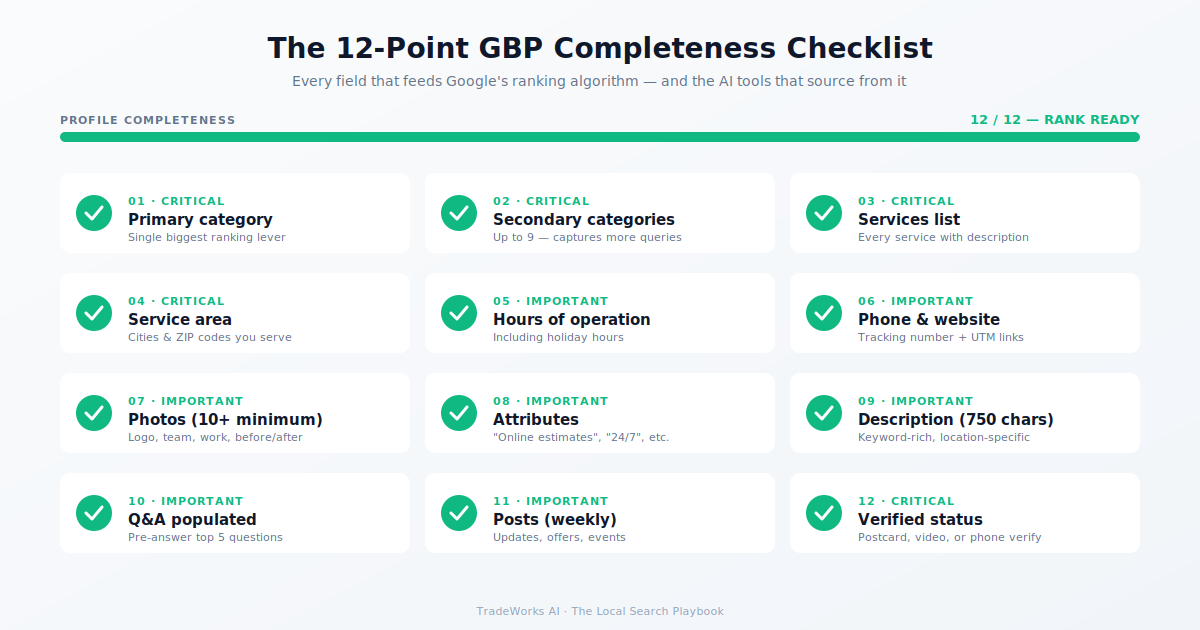
The 12-point completeness checklist at the top of this article is your starting point. Audit every section. Fill every gap. Upload the photos. Seed the Q&A. Post weekly. The contractors who do this build a foundation that every subsequent optimization compounds on.
Initial optimization takes 3–5 hours for a thorough setup. Photo uploads, service listing, Q&A seeding, and attribute selection are the most time-intensive sections. Ongoing maintenance (weekly posts, monthly photo uploads) takes 1–2 hours per week.
No. Google explicitly prohibits adding keywords, location names, or descriptors to the business name field that are not part of your legal business name. Violations can result in profile suspension. Your business name should match your DBA exactly.
Target 100-plus total across 8 content types. Profiles with 100-plus photos receive 520% more calls than profiles with fewer than 5. Upload 5–10 new photos monthly to maintain freshness.
Yes. Google uses posting activity as a freshness and engagement signal. Profiles with weekly posts consistently outperform dormant profiles in Map Pack ranking tests. The effect is moderate but compounding — consistent posting over months produces measurable ranking improvement.
Yes — immediately. Anyone can answer questions on your GBP. If a stranger answers incorrectly, that incorrect answer appears on your profile. Owner-seeding the top 10 questions preemptively and monitoring for new questions protects your information accuracy.
Set your primary category to your highest-volume trade. Use secondary categories to cover additional trades. If the businesses operate under different licenses or brands, consider separate GBP profiles for each — but only if they have legitimately different business identities and service areas. Duplicate profiles for the same business at the same address violate Google policy.
We'll run your Google Business Profile through the same audit framework outlined above — categories, services, photos, posts, Q&A, attributes, and description — and return a punch list of every gap costing you Map Pack visibility and AI recommendation eligibility.
The math behind Google leads, the GBP revenue formula, and the 5-Layer Local Search Stack.
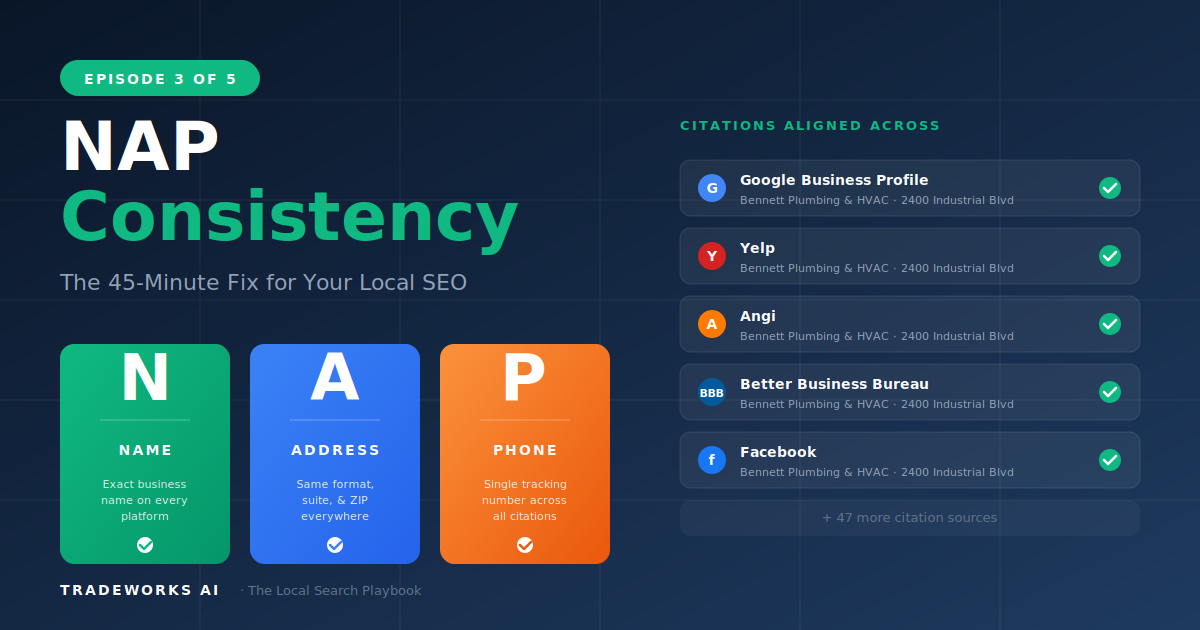
Why citation inconsistencies silently kill local rankings and the 45-minute audit that fixes them.