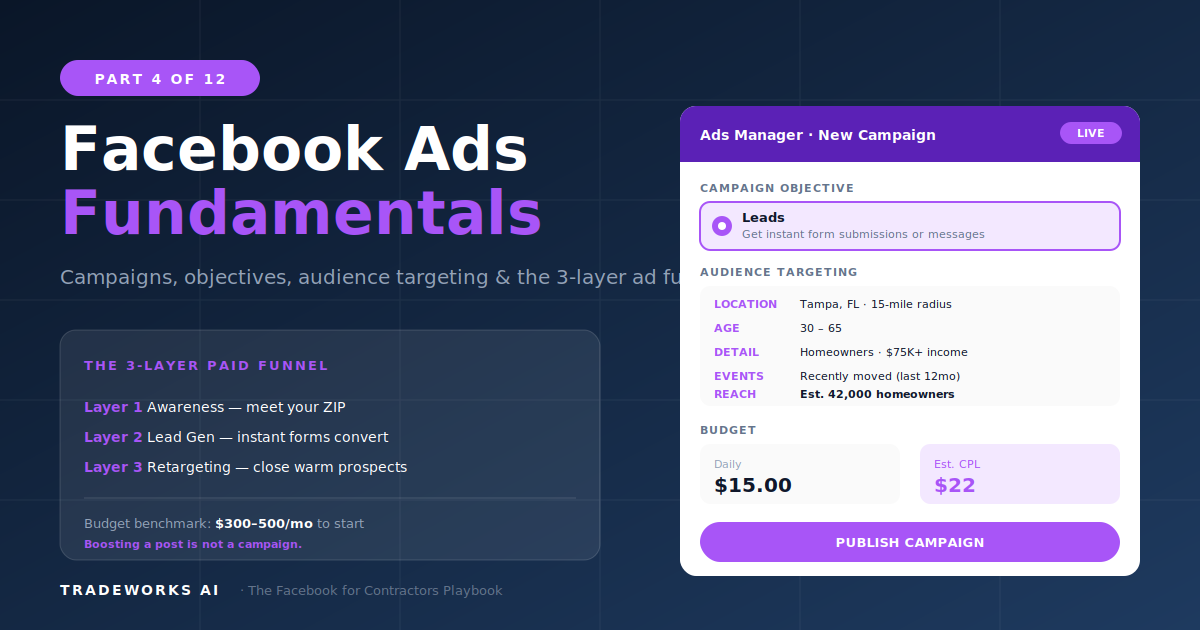
Facebook · Part 4
Facebook Ads Fundamentals
Campaigns, objectives, audience targeting, and the 3-layer ad funnel for contractors.
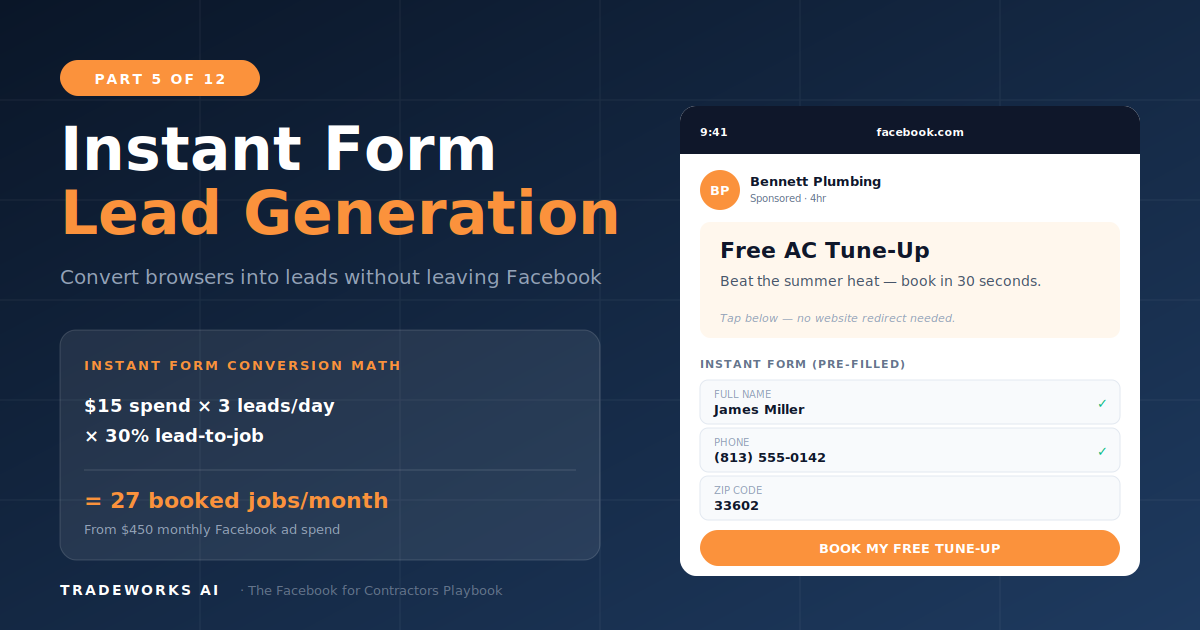
Facebook lead generation campaigns for contractors produce leads at $15 to $60 per submission when configured correctly, with a 20–35% conversion rate from lead to booked job. The three lead mechanisms available, Instant Forms, click-to-call ads, and Messenger conversations, each serve different customer behaviors and service types.
Instant Forms produce the highest volume of leads at the lowest cost but require careful form design and immediate CRM follow-up to maintain quality. Click-to-call ads produce fewer leads at higher cost but those leads are further along the buying decision and convert at 40–55%. Messenger conversations sit between the two, offering qualification capability through automated chat flows.
This goes deep on Layer 2 from Part 4: the lead generation layer that produces direct revenue.
Instant Forms are the highest-volume, lowest-cost lead mechanism for contractors. The form opens inside the Facebook app, so the user never leaves the platform. Facebook pre-fills name, email, and phone from the user's profile, reducing friction to a single tap.
Low-quality leads are the number one complaint contractors have about Facebook advertising. The root cause is almost always a poorly configured Instant Form.
An Instant Form lead that sits unseen for 4 hours is a dead lead. The integration pipeline must be:
This pipeline is the difference between a 20% and a 35% conversion rate. Speed is the variable, not lead quality. The same lead that converts when called in 5 minutes goes cold when called in 4 hours.
Click-to-call ads display a prominent "Call Now" button that initiates a phone call directly from the ad. These are your highest-intent lead mechanism: someone who taps "Call Now" is ready to talk to a human right now.
Tracking: Use a dedicated call tracking number (CallRail $30–50/month).
Messenger ads open a conversation in Facebook Messenger when clicked. The advantage is qualification: ask questions before collecting contact info, filtering out unqualified leads.
Leads who complete all 4 steps are pre-qualified. The flow saves your office team 5–10 minutes per lead.
Example: "$49 AC tune-up (regular $129). Tampa homeowners only. Book by [date]."
Why it works: Concrete savings, expiration creates urgency, geographic limitation reinforces relevance.
CPL benchmark: $12–25.
Example: "Free AC diagnostic with any repair. Find out exactly what is wrong before you spend a dime."
Why it works: Removes financial risk of the first step.
CPL benchmark: $18–35.
Example: "Pre-season tune-up: only 50 spots at early-bird pricing. Scheduling now through [date]."
Why it works: Combines seasonal relevance with real scarcity. Mirrors the pre-season principle.
CPL benchmark: $15–30.
Example: "Join our maintenance plan: first month free. 2 tune-ups/year, priority scheduling, 15% off repairs."
Why it works: Long-term customer acquisition. Each lead becomes recurring revenue.
CPL benchmark: $25–50.
Example: "New AC system installed from $89/month. 0% financing for 60 months. Free in-home estimate."
Why it works: Reframes a $6,000–15,000 purchase as manageable monthly payment.
CPL benchmark: $30–60. Highest CPL but largest tickets and best ROI.
Track weekly: contact rate (% reached by phone — target 60%+), qualification rate (% real prospects — target 70%+), booking rate (% scheduling — target 30%+).
Aligns with the Email Playbook seasonal campaigns. Facebook ads amplify email campaigns by reaching both your existing customer database and cold audiences with the same seasonal offer, creating multi-channel reinforcement that lifts conversion 25–40%.
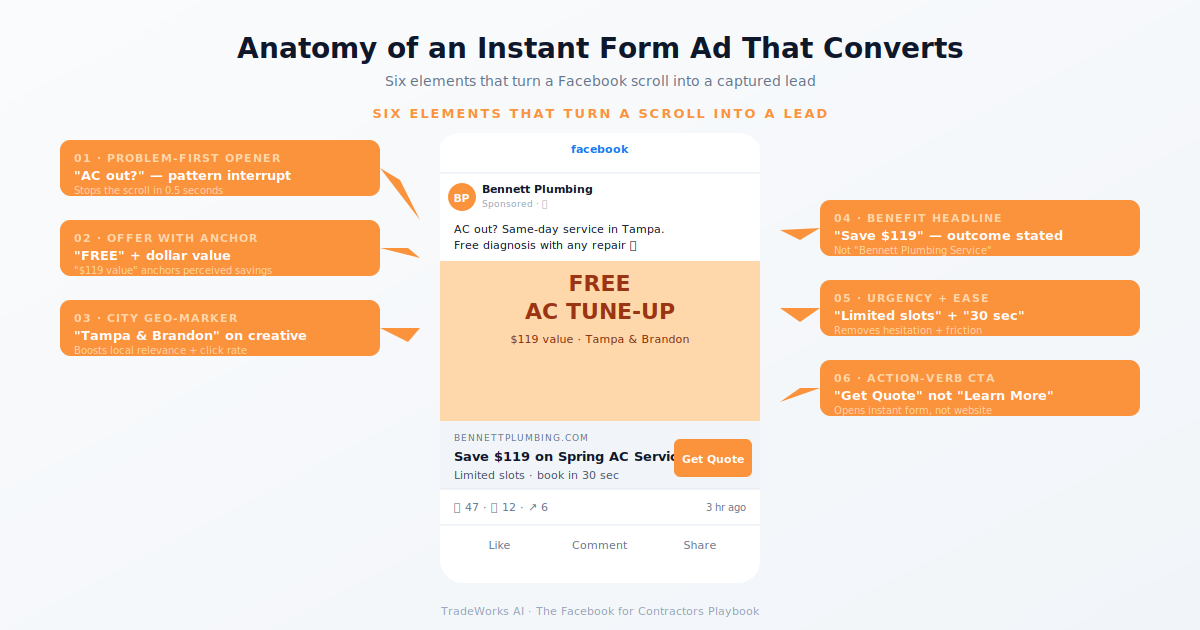
At $300–500/month: 8–20 leads. At $750–1,500: 20–50 leads. At $1,500–3,000: 40–100+ leads. Assumes optimized campaigns running 30+ days with tested creative.
Instant Forms for most contractors. They produce 30–50% more leads at lower cost because the user never leaves Facebook. Send to your website only if your landing page is specifically optimized and you need the Pixel to fire for conversion tracking.
Attempt 3 calls over 48 hours: immediately, 4 hours later, and the next business day. Pair each with a text message. The Speed-to-Lead email sequence runs in parallel. Leads who do not respond after 3 calls + 3 texts + 3 emails move to a nurture sequence rather than dead.
Train your CSRs to provide a price range rather than a hard quote: 'Typically a tune-up runs $89–129 depending on what the technician finds.' Always pivot to scheduling: the goal of the call is an appointment, not a price negotiation.
Check: Is your offer compelling? (Generic 'contact us' ads produce CPLs 2–3x higher.) Is your audience too narrow? Is your creative stale (3–4 weeks)? Are you running the three-layer funnel? Cold lead gen without awareness and retargeting layers produces the most expensive leads.
Facebook automatically suppresses ads for users who have submitted a form for 7-30 days (you choose). In Ads Manager, set the form to 'New leads only' and add the 'Form Submitters' Custom Audience as an exclusion across all your lead gen campaigns.
Most contractors run lead gen with poorly designed forms and generic offers. Our free audit benchmarks your current cost per lead and shows the gap to the $15-$60 range outlined in this part.
Campaigns, objectives, audience targeting, and the 3-layer ad funnel for contractors.
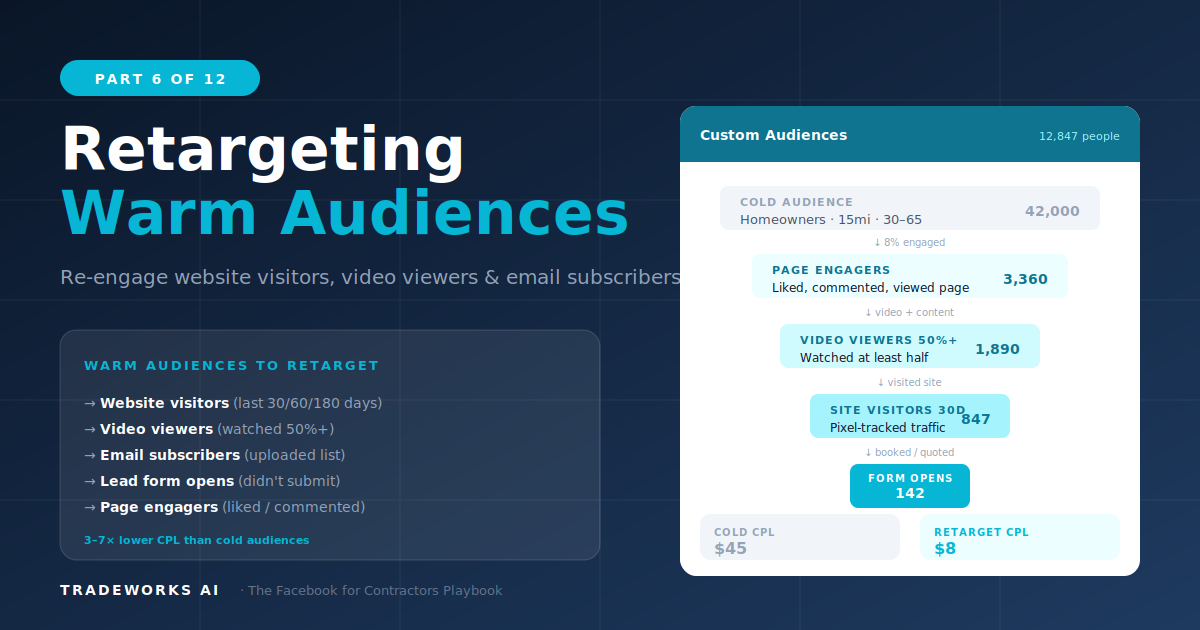
The 5 retargeting audiences every contractor needs and the email-to-Facebook sync.