Facebook for Contractors Playbook · Part 4 of 12

Facebook Ads for Contractors: Campaign Types, Objectives, and Audience Targeting

By Trevor Bennett · May 2026 · 11 min read

Series

The Facebook for Contractors Playbook

Part 4 of 12
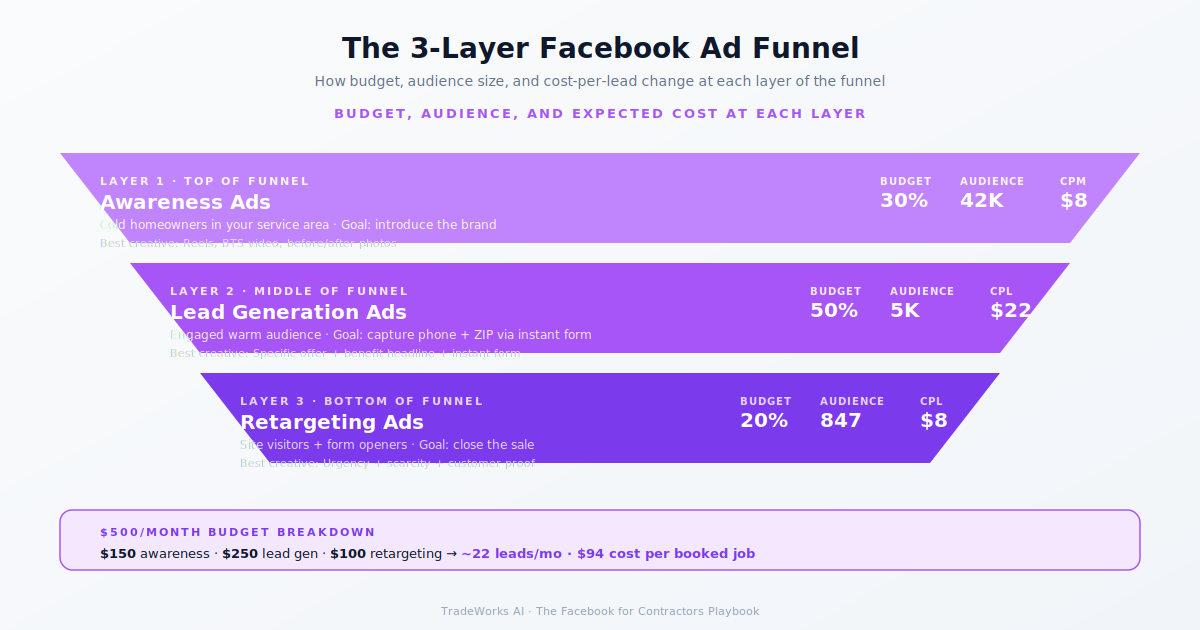
Three-layer ad funnel showing Awareness, Lead Generation, and Retargeting flowing into booked jobs

Facebook advertising for contractors is a three-layer funnel that moves homeowners from awareness through consideration to conversion. The first layer introduces your business to people in your service area who have never heard of you. The second layer generates leads through forms, phone calls, or Messenger conversations from people who already know you exist. The third layer retargets website visitors, video viewers, and email subscribers who have not yet booked.

Most contractors skip directly to lead generation, which is like asking someone to marry you on a first date. The funnel works because each layer warms the audience for the next, producing leads that cost 30–50% less and convert at 2–3 times the rate of cold lead campaigns run in isolation.

This is the Advertising System component of the DEMAND Engine. Parts 5 and 6 go deeper into lead generation campaigns and retargeting respectively.

Boosting Posts vs Running Ads: The Critical Distinction

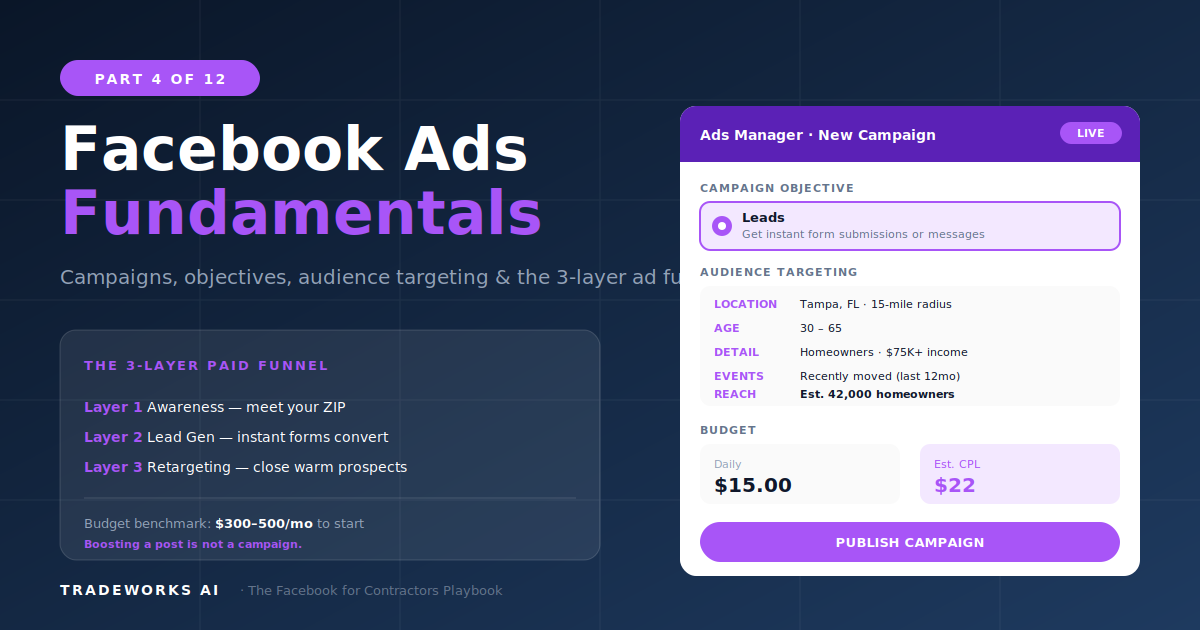
Boosting a post is not a Facebook ad strategy. Real Facebook advertising happens in Meta Ads Manager (formerly Facebook Ads Manager), accessible through Meta Business Suite. Ads Manager gives you control over campaign objectives, audience targeting, ad placements, creative testing, budget optimization, and conversion tracking. It is the difference between throwing money at a wall and building a lead generation system.

The Three Campaign Objectives That Matter

Meta Ads Manager offers six campaign objectives in 2026, but only three matter for home service contractors:

  • Awareness: Reach the maximum number of relevant people. Used for Layer 1 (top of funnel).
  • Leads: Drive form submissions, calls, or Messenger conversations. Used for Layer 2.
  • Sales/Conversions: Drive specific website actions (booking, schedule). Used for retargeting and high-intent campaigns.

Traffic, Engagement, and App Promotion are rarely the right choice for contractors.

Layer 1: Awareness Campaigns

  • Objective: Get your business in front of every homeowner in your service area who has never heard of you.
  • Budget allocation: 20–30% of total ad spend.
  • Ad types: Video views (30–60-second brand intro or educational content), reach campaigns. Reels-format video performs best for awareness in 2026.
  • Creative approach: Not a sales pitch. Educational content, community involvement, or before/after transformation. Goal is recognition and trust.
  • Targeting: Broad geographic (15–25-mile radius). Age 28–65. Homeowner interest. Exclude existing customers.
  • Success metrics: CPM $8–20, video view rate 25%+, frequency 1.5–3 per week.

Layer 2: Lead Generation Campaigns

  • Objective: Convert interested homeowners into form submissions, phone calls, or Messenger conversations.
  • Budget allocation: 50–60% of total ad spend.
  • Ad types: Lead form ads (Instant Forms), click-to-call, Messenger conversations, conversion-optimized website traffic.
  • Targeting: Layer behavioral signals on geographic targeting: homeowner status, household income ($75K+ for premium services), recently moved, home improvement interests.
  • Success metrics: CPL $15–60, lead-to-job conversion 20–35%, cost per booked job $75–250.

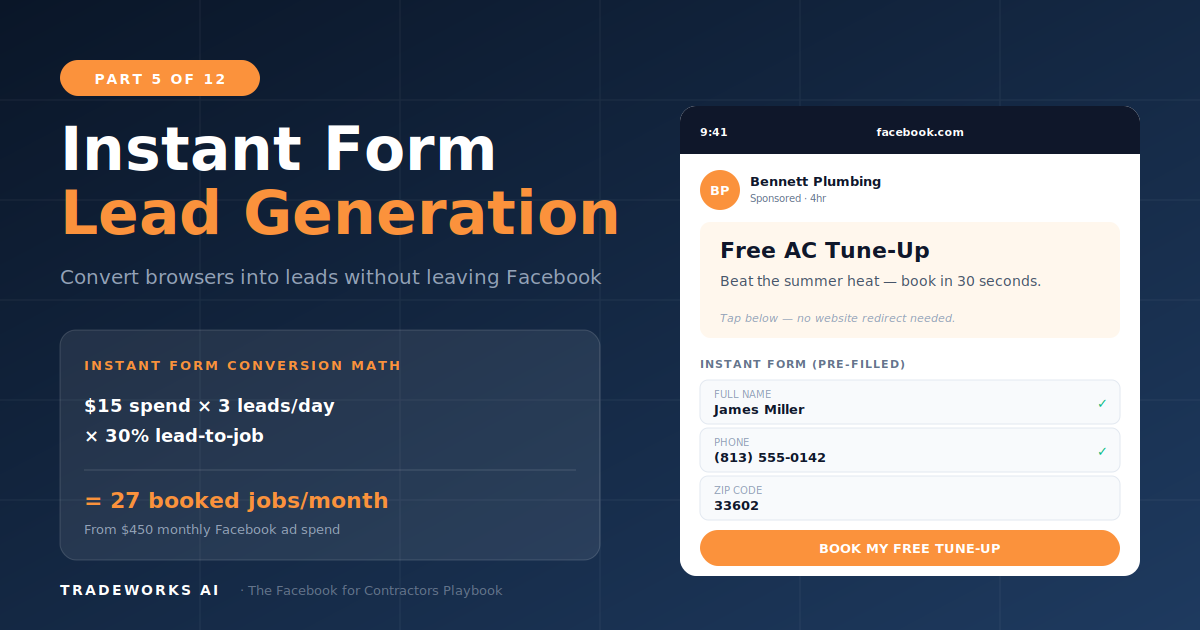
Facebook Instant Forms deserve special attention. Forms open within Facebook so the user never leaves the app. Configure with pre-filled name, email, phone; one custom question ("What service do you need?"); thank-you screen with phone number and Call Now button; CRM integration via Zapier so every lead enters your email system and triggers Speed-to-Lead.

Layer 3: Retargeting Campaigns

  • Objective: Re-engage people who already interacted with your business but did not convert.
  • Budget allocation: 15–25% of total ad spend.
  • Audiences: Website visitors (30 days), video viewers (50% watched), Instant Form openers who did not submit, email custom audiences (dormant customers, seasonal non-bookers, unconverted leads).
  • Creative approach: Testimonials, review highlights, limited-time offers, urgency. They already know you. They need a final push.
  • Success metrics: CPL $8–30, conversion rate 8–20%, ROAS 5x+.

Audience Targeting Deep-Dive

Geographic Targeting

  • Radius: 10–25-mile radius around your primary service location.
  • ZIP codes: For more precision, target specific ZIP codes.
  • Location type: "People living in this location" not "Everyone in this location."

Demographic Targeting

  • Age: 28–65 for residential. Skew younger (28–45) for first-time homebuyer campaigns. Skew older (45–65) for replacements.
  • Homeownership: "Likely to move" and "New homeowner" reach people in active home-decision phases.
  • Household income: $75K+ for premium services and replacements. Broader for emergency repairs.

Interest and Behavioral

  • Home & Garden, Home Improvement, DIY interests.
  • Specific trade interests: Air Conditioning, Heating Systems, Plumbing, Electrical.
  • Recently moved, new homeowner, in-market for home services.

Lookalike Audiences

Upload your existing customer email list (1,000+ contacts recommended). A 1% lookalike of your customer list in your metro targets people who statistically resemble your best customers. Lookalikes typically produce leads at 20–40% lower cost than interest-based targeting.

Ad Creative Best Practices

  • Video outperforms static images by 2–3x. A 30-second technician video on a phone outperforms a professionally designed graphic.
  • Before/after carousels work for lead gen. Show the transformation, include the offer in the final slide.
  • The first 3 seconds determine everything. If they do not stop scrolling in 3 seconds, the ad fails.
  • Include your phone number as text overlay in the creative, not just the CTA button.
  • Test 3–5 creative variants per campaign. Let Facebook's algorithm determine the winner.
  • Mobile-first design. 94% of Facebook users access via mobile.

Budget Framework

  • Stage 1 (1–5 trucks): $300–500/month. Layer 1: $75–150. Layer 2: $175–275. Layer 3: $50–125.
  • Stage 2 (5–15 trucks): $750–1,500/month.
  • Stage 3+ (15+ trucks): $1,500–3,000+/month.

Start at the lower end. Use the first 30 days to test audiences, creative, and offers. Scale once you identify the combinations that produce leads below your target cost.

Campaign Structure in Ads Manager

  • Campaign: One objective per campaign. Name clearly: "[Season] [Service] [Objective] — [Date]."
  • Ad Set: Define audience, budget, schedule, placements. Run 2–3 ad sets per campaign with different audiences to test targeting.
  • Ad: 3–5 ad variants per ad set with different creative and hooks. Algorithm allocates budget to the winner.

Enable Advantage+ placements to let Facebook optimize where your ads appear (Feed, Stories, Reels, Marketplace, Audience Network).

Tracking and Attribution Setup

  • Meta Pixel: Installed on your website. Tracks website visits, form submissions, phone clicks.
  • Conversion API (CAPI): Server-side tracking that complements the Pixel.
  • Offline Conversions: Upload booked-job data monthly to train the algorithm on which leads became paying customers.
  • UTM parameters: Tag all ad links with utm_source=facebook, utm_medium=paid, utm_campaign=[name].
  • Call tracking: Dedicated phone number (CallRail $30–50/month) to attribute calls.

Frequently Asked Questions

How long before I see results from Facebook ads?

At $300/month, expect 2–4 weeks for the algorithm to optimize. At $1,000+/month, meaningful data accumulates within 7–14 days. The first 2 weeks of any new campaign are the learning phase. Do not make major changes during this phase.

What is a good cost per lead for contractors?

$15–60 depending on service type and market. Emergency services produce cheaper leads ($15–35). Replacement services produce more expensive leads ($40–80). The metric that matters more is cost per booked job, which should be $75–250.

Should I run ads year-round or only during peak season?

Year-round at a minimum baseline, with budget increases during pre-season. Running ads consistently maintains your pixel data, audience learning, and algorithm optimization. Stopping and restarting forces the algorithm back into learning phase, wasting budget.

Can I run Facebook ads myself or should I hire someone?

Start yourself using this guide and the $10/day rule. Most contractors can manage effective campaigns with 2–3 hours per week. Hire a specialist when your monthly budget exceeds $1,500 and you want to scale aggressively, or when you do not have the time.

What about Instagram ads?

Instagram ads are managed through the same Ads Manager and share the same targeting and tracking. When you enable Advantage+ placements, your ads automatically run on Instagram. There is no need to manage Instagram ads separately.

Is the iOS 14.5+ tracking limitation still a problem in 2026?

Less than it was. Conversion API (server-side tracking) plus Offline Conversions uploads now restore most of the attribution that was lost. Setting up CAPI is a 2-hour technical task per platform. Without it, attribution gaps will undercount Facebook's contribution by 25-40%.

Are Your Facebook Ads Booking Jobs or Burning Budget?

Most contractors are boosting posts and calling it advertising. Our free audit reviews your current campaigns, calculates true cost per booked job, and rebuilds your funnel against the 3-layer model.

Continue the Series

4-Pillar Content Calendar
Facebook · Part 3

4-Pillar Content Calendar

What to post, when to post, and the engagement model that keeps the algorithm working for you.
Related Services

Digital Marketing Pricing