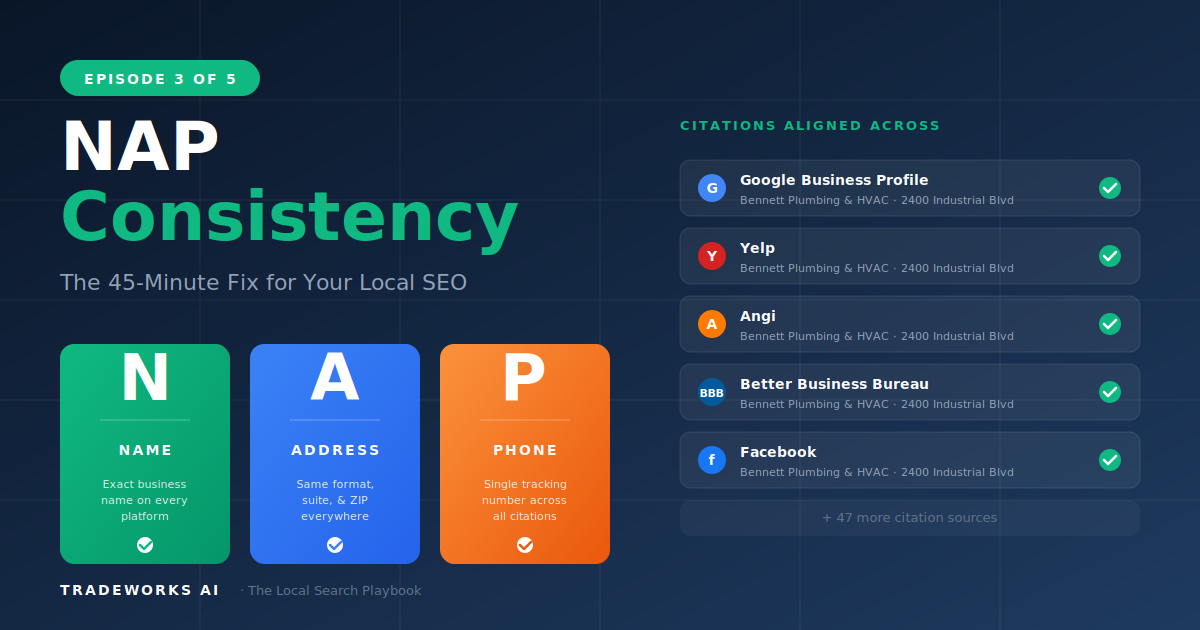
Local Search · Part 3
NAP Consistency: The 45-Minute Fix for Your Local SEO
The citation audit, top 25 sources, and tools that automate ongoing consistency.
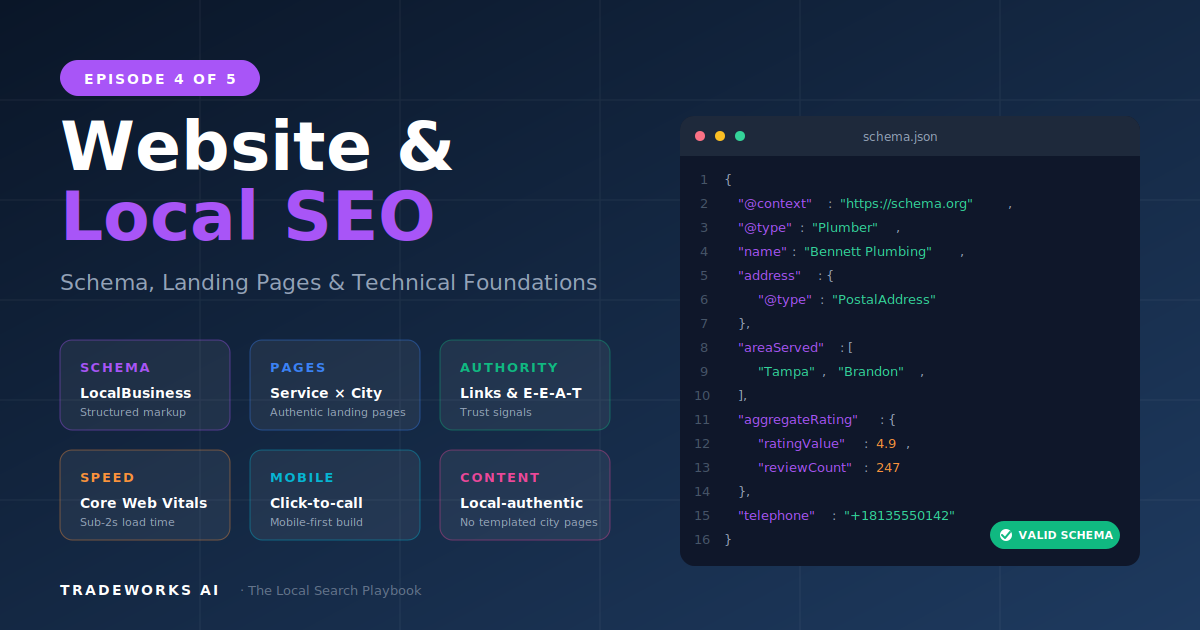
A contractor website optimized for local search in 2026 has three structural components most contractor sites lack: schema markup that tells Google and AI tools exactly what services you offer, where you operate, and what entity you are; service-specific landing pages that rank for long-tail queries like "AC repair Tampa" or "emergency plumber Hillsborough County"; and FAQ content matching the questions homeowners actually type into Google and AI tools.
Together, these components form the Content Authority Layer — the layer that gives AI Overviews and AI recommendation tools something on your website to cite. Without content depth, AI tools recognize your business exists (from your GBP and citations) but have nothing substantive from your own domain to reference in recommendations.
Perplexity specifically rewards website depth over platform reviews. Google AI Overviews pull FAQ answers directly from pages with proper schema. This article covers the three website components, the schema implementation guide for contractors, the landing page architecture that ranks without triggering doorway page penalties, and the FAQ content strategy that captures AI Overview citations.
Many contractors treat their website as a digital business card — a homepage with a phone number and a contact form. In 2018, that was marginally acceptable. In 2026, it is a competitive disadvantage.
Three reasons your website now directly impacts local search visibility:
Schema markup is structured data you add to your website that helps search engines and AI tools understand your content. Four schema types matter most for contractors.
The foundation. Tells Google your business name, address, phone, hours, service area, payment methods, and geo-coordinates. Every contractor website needs this on the homepage at minimum.
Key fields: @type (use the most specific type — HVACBusiness, Plumber, Electrician, RoofingContractor), name, address (PostalAddress), telephone, openingHours, areaServed, priceRange, geo (latitude/longitude), sameAs (links to your GBP, Facebook, Yelp, BBB profiles).
The sameAs field is critically underused. It explicitly connects your website entity to your listings on other platforms — reinforcing entity resolution for AI tools.
Applied to each service page. Tells Google what specific service the page covers, the provider, the service area, and the service output.
One Service schema per service page. AC Repair page gets AC Repair service schema. Water Heater Installation page gets its own. Do not stack all services into one schema block on the homepage.
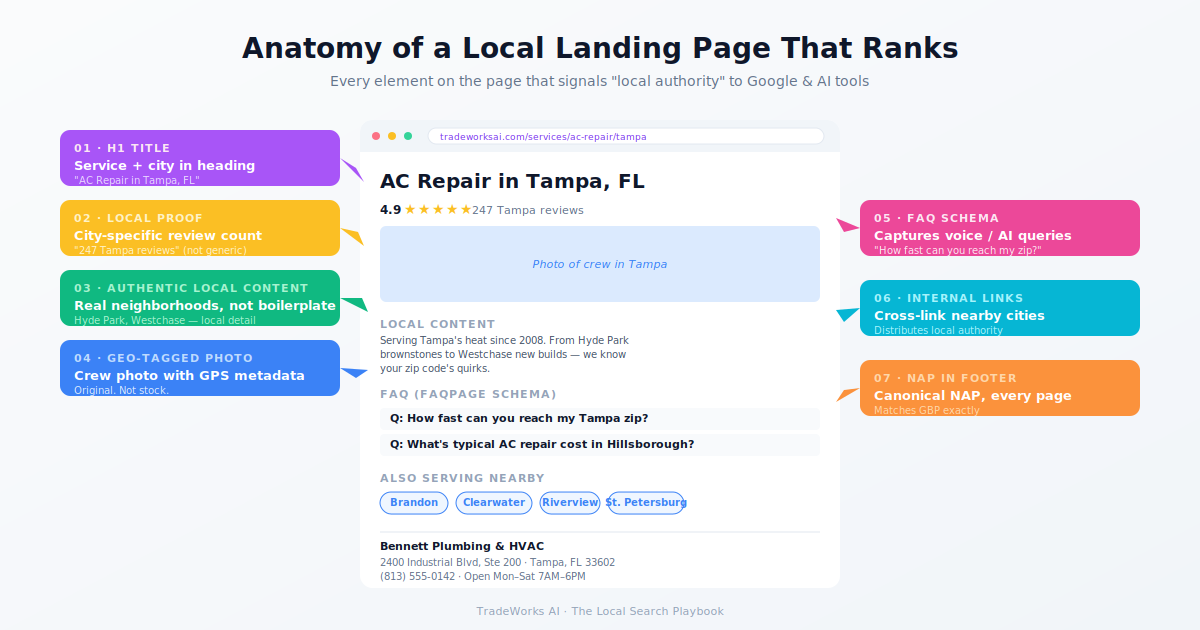
Applied to any page with question-and-answer content. This is the schema type most directly connected to AI Overview citations. Google pulls FAQ answers from pages with proper FAQPage schema and displays them in AI Overviews and People Also Ask boxes.
Add FAQPage schema to every service page that includes an FAQ section. Most contractor service pages should end with 5–8 frequently asked questions specific to that service.
Applied to instructional content — troubleshooting guides, maintenance checklists, DIY assessments. Best application for contractors: seasonal maintenance checklists, pre-service preparation guides, and troubleshooting flowcharts.
Validate all schema using Google Rich Results Test (search.google.com/test/rich-results) before publishing.
Each core service you offer should have its own dedicated landing page. A single "services" page that lists everything is a 2015 pattern that does not rank in 2026.
One page per core service. Most contractors need 8–15 service pages minimum.
HVAC example: AC Repair, AC Installation, Heating Repair, Furnace Installation, Duct Cleaning, Indoor Air Quality, Maintenance Plans, Emergency HVAC Service, Thermostat Installation, Mini-Split Installation.
Each page targets a different keyword cluster and captures different long-tail queries.
City pages extend your visibility beyond your primary location. They rank for searches in cities and neighborhoods within your service area where your GBP address is not physically located.
Google explicitly penalizes doorway pages — thin pages created solely to rank for specific city names with no unique content. The March 2026 Core Update targeted these specifically. Contractors who had 30 identical pages with only the city name swapped lost visibility overnight.
The fix: every city page must contain genuinely unique content relevant to that specific location.
Target: 400–600 words of genuinely unique content per city page. If you cannot write 400 unique words about serving that city, the page should not exist.
FAQ content is the highest-leverage content type for AI citations. Google AI Overviews pull directly from FAQ-structured content with proper schema. ChatGPT and Perplexity reference FAQ answers when constructing recommendations.
Three sources for high-value FAQ questions:
Each answer should be 100–200 words. Lead with a direct answer in the first sentence (AEO format). Follow with supporting detail. Include specific numbers, location references, and trade-specific context. End with a natural CTA where appropriate.
Example: "How much does AC replacement cost in Tampa?" A standard residential AC replacement in Tampa Bay costs $4,500–12,000 depending on system size, efficiency rating, and installation complexity. A 2.5-ton 14 SEER unit for a 1,500 square foot home typically runs $5,000–7,000 installed. Higher efficiency units (16–20 SEER) and larger homes push toward the $8,000–12,000 range. Tampa-specific factors include ductwork condition in older homes (pre-1985 construction often needs duct modification), electrical panel capacity, and hurricane tie-down requirements.
Internal links connect your pages into a logical structure that helps Google understand your site hierarchy and distributes ranking authority across pages.
The structure should feel natural to a human reader navigating between related topics. If the link would be useful to a customer, it is a good internal link.
Your website is no longer a digital business card. It is the content authority layer that determines whether AI tools cite you or ignore you. Schema markup tells search engines what you are. Service pages rank for the queries customers type. City pages extend visibility beyond your physical location. FAQ content gets pulled into AI Overviews.
The contractors with deep, well-structured websites capture AI citations that thin-site competitors miss entirely. The content investment compounds over time — every page you build continues ranking and earning citations for years.
Minimum: homepage, about, contact, 8–15 service pages, 5–10 city/service area pages, and a dedicated FAQ page. Total minimum: 20–30 pages. Larger operations with more services and broader service areas may need 50–100 pages. Quality matters more than quantity — every page must have genuinely useful, unique content.
Not necessarily. WordPress plugins like Rank Math and Yoast SEO include schema generators with GUI interfaces. For basic LocalBusiness and FAQPage schema, the plugins handle it without code. For more complex Service schema or custom implementations, a developer or SEO specialist is more efficient.
Only if they are doorway pages — thin pages with identical content where only the city name changes. Legitimate city pages with 400-plus words of genuinely unique, location-specific content are not penalized. The March 2026 Core Update specifically targeted templated doorway pages. The solution is real content, not avoidance of city pages.
New service pages on an established domain typically begin showing search visibility within 4–8 weeks. Full ranking potential takes 3–6 months as Google evaluates content quality, user engagement, and authority signals. City pages on new domains take longer — 6–12 months for competitive markets.
Service pages first. They target the highest-intent commercial keywords (AC repair Tampa, emergency plumber near me) and directly generate leads. Blog posts support service pages through internal linking and capture informational queries. Build the service page foundation first, then layer blog content on top.
Perplexity rewards specific, deep website content more than any other AI tool. ChatGPT leans heavily on platform reviews (Angi, Yelp, BBB). Perplexity cited 14 local contractor websites directly for one AC repair query in testing. Deep service pages, FAQ content, and original expertise on your domain are the primary signals Perplexity extracts.
Most contractor websites are invisible to ChatGPT, Perplexity, and AI Overviews because they lack the schema, service pages, and FAQ content AI tools extract. Our free audit checks your site against the Content Authority framework and shows you exactly what to fix.
The citation audit, top 25 sources, and tools that automate ongoing consistency.
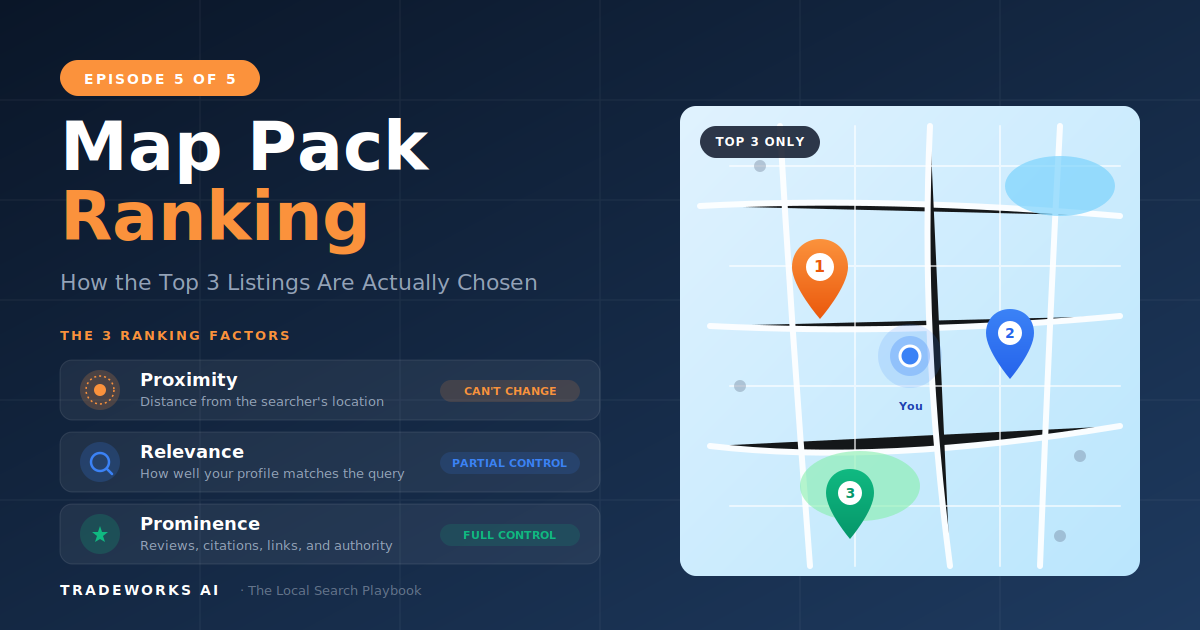
The three ranking factors, the weight breakdown, and the 8 tactical levers contractors actually control.