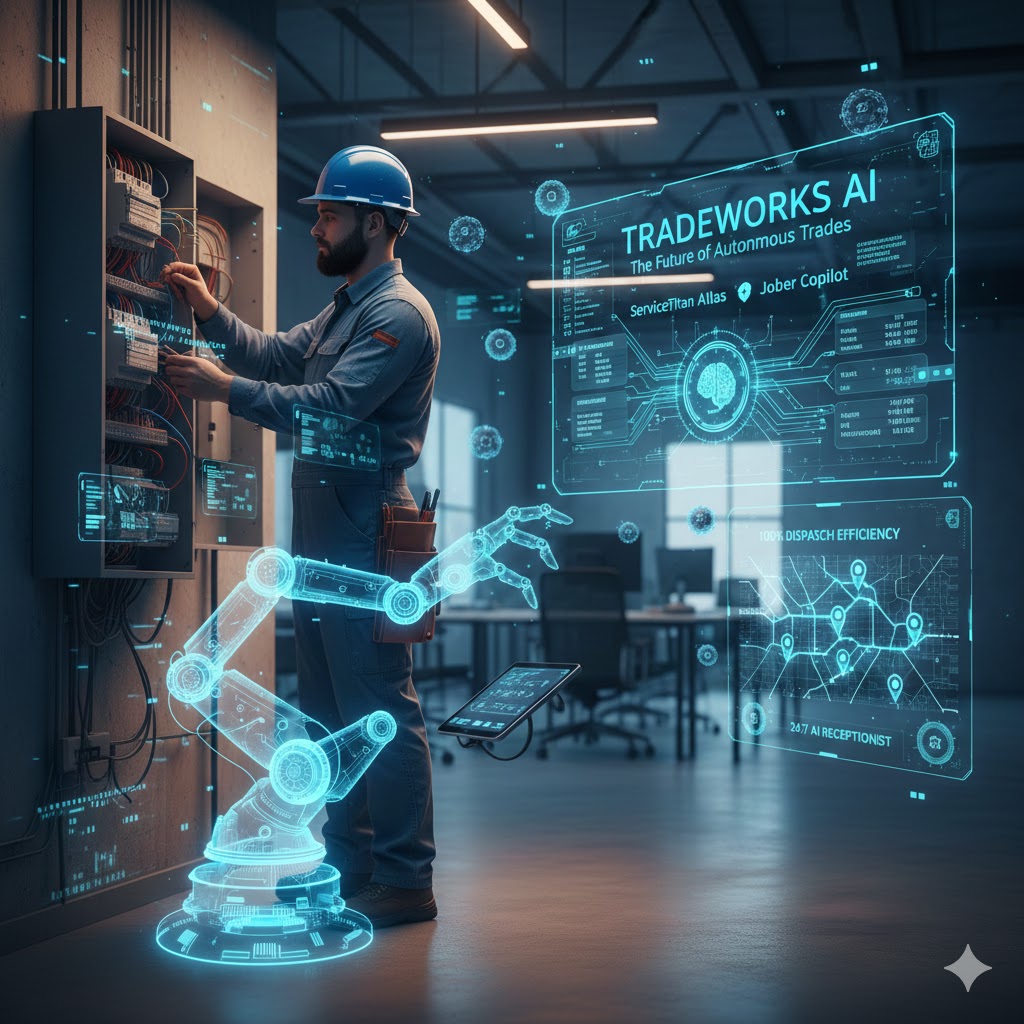
AI Automation for Contractors: How Digital Labor Is Replacing the Back Office in HVAC, Plumbing, and Electrical Businesses
If you run a trade business with 1 to 15 employees, you already know the math does not work. You need one office person for every three field technicians just to answer calls, dispatch trucks, send invoices, and chase payments. That means a plumbing company with six techs carries two full-time office staff — roughly $90,000–$120,000 a year in wages, benefits, and overhead — before those employees generate a dollar of revenue. Every new truck you add pushes you closer to hiring another admin. Every admin you hire pushes your break-even point higher. This is the constraint that has capped growth for independent contractors for decades.
Digital labor is the technology that breaks this constraint. It is not software you operate — it is software that operates on your behalf.
Digital labor for contractors refers to autonomous AI agents that perform cognitive back-office tasks — answering customer calls, dispatching technicians, sending quotes, following up on unpaid invoices, and optimizing schedules — without human intervention. Unlike traditional automation that follows rigid if/then rules, digital labor agents use large language models and retrieval-augmented generation (RAG) to reason through problems, access your specific business data, and make judgment calls in real time. For HVAC, plumbing, electrical, and other trade businesses with 1–25 employees, digital labor replaces the need to hire additional dispatchers, CSRs, and office managers as the company grows, enabling what industry analysts are calling the "self-driving business" — a contractor operation where the back office runs autonomously while the humans focus on the physical work that AI cannot perform.
The shift is already underway. ServiceTitan has deployed Titan Intelligence with AI-powered dispatch optimization. Jobber has rolled out an AI Receptionist that answers calls and books jobs without a human CSR. Startups like Avoca ($40M+ funded) and Netic are building AI workforces specifically for home service companies. Housecall Pro offers CSR AI for inbound handling. And platforms like TradeWorks AI are positioning digital labor as the core operating model for the small-to-mid-market contractor who cannot afford ServiceTitan's enterprise pricing but needs more than Jobber's task-reduction tools.
This guide explains what digital labor is, how it differs from the automation and software tools you already use, what the major platforms are doing with AI, and how to evaluate whether your business is ready to hire its first digital employee.
Why AI Automation Is No Longer Optional for Contractors
The urgency for Digital Labor is underscored by the aggressive consolidation of the industry and the escalating costs of legacy technology. Private Equity (PE) firms have rolled up independent contractors into regional behemoths, driving a need for standardized, scalable operations. However, the software designed to manage these enterprises has become a significant overhead center itself.
Market analysis reveals that enterprise-grade FSM platforms like ServiceTitan have shifted their pricing strategies to capture a larger share of contractor revenue. Reports indicate that for larger entities, ServiceTitan requires multi-year commitments that can exceed $250,000, or a per-technician cost ranging from $250 to $400 per month. For a mid-sized firm with 20 technicians, the software bill alone can rival the cost of a new service van every year. This "growth penalty"—where success leads to linearly increasing software costs—has created a fertile market for challengers offering outcome-based or scalable Digital Labor solutions.
Furthermore, the administrative friction of legacy software often necessitates dedicated "software administrators"—employees whose sole job is to manage the complexity of the FSM. This adds a layer of "meta-work" that Digital Labor aims to eliminate. By replacing the complex dashboard with an autonomous agent, businesses can theoretically remove the need for a dispatcher or a CSR manager, allowing the owner to interact with the business through natural language rather than clicks and dropdown menus.
What Is Digital Labor? The Difference Between Tools, Automation, and AI Agents
To understand digital labor and how platforms like TradeWorks AI differ from incumbents, you must first understand how it differs from "Automation" (e.g., Zapier scripts) and "Tools" (e.g., FSM dashboards).
| Dimension | Traditional Tool (FSM) | Automation (Scripts) | Digital Labor (Agents) |
|---|---|---|---|
| Trigger | User Initiated | Event Triggered | Goal Oriented |
| Cognition | None (Passive) | Rigid Logic (If/Then) | Reasoning (Probabilistic) |
| Context | Siloed Data | Limited Metadata | Full Context (RAG) |
| Example | Dispatch Board | Auto-Reply Email | Negotiating a reschedule |
| Role | "The Clipboard" | "The Assistant" | "The Employee" |
Table 1.1: The Evolution of Trade Technology
Digital Labor utilizes Large Language Models (LLMs) and Retrieval-Augmented Generation (RAG) to perform cognitive tasks that require judgment. A traditional automation script can send an email when a job is marked "Complete." A Digital Labor agent can read the technician's notes, notice a recommendation for a future repair, check the customer's warranty status, price the repair using the current materials database, and compose a persuasive email to the homeowner explaining why the repair is urgent—all without human intervention.
The potential market for this technology is estimated between $3 trillion and $12 trillion globally, as it fundamentally rewrites the cost structure of service industries. For the trade business owner, Digital Labor offers the promise of the "Self-Driving Business," where the back office runs autonomously, leaving the humans to focus on the physical craftsmanship that robots cannot yet perform.
The Technological Engine of Digital Labor
How AI Agents Use Your Business Data (RAG)
The reason digital labor agents can answer questions accurately — "Is Mrs. Jones's compressor under warranty?" — instead of guessing is a technology called Retrieval-Augmented Generation (RAG). RAG connects the AI model to your specific business data: customer records, equipment manuals, pricebooks, warranty documents, and job histories. When the agent needs an answer, it retrieves the relevant documents first, then generates a response grounded in your verified information rather than generic internet data.
For a deeper explanation of how RAG works and which FSM platforms (ServiceTitan Atlas, Housecall Pro CSR AI, Jobber Copilot) are using it, see our complete guide: What Is RAG for Contractors? How Retrieval-Augmented Generation Works for Trade Businesses.
How AI Agents Actually Work: From Goal to Action
While RAG provides the knowledge, Agentic AI provides the autonomy. An "Agent" is an AI system equipped with "tools"—functions it can call to manipulate the outside world.
In a trade context, an agent might be given a high-level goal: "Fill the schedule for tomorrow." The agent would then autonomously loop through a series of reasoning steps:
- Observation: "I have three empty slots in the afternoon."
- Reasoning: "I should contact customers with pending estimates in that zip code to minimize drive time."
- Action: The agent accesses the CRM, filters for 'Pending Estimates' in Zip Code 90210, and initiates an SMS conversation: "Hi, we have a truck in your area tomorrow afternoon, would you like us to swing by and complete that repair?"
- Result: If the customer says yes, the agent accesses the Scheduling API to book the job.
This "Agentic Loop" is what distinguishes TradeWorks AI from a simple scheduling tool. It moves the software from a passive database to an active revenue generator.
Answer Engine Optimization: How AI Search Is Changing Contractor Marketing
Digital Labor also extends to how trade businesses acquire customers. As consumers increasingly use AI search tools (Perplexity, ChatGPT Search, Google Gemini) instead of traditional blue-link search engines, the rules of visibility have changed.
Answer Engine Optimization (AEO) is the practice of structuring business data so that AI models cite it as the "best answer." A Digital Labor platform manages a contractor's digital footprint to ensure they are the recommended provider when a user asks Siri, "Who is the most reliable plumber for a tankless heater installation?". This involves generating high-quality, authoritative content (FAQs, technical guides) that AI models ingest during training or retrieval, effectively "teaching" the global AI that this specific contractor is the authority.
What Digital Labor Looks Like in Practice: The AI Office Manager
The major FSM platforms are adding AI features to existing dashboards. TradeWorks AI takes a different approach: rather than adding intelligence to a tool you operate, it provides digital employees that operate autonomously on your behalf.
The market positioning is what the industry calls the "Doughnut Hole." ServiceTitan delivers enterprise-grade AI (Titan Intelligence, Dispatch Pro, Marketing Pro) but requires $30,000+ annually and months of implementation — pricing that excludes contractors under $2M in revenue. Jobber delivers excellent usability and an AI Receptionist but remains a tool that reduces your tasks rather than performing them autonomously. Housecall Pro occupies a strong middle ground with CSR AI and financial automation but ties advanced features to its highest-priced tier.
TradeWorks AI targets the 1–15 employee contractor who needs the operational sophistication of a large enterprise — 24/7 call answering with scheduling authority, profit-based autonomous dispatch, proactive estimate follow-up, and cash flow optimization — without the enterprise overhead.
What a digital labor platform handles for a contractor:
- Inbound calls: AI voice agent answers every call 24/7, qualifies the lead, checks your schedule in real time, and books the appointment — or escalates emergencies to the on-call technician. No hold music, no voicemail, no missed revenue.
- Dispatch and scheduling: Agent evaluates tomorrow's schedule, identifies gaps, cross-references pending estimates in nearby zip codes, and proactively contacts those customers to fill empty slots — maximizing revenue per truck roll without dispatcher involvement.
- Quoting and follow-up: After a technician completes an inspection and logs notes, the agent drafts a quote using your pricebook, attaches photos from the job, and sends it to the homeowner within minutes — with automated follow-up sequences for unsigned estimates.
- Invoicing and collections: On job completion, the agent generates the invoice, sends payment links, tracks open balances, and sends escalating follow-ups (friendly reminder → firm notice → final notice) without any human involvement.
- Customer re-engagement: Agent monitors customer history for aging equipment, approaching warranty expirations, and seasonal maintenance windows, then initiates personalized outreach: "Your water heater was installed in 2015 — would you like us to inspect it before winter?"
The key difference from traditional FSM software: you do not log in to do any of this. The agent does it. You review, approve, and override when necessary — the "Human-in-the-Loop" model described later in this article.
How ServiceTitan, Jobber, and Housecall Pro Are Adopting AI
To fully understand Tradeworks.ai's value, one must compare it against the AI strategies of the entrenched players: ServiceTitan, Jobber, and Housecall Pro.
ServiceTitan: The "Titan Intelligence" Strategy
ServiceTitan is the enterprise standard, and its response to Digital Labor is Titan Intelligence (TI). This is a comprehensive suite of AI features designed to justify its premium price point.
- Atlas: The flagship "AI Sidekick." Atlas allows users to query the database using natural language ("Show me all customers with a Carrier system installed over 10 years ago"). It uses RAG to retrieve this data, functioning as a super-powered search engine.
- Dispatch Pro: A machine-learning powered dispatch engine. It scores every incoming job based on predicted revenue and matches it with the technician most likely to close that specific type of job. It creates a "Moneyball" approach to contracting.
- Marketing Pro: Uses AI to attribute revenue to specific marketing channels and automate review requests, effectively acting as a Digital Marketing Manager.
Critique: While powerful, these features are often gated behind the most expensive tiers ("The Works"), reinforcing the perception that ServiceTitan is only for the "1%" of contractors.
Jobber: The "Invisible Assistant" Strategy
Jobber focuses on the SMB market (1-20 trucks) and prioritizes usability. Its AI strategy, Jobber AI, is less about "Enterprise Optimization" and more about "Task Reduction."
- AI Receptionist: Jobber has aggressively rolled out an AI receptionist that can answer calls, take messages, and book jobs. This directly attacks the need for human CSRs in small businesses.
- Jobber Copilot: An embedded assistant that helps rewrite emails, draft quotes, and summarize job notes. It uses RAG to ensure the tone matches the business's brand.
- Pricing & Packaging: Jobber includes some AI features in its core tiers but pushes advanced automation to its "Grow" plan (~$349/mo). However, this is still significantly cheaper than ServiceTitan's entry point.
Housecall Pro: The "Financial Pipeline" Strategy
Housecall Pro occupies the middle ground, with a strong emphasis on the financial lifecycle of the job.
- QuickBooks Integration: Housecall Pro is widely cited as having the most robust, two-way sync with QuickBooks Online. This automation is a form of digital labor, replacing the need for a bookkeeper to double-entry data.
- Pipeline & Proposals: Its "Sales Proposal Tool" allows for "Good/Better/Best" option presentation, a critical sales tactic in the trades.
- AI Strategy: Focused on "CSR AI" to handle inbound traffic, similar to Jobber but often integrated more tightly with their "Superpro" community features.
Feature Comparison: ServiceTitan vs. Jobber vs. Housecall Pro vs. Digital Labor
| Feature | ServiceTitan | Jobber | Housecall Pro | Digital Labor (TradeWorks AI) |
|---|---|---|---|---|
| Core Value | Revenue per Lead (Reporting) | Ease of Use (Workflow) | Community-Driven Growth | Autonomous Agent |
| Dispatch | ML-Assisted (Dispatch Pro) | Drag-and-Drop Manual | Map-Centric / GPS | Fully Autonomous / Profit-Based |
| Customer Calls | VoIP / Phones Pro | AI Receptionist (message + book) | CSR AI (inbound handling) | Voice Agent (negotiation + booking) |
| Data Architecture | SQL / Structured | Structured | Structured | Vector / RAG (unstructured) |
| Setup Time | Months | Days | Days | Days (AI ingestion) |
| Pricing Model | Per-Tech ($$$) | Per-User ($$) | Tiered ($$) | Usage / Outcome ($) |
| Best For | 20+ truck enterprises | 1–20 all trades | Growing residential teams | 1–15 seeking autonomous ops |
Comparative Analysis: AI Strategy by Platform
The ROI of AI Automation: What Digital Labor Saves a 5–10 Person Contractor
The financial case for Digital Labor is based on the concept of Zero Marginal Cost Administration.
Scenario: A plumbing business has 5 technicians. To grow to 10, they traditionally need to hire 1-2 more office staff (dispatch/CSR) and buy more software licenses.
Digital Labor Scenario: To grow to 10 technicians, the business spins up more instances of the AI agent. The cost of the agent scales with usage (number of calls/jobs) but is significantly lower than a human salary + benefits + office space.
Quantifiable Impact:
- Missed Calls: The average contractor misses 30% of calls. If an AI receptionist captures just 5 of those missed calls a month, and the average ticket is $500, that is $2,500 in found revenue—often paying for the software entirely.
- Dispatch Efficiency: Automated optimization can squeeze one extra job per tech per week. For a 10-tech firm, that is 10 extra jobs/week. At $500/job, that is $20,000/month in pure margin gain.
The Pricing Trap of Legacy Software
The report analysis highlights a critical friction point: Per-User Pricing. ServiceTitan, Fieldproxy, and others often charge based on the number of "seats" or technicians. This penalizes growth. If a business hires an apprentice who generates little revenue, they still pay the full software license fee.
TradeWorks AI Opportunity: By adopting a pricing model based on usage (e.g., number of jobs processed) or a flat platform fee, new entrants can disrupt the "Seat Tax" model that contractors despise. The analysis of Fieldproxy vs. ServiceTitan shows that challengers are already using "Unlimited User" models to attack incumbents.
Implementation Challenges: Data Hygiene, Trust, and the Cultural Shift
While the technology is promising, the implementation of Digital Labor in a "Blue Collar" environment is fraught with challenges.
The "Data Hygiene" Barrier
RAG systems are only as good as the data they retrieve. "Garbage in, Garbage out" applies literally here.
- Problem: Most contractors have messy pricebooks. "Labor" might be listed as "Labor - $1" in one entry and "hrly rate" in another. If the data is unstructured, the AI cannot price accurately.
- Solution: Platforms must offer "AI Ingestion" tools that clean and normalize data during setup. ServiceTitan's "Pricebook Pro" attempts to solve this by selling a pre-built, standardized catalog. Tradeworks AI must offer similar automated "clean-up" capabilities to be viable.
Trust and Control
Contractors are control freaks by necessity; a mistake costs them money. Trusting an AI to dispatch a truck or quote a price requires a leap of faith.
Solution: "Human-in-the-Loop" (HITL) workflows. The AI does not send the quote; it drafts the quote and sends a push notification to the owner: "I prepared a quote for $4,500 based on these findings. Approve?" This allows the owner to be the "editor" rather than the "writer," saving time while maintaining control.
The Cultural Shift
Technicians may view AI tracking and dispatching as "Big Brother."
Adoption Strategy: The software must be positioned as a "Sidekick" that handles the parts they hate (paperwork, waiting on hold) rather than a "Boss" that monitors their location. Features like ServiceTitan Atlas are explicitly marketed as "empowering" the technician with instant answers, framing the AI as a tool for their success rather than oversight.
The Future of AI in the Trades: The Rise of the Super-Sole-Proprietor (2026–2030)
Digital Labor will hollow out the mid-market. We will see the rise of "Super-Sole-Proprietors"—individual master tradespeople who use TradeWorks AI agents to run a sophisticated operation that previously required a staff of five. They will have the responsiveness of a large firm (24/7 answering, instant booking) with the low overhead of a one-man truck.
AEO Dominance
By 2027, "Googling" a plumber will be replaced by asking an AI assistant. Trade businesses that do not optimize their data for AEO—ensuring their availability, pricing, and expertise are machine-readable—will become invisible. Digital Labor platforms will include "AEO Agents" that constantly update the business's semantic profile across the web to ensure visibility in this new search paradigm.
Conclusion
The transition to digital labor is the most significant shift in the trade industry since the adoption of the mobile phone.
For the trade business owner, the message is clear: the labor shortage will not be solved by finding more humans; it will be solved by adopting digital ones. Platforms like TradeWorks AI autonomous agents for contractors are not just software upgrades; they are the hiring strategy of the future. By leveraging RAG to ensure accuracy and Agentic AI to ensure autonomy, these platforms offer the only viable path to scaling in an economy constrained by human capacity. The winners of the next decade will be those who successfully integrate these digital employees into their physical workforce, creating a hybrid organization that is efficient, scalable, and relentlessly profitable.
To learn more, explore our AI agents for contractors, digital marketing and AEO services for contractors, and AI and software consulting for trade businesses.
Frequently Asked Questions About AI Automation for Contractors
Ready to Automate Your Business with Digital Labor?
See how TradeWorks AI can transform your trade business with autonomous agents.
Schedule a Free Consultation