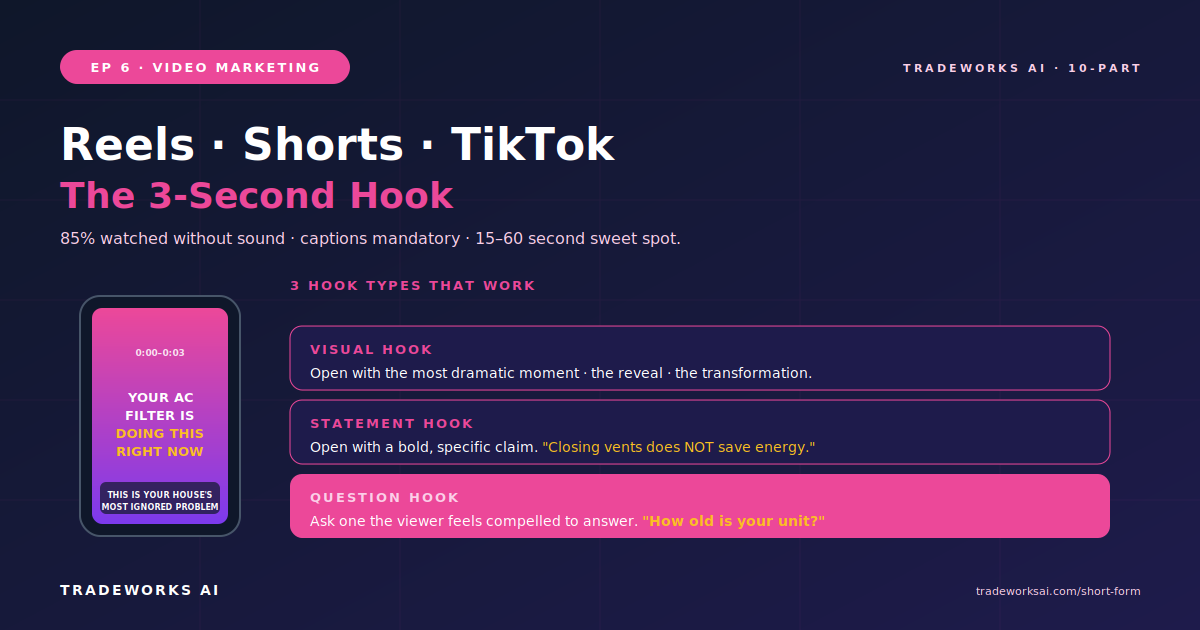
Video Marketing · Part 6
Short-Form Video: Reels, Shorts, TikTok Strategy
Continue the Video Marketing series with Part 6 of 10.
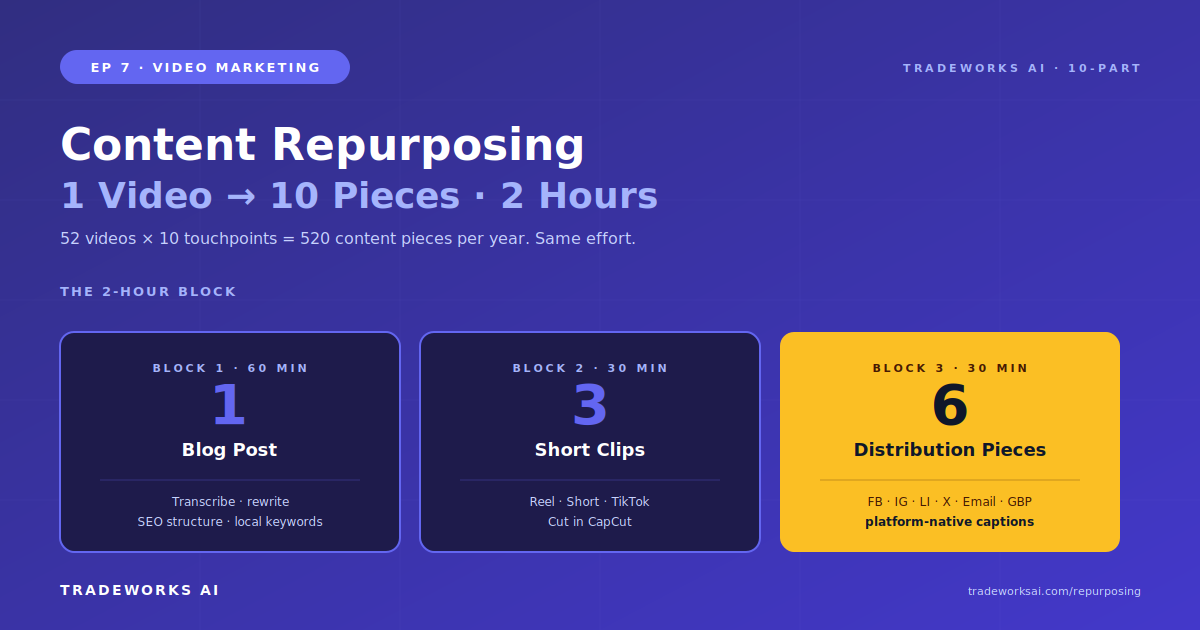
The 1-to-10 content repurposing system for contractors transforms one YouTube video into 10 content pieces in approximately 2 hours. Step 1: publish the YouTube video (the authority piece). Step 2: transcribe and rewrite as a blog post optimized for local SEO (45 minutes). Step 3: cut 3 short-form clips for Reels, Shorts, and TikTok using the strongest 15 to 60 second segments (30 minutes). Step 4: create 3 platform-native social media posts with key quotes and takeaways for Facebook, X, and LinkedIn (20 minutes). Step 5: write one email newsletter segment summarizing the content with a link to the full video (10 minutes). Step 6: create a Google Business Profile post with a photo and link (5 minutes). One production effort, 10 distribution touchpoints, every major platform covered. This is the Content Flywheel from Episode 1 operationalized.
Most contractors who start creating content make the same mistake: they film a video, post it to YouTube, and move on. That single video reaches YouTube’s audience—but misses Facebook’s audience, Instagram’s audience, LinkedIn’s audience, their email list, Google’s organic search, and their Google Business Profile visitors. Each platform has a unique audience. A homeowner who never visits YouTube might discover your content on Instagram. A property manager who avoids social media might find your blog post through Google. The 1-to-10 system ensures every piece of content reaches every audience without creating 10 separate productions.
The anchor is always one long-form YouTube video (5 to 12 minutes). From that single production, create: 1. Blog Post: transcribe the video using a free tool (Otter.ai, YouTube’s auto-transcript). Rewrite the transcript into a structured blog article with an AEO opening paragraph, H2/H3 hierarchy, and local keywords. 45 minutes. 2. Short #1: the strongest 15 to 30 second hook or reveal from the video. 10 minutes to cut in CapCut. 3. Short #2: a key educational moment or tip. 10 minutes. 4. Short #3: the most quotable or surprising stat. 10 minutes. 5. Facebook post: native text with a key takeaway image or video clip. 7 minutes. 6. X/Twitter post: the most tweetable stat or insight plus thread if the topic supports it. 5 minutes. 7. LinkedIn post: professional angle or first-person narrative tied to the content. 8 minutes. 8. Email segment: 100 to 150 word summary with link to the full video. 5 minutes. 9. GBP post: photo from the video plus 150-word description with primary keyword. 5 minutes. 10. YouTube Community post: question or poll related to the video topic. 2 minutes.
The entire repurposing process fits into a single 2-hour block. Schedule it for the day after the video publishes. Block 1 (60 minutes): blog post transcription and rewrite. Block 2 (30 minutes): cut 3 Shorts. Block 3 (30 minutes): write social posts, email segment, GBP post, and community post. Batch the work. Do not spread it across the week. One focused session produces all 10 pieces. If you hire a virtual assistant or content manager, this process can be delegated entirely with a documented SOP.
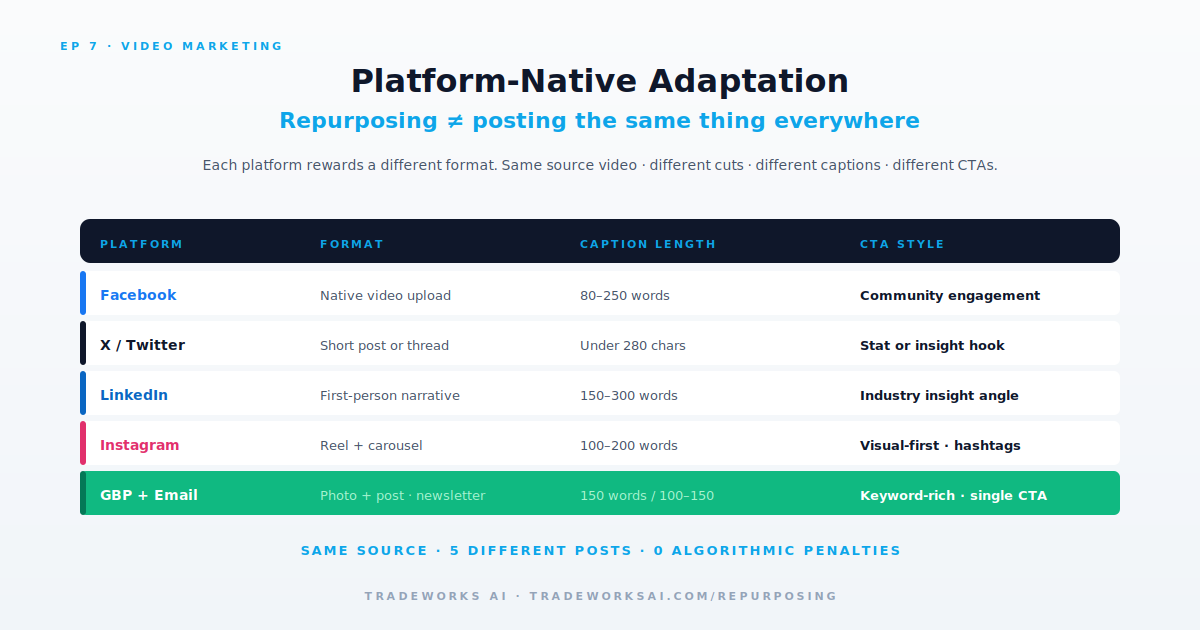
Repurposing does not mean posting the same content everywhere. Each platform requires adaptation. Facebook: longer captions (80 to 250 words), native video upload (not YouTube links, which are penalized by the algorithm), community engagement focus. X/Twitter: concise (under 280 characters), thread format for deep content, visual images drive engagement. LinkedIn: professional tone, first-person narrative, industry insight angle, no hashtag overload. Instagram: visual-first, Reel format for video, carousel for educational content. GBP: keyword-rich description with photo, CTA button. Email: personal tone, value-first summary, single clear CTA.
Track total touchpoints per video. Before the 1-to-10 system, one video created one touchpoint. After, one video creates 10. Over 52 weeks, that is 520 touchpoints from 52 videos versus 52 touchpoints without repurposing. A 10x content multiplication ratio. Track which platforms drive the most website visits, phone calls, and leads. Most contractors discover that blog posts (search traffic) and email (direct response) generate the most measurable leads, while social posts (awareness) and Shorts (reach) drive the top-of-funnel discovery that feeds the conversion channels.
Approximately 2 hours per video when following the 1-to-10 system. This includes blog post creation, 3 Short cuts, social media posts, email segment, and GBP update.
Yes. The 1-to-10 system is fully delegable with a documented SOP. A virtual assistant ($15–$25/hour) can handle the entire process. Expect 2 to 3 hours per video including review and scheduling.
An ad stops working the day you stop paying. A video published today still drives leads in 2030. The Content Audit grades your existing content engine, identifies the highest-leverage gaps, and shows you the one weekly habit that compounds into an authority library that generates leads for years.
Continue the Video Marketing series with Part 6 of 10.
Continue the Video Marketing series with Part 8 of 10.