Video Marketing · Part 2
How to Start a YouTube Channel for Contractors
Continue the Video Marketing series with Part 2 of 10.
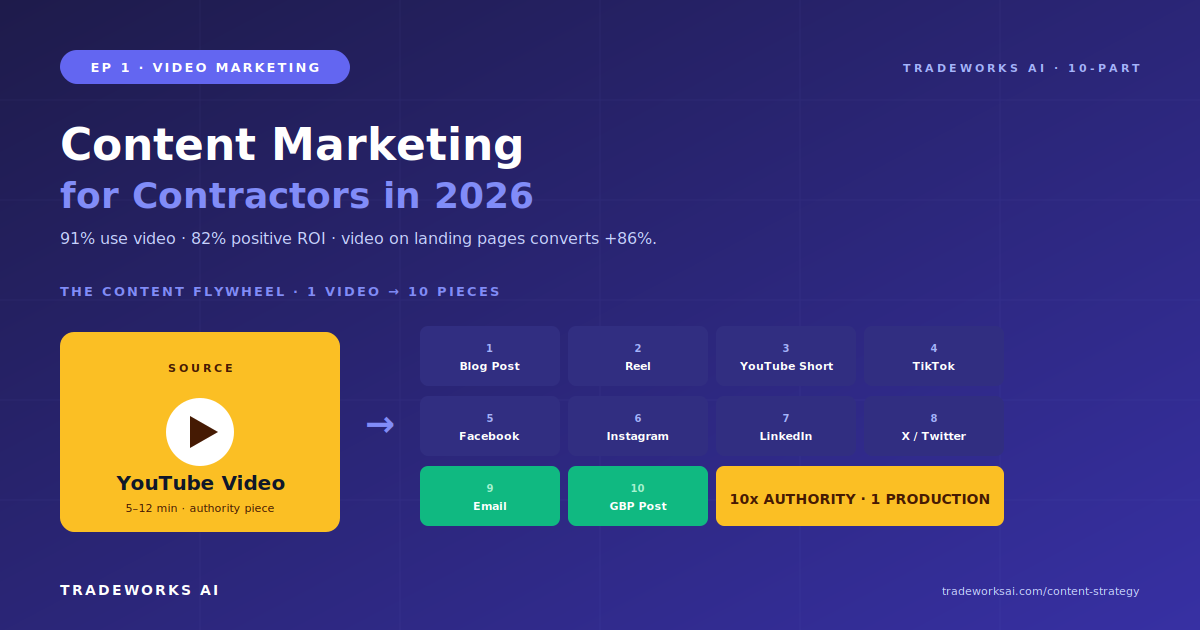
Content marketing for contractors generates leads through four content types: educational videos explaining common problems and solutions, testimonial videos from satisfied customers, before-and-after transformation content, and blog articles optimized for local search. The Content Flywheel model shows how one piece of authority content (a YouTube video) becomes a blog post, social media posts, email content, and short-form video clips—multiplying a single production effort into 10 or more touchpoints. Industry data supports the investment: 91% of businesses use video marketing in 2026, 82% report positive ROI, and video on landing pages increases conversions by 86%. For contractors, the phone-first approach works best: film with your phone, keep production simple, and prioritize authenticity over polish. One video per week compounds into an authority library that generates leads for years.
Most contractors think of marketing as ads. Run Google Ads, run Facebook Ads, pay for leads. Content marketing is a fundamentally different model. Instead of paying for attention, you earn it by providing genuine value. An HVAC contractor who publishes a video explaining why AC units fail in Florida humidity is not selling anything. They are answering a question a homeowner actually has. When that homeowner’s AC fails next summer, they remember the contractor who educated them for free. The compound effect is the key differentiator. An ad stops generating leads the moment you stop paying. A YouTube video published today continues generating leads for 3 to 5 years. A blog post ranking for a local keyword generates organic traffic indefinitely. Content marketing builds an asset, not an expense.
The Content Flywheel is the operating model for contractor content marketing. Start with one authority piece: a 5 to 12 minute YouTube video on a topic your customers actually ask about. From that single video, produce: a blog post (transcribe and rewrite for SEO), 3 short-form video clips (Reels, Shorts, TikTok), 3 to 5 social media posts (platform-native captions with video clips or key quotes), an email newsletter segment, and a Google Business Profile post. One video becomes 10 or more content pieces across every platform. The flywheel compounds because each piece drives traffic back to the others. A TikTok clip drives views to the full YouTube video. The blog post ranks in Google and drives website traffic. The email drives opens and click-throughs. Every piece reinforces every other piece.
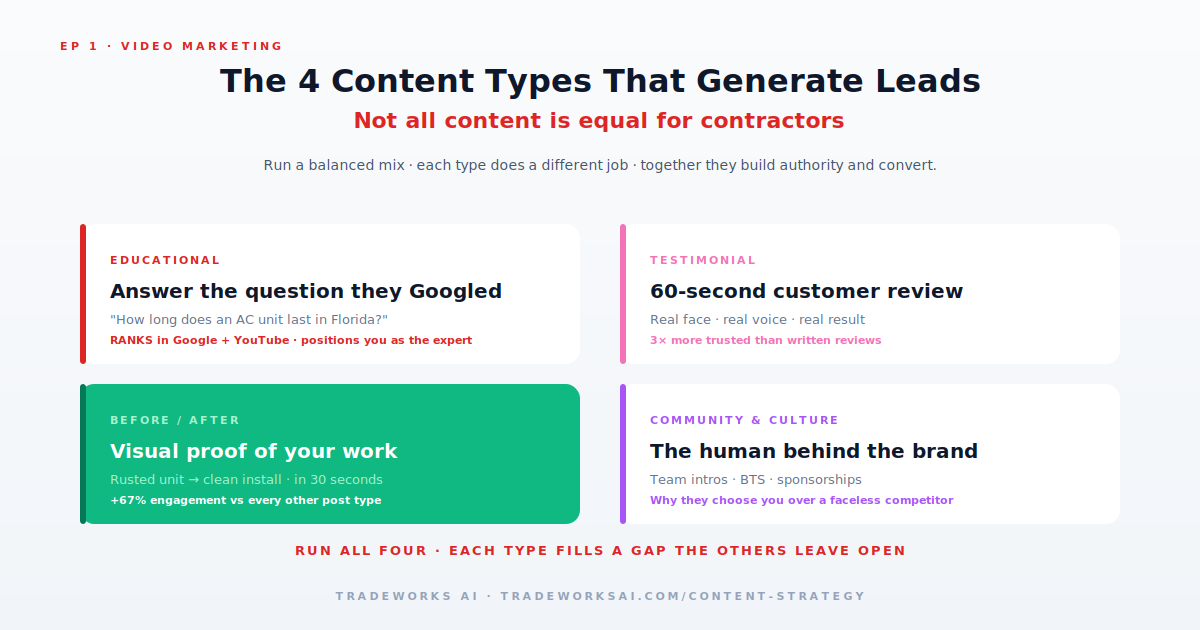
Not all content is equal for contractors. Four types consistently generate leads. Educational content: videos and articles that answer questions homeowners ask. How long does an AC unit last in Florida? What causes pipes to leak? When should I upgrade my electrical panel? These position you as the expert and rank in both Google and YouTube search. Testimonial content: 60-second videos of real customers describing their experience. The most powerful trust-building content available. Before-and-after content: visual transformations showing the quality of your work. The contractor’s natural advantage—you create dramatic visual proof every day on the job site. Community and culture content: behind-the-scenes videos, team introductions, community involvement. This builds the human connection that makes homeowners choose you over a faceless competitor.
The number one reason contractors do not create content is the belief that they need expensive equipment, professional editing, and studio-quality production. This is false. Film with your phone. Modern smartphones shoot 4K video that exceeds the quality threshold for every social platform. Use natural lighting on job sites. Speak naturally—not from a script. The authenticity of a real technician explaining a real problem on a real job site outperforms polished corporate video every time. The phone-first promise: if you have a phone, you have a video studio. The only equipment you need on day one is the device in your pocket.
The numbers in 2026 are overwhelming. 91% of businesses use video as a marketing tool. 82% report positive ROI. 85% of people have been convinced to buy a product or service after watching a video. Video on landing pages increases conversions by 86%. YouTube is the second-largest search engine in the world. For contractors specifically, before-and-after content generates 67% higher engagement than any other post type, and testimonial videos are the single most trusted content format for service businesses.
Film one video this week. Point your phone at your next job. Talk for 60 to 90 seconds about what you are doing and why. Post it to YouTube, Facebook, and Instagram. That is content marketing. One video per week for 12 months gives you 52 pieces of authority content. By month 6, the compound effect starts showing in your analytics. By month 12, you have a content library that generates leads without ads. The flywheel is real. It just requires the first push.
One video per week is the baseline for building a meaningful content library. Consistency matters more than frequency—one video per week for 52 weeks beats three videos per week for 8 weeks.
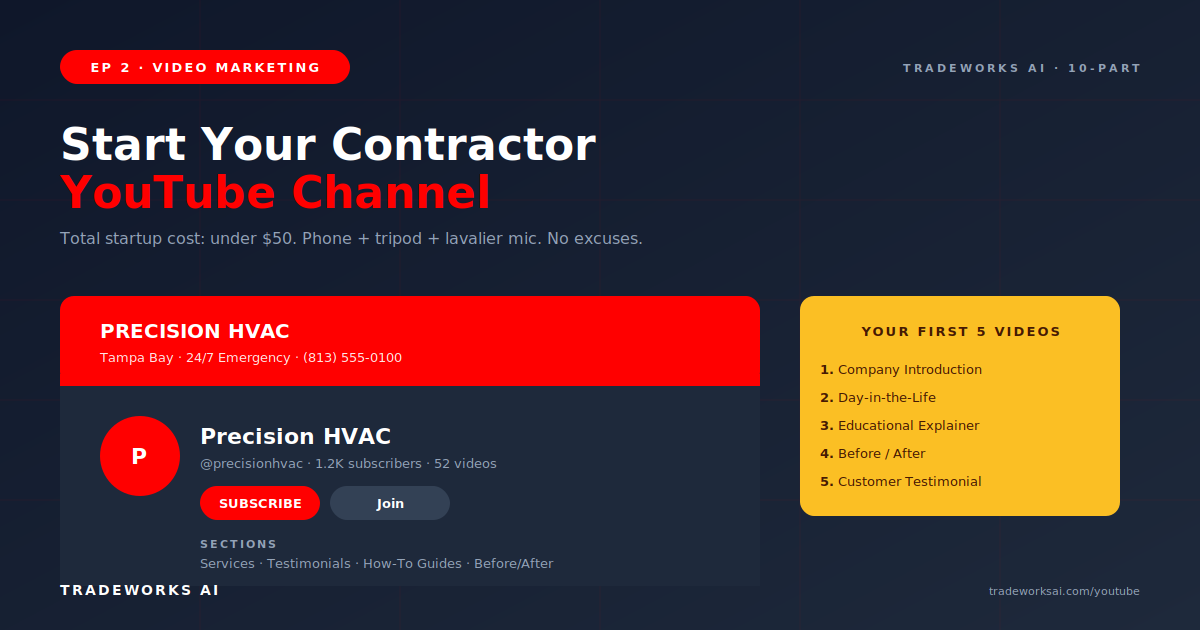
No. A modern smartphone, natural lighting, and authentic delivery outperform professional production for contractor content. Invest in a $15 phone tripod and a $25 clip-on microphone. Total equipment cost: under $50.
Expect measurable results by month 4 to 6 with consistent weekly publishing. The compound effect accelerates in months 6 to 12 as the content library grows and search rankings improve.
An ad stops working the day you stop paying. A video published today still drives leads in 2030. The Content Audit grades your existing content engine, identifies the highest-leverage gaps, and shows you the one weekly habit that compounds into an authority library that generates leads for years.
Continue the Video Marketing series with Part 2 of 10.
Continue the Video Marketing series with Part 3 of 10.